How Aesthetic Doctors Can Turn Content Into Qualified Enquiries
Content can create useful demand for an aesthetic practice, but education is not an automatic compliance shield and a direct message is not a regulatory loophole. Build the system with review, context and measurement from the start.

Written by Benjamin Chua, founder of Trueframe.
On this page
- 1. Choose one patient context for each piece
- 2. Teach the decision, but still review the advertising
- 3. Build credibility without patient testimonials
- 4. Use a clear and appropriate next step
- 5. Design the review and moderation workflow
- 6. Connect attention to enquiry evidence
- 7. Use the front desk as a research loop
Aesthetic doctors do not need louder claims to generate enquiries. They need a clearer audience, useful practitioner-led explanations, an approved route to the next step and a booking team that preserves the source.
The old shortcut was simple: show a dramatic outcome, add patient praise and push a booking. For Australian regulated health services, that approach creates obvious problems. Ahpra prohibits testimonials about clinical aspects in advertising, misleading imagery and unreasonable expectations create risk, and TGA rules matter when the service advertising involves therapeutic goods.
The answer is not to stop communicating. It is to build content around what a prospective patient genuinely needs to understand, then keep regulatory review and commercial measurement inside the same workflow. This article is general information, not legal advice or a guarantee of compliance.
1. Choose one patient context for each piece
A broad topic such as facial aesthetics produces broad, forgettable content. A useful brief identifies the person's stage, concern and decision. Are they researching for the first time? Comparing practitioners? Unsure whether a consultation is appropriate? Recovering from bad information elsewhere? Specificity lets the doctor teach something real without resorting to an aggressive claim.
This piece is for [specific patient context].
They are trying to decide [one decision].
The misunderstanding to correct is [one misconception].
The factual source or clinical basis is [approved source].
The appropriate next step is [read, ask, or request a consultation].
The clinical advertising reviewer is [name].
2. Teach the decision, but still review the advertising
Useful education can explain how assessment works, what makes a person suitable or unsuitable, what questions to ask, what alternatives exist, what limitations matter and how the doctor approaches risk. That often builds more trust than a promise because the audience can hear the doctor's judgement.
Education is not a magic label. A clinic-controlled post that promotes a service can still be advertising. Review the headline, spoken words, visuals, caption, product references, links and call to action as one communication. Keep the final decision with the clinic's authorised reviewer.
| Weak shortcut | Stronger direction | Why it helps |
|---|---|---|
| Perfect result claim | Explain how expectations and suitability are assessed | Shows judgement without promising an outcome |
| Patient success story | Explain the consultation process and clinic standards factually | Builds trust without using clinical testimonial content |
| Product-led post | Answer the patient decision without unlawfully promoting a therapeutic good | Keeps the content focused on informed care |
| Book now urgency | Invite an appropriate question or consultation | Reduces pressure and matches the person's stage |
3. Build credibility without patient testimonials
The clinic can verify the doctor's real name, role, qualifications, registration, relevant scope and professional interests. It can publish original explanations, transparent consultation information and balanced service pages. It can show the clinic environment and process where the use is factual, consented and approved. It can cite primary sources for medical and regulatory claims.
What it should not do is turn a patient's own words into a supposed compliance solution. Positive statements about the reason for treatment, clinical experience, outcome or practitioner skill can be prohibited testimonials when used in advertising. The higher-risk cosmetic procedure guidance also addresses influencer and social-media use.
Need content connected to the whole clinic growth path?
Trueframe builds the practitioner content, website, local search, paid distribution, booking flow and measurement system for Australian clinics, with your reviewer in control of approval.
See aesthetic clinic marketing in Australia4. Use a clear and appropriate next step
A call to action does not need to pressure somebody into treatment. Match it to the content. An early educational post can link to a detailed guide. A practitioner comparison piece can link to the practitioner's profile. A consultation-process video can invite an appropriate enquiry. If a direct message is used, give the team a reviewed response framework and move clinical discussion into the clinic's appropriate systems.
- Read the full treatment guide.
- Meet the practitioner and check their relevant qualifications.
- See what the first consultation covers.
- Ask the clinic a general process question.
- Request a consultation to discuss individual suitability.
Do not promise that a direct message is a private zone outside advertising, privacy or professional obligations. Train the response owner to avoid making individual clinical assessments through a marketing inbox and to protect personal information.
5. Design the review and moderation workflow
- Write the content purpose, patient context, service and conversion action.
- List the claims and primary sources before the script is approved.
- Check testimonial, image, therapeutic-good, offer and influencer issues before filming.
- Review the final edit, caption, thumbnail, links and placement together.
- Record the approver, date, version and source-review date.
- Monitor patient comments so clinical testimonials are not pulled into clinic-controlled advertising.
6. Connect attention to enquiry evidence
Dr Marion Chan is a Melbourne plastic and reconstructive surgeon and a verified Trueframe clinic client. In the first full month of the content system, her two accounts reached 430,563 people compared with a 48,840 baseline. Campaign-period tracking recorded 12,043 to 26,164 followers over five weeks, and her following has since grown from roughly 11K before the system to 36.2K now. Across 17 June posts, the content earned 3,205 saves.
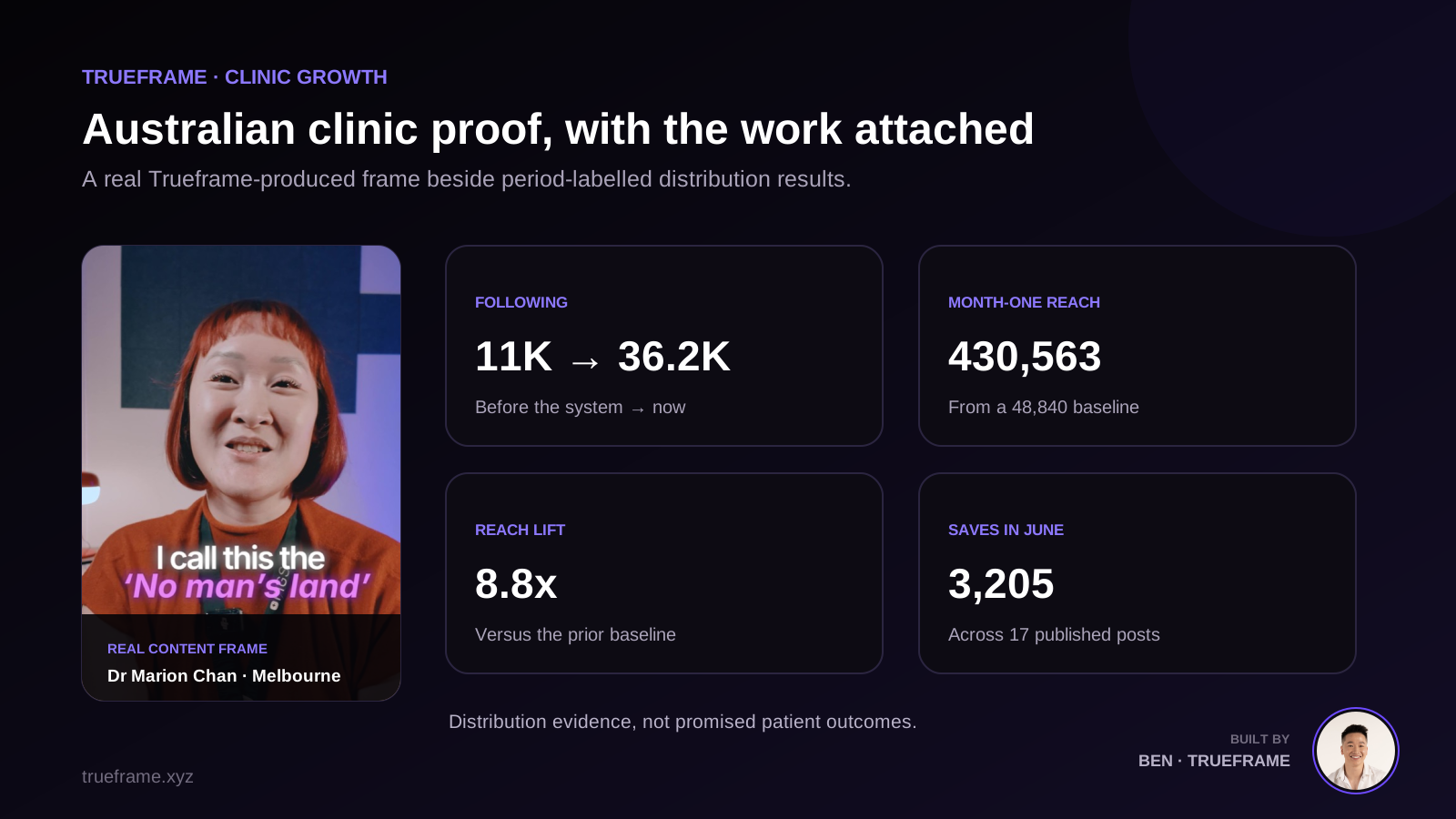
Swipe sideways to inspect the full graphic.
Those results demonstrate distribution and audience response. They do not prove a fixed number of booked consultations and we do not claim they do. The next layer is the clinic's own path: tagged page visit, appointment action, enquiry, booked consultation and attendance. Each layer should be reported with the evidence actually available.
7. Use the front desk as a research loop
The booking team hears the questions content needs to answer. Record repeated misconceptions, suitability questions, response gaps and reasons people do not proceed. Turn recurring themes into approved scripts and page improvements. This makes the content more useful and reduces the burden on the front desk without letting marketing staff give clinical advice.
The content-to-enquiry system
- Write for one patient context and one decision at a time.
- Use practitioner judgement and useful education, then review the full material as advertising where appropriate.
- Build credibility from factual qualifications, process and sourced information, not patient testimonial workarounds.
- Match the call to action to the person's stage and protect clinical discussion and personal information.
- Put claims, images, product references, comments and final approval in one recorded workflow.
- Separate reach, saves, enquiries and booked consultations so every claim matches the evidence.
Build the complete system
Sources and review date
We use primary official sources for rules and platform guidance. This article is general information, not medical or legal advice.
- Guidelines for advertising a regulated health service · Ahpra and National BoardsReviewed 12 August 2026
- Guidelines for advertising higher risk non-surgical cosmetic procedures · Ahpra and National BoardsReviewed 12 August 2026
- Advertising health services and cosmetic injections: frequently asked questions · Therapeutic Goods AdministrationReviewed 12 August 2026
Skip the reading. Talk it through instead.
Book a fit call and we'll map out what a content engine looks like for your business. No pitch, no pressure.
Don't miss the next one
Some of what we share is time-sensitive. A format that's working right now, a window that closes fast. We email those the moment they're worth jumping on. Drop your email so you catch them in time.
No spam. Unsubscribe anytime.
Frequently asked questions
Can aesthetic doctors advertise in Australia?
Is educational content exempt from advertising rules?
Can a doctor move patient proof into direct messages?
What should an aesthetic doctor post?
How do I measure leads from content?
Founded & led by
Benjamin Chua (BenChuchu)
Founder and CEO of Trueframe. 9 years building businesses (started at 16), tens of millions of views generated, and 8 figures in revenue created for the founders and brands he works with. He builds the content systems Trueframe runs.