How Ali Abdaal Turned Free YouTube Videos Into a Multi-Million-Dollar Business
A doctor started a YouTube channel on the side of his hospital shifts, gave away his best advice for free, and years later runs a multi-million-dollar business with a bestselling book and a flagship course. The videos are still free. So where does the money come from? This is the Ali Abdaal content engine, and the part of it a founder can actually copy.

Written by Benjamin Chua, founder of Trueframe.
Ali Abdaal spent years giving away his best productivity advice for free on YouTube. The videos cost nothing to watch. The business underneath them is worth millions. That gap is the whole point, and almost nobody who studies him copies the part that matters.
Abdaal is a former doctor. He studied medicine at Cambridge, worked as a junior doctor in the NHS, and started a YouTube channel in 2017 in his final year of medical school. He kept the day job and posted on the side. More than five million subscribers later, that channel is the front door to a course business, a bestselling book, a membership, and an app. He is one of the clearest living examples of a simple idea. Teach for free, at volume, for years, and the audience you build becomes the business.
Most people watch him and try to reverse-engineer the videos. The lighting, the editing, the thumbnails. All of that is real and none of it is the point. The videos were the cheapest possible way to earn trust from millions of strangers who would later buy something. The trust is the asset. The videos are just how he built it in public.
The free content was never the product. It was the lead magnet that happened to have an audience of millions attached to it.
The origin: a doctor with a camera and a day job
There is no overnight story here, which is exactly why it is worth studying. Abdaal started the channel in 2017 while finishing medical school, then kept filming through his hospital shifts. For a long stretch it was a hobby that paid almost nothing. He posted anyway, roughly once a week, on topics he was actually living: how to study, how to get more done, how to build a life you do not want to escape from.
His own advice sums up the timeline better than any metric. Upload one good video a week for about two years, he says, and your life starts to change. That is not a growth hack. It is a description of how long the compounding takes before an audience turns into income. The founders who quit at month three never find out what month twenty-four would have paid them.
The content engine: teach the real thing, every week, for years
Strip away the production and the discipline is the part to steal. He publishes consistently, he teaches genuinely useful things, and he does not hold the good stuff back for a paid tier. The frameworks he could charge for show up free on YouTube. A viewer who uses one of them and gets a result now believes the paid version must be worth it. Giving away the knowledge is what makes the products credible.
The second move is systems. One idea becomes a long-form video, a handful of short clips, a newsletter, and a podcast episode. He built a team and a repeatable process around producing and repurposing, so the output kept coming even as the topics went deeper. That is the difference between a creator who burns out in a year and one who is still publishing a decade in. Consistency is a production problem, and he solved it like an operator.
People buy from the person whose free advice already worked for them. Demonstrated expertise converts. Stated expertise gets scrolled past.
The business behind the free content
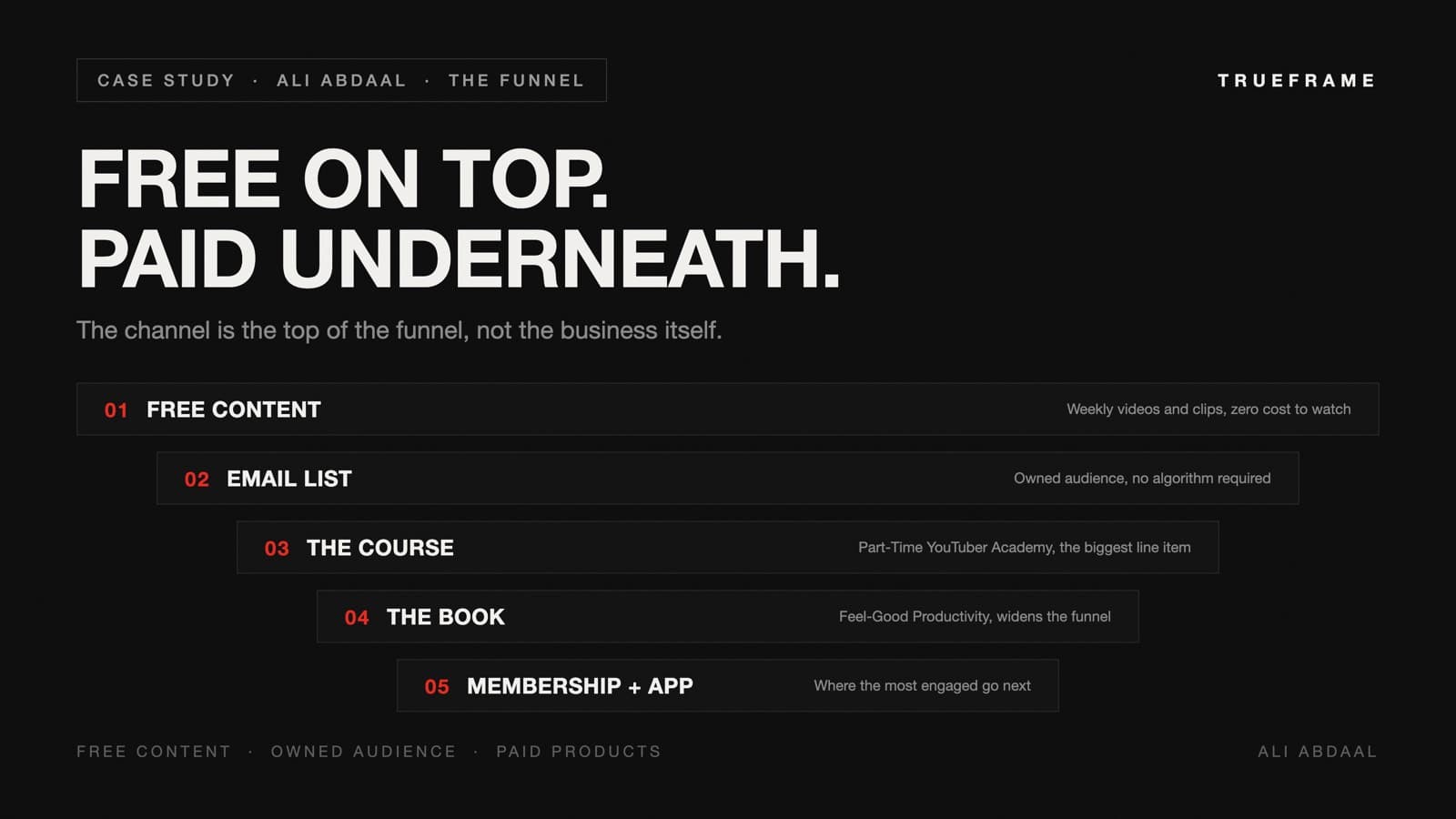
Here is where most people lose the thread. The YouTube channel is not the business. The channel is the top of a funnel that ends in things that carry real margin. Walk the layers and the machine becomes obvious.
- Free content: weekly videos and clips across YouTube and short-form platforms pull in millions of viewers at zero cost to them.
- The email list: the single most important layer, and the one creators skip. He turns rented attention on YouTube into an owned audience he can reach without an algorithm's permission.
- The flagship course: the Part-Time YouTuber Academy teaches the exact skill his audience watches him do, and it has become the biggest single line in his reported income.
- The book: Feel-Good Productivity, published in 2024, is a bestseller that widens the top of the funnel and deepens trust at the same time.
- The rest of the stack: a paid membership and an app give the most engaged people somewhere to go after the free content and the book.
The number that reframes everything is the mix. By his own reported breakdowns, YouTube ad revenue is one of the smaller slices of what he earns. The courses and products are the business. The free videos are the cheapest customer-acquisition channel he could have built, and every view is someone getting a little closer to buying something that is not free.
Tired of making content that goes nowhere?
Rendered from the shared mid-post template.
See how we build content engines for creatorsWhat a founder or creator can steal
You are not going to post weekly for a decade while running a company, and you do not need to. The principle works at any size. Copy the mechanics, not the scale.
- Build the offer before the audience. Abdaal teaches the thing he sells, so every video is a soft demonstration of the paid product. Know exactly what people will buy once they trust you, then make content that earns that trust.
- Give away your genuinely best thinking. The free framework that actually works is what makes the paid version believable. Holding back the good stuff kills the trust the whole model runs on.
- Own the audience through an email list. Followers are rented. An email list is owned. This is the layer that turns a big view count into a business you control.
- Ship on a schedule, not a mood. One idea, repurposed into many assets, published consistently. The compounding comes from showing up weekly, not from one video popping off.
- Be the face. People followed Ali Abdaal, not a faceless brand. For a founder, your credibility is the differentiation, and the company inherits the trust you build.
Where most people get it wrong
The most common mistake is copying the output and skipping the input. Founders see the polished videos and the millions of subscribers and try to start there. Abdaal started with a phone, a day job, and two years of posting into near silence. The production quality came after the audience, funded by the audience.
The second mistake is chasing the follower count as if attention alone pays. It does not. Plenty of creators have huge audiences and thin bank accounts because there is nothing on the back end for the attention to land on. What made Abdaal's audience a business was the course, the book, and the email list sitting underneath it. Reach without an offer is a hobby with good numbers.
The last mistake is treating it as a full-time creator's job when you are running a company. Abdaal has a team and a system built entirely around producing content at volume. A founder does not have that time, and that gap is the entire reason a done-for-you content engine exists. You bring the expertise and the offer. Someone else runs the machine that gives it away at scale.
The short version
- Abdaal gave away his best productivity advice free on YouTube for years and built a multi-million-dollar business on top of it.
- The videos are the funnel, not the product. Reported ad revenue is one of the smaller slices; the course and book are the business.
- The audience came first and slowly. He posted weekly through medical school and beyond before it paid.
- The email list is the layer creators skip and the one that turns rented attention into an owned audience.
- Copy the mechanics, not the scale: build the offer first, teach the real thing, ship weekly, own the list, be the face.
- Running it yourself is a full-time job, which is the whole reason a done-for-you content engine exists.
Abdaal's videos live and die on the first few seconds. Steal the exact hook formulas we use to stop the scroll across founder and creator content.
Get the hooksWant to see what teach-the-real-thing content looks like for your business? We make a free custom video for a handful of founders and creators each month.
Apply nowKeep reading
Want the Ali Abdaal engine without the weekly grind?
We build and run the whole content engine for creators and personal brands: strategy, scripts, filming direction, editing, repurposing one recording into dozens of assets, posting, and the offer that turns viewers into revenue. Your time cost is about 90 minutes a month.
See how it worksSkip the reading. Talk it through instead.
Book a fit call and we'll map out what a content engine looks like for your business. No pitch, no pressure.
Don't miss the next one
Some of what we share is time-sensitive. A format that's working right now, a window that closes fast. We email those the moment they're worth jumping on. Drop your email so you catch them in time.
No spam. Unsubscribe anytime.
Frequently asked questions
How did Ali Abdaal make money from free content?
How long did it take Ali Abdaal to build his business?
Can a founder replicate this without being a full-time creator?
What is Ali Abdaal's content strategy?
Do you need millions of subscribers like Ali Abdaal to make money from content?
Founded & led by
Benjamin Chua (BenChuchu)
Founder and CEO of Trueframe. 9 years building businesses (started at 16), tens of millions of views generated, and 8 figures in revenue created for the founders and brands he works with. He builds the content systems Trueframe runs.