Content for Aesthetic Clinics: A System Built for Trust and Bookings
The clinic does not need more filler reels. It needs a repeatable content system that answers real questions, demonstrates practitioner judgement and connects each response to an appropriate next step.

Written by Benjamin Chua, founder of Trueframe.
A clinic feed can look active while doing no useful work. The fix is not another content calendar. It is deciding which patient decision each piece helps, who approves it and where the person should go next.
Most aesthetic clinic content falls into two piles: procedure footage with no context and promotional posts with no reason to trust the claim. Neither helps a cautious prospective patient compare practitioners, understand a consultation or decide whether they should ask a question.
The content has three jobs: make the clinic easier to understand, make the practitioner's judgement easier to verify and make the next step easier to take.
1. Map content to the patient decision
List what a person needs at each stage. Early content names a concern and explains whether it deserves professional assessment. Middle content explains the service, practitioner approach, suitability, limitations and questions to ask. Decision-stage content explains the consultation, location, fees where the clinic chooses to publish them, availability process and appropriate next step.
| Stage | Patient question | Useful content | Next step |
|---|---|---|---|
| Awareness | What is happening and should I learn more? | Plain-language concern education and practitioner perspective | Read a relevant guide |
| Consideration | What are my options and what should I ask? | Suitability, alternatives, process, limitations and risk context | Visit the treatment page |
| Comparison | Who provides this and how do they think? | Practitioner credentials, consultation approach and clinic standards | View the practitioner profile |
| Action | What happens if I contact the clinic? | Booking process, location, response time and preparation | Request a consultation or ask a question |
2. Use practitioner judgement as the creative engine
A practitioner does not need to perform like an influencer. Their advantage is judgement. Build recurring formats around what they notice, what they would want a patient to understand, common misconceptions and how they approach suitability. Record the practitioner answering real prompts, then turn one session into short videos, longer explanations, site sections and front-desk answers.
- What should somebody ask before choosing a provider?
- What makes a person unsuitable or changes the recommendation?
- Which expectations need correcting during a consultation?
- What does the clinic do differently in assessment, follow-up or patient education?
- Which risks or limitations are commonly missed in social content?
Avoid claims such as safest, best, painless, guaranteed or perfect unless the clinic has an appropriate lawful basis and the exact context has been reviewed. A clear explanation is often more persuasive than a superlative because it gives the audience something concrete to evaluate.
3. Do not use patient outcome stories as a shortcut
Ahpra prohibits using testimonials about clinical aspects of regulated health services in advertising. In higher-risk cosmetic procedure advertising, that can include a positive statement about the reason for, experience of or outcome of a procedure, or the skills and experience of the practitioner. A patient speaking in their own words can still be a testimonial. Consent does not remove the advertising restriction.
Build trust with factual practitioner information, balanced education, transparent consultation process, clinic standards and substantiated non-clinical information. Review images separately under the current guidance. Do not imply that keeping a result in direct messages or a consultation automatically makes every use acceptable. Facts and context still matter.
Need the whole clinic growth system, not just more posts?
Trueframe connects practitioner-led content to the website, local search, paid distribution, booking path and measurement for Australian clinics.
See aesthetic clinic marketing in Australia4. Put approval before production
A marketer should not finish the edit before discovering that the concept cannot be used. Start each brief with the intended service, audience, claim sources, image plan, product references, call to action and approval owner. Use current Ahpra, National Board and TGA sources, then keep the final decision with the clinic's authorised reviewer.
- Draft from a specific patient question and approved factual sources.
- Review the claim, testimonial, image, therapeutic-good, offer and influencer issues before filming.
- Film only the approved concept and preserve the source context.
- Review the final edit, caption, thumbnail, links and comments settings together.
- Record the final version, approver, date and source-review date.
- Monitor comments and re-review evergreen content when guidance changes.
5. Connect each piece to the website and booking path
A useful video should not end at the profile. Link it to the treatment page, practitioner page, local guide or consultation path that continues the same question. Keep one page responsible for each clear intent. Use campaign tags on controlled links so the clinic can see the path without creating duplicate indexable URLs.
The front desk completes the content system. Give them the campaign context, expected questions and a simple source field. If the message attracts the wrong patient or the booking team keeps answering the same confusion, feed that information into the next scripts and page updates.
6. Report evidence at the right level
Dr Marion Chan and De Lune Aesthetics in Melbourne provide verified distribution proof for Trueframe's clinic work. In the first full month, content reached 430,563 people compared with a 48,840 baseline, and campaign-period tracking recorded 12,043 to 26,164 followers over five weeks. Her following has since grown from roughly 11K before the system to 36.2K now. Those numbers show attention and audience growth. They are not a guarantee of patient bookings, and we do not relabel them as revenue proof.
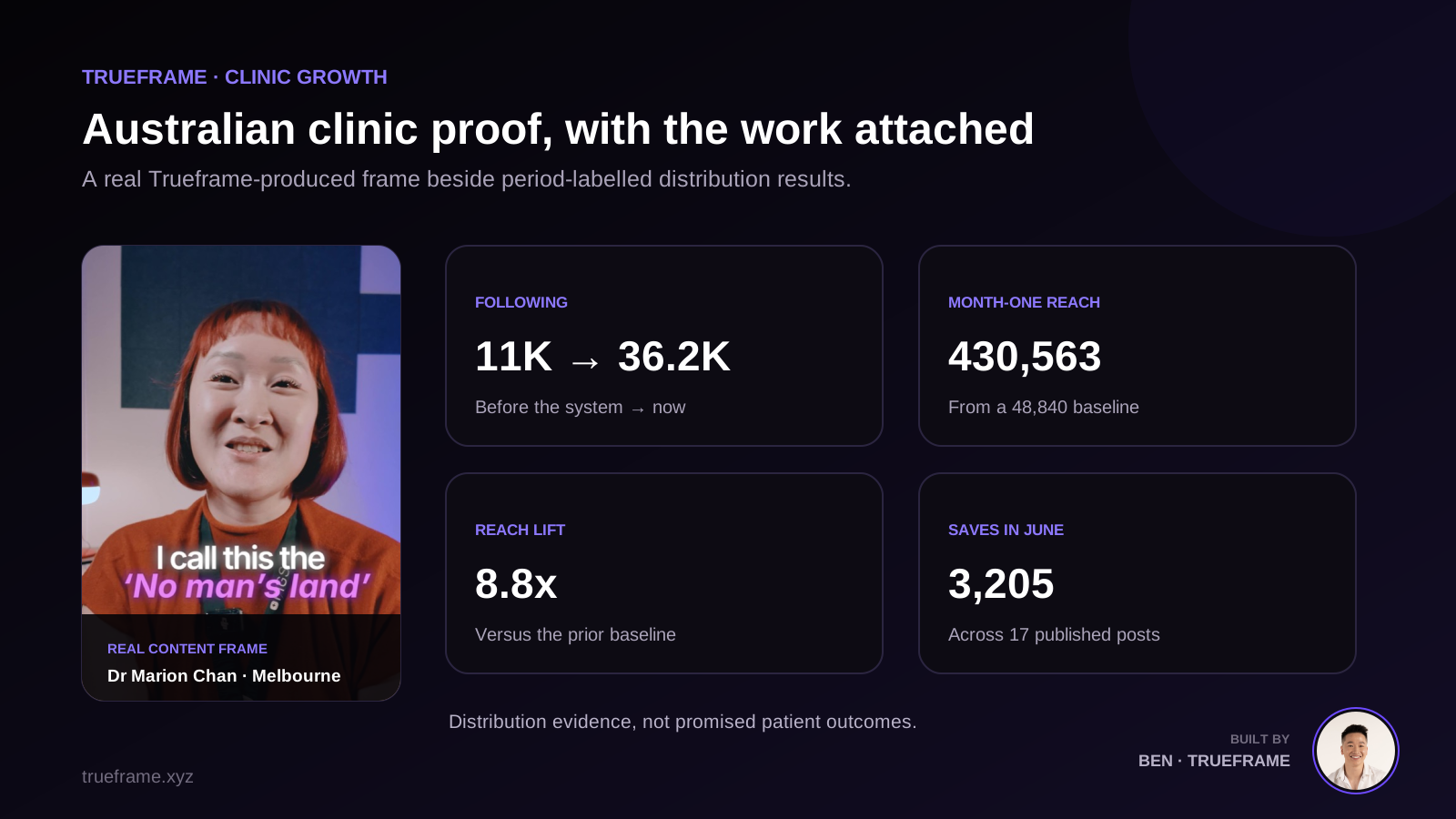
Swipe sideways to inspect the full graphic.
The clinic content operating system
- Map every piece to a real patient question and an appropriate next step.
- Use practitioner judgement and factual education instead of generic promotional filler.
- Do not treat patient stories or the patient's own words as a testimonial workaround.
- Review the brief before filming and the complete final context before publishing.
- Connect content to one useful page and preserve source data through the booking path.
- Report reach, intent and booking evidence separately without inventing causation.
Build the wider clinic system
Sources and review date
We use primary official sources for rules and platform guidance. This article is general information, not medical or legal advice.
- Guidelines for advertising a regulated health service · Ahpra and National BoardsReviewed 12 August 2026
- Guidelines for advertising higher risk non-surgical cosmetic procedures · Ahpra and National BoardsReviewed 12 August 2026
- Advertising health services and cosmetic injections: frequently asked questions · Therapeutic Goods AdministrationReviewed 12 August 2026
Skip the reading. Talk it through instead.
Book a fit call and we'll map out what a content engine looks like for your business. No pitch, no pressure.
Don't miss the next one
Some of what we share is time-sensitive. A format that's working right now, a window that closes fast. We email those the moment they're worth jumping on. Drop your email so you catch them in time.
No spam. Unsubscribe anytime.
Frequently asked questions
What content should an aesthetic clinic create?
Can a clinic use a patient story if the patient consents?
Can an aesthetic clinic post before-and-after images?
How often should a clinic post?
How should clinic content be measured?
Founded & led by
Benjamin Chua (BenChuchu)
Founder and CEO of Trueframe. 9 years building businesses (started at 16), tens of millions of views generated, and 8 figures in revenue created for the founders and brands he works with. He builds the content systems Trueframe runs.