How Dr. Miami Built a 2-Year Surgery Waitlist With a Snapchat Account
In 2015 a Bal Harbour plastic surgeon started broadcasting his operating room to Snapchat. Within a year his practice stopped taking appointments because the waitlist passed two years. This is the funnel behind it, with every number sourced, and what an aesthetic practice can copy today without the shock factor.
Written by Benjamin Chua, founder of Trueframe.
The most effective patient-acquisition funnel in aesthetic medicine wasn't built by an agency. It was built in 2015 by a Bal Harbour plastic surgeon with an iPhone, a free app, and a staff member willing to film in scrubs.
Historical scope: this is a United States case study from 2015, not a current Australian clinic advertising playbook. Do not copy its patient stories, results footage or shock content into Australian advertising. Use the current Ahpra and TGA guide linked below.
Dr. Michael Salzhauer, better known as Dr. Miami, went from a respected local practice to the most famous plastic surgeon in America in roughly 18 months. Not famous in the vanity sense. Famous in the only sense that matters commercially: by 2016 his practice had stopped taking appointments because, as he told ABC News, the backlog had passed a year, and press coverage at the time put the waitlist at two years and beyond.
The numbers, all from dated reporting by BuzzFeed News, ABC News, Vice and Complex: appointment requests jumped from 15-20 a day to 80-100. The business grew around five-fold. Over a million people followed his Snapchat, with individual posts pulling 800,000 views on an ordinary Wednesday. He performed roughly 500 Brazilian butt lifts a year at package prices reported between $14,000 and $26,000. No ad budget did that. A content funnel did.
Everyone remembers the shock factor. Almost nobody studies the funnel underneath it. The shock factor stopped working years ago. The funnel never did.
The origin: kicked off one platform, all-in on another
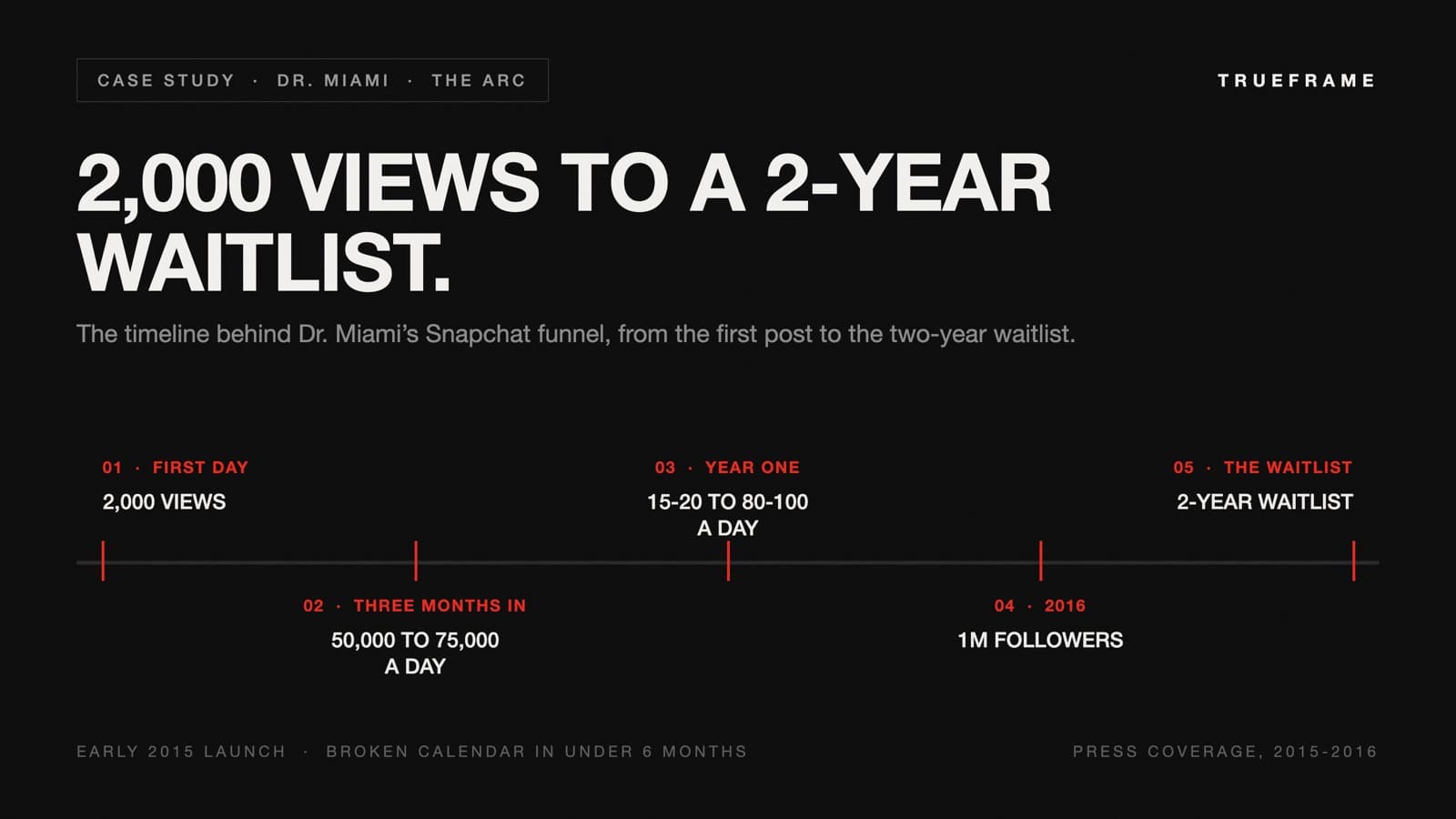
The part most people don't know: Dr. Miami didn't choose Snapchat. Instagram suspended his roughly 90,000-follower account in early 2015 for graphic content. So he moved to the one platform whose disappearing-video format tolerated what he wanted to show, and posted his first surgery clips to about 2,000 views.
Three months later, 50,000 to 75,000 people were tuning in daily. By June 2015 the practice had stopped scheduling consultations entirely and switched to first-come, first-served walk-ins, four days a week. He told Vice that spring he was booked out 13 months, with around a thousand patients paid and signed up. That's the speed demonstration content moves at when the audience is right: under six months from first post to a broken booking calendar.
The content: demonstration, not decoration
Strip away the spectacle and his content mix was disciplined. Around 4 minutes of a 2-hour procedure, cut into Snapchat-length clips. Before-and-afters. Patients talking on camera before and after their operations. And between cases, skits and music videos that made the account feel like a show rather than a brochure.
Notice what's missing: clinic-tour fluff, stock-photo wellness quotes, awareness-day posts. Every substantive piece of content answered the exact question a prospective patient brings to a $20,000 decision: what does this surgeon's actual work look like? Patients told reporters as much. One explained her choice to Complex by saying she watched his Snapchat all the time. The content WAS the consultation.
Patients don't book the clinic with the nicest logo. They book the doctor whose work they've already watched. Demonstration beats decoration in every vertical we produce for, and aesthetics most of all.
The funnel: views became DMs, DMs became walk-ins
Attention is worthless until something catches it, and this is where the Dr. Miami story gets underrated. In March 2015, before the explosion, he hired a dedicated staffer, Brittany Benson, to run the accounts. By that summer his assistant described answering Instagram DMs as literally a full-time job, with hundreds upon hundreds arriving daily. By 2016 there were two full-time social media staff inside the practice, one of them filming in surgical gear.
- Content: daily OR clips and patient stories pulled six figures of views to a free app.
- Capture: every DM got answered by a staffed team, not an autoresponder and not whenever the front desk had a spare minute.
- Conversion: consults went walk-in-only because demand beat scheduling, and out-of-state viewers got a travel concierge. "I have a travel concierge now," he told ABC News.
- Retention of demand: cancellation slots were announced straight to the feed and filled from the waitlist within hours.
There's also a flywheel hiding in the consent numbers. Early on, roughly one in three patients agreed to be filmed. Within a year, patients were arriving and asking to be on the Snapchat. The content recruited patients, and the patients became content. Once that loop closes, the funnel feeds itself.
Audience is not a funnel
Useful contrast: Dr. Anthony Youn, the most-followed plastic surgeon on TikTok with around 8.5 million followers, several times Dr. Miami's current footprint. Youn's model is media: books, brand deals, education at massive scale. It's a real business, but it isn't a patient funnel, and it isn't trying to be. Dr. Miami's smaller audience produced a multi-year surgical waitlist because every layer under the content, the DM team, the walk-in system, the concierge, was built to convert watchers into patients.
This is the distinction we push hardest with clinic clients: follower count tells you who's entertained. The waitlist tells you who's converting. Build for the second number.
Tired of making content that goes nowhere?
Rendered from the shared mid-post template.
See how we build patient funnelsWhat to copy, and what to leave in 2015
Don't copy the shock factor. Platform rules around graphic surgical content have tightened hard since 2015, and the ethics pushback was real even then: Dr. Oz criticized him publicly for blurring entertainment and surgery, and peer-reviewed papers in Plastic & Reconstructive Surgery raised concerns about live surgical broadcasts. Graphic footage was his traffic hack for one platform in one era. It was never the system.
Copy the system:
- Use approved practitioner education and consultation information. Do not assume consent makes patient stories, outcomes or results footage permissible advertising in Australia.
- Make the doctor the face. People followed Dr. Miami, not Bal Harbour Plastic Surgery Associates. In aesthetics the practitioner is the brand, and the practice inherits the trust.
- Staff the capture layer. His DMs were a full-time job in year one. If enquiries from content sit unanswered for two days, the funnel leaks at the exact point it should convert.
- Separate the historical proof loop from a current Australian plan. Patient participation and consent do not override testimonial, image or advertising restrictions.
- Commit to volume. Daily posting for years, with a team built around it, before the TV show and the million followers. The funnel compounded because it never paused.
The short version
- Dr. Miami went from 15-20 appointment requests a day to 80-100, a five-fold business jump and a 2-year waitlist, on a free app.
- The content was demonstration: real surgeries, real patients, real results. The entertainment was seasoning, not the meal.
- The funnel was staffed: dedicated content hire before the spike, DMs answered as a full-time job, walk-in consults, travel concierge.
- The proof flywheel closed: patients recruited by content started asking to appear in it.
- Audience is not a funnel. An 8.5M-follower doctor runs a media business; a 1M-follower doctor ran a 2-year waitlist.
- Copy the operating discipline, not the patient-content tactics. Use current official guidance and a staffed, reviewed enquiry path.
Want to see what demonstration content looks like for your practice? We make a free custom video for a handful of business owners each month.
Apply nowKeep reading
- How aesthetic doctors build a personal brand that books consults
- How to create content for an aesthetic clinic (that books patients, not just likes)
- What content marketing actually looks like when it drives revenue
- Personal branding for aesthetic doctors, done for you
- Current Australian Ahpra and TGA advertising guide
Want the funnel without becoming a full-time creator?
We build and run the content operation for doctor-led practices: strategy, sourced scripts, filming direction, editing, posting and a reviewed enquiry path. Your authorised clinic reviewer retains final approval.
See how it worksSkip the reading. Talk it through instead.
Book a fit call and we'll map out what a content engine looks like for your business. No pitch, no pressure.
Don't miss the next one
Some of what we share is time-sensitive. A format that's working right now, a window that closes fast. We email those the moment they're worth jumping on. Drop your email so you catch them in time.
No spam. Unsubscribe anytime.
Frequently asked questions
How did Dr. Miami get famous?
How many patients did Dr. Miami get from social media?
What did Dr. Miami actually post on Snapchat?
Would Dr. Miami's playbook still work today?
What can aesthetic doctors copy from Dr. Miami without the shock factor?
Founded & led by
Benjamin Chua (BenChuchu)
Founder and CEO of Trueframe. 9 years building businesses (started at 16), tens of millions of views generated, and 8 figures in revenue created for the founders and brands he works with. He builds the content systems Trueframe runs.