How Aesthetic Doctors Build a Personal Brand That Books Consults
In aesthetics, patients don't choose the best clinic. They choose the doctor they already trust. Here's the system we use to build a personal brand that books consults, not just followers.

Written by Benjamin Chua, founder of Trueframe.
Patients don't book the best clinic. They book the doctor they already feel like they know.
The aesthetics market is crowded and it all blurs together. Every clinic runs the same before-and-afters, the same glow-up reels, the same seasonal promo. To a patient deciding who gets near their face, one polished clinic looks exactly like the next.
A personal brand is the one thing none of them can copy. Your competitor can match your treatments, undercut your prices, and redo their interior to look like yours. They can't be you. The doctor is the moat.
We've built content engines for more than 40 founders and brands. An aesthetic doctor we produce for has built an Instagram audience of 12,000, and patients arrive already trusting her judgement instead of price-shopping her against the place down the road. Her practice doesn't compete on promos. It competes on her.
Patients don't trust clinics. They trust doctors. The brand that wins is a person.
Here's the exact system we use to turn an aesthetic doctor into the name patients ask for. Six parts. None of them require you to become an influencer.
1. Put the doctor in front of the clinic
Most aesthetic practices market the building. The clinic name, the machines, the marble. But a patient about to trust someone with their face isn't choosing a room. They're choosing a human, their hands, their taste, their restraint. So the doctor goes in front. The clinic is the setting. You're the brand.
The objection here is always, I'd rather keep it professional, or I'm camera-shy. That discomfort is the whole moat. Almost no doctors in your city will do it, which is precisely why the handful who do become the ones patients feel they already know before the first consult.
2. Teach the decision, not the highlight reel
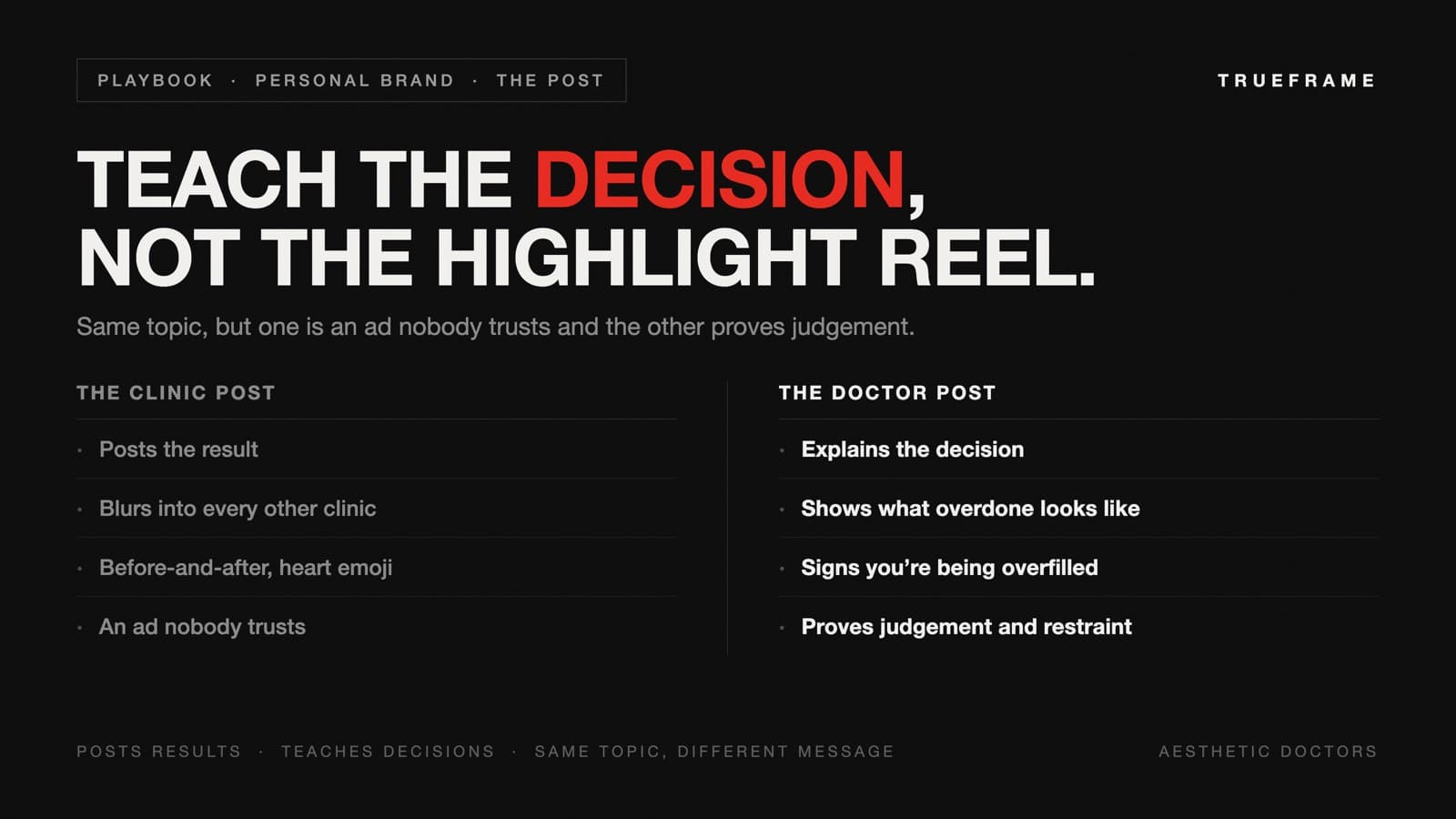
Every clinic posts results. They scroll past in a blur because they all look the same and a nervous patient can't tell good work from luck. What that patient actually wants is to understand the decision they're afraid to get wrong. When a treatment is right and when it isn't. What overdone looks like. How to spot a careful injector from a reckless one.
Here's the difference in practice. A clinic posts a lip-filler before-and-after with a heart emoji. A doctor posts, here are three signs your injector is overfilling you, and what to ask before you book. Same topic. One is an ad nobody trusts. The other proves your judgement and restraint, which is the exact thing a patient wants in the person holding the needle.
See what content built to land clients looks like. We'll make you one, free, so you can judge the work before anything else.
Apply now3. Speak to one patient, not everyone who wants to look better
Aesthetic doctors try to talk to anyone who could book, so the content goes vague, and vague content reaches a lot of people who feel nothing. The fastest way to fill a calendar is to make the content almost uncomfortably specific.
Not women who want to feel more confident. The 45-year-old who wants to look refreshed but is quietly terrified of walking out looking done. The bride six months from the wedding. The man considering his first treatment and too embarrassed to ask anyone. When you name the exact person and the exact worry they were Googling at 11pm, the right patient feels like you read their mind, and that feeling is what trust is made of.
Specific content reaches fewer people at far higher intent. Ten of the right patients beat ten thousand of the wrong ones. The doctors who win pick a patient and own them.
The exact opening lines we use to make the right patient stop scrolling instead of dismissing one more aesthetics ad. Swipe them for your own content.
Get the hooks freeThis is the part most aesthetic doctors never get to
We do the research, scripting, and editing so your content shows your judgement and speaks to the exact patient you want, instead of looking like every other clinic's ad. You film in one short session a month and we run the rest.
See how the done-for-you system works4. Show the human, not just the work
In aesthetics, your bedside manner, your taste, and your willingness to say no are not soft extras. They are the product. The patient is trusting you with their face, and they're buying the belief that you'll handle them carefully and tell them the truth.
So show how you think. The treatment you talked a patient out of because it wasn't right for them. The standard you won't drop even when someone asks you to. The care behind the work, not just the after photo. In this field the personality isn't a distraction from the expertise. It is the expertise the patient is actually shopping for.
You can do this without making an outcome promise. Teach, show your judgement and explain your standards. Then run the final material through the clinic's advertising review. No content format or teaching angle guarantees compliance on its own.
5. Build it as a system the practice can actually keep running
A fully booked doctor cannot sit in an editor at midnight. The moment content depends on your spare time, it dies the first busy clinic week. So it can't depend on your time. You film in one focused session, and a system handles the scripting, editing, posting, and tracking after that.
Consistency beats intensity. The practice that shows up every week for a year beats the one that posts a burst after a slow month and then goes quiet the moment the schedule fills back up. Content compounds, but only if it keeps running.
6. Count consults booked, not followers
Followers feel like progress because the work is so visual. They aren't the scoreboard. Booked consults are. Tag every call to action so a new patient traces back to the exact piece of content that brought them in.
Once you can see which content fills your calendar and which just collects likes, you stop running content on hope and start running it like every other part of the practice you'd actually defend in a budget. That's the difference between content as a cost and content as a channel. A cost is something you hope is working. A channel is something you can measure and scale on purpose.
Ben has been a pleasure to work with. He gives very detailed reports and suggestions which helps content creation in a tremendous way. Highly recommend his services. He has an excellent team of very experienced staff.
Marion C., De Lune Aesthetics
The short version
- Put the doctor in front of the clinic. Patients choose a person, not a logo.
- Teach the decision your patient is scared to get wrong, not the highlight reel.
- Speak to one specific patient, not everyone who wants to look better.
- Show the human. In aesthetics your judgement and restraint are the product.
- Run it as a system on one filming session a month, not a burst when it's quiet.
- Count consults booked, not followers.
Followers feel like progress. A full consult calendar is progress. The aesthetic doctors who win aren't the ones with the glossiest clinic page. They're the ones patients already trust by the time they book, because the doctor, not the clinic, is the brand.
Your treatments can be copied. Your prices can be undercut. You can't. Build the brand around the doctor.
Keep reading
- How Dr. Miami built a 2-year surgery waitlist with a Snapchat account
- How to create content for an aesthetic clinic that books patients
- Video marketing for wellness brands: sell without looking like an ad
- How to make founder content that drives pipeline, not just views
- Done-for-you personal branding for aesthetic doctors
- Ahpra and TGA advertising guide for aesthetic clinics
- Aesthetic clinic marketing across Australia
Want this built for you?
We build and run the whole content engine for aesthetic doctors, from strategy to scripting to editing to tracking. You film in one short session a month, and we turn your judgement into a personal brand that books consults instead of just collecting followers.
See how it worksSources and review date
We use primary official sources for rules and platform guidance. This article is general information, not medical or legal advice.
- Guidelines for advertising a regulated health service · Ahpra and National BoardsReviewed 12 August 2026
- Guidelines for advertising higher risk non-surgical cosmetic procedures · Ahpra and National BoardsReviewed 12 August 2026
- Advertising health services and cosmetic injections: frequently asked questions · Therapeutic Goods AdministrationReviewed 12 August 2026
Skip the reading. Talk it through instead.
Book a fit call and we'll map out what a content engine looks like for your business. No pitch, no pressure.
Don't miss the next one
Some of what we share is time-sensitive. A format that's working right now, a window that closes fast. We email those the moment they're worth jumping on. Drop your email so you catch them in time.
No spam. Unsubscribe anytime.
Frequently asked questions
Why should an aesthetic doctor build a personal brand instead of just marketing the clinic?
I'm a doctor, not an influencer. Do I really need to be on camera?
How do I post content without breaking advertising rules or making claims I can't back?
How much time does this take when I'm fully booked with patients?
How do I know if my content is actually booking consults, not just getting likes?
Founded & led by
Benjamin Chua (BenChuchu)
Founder and CEO of Trueframe. 9 years building businesses (started at 16), tens of millions of views generated, and 8 figures in revenue created for the founders and brands he works with. He builds the content systems Trueframe runs.