Video Marketing for Wellness Brands: How to Sell Without Looking Like an Ad
In wellness and aesthetics, the more an ad looks like an ad, the less people believe it. Here's the system we use to make content that demonstrates the result and sells without looking like it's selling.

Written by Benjamin Chua, founder of Trueframe.
Wellness and aesthetic brands have a trust problem most other businesses don't. The second your content looks like an ad, people stop believing it.
Scope note: this article's testimonial and transformation examples are for non-regulated consumer wellness brands such as Pilates and fitness studios. Australian regulated health services and aesthetic clinics need the separate Ahpra and TGA review workflow linked below.
Someone is deciding whether to put a treatment near their face, a supplement in their body, or a coach in charge of their health. They are already skeptical. So they scroll past the perfectly lit ad with the confident claim, because that is exactly what every brand that didn't deliver also looked like.
The brands that win in this space don't post better ads. They post content that doesn't feel like one.
We've built content engines for more than 40 founders and brands and generated over 17 million views across their content. Siluet hit a 7:1 return on ad spend while running more than 40 ads a week at peak. Their words were simple. The content engine they built changed everything for us. A health and performance brand we work with went from posting randomly to a real system and grew its Instagram about 47% in a year.
Same treatments. Same results. The brands that win just stopped looking like an ad.
Here's the exact system we use to make wellness content that sells without selling. Six parts. None of them are about a bigger ad budget.
1. Show the transformation. Stop claiming it
A claim is something the viewer has to take on faith. A demonstration is something they can see. In wellness, faith is exactly what people are short on, so the brand that shows wins every time.
Here's the difference in practice. A claim-first aesthetic clinic posts a graphic that reads, achieve glowing, youthful skin with our signature facial. A show-first clinic posts a real client at the consultation explaining the texture and dullness that bothered her, then the same client six weeks later, on camera, describing what actually changed. Same treatment. One is an ad nobody believes. The other is proof a skeptical buyer can't argue with.
The objection here is usually, but my best results are the personal ones I can't show. Then show the process, the room, the practitioner, the care. People buy the belief that you'll handle them well. You can demonstrate that without ever overpromising an outcome.
2. Speak to one specific person, not everyone who could buy
Wellness brands try to talk to everyone because everyone could technically use what they sell. So the content gets vague, and vague content reaches a lot of people who feel nothing.
The fastest way to make content that converts is to make it almost uncomfortably specific. Not women who want to feel better. The 38-year-old who hasn't slept properly since her second kid and is quietly worried it's now permanent. When you name the exact person and the exact problem they were searching at 11pm, the right buyer feels like you read their mind, and that feeling is what trust is made of.
Specific content reaches fewer people at far higher intent. Ten of the right viewers beat ten thousand of the wrong ones. The wellness brands that win pick a person and own them.
The exact opening lines we use to make the right buyer stop scrolling instead of dismissing one more wellness ad. Swipe them for your own content.
Get the hooks free3. Educate first. The teaching is the marketing
Your buyer doesn't wake up wanting your treatment or your program. They wake up confused about their own body. If your content answers the question they're already stuck on, you've earned the right to be heard. If it pitches, you've lost them by the second line.
A clinic that explains why a certain skin concern actually happens, in plain language, builds more belief in one video than ten ads do. By the time someone has watched three of those, the treatment isn't a pitch. It's the obvious next step from the person who clearly understands the problem better than anyone else they've watched.
This is the whole fix for the looks-like-an-ad problem. Ads ask for something. Teaching gives something first. People buy from the brand that helped them before it ever asked for the booking.
This is the part most wellness brands never get to
We do the research, scripting, and editing so your content demonstrates the result and teaches the buyer instead of pitching them. You show up for a short filming session each month and we run the rest.
See how the done-for-you system works4. Make your proof feel real, not produced
The instinct in wellness is to make the testimonial look as polished as possible. That's the mistake. The more produced a testimonial looks, the more it reads as an ad, and the less a skeptical buyer believes it.
The fix is less polish, not more. A real client describing a specific before and after in their own messy words beats a scripted, color-graded testimonial every time. Keep the natural reaction. Keep the pause where they search for the word. That texture is the proof. People trust what looks like it actually happened.
The objection is always, won't rough footage hurt my premium brand? No. Premium and believable aren't opposites. You can shoot it beautifully and still keep the human moment intact. The brands that win make proof that feels captured, not manufactured.
5. Build it as a system you can actually keep running
Most wellness brands post in bursts. A flurry of content the week after a workshop fires them up, then silence for a month when the clinic gets busy. The audience never builds the steady trust that turns into bookings, because the brand keeps disappearing.
Document, don't create from scratch. Siluet, which ran 40-plus ads a week, didn't sit in an editor at midnight. They filmed, and a system handled the scripting, editing, packaging, posting, and tracking after that. Volume only worked because it was built to run without depending on anyone's free time.
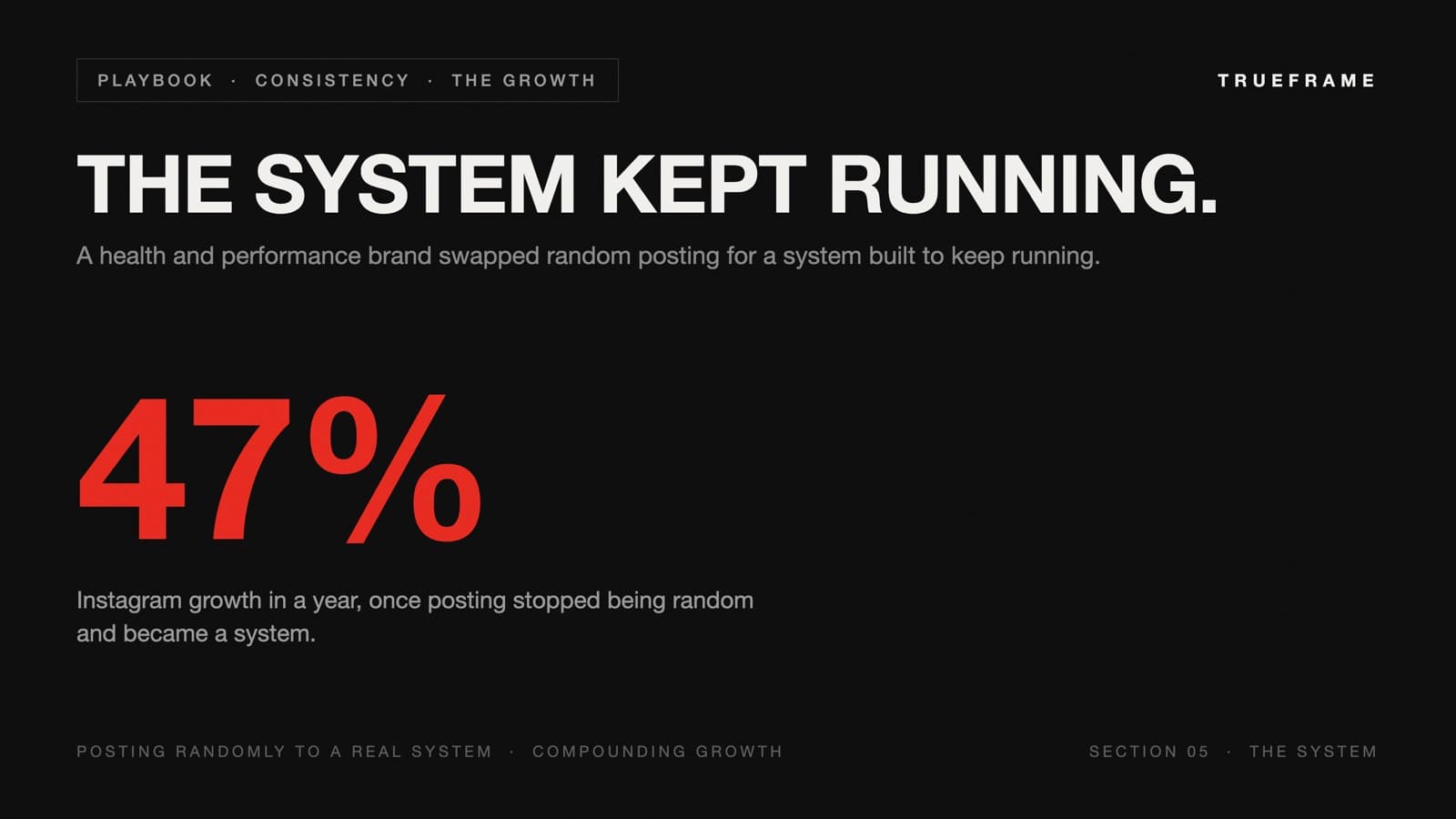
Consistency beats intensity. A health and performance brand we work with put it plainly. They went from posting randomly to a real system that works, and grew about 47% in a year. The system is what turned scattered posts into compounding growth.
6. Count bookings, not likes
Views and likes feel like progress in wellness because the content is so visual. They aren't the scoreboard. Bookings, consults, and sales are. Tag every call to action so an inquiry traces back to the exact piece of content that drove it.
That's how Siluet could prove a 7:1 return on ad spend instead of guessing. Once you can see which content produces customers and which just produces attention, you stop running content on hope and start running it like every other channel you'd defend in a budget meeting.
The content engine they built changed everything for us.
Siluet
This is the difference between content as a cost and content as a channel. A cost is something you hope is working. A channel is something you can measure and scale on purpose.
The short version
- Show the transformation instead of claiming it. Skeptical buyers believe what they can see.
- Speak to one specific person, not everyone who could buy.
- Educate first. The teaching is what earns the booking.
- Make your proof feel real and captured, not produced and scripted.
- Run it as a consistent system, not a burst of content every few weeks.
- Count bookings and return on spend, not likes.
Views feel like progress. Bookings are progress. The wellness brands that win aren't the ones with the glossiest ads. They're the ones whose content shows the result, teaches the buyer, and gets tracked all the way to a booked consult.
In wellness, the goal isn't a better ad. It's content so useful and so real that nobody clocks it as one.
Keep reading
- How aesthetic doctors build a personal brand that books consults
- How to create content for an aesthetic clinic that books patients
- How to make founder content that drives pipeline
- How coaches turn content into clients, not just followers
- Done-for-you video for wellness brands
- For regulated clinics: Ahpra and TGA advertising guide
Want this built for you?
We build and run the whole content engine for wellness and aesthetic brands, from strategy to scripting to editing to tracking. You film, and we turn your results into content that books clients instead of looking like another ad.
See how it worksSkip the reading. Talk it through instead.
Book a fit call and we'll map out what a content engine looks like for your business. No pitch, no pressure.
Don't miss the next one
Some of what we share is time-sensitive. A format that's working right now, a window that closes fast. We email those the moment they're worth jumping on. Drop your email so you catch them in time.
No spam. Unsubscribe anytime.
Frequently asked questions
Why does my wellness content get ignored even when it looks professional?
How do I show transformation without making medical or health claims I can't back up?
Do testimonials still work, or do people tune them out?
How much content do I actually need to post to see results?
How do I know if my wellness content is actually working?
Founded & led by
Benjamin Chua (BenChuchu)
Founder and CEO of Trueframe. 9 years building businesses (started at 16), tens of millions of views generated, and 8 figures in revenue created for the founders and brands he works with. He builds the content systems Trueframe runs.