How Siluet Turned $1 of Ad Spend Into $7 With a Content Engine
Siluet, a Pilates-reformer wellness brand, needed more ad creative than anyone could hand-make. Here's the system we built, and the 7:1 return it ran on.

Written by Benjamin Chua, founder of Trueframe.
Siluet, a wellness brand built around a Pilates reformer, had a good product and a paid-ads problem. They needed more creative than anyone could hand-make.
Paid social runs on fresh creative. An ad works, then the audience sees it enough times that it stops working, and costs climb. The only way to hold performance is to keep feeding the account new angles. This brand was scaling spend and the creative pipeline behind it couldn't keep pace. Their previous setup ran out of road.
That's the situation we got brought in on. Not a one-off video. A production problem. They needed a system that could ship ads at a volume a person making them one at a time could never match, without the work turning into stock-footage filler that looks like every other brand in the feed.
The bottleneck wasn't ideas or budget. It was the ability to produce enough good creative, fast enough, to keep the ads working.
So we built one. Here's exactly what went into it, and the return it ran on.
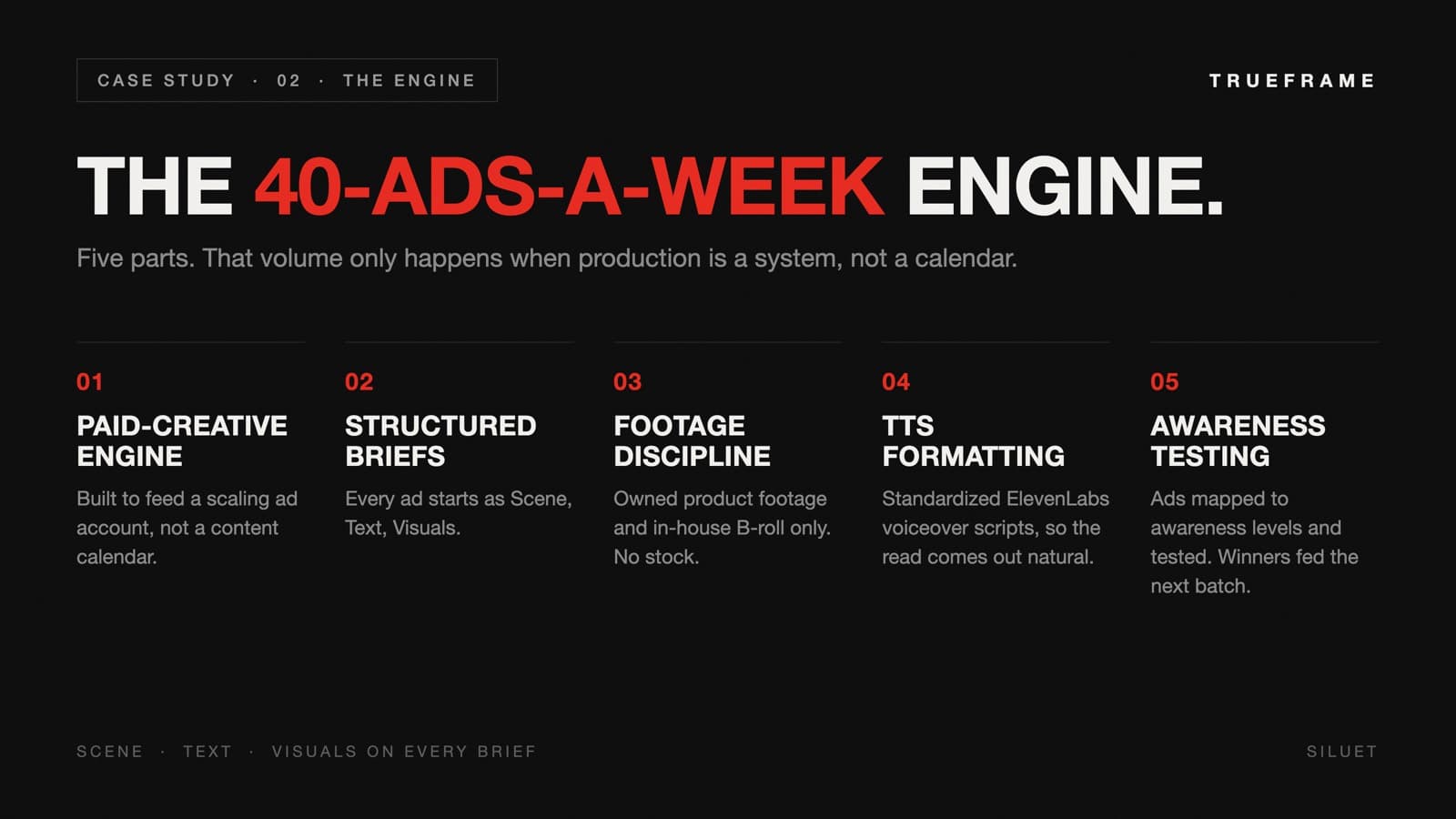
1. We built a paid-creative engine, not a content calendar
The whole thing was designed around one job: produce enough fresh, on-brand ad creative to keep a scaling ad account fed. At peak it ran more than 40 ads a week. That number only happens when production is a system instead of a series of one-off requests, so the first thing we did was treat it like a factory line with standards, not a calendar someone fills in when they have time.
2. Every ad started from a structured brief
You can't ship 40 ads a week off vague ideas in a chat thread. Every ad began as a brief in a fixed table format, broken into Scene, Text, and Visuals. Each row spelled out what happens on screen, what gets said, and what the viewer sees. That structure is what let the team produce at volume without the quality wobbling from one ad to the next. Anyone picking up a brief knew exactly what to make.
3. Strict footage discipline: owned product footage and in-house B-roll only
No stock. Every ad used the brand's own product footage and B-roll we shot ourselves. This was a hard rule. Stock footage is the quickest way to look interchangeable with every other brand pulling from the same library, and in wellness the buyer is deciding whether to spend on their own health and body. Real footage of the real product earns the trust that a generic clip never will. The discipline held even at 40 ads a week.
4. Standardized text-to-speech script formatting
A lot of the creative used ElevenLabs text-to-speech for voiceover. The catch with TTS is that raw scripts read flat and robotic, which sinks an ad. So we standardized how every script got formatted before it went in, so the read came out natural and consistent across the whole batch. That consistency is part of what made volume possible. The voice didn't have to be re-figured-out for every ad.
5. Ads mapped to awareness levels and tested systematically
Volume alone isn't the point. Volume aimed at the right person is. Every ad was mapped to an awareness level, from the buyer who has never heard of the product to the one already comparing it against alternatives. Then we tested across those levels instead of guessing which angle would land. The account learned what worked at each stage, and the next batch of briefs leaned into the winners. That's the loop that turns a pile of ads into a 7:1 return.
The result: a documented 7:1 ROAS. Every $1 of ad spend returned about $7, and the 40-ads-a-week cadence held as a repeatable production system, not a one-time sprint.
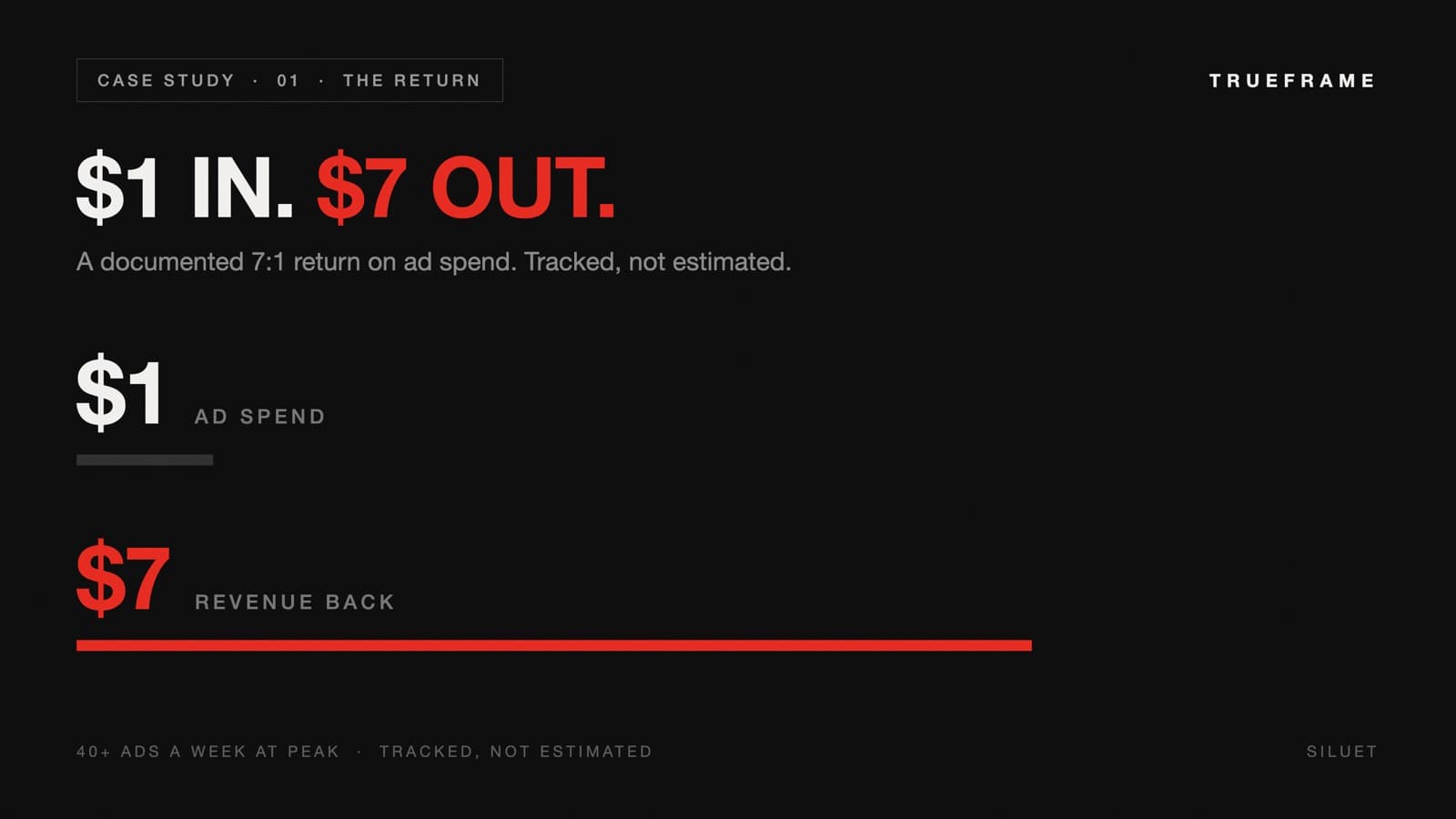
The number is the headline, but the cadence is the real story. Plenty of brands get one good ad. The hard part is producing enough good ones, week after week, to keep a scaling account profitable. This system did that, which is what made the 7:1 a thing you could count on rather than a lucky month.
The content engine they built changed everything for us.
Siluet
The short version
- Siluet's problem was production, not budget or ideas. Their old setup couldn't make enough creative to feed a scaling ad account.
- We built a paid-creative engine that ran 40-plus ads a week at peak, designed as a system rather than a calendar.
- Every ad started from a structured Scene / Text / Visuals brief, so quality held at volume.
- Strict footage discipline: owned product footage and in-house B-roll only, never stock.
- Standardized text-to-speech formatting kept the voiceover natural and consistent across the whole batch.
- Ads mapped to awareness levels and tested systematically, so each batch got smarter.
- The result was a documented 7:1 ROAS, and the cadence proved it was repeatable.
If you're spending real money on paid social and the creative can't keep up, the missing piece is usually a production system, not a bigger budget. One good ad doesn't scale. A system that ships fresh, on-brand creative every week is what holds the return as you spend more.
Want a creative engine like this for your brand?
We build the brief structure, the footage workflow, the script formatting, and the testing system, then run the volume so your team isn't hand-making ads one at a time. You get a steady stream of fresh, on-brand creative built to keep your paid account profitable as you scale.
See how the done-for-you system worksKeep reading
Skip the reading. Talk it through instead.
Book a fit call and we'll map out what a content engine looks like for your business. No pitch, no pressure.
Don't miss the next one
Some of what we share is time-sensitive. A format that's working right now, a window that closes fast. We email those the moment they're worth jumping on. Drop your email so you catch them in time.
No spam. Unsubscribe anytime.
Frequently asked questions
What does a 7:1 ROAS actually mean here?
Why did Siluet need 40-plus ads a week?
Do you use stock footage to hit that volume?
Can you build a system like this for our brand?
Founded & led by
Benjamin Chua (BenChuchu)
Founder and CEO of Trueframe. 9 years building businesses (started at 16), tens of millions of views generated, and 8 figures in revenue created for the founders and brands he works with. He builds the content systems Trueframe runs.