The 5 Video Formats Every Tech Founder Should Steal
Use the job in front of you to choose a format, then adapt it to a real story, product, or technical lesson your audience needs.

Written by Benjamin Chua, founder of Trueframe.
Choose the format by the job: use a split screen explainer to teach a technical fix, a breakdown to explain a change in your category, a news-reporter video to unpack a company event, and a personal journey or build-in-public video when you have a real story to show.
Match the format to the job
- Need a buyer to understand one technical limitation and the fix? Make the split screen explainer.
- Need to establish a point of view in a crowded category? Distil the release, outage, acquisition, or failed launch into a summarised breakdown.
- Need people to trust the person behind the product? Use the personal journey or build-in-public format, but only when the underlying moment is real.
The five examples below are public posts selected for their format and packaging. Figures reflect the examples used when this article was first published in June 2026, not live benchmarks or a forecast of what your video will reach.
Format 1: The personal journey (b-roll storytelling)
The example to study is @junead.kh. His video opens with: "I walked away from a $200K job at Microsoft to bet everything on my startup. Here's why." It did 352K views, 10.4K likes, and 457 comments.
The hook formula is one specific number, plus one irreversible decision, plus "Here's why." The idea underneath it is your origin story framed as a hard decision, not a flex. Focus on the moment you burned the boats.
The format is a selfie vlog cut with real-world b-roll. The office, the laptop, the resignation moment. No graphics. The proof is visual.
Why it works: your decision to start is your most underused asset. It builds trust, attracts believers, and makes every lesson you share afterwards land harder. Here's how you steal it.
- Open with a specific number, the startup bet, and "Here's why."
- Show the place where it happened. The desk, the office, the city.
- End with what changed ethically or emotionally, not financially.
Format 2: The summarised breakdown
The example: @youraveragetechbro. "I watched all the AWS re:Invent keynotes so that you don't have to. Here are the big announcements." That video did 231K views on a channel with 47K subscribers.
The hook formula: "I did [huge effort] to achieve [dream outcome] so you don't have to." The idea is to summarise the technical noise in your space into a ranked list people can actually use.
The format is a greenscreen talking head in front of logos, screenshots, and key terms. Three to five announcements, ranked, each with a one-line implication.
Why it works: founders are drowning in tech news. The person who says "ignore 95% of this, here's the 5% that matters" gets saved, shared, and followed. Here's how you steal it.
- Every 2 to 4 weeks, pick one event or release in your space.
- Consume the source material and distill it to 3 to 5 takeaways, ranked by impact.
- End with "If you only do one thing, do [X] this week."
The formats give you the structure. These give you the first three seconds. Swipe the exact opening lines we use to stop the scroll.
Get the hooks freeFormat 3: The green screen news reporter
The example: @nataliebarbu. "Spirit Airlines is done. Not bankrupt, not restructuring, they are shutting down." That did 103K views on a 66K-subscriber channel.
The hook formula is [huge brand] plus [crazy unexpected news]. The idea is to reverse-engineer a high-profile failure into a story arc with real causes and a clear takeaway.
The format is greenscreen with article overlays, news clippings, charts, and company logos. It should feel like a mini documentary. Five beats, each tied to dates, dollar amounts, and real names.
Why it works: when your profile is small, the news does the heavy lifting on engagement. And you get associated with the role of the messenger, the person who explains what just happened in your space. Here's how you steal it.
- Pick one company in your space that failed, got acquired, or pivoted hard.
- Spend an hour in the news coverage and find the 4 to 5 moments that mattered.
- Tell it as a story arc, not a list. Each beat sets up the next.
- End with the implication, not just "isn't that interesting."
This is the part most founders never get to
Knowing the formats is step one. Scripting, filming, and shipping them every single week is where most founders stall. We run that whole engine for you. You record, we handle the rest.
See how the done-for-you system worksFormat 4: Build in public (behind the scenes)
The example: @morilliu. "Build an app with me with AI while flying to New York." 1.4M views, 59.7K likes, 21.9K comments.
The hook formula: "Build [dream outcome] with me with [tool] while [high stakes pattern interrupt]." The idea is to turn a real build sprint into a story with a clock on it, and show the real, messy work.
The format is a POV vlog plus screen recordings. The IDE, the AI tools, the debugging. Cut against travel or home b-roll, ending with a simple CTA.
Why it works: everyone posts "we shipped X." Almost no one shows how. Process content turns you into a builder people root for. Here's how you steal it.
- Pick a real constraint window. A flight, a 3-hour block, a sprint.
- Film the messy reality. False starts, bugs, the whiteboard, the Slack messages.
- Lead with the constraint: "I built [X] in [Y]. Here's how."
Format 5: The split screen explainer
The example: @hamelsmu. "Claude is great at writing code. It's not great at understanding images, videos, and PDFs. Here's how to give it a model that is." 16.3K views, 321 likes, 989 comments. And here's the part that matters: that one video led to 600+ leads.
The hook is three lines. A strength everyone agrees on, a specific limitation they've personally hit, and a "here's how" promise to fix it.
The idea: solve one specific limitation your buyers are actively fighting, then give the fix away. The format is a tutorial with a quick explanation up front, and every step is concrete with visuals that match what you're saying. Animated explainer elements carry the concept, the talking head sits at the bottom with text overlays, and the whole thing stays clean and diagrammatic. It closes with a comment trigger.
Why it works: solving one specific problem earns the follow. And the comment trigger does double duty. It boosts the video in the algorithm, and it turns your comment section into a lead list. Here's how you steal it.
- Find one specific limitation your audience hits with a tool they already use.
- Build or show the fix. A plugin, a template, a process, a checklist.
- Walk through the setup in concrete steps with matching visuals.
- End with a comment trigger to deliver it.
Which format should you steal first?
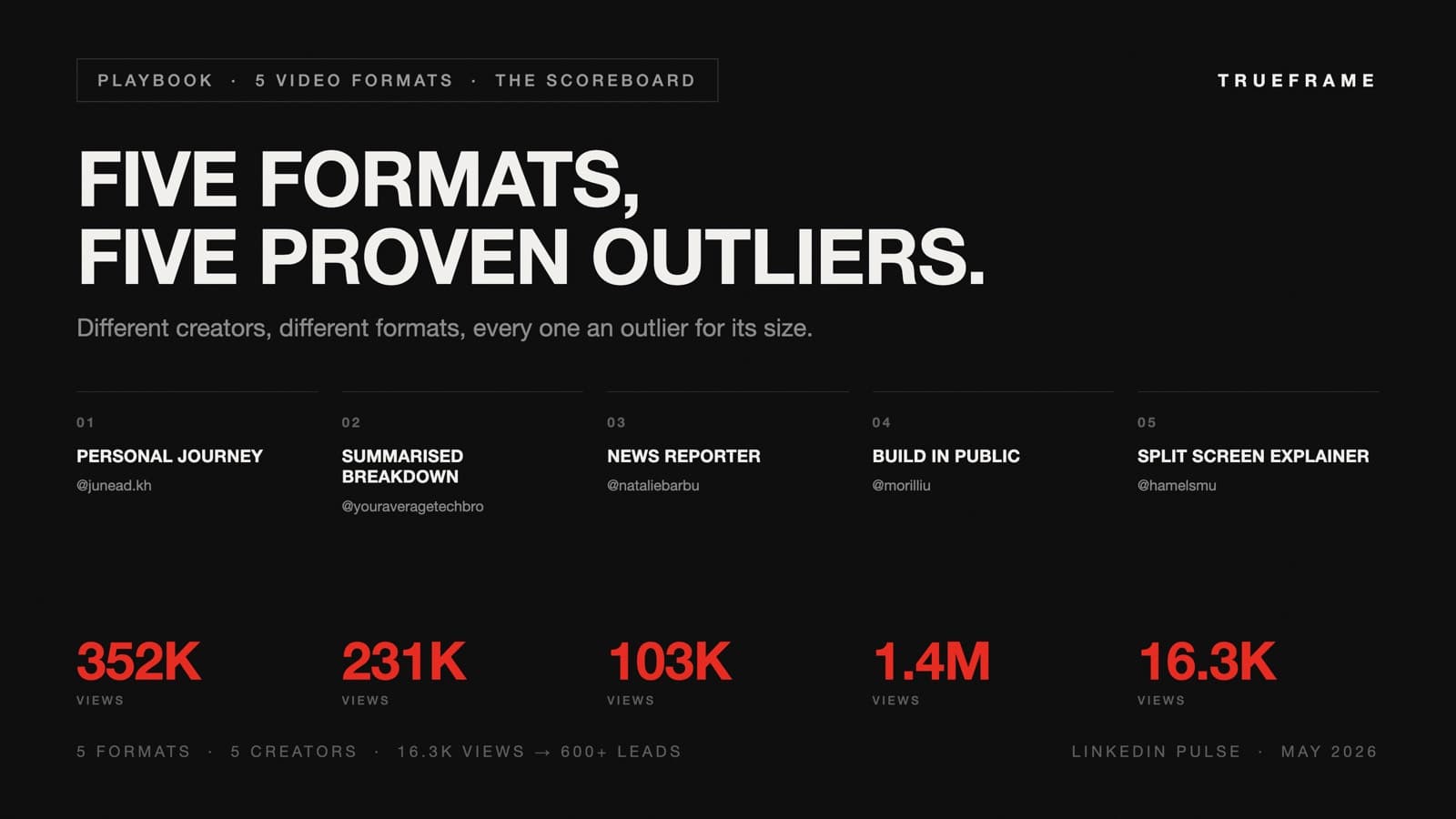
The one closest to material you already have. If your origin story has a real burned-the-boats moment, start with the personal journey. If you're mid-build on something, build in public is sitting right there. If your space just had a big event or a big failure, that's a summarised breakdown or a news reporter video waiting to happen.
Don't overthink the choice. Any of the five beats posting nothing. Pick one, script it today, record it this week.
The short version
- Personal journey: open with a specific number and an irreversible decision, then show where it happened.
- Summarised breakdown: consume the noise in your space so your audience doesn't have to.
- Green screen news reporter: turn a high-profile failure into a story arc with a takeaway.
- Build in public: film a real build sprint inside a real constraint window.
- Split screen explainer: fix one specific limitation, then close with a comment trigger.
- Pick one format, script it today, record it this week.
Use the examples to make a more deliberate first test. Adapt the hook and structure to a real buyer problem, then judge the result by the attention and qualified response it earns for your business.
Choose a format with a clear job, plug in a real story or technical lesson, then test it with your audience this week.
Want to see one of these formats built for you before you commit to anything? Apply and we'll make you a custom video, free, so you can judge the work first.
Apply nowKeep reading
Want this built for you?
We build and run the whole content engine for tech founders. Formats, scripts, editing, posting, tracking. You record in one short session a month, and we turn these five formats into a system that runs without eating your week.
See how it worksSkip the reading. Talk it through instead.
Book a fit call and we'll map out what a content engine looks like for your business. No pitch, no pressure.
Don't miss the next one
Some of what we share is time-sensitive. A format that's working right now, a window that closes fast. We email those the moment they're worth jumping on. Drop your email so you catch them in time.
No spam. Unsubscribe anytime.
Frequently asked questions
Which video format should a tech founder start with?
Do these formats work if I have a small following?
Do I need a big production setup to film these?
How do these video formats actually turn into leads?
Founded & led by
Benjamin Chua (BenChuchu)
Founder and CEO of Trueframe. 9 years building businesses (started at 16), tens of millions of views generated, and 8 figures in revenue created for the founders and brands he works with. He builds the content systems Trueframe runs.