How a Niche B2B SaaS Got a 4-Week Ad System It Could Run Itself
A UK software founder sold to a small, skeptical market that hates being sold to. Here's the 4-week video ad system we built around that, then handed over so his team could keep running it without us.

Written by Benjamin Chua, founder of Trueframe.
This founder sold software to a few thousand people who hate being sold to. That was the whole problem.
He runs a UK SaaS company that builds software for heat-pump installers. Around £1M in ARR, with a target of £4M by the end of 2026. The catch is the market. There are only about 3,000 to 4,000 installers in the entire UK, mostly older men running family businesses, not especially tech-savvy, and allergic to a hard pitch. Get the tone wrong and you don't just lose a sale. You burn trust in a market small enough that word travels.
He'd been using a cheap freelancer and wanted two things that rarely come together: real strategic guidance and execution that actually looked good. So we built him a 4-week Ad System Sprint, designed around exactly how suspicious this audience is, then handed the whole thing over so his team could keep running it after we left.
A market of 3,000 to 4,000 installers who hate a hard sell. The ads had to earn trust, not pitch.
Here's what the situation demanded, what we built in four weeks, and why the real win was the system he kept.
The situation: a small market that hates being sold to
Most B2B ad playbooks assume a big addressable market and a buyer who expects to be marketed to. Neither was true here. The total market is a few thousand installers, and they're the kind of buyer who tunes out the second something feels like an ad. A polished corporate spot would have been the fastest way to get ignored.
The freelancer route had given him cheap output and no strategy. Nobody was asking who each ad was for, what stage of the decision it spoke to, or why an installer should believe a word of it. For a founder trying to go from £1M to £4M in ARR, that gap matters. You can't quadruple revenue in a tiny market on ads that the market quietly scrolls past.
So the brief wasn't make more ads. It was build ads this specific audience would actually trust, in enough variety to test properly, and leave behind a way to keep making them.
What we built
We ran a focused 4-week Ad System Sprint. Not a one-off batch of clips, a system the founder's team could keep using once we were done. Six parts.
- We produced 8 to 10 distinct ad concepts with 3 to 4 variations each, which came to 30 to 40 finished video exports ready for Meta. Enough range to test angles properly, not just a single ad nobody could learn from.
- We mapped every ad to an awareness level: problem-aware, solution-aware, product-aware, and proof or retargeting. The right message reaches the installer at the right stage instead of pitching a product to someone who doesn't yet know they have the problem.
- We led with testimonial ads featuring real installers, because this audience trusts its own kind far more than a slick pitch. An installer hearing from another installer lands where a brand voice never would.
- We standardized UK English across every piece of on-screen text. A small detail that signals you know this market and aren't a generic vendor copying American ads at them.
- We ran a strategy call every Friday, so the work stayed pointed at the founder's actual goal instead of drifting into output for its own sake.
- We handed over a Notion briefing system so the team could keep producing on their own after the sprint ended. They left owning the engine, not renting it from us.
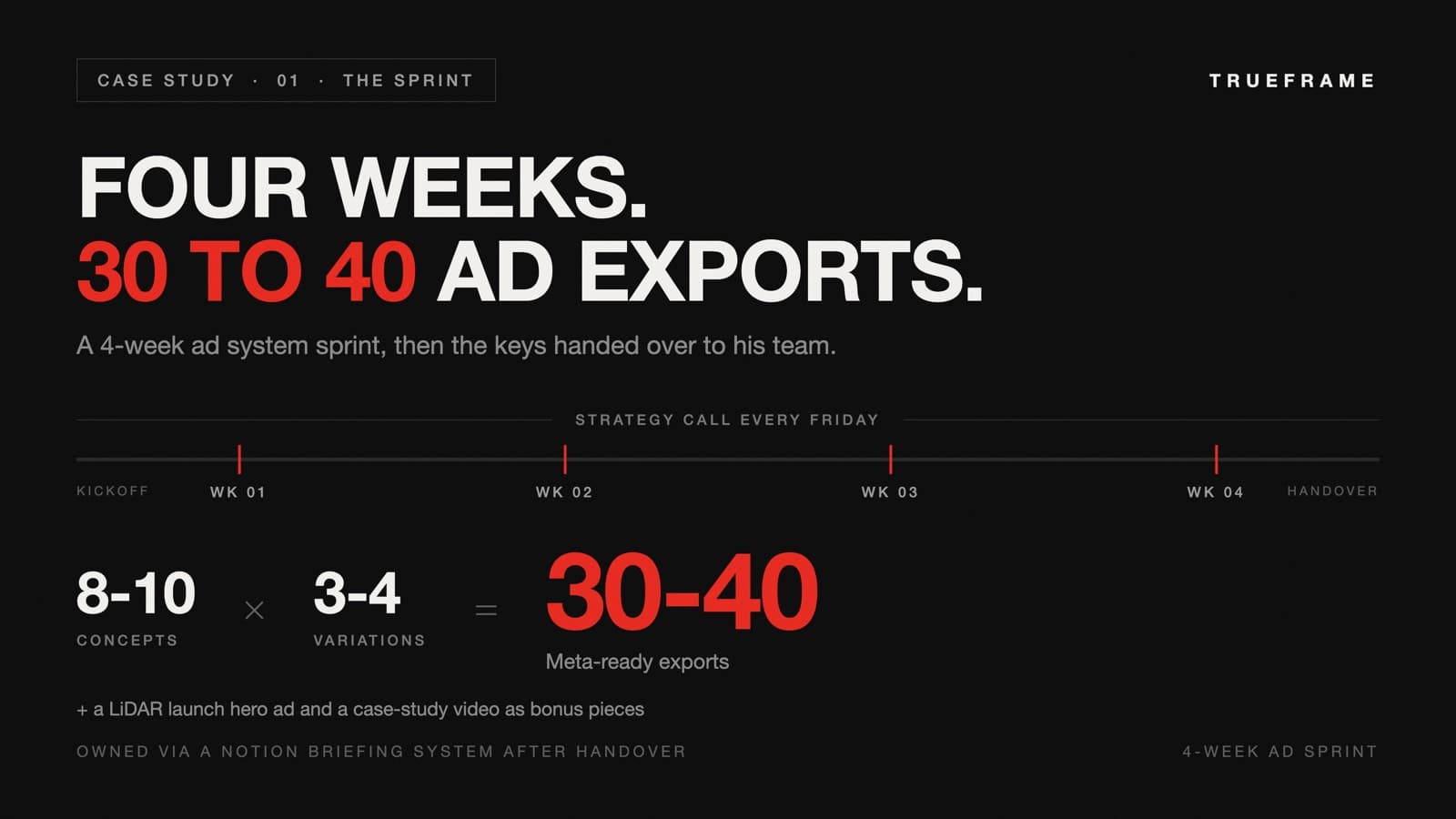
Two bonus pieces came out of the four weeks as well. A LiDAR launch hero ad for a new feature, and a case-study video. Both built to the same standard as the core library.
See what an ad built for your exact buyer looks like. We'll make you one, free, so you can judge the work before anything else.
Apply now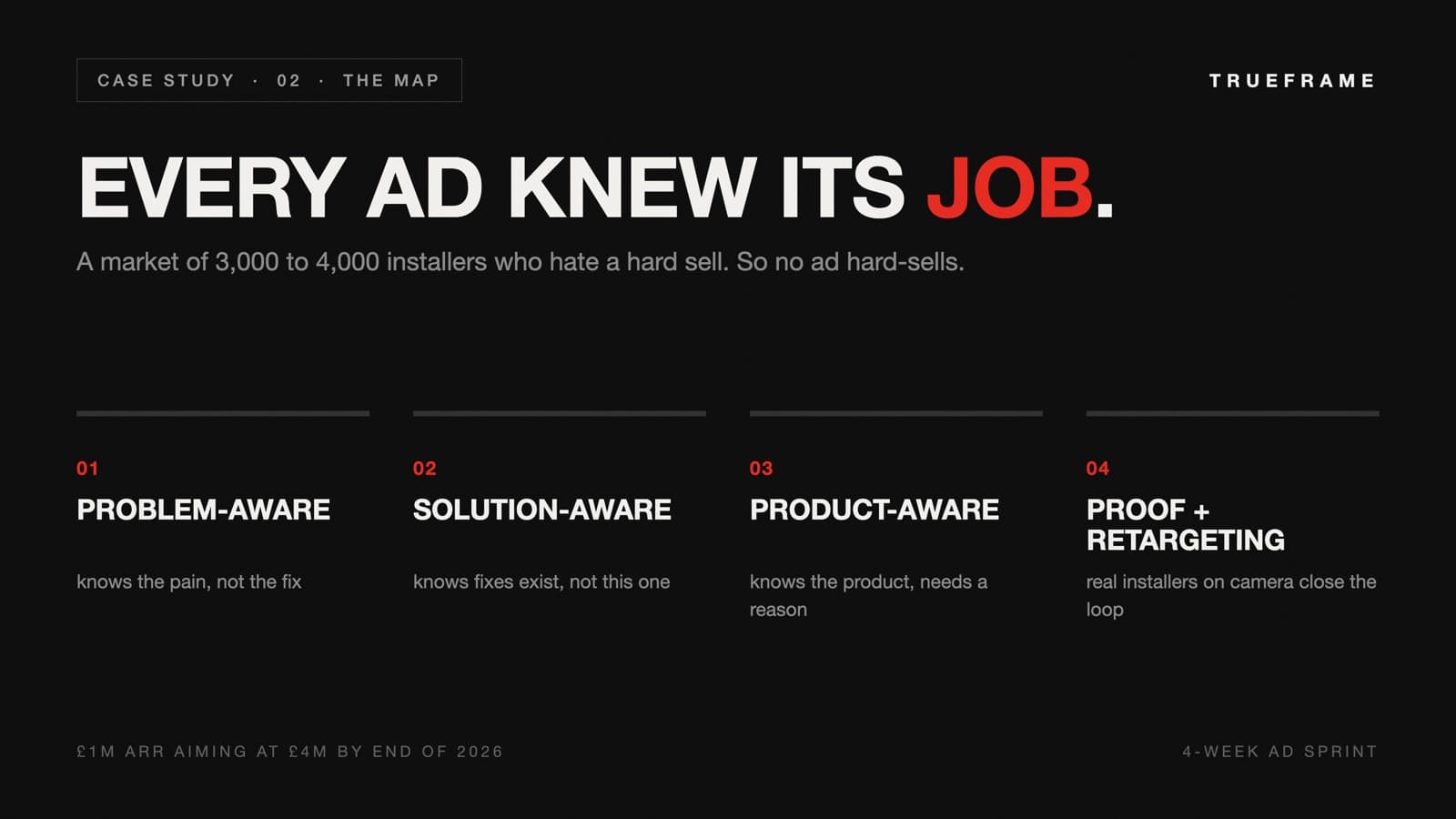
The results
Every deliverable shipped on time, and the founder was happy with the quality. The part that mattered most came after the sprint. The Notion handover worked, so his team is now self-sufficient for continued ad production. They don't need us in the room to brief, build, and ship the next batch.
A complete 4-week ad system the client now runs without us, built for a market that hates a hard sell.
The engagement included a US$2,000 guarantee. It applied if no new paying customer had a tracked paid-ad touchpoint using Trueframe creative within 21 days after the sprint. The conditions included at least £6,000 in paid media, timely cooperation and working CRM attribution. The guarantee was not a full project refund and was not tied to cost per result.
The short version
- The client is a UK SaaS founder selling to 3,000 to 4,000 heat-pump installers, a small market that hates being hard-sold.
- We built a 4-week Ad System Sprint: 8 to 10 concepts with 3 to 4 variations each, totaling 30 to 40 Meta exports, plus a LiDAR launch hero ad and a case-study video.
- Every ad was mapped to an awareness level, led with testimonial ads from real installers, and standardized to UK English, with a strategy call every Friday.
- We handed over a Notion briefing system, so the team produces on their own now instead of depending on us.
- Every deliverable shipped on time and the founder was happy with the quality.
- The sprint carried a US$2,000, 21-day customer-linked guarantee with a £6,000 minimum paid-media condition. It was not triggered.
The point of this one wasn't a viral ad. It was matching the creative to how guarded these installers are, then leaving the founder a system his own team runs toward that £4M target without us.
Build the ads a skeptical installer actually trusts, map them to the buyer's stage, then hand over the system so the team keeps going.
Want an ad system you own?
We build the whole thing in a focused sprint: concepts, variations, awareness-level mapping, and the creative your skeptical buyer actually trusts. Then we hand it over so your team keeps running it.
See how it worksKeep reading
Skip the reading. Talk it through instead.
Book a fit call and we'll map out what a content engine looks like for your business. No pitch, no pressure.
Don't miss the next one
Some of what we share is time-sensitive. A format that's working right now, a window that closes fast. We email those the moment they're worth jumping on. Drop your email so you catch them in time.
No spam. Unsubscribe anytime.
Frequently asked questions
How do you sell to a market that hates being sold to?
What does a 4-week ad sprint actually deliver?
Why hand over a system instead of keeping the client dependent?
Why map ads to awareness levels?
Founded & led by
Benjamin Chua (BenChuchu)
Founder and CEO of Trueframe. 9 years building businesses (started at 16), tens of millions of views generated, and 8 figures in revenue created for the founders and brands he works with. He builds the content systems Trueframe runs.