Should You Hire a Content Agency or Build It In-House?
Hiring an editor in-house looks cheaper on paper. Here's the honest cost of building a content team yourself versus a done-for-you agency, and how to actually decide.

Written by Benjamin Chua, founder of Trueframe.
You need more content. So you're deciding between hiring someone in-house and handing it to an agency. The in-house route looks cheaper. It usually isn't.
Here's the trap. You compare an editor's salary to an agency's monthly fee, the salary wins, and you hire. Six months later the content is inconsistent, you're reviewing every draft, and the person you hired can edit but can't decide what to make or write the script. The number you compared was never the real cost.
This is an honest breakdown of both, including when in-house genuinely wins. The goal is to help you make the right call, not to talk you into one answer.
| Option | Visible cost | You still own | Usually wins when |
|---|---|---|---|
| Freelance editor | $15-$150+/hour | Strategy, script, footage, posting and performance | Your brief and production process already work |
| Full-service agency | $2,000-$10,000+/month | Founder expertise, approvals and sales follow-up | You need the whole system without new management |
| One in-house editor | $75,420 U.S. median wage before extras | Strategy, writing, production, distribution and management | You have daily volume and internal owners for the gaps |
| Full in-house function | Several salaries plus tools and equipment | Hiring, leadership, quality control and continuity | Content is a department, not one channel |
We've built content engines for more than 40 founders and brands. The pattern is consistent. The salary is easy to see. The founder's time, the missing roles and the cost of a quiet channel during hiring are the parts that get discovered later.
The real cost of in-house isn't the salary. It's your hours and the management tax nobody puts in the spreadsheet.
Let's break it down properly, in five parts.
1. The true cost of in-house is more than the salary
An editor's salary is the line you can see. It's not the bill. To run content as a channel you need someone deciding what to make, someone writing it, someone editing, someone packaging and posting it for each platform, and someone tracking whether any of it worked. That's four or five jobs, and a single editor does one of them.
So one of two things happens. You hire more people to cover the gaps, and your cheap in-house option is now a small team with real payroll. Or you hire one editor and quietly absorb the other four jobs yourself. Most founders do the second one without noticing, then wonder why content keeps stealing their week.
Add the parts that never make the spreadsheet. The weeks of ramp before a new hire is producing anything good. The drafts you send back. The day the role doesn't work out and you start the search again. Each of those is a cost, and none of them showed up in the salary you compared.
2. The management tax is the cost founders underestimate most
An in-house hire is not a thing you buy once. It's a person you manage every week. You write the brief, review the cut, give feedback, unblock them when they're stuck, and keep them pointed at the right work. That's the management tax, and founders almost never price it in.
Here's why it matters more than the money. Those hours come out of the work only you can do. Selling, building the product, talking to customers. A two-hour review loop on a video isn't free even if the salary is already paid, because you spent it being a content manager instead of a founder. The cheaper the hire looked, the more of your own time it tends to demand to make it work.
The honest version of in-house is this. You're not just paying for an editor. You're adding a direct report and a recurring slice of your calendar. For some founders that's fine. For most, it's the exact thing they were trying to avoid.
3. The single point of failure: what happens when they quit
One in-house editor means one person holds the whole thing. They know your style, your accounts, your backlog, your file system. When they take a holiday, output stalls. When they quit, it stops, and the knowledge walks out with them.
Now you're hiring again, training again, and rebuilding the context from scratch, while your channel goes quiet for two or three months. Content compounds only if it keeps running, so a gap like that doesn't just pause the results. It resets the curve you'd spent a year climbing.
A team built as a system doesn't have that fragility. The strategy, the process, and the standards live in the system, not in one person's head. One editor being out doesn't take the whole engine down with them.
See what content built to land clients looks like. We'll make you one, free, so you can judge the work before anything else.
Apply now4. What done-for-you actually takes off your plate
The honest case for an agency isn't that it's cheaper than a single salary. Sometimes it isn't. It's that you're not buying an editor. You're buying the whole function, already assembled and already running.
That means strategy, scripting, editing, packaging, posting, and tracking, handled by people who do only this. No hiring. No training. No managing. No single point of failure. Our clients save 20+ hours a week on content production once the system is running, and the founder's part shrinks to about 90 minutes a month of recording. You stay the source of the thinking. You never touch the production line.
Compare the two honestly. In-house, you add headcount and a standing chunk of your week to manage it. Done-for-you, you record for an hour and a half a month and review the output. The first is a department you run. The second is a result that shows up without you running anything.
The exact opening lines we use to make the right buyer stop scrolling. Useful whether your content is built in-house or done for you.
Get the hooks free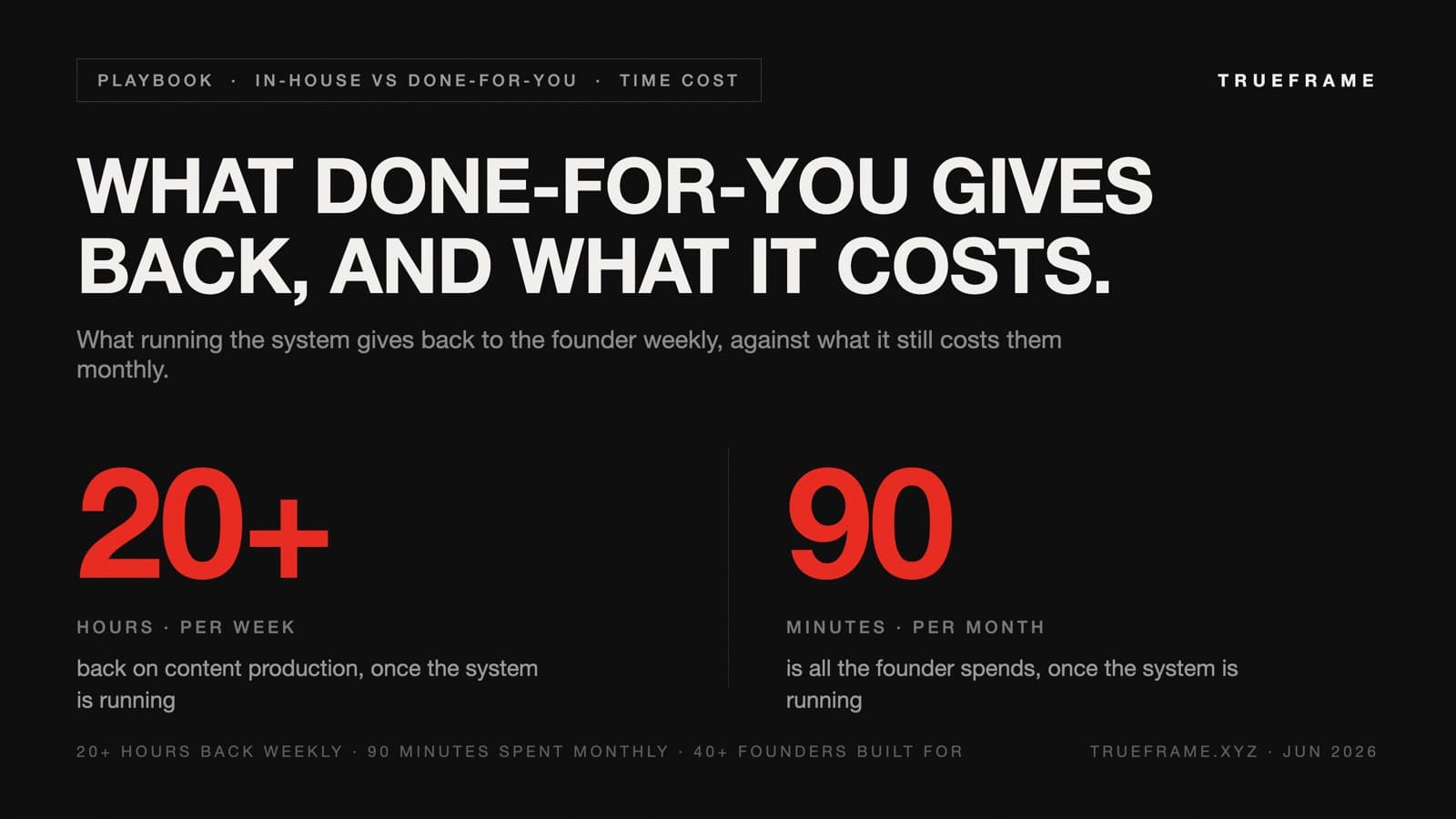
Want to see what done-for-you actually removes from your plate?
We build and run the whole content engine, from strategy to scripting to editing to tracking. You record in one short session a month, and we handle everything after that.
See how the done-for-you system works5. When in-house actually wins, and how to judge an agency
In-house is the right call in two cases. The first is volume. If you're shipping content all day, every day, enough to keep a full team busy, you'll eventually justify owning the function outright. The second is a very particular brand, where you want someone living inside it full-time and the founder cares about every frame. If that's you, build the team and build it properly, with all the roles, not just an editor.
For most founders, neither is true. You need consistent, high-quality content that drives the business, without running a content department to get it. That's the case where done-for-you wins, because the thing you're short on is your own time, and that's exactly what it gives back.
If you do go the agency route, judge it on two questions. Do they track pipeline, or just send you view counts? An agency that can't tell you which content drove a booked call is selling you activity. And do they own the whole system, so you're not back to stitching freelancers together? If they only edit, you haven't solved the problem. You've just moved the editing.
As someone who runs an agency myself, I don't say this lightly: Ben is one of the best in the business. He's constantly at the cutting edge of what's new and he's always FAST to implement those changes. That combination of staying ahead of the curve while consistently producing beautiful work for his clients is rare.
Vitor A., agency owner
That's from someone who runs an agency himself, which is the point. The bar for handing this off isn't whether someone can edit. It's whether they own the whole thing well enough that you can stop thinking about it.
The short version
- The salary is the small cost of in-house. Your time and the management hours are the big ones.
- An editor is one role. Running content needs strategy, writing, editing, posting, and tracking too.
- One in-house editor is a single point of failure. When they quit, the channel goes quiet for months.
- Done-for-you buys the whole function, not a hire. Founders show up about 90 minutes a month.
- In-house wins on huge volume or a very particular brand. For most founders, it's more cost and management than it's worth.
- Judge an agency on two things: do they track pipeline, and do they own the whole system.
The in-house number looks smaller because it leaves out the most expensive thing you own, which is your time. Build the team if your volume or your brand truly demands it. Otherwise the founders who win are the ones who buy back their week instead of spending it managing a content department.
Don't compare a salary to a fee. Compare what each one costs you in hours, in management, and in the work you stop doing to keep it running.
Keep reading
Want this built for you instead of built in-house?
We run the whole content engine for founders, from strategy to scripting to editing to tracking. You record in one short session a month, and we hand you back the 20+ hours a week that running it yourself would cost.
See how it worksSources and review date
Primary sources, first-party data and review dates are listed below. Client-reported results and Trueframe analysis are labelled in the article.
- Film and Video Editors and Camera Operators · U.S. Bureau of Labor StatisticsReviewed 20 August 2026
- How Much Does Hiring a Video Editor Cost? · UpworkReviewed 20 August 2026
- Video Production Pricing Guide 2026 · ClutchReviewed 20 August 2026
Skip the reading. Talk it through instead.
Book a fit call and we'll map out what a content engine looks like for your business. No pitch, no pressure.
Don't miss the next one
Some of what we share is time-sensitive. A format that's working right now, a window that closes fast. We email those the moment they're worth jumping on. Drop your email so you catch them in time.
No spam. Unsubscribe anytime.
Frequently asked questions
Is it cheaper to hire an in-house editor or a content agency?
What roles do I actually need to run content in-house?
How much of my time does an agency save versus doing it in-house?
When does building content in-house actually make sense?
What should I look for when choosing a content agency?
Founded & led by
Benjamin Chua (BenChuchu)
Founder and CEO of Trueframe. 9 years building businesses (started at 16), tens of millions of views generated, and 8 figures in revenue created for the founders and brands he works with. He builds the content systems Trueframe runs.