Content Marketing for SaaS Founders: The Pipeline Playbook
SaaS doesn't fail at content because the videos are bad. It fails because the content isn't pointed at a buying committee, a long sales cycle, or a pipeline number. Here's the strategy that fixes that.

Written by Benjamin Chua, founder of Trueframe.
On this page
- 1. Run demand generation and demand capture as two different jobs
- 2. Create for the whole buying committee, not one viewer
- 3. Use content to do the selling before the demo ever happens
- 4. Make founder-led content your cheapest distribution
- 5. Map every piece to the funnel, from problem-aware to product-aware
- 6. Measure content as pipeline, not as traffic
Most SaaS content marketing fails for a boring reason. The content is fine. The strategy underneath it was built for a blog, not a sales cycle.
You hired someone to post. You got articles and clips and a calendar that fills itself. Traffic ticks up. And the number that actually matters, qualified demos booked, doesn't move. So the assumption sets in that content is a brand thing, a nice-to-have, something you do once the real growth channels are tapped out.
That assumption is expensive. For a B2B SaaS, content is the cheapest distribution you will ever own, and the founder's voice is the part competitors can't buy. The problem was never the videos. It was that nobody pointed them at how a SaaS deal actually gets won.
We've built content engines for more than 40 founders and brands, and generated over 17M views across that work. One B2B founder we produce for has tracked six figures in qualified pipeline back to specific content, every lead pointing to a piece of content as the reason they trusted him enough to reach out. The strategy below is what makes that happen, and it has almost nothing to do with how the videos get edited.
SaaS content isn't a traffic channel. It's a pipeline channel that happens to look like a blog.
Here's the playbook. Six strategic moves that turn content from a brand expense into a measurable source of SaaS pipeline.
1. Run demand generation and demand capture as two different jobs
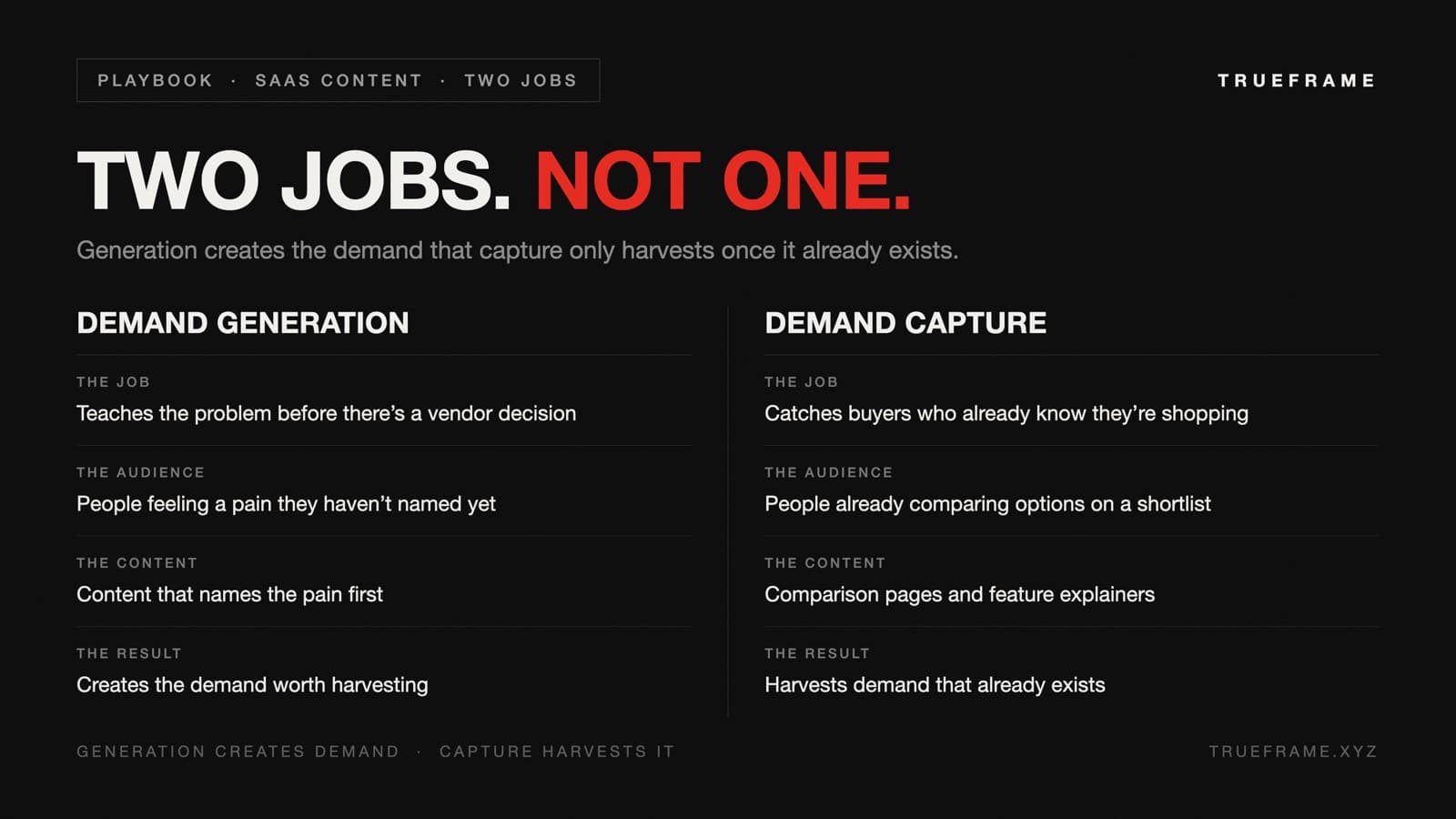
Most SaaS content lives entirely in demand capture. Comparison pages, feature explainers, the stuff that catches people who already know they're shopping for a tool like yours. That's real, but it's a small pool, and you're fighting every competitor in it on the same keywords at the same time.
Demand generation is the bigger game and the one founders skip. It's teaching the problem to people who don't yet know they're going to make a vendor decision in six months. They aren't searching for your category. They're feeling a pain they haven't named. Content that names it for them is how you get into the consideration set before there's a shortlist to be on.
The objection here is usually that demand gen can't be attributed, so it feels like a waste. It can be attributed, you just measure it later, when a buyer books a call and tells you the video they watched three months ago is the reason they trusted you. Capture harvests demand that already exists. Generation creates the demand worth harvesting. A SaaS that only does capture is splitting a pie it never helped grow.
2. Create for the whole buying committee, not one viewer
A B2B SaaS deal almost never runs through one person. There's a champion who found you and wants you in. There's an economic buyer who controls the budget and cares about outcomes, not features. And there's a technical evaluator who can quietly kill the deal if the product doesn't hold up under real scrutiny.
Content that speaks to only one of them stalls the moment it reaches the others. A clip that wins over a champion does nothing for the CFO who needs to see ROI. A deep technical teardown that satisfies the evaluator goes over the head of the buyer who signs. Strategy means deliberately producing for all three, so when your champion forwards your stuff internally, every person in the room finds the thing that answers their specific doubt.
This is also why the founder is the right voice. The founder can speak to the technical reality and the business outcome in the same breath, because they live in both. A marketing hire usually can't, and the buying committee can tell.
See what content built to land clients looks like. We'll make you one, free, so you can judge the work before anything else.
Apply now3. Use content to do the selling before the demo ever happens
A long B2B sales cycle is mostly dead time. The buyer is building internal confidence, comparing options, and quietly selling your product to people you'll never get on a call. You can't compress that with more follow-up emails. You compress it by doing the convincing in advance, in public, where the whole committee can watch on their own time.
When a buyer books a demo having already watched you explain the problem, walk through the tradeoffs, and handle the objection they were about to raise, the call changes. You're not starting from scratch and earning trust in 30 minutes. You're confirming a decision they've mostly already made. The deals that close fastest are the ones where the prospect showed up warm because your content did the warming.
This is the whole reason content beats outbound for SaaS over time. Outbound interrupts a stranger and tries to build trust from zero in one cold message. Content builds that trust at scale, asynchronously, while you sleep, so the demo is the finish line instead of the starting line.
4. Make founder-led content your cheapest distribution
Every other channel a SaaS uses gets more expensive as you scale. Paid acquisition costs climb. Outbound needs more reps. Affiliates take a cut forever. Founder-led content is the one channel where the marginal cost of reaching the next thousand right-fit buyers is close to nothing once the engine is running.
And it's an asset that compounds instead of a budget that resets. A paid campaign stops the day you stop funding it. A library of content that explains your buyer's problem keeps pulling in qualified people for years, gets cited by AI search tools when buyers ask them questions, and earns trust on autopilot. You're not renting attention every month. You're building something that keeps paying out.
The founders who get this treat content as the foundation other channels stand on, not the thing they'll get to later. The warm pipeline content generates makes every paid dollar and every sales rep more efficient, because they're working leads who already know you.
The exact opening lines we use to make the right SaaS buyer stop scrolling instead of dismissing one more founder post. Swipe them for your own content.
Get the hooks freeThis is the part most SaaS founders never build
We do the strategy, scripting, and editing so your content speaks to the whole buying committee and warms leads before the demo, all built on the technical depth only you have. You record, and we run the rest.
See how the done-for-you system works5. Map every piece to the funnel, from problem-aware to product-aware
A buyer doesn't go from never having heard of you to booking a demo in one video. They move through stages. Problem-aware, where they feel the pain but haven't named it. Solution-aware, where they know a category of tools exists. Product-aware, where they're comparing specific options and you're one of them.
Most SaaS content piles up at the product-aware end, comparison content and feature demos, and starves the top. So there's nobody in the funnel to capture, because no one did the work of pulling problem-aware strangers in. The fix is a deliberate spread. Content that names the problem for people who haven't, content that frames how to think about the category, and content that makes the case for you specifically once they're choosing.
When the funnel is mapped, every piece has a clear job and a place. You stop publishing random posts and start moving a defined buyer one stage closer to a decision. That's the difference between a content calendar and a content engine.
6. Measure content as pipeline, not as traffic
Traffic is the metric that makes content easy to cancel. It looks busy and means nothing in a board meeting. The scoreboard that keeps content funded is sourced and influenced pipeline, the same language you use for every other growth channel.
Tag every call to action so a booked demo traces back to the exact piece of content that drove it. Ask every new opportunity what they read or watched before they reached out, and log it. Once content shows up in the pipeline report sitting next to paid and outbound, the conversation changes. It stops being a brand cost you justify and becomes a channel you defend and scale on purpose.
Ben is fantastic to work with. Very knowledgeable about content strategy and business strategy as whole. Him and his team run super clean from start to finish. Supportive and work was clean and sent on time.
James D., founder
This is the line between content as a guess and content as a system. A guess is a calendar you hope is doing something for the business. A system is a measured channel that brings qualified buyers to the demo already warm, every month, on a strategy you can point to.
The short version
- Run demand generation and demand capture as two separate jobs.
- Create for the whole buying committee, the champion, the budget holder, and the technical evaluator.
- Use content to do the selling before the demo, so the call confirms a decision instead of starting one.
- Make founder-led content your cheapest, compounding distribution channel.
- Map every piece to the funnel, from problem-aware to product-aware.
- Measure content as sourced pipeline, not as traffic.
SaaS content marketing isn't about publishing more. It's about pointing the content you publish at how the deal actually gets won, the committee that has to agree, the cycle you want to shorten, and the pipeline number you have to hit. Do that and content stops being the thing you'll get to later and becomes the cheapest growth channel you own.
A competitor can copy your features. They can't copy a founder teaching the problem to the exact buyers who'll pay to solve it.
Keep reading
- Choose a personal branding agency for your business
- Compare a content intensive with a monthly retainer
- Turn your SaaS strategy into a 90-day video plan
- Choose five video formats for your tech founder content
- How to write a VSL script (the 5-part structure)
- How Adam Robinson bootstrapped RB2B to $5M ARR with a LinkedIn account
- What content marketing actually looks like when it drives revenue
- How to make founder content that drives pipeline, not just views
- How tech founders build a personal brand without becoming an influencer
- Done-for-you video content for SaaS founders
Want this built for you?
We build and run the whole content engine for SaaS founders, from strategy to scripting to editing to tracking. You record in one short session a month, and we turn your expertise into pipeline you can see in the report.
See how it worksSkip the reading. Talk it through instead.
Book a fit call and we'll map out what a content engine looks like for your business. No pitch, no pressure.
Don't miss the next one
Some of what we share is time-sensitive. A format that's working right now, a window that closes fast. We email those the moment they're worth jumping on. Drop your email so you catch them in time.
No spam. Unsubscribe anytime.
Frequently asked questions
What is content marketing for a SaaS company, really?
Should the SaaS founder be the face, or should marketing run it?
How does content shorten a B2B sales cycle?
Who am I actually creating content for in a SaaS deal?
How do I measure SaaS content as pipeline instead of traffic?
Founded & led by
Benjamin Chua (BenChuchu)
Founder and CEO of Trueframe. 9 years building businesses (started at 16), tens of millions of views generated, and 8 figures in revenue created for the founders and brands he works with. He builds the content systems Trueframe runs.