What Content Marketing Actually Looks Like When It Drives Revenue
The standard content marketing playbook builds an audience and hopes revenue follows. After building content engines for 40+ founders and brands, we run it the other way: start from the sale and work backwards. This is the full system.

Written by Benjamin Chua, founder of Trueframe.
Google "content marketing" and you'll get the same advice on every result: post consistently, provide value, grow an audience. Thousands of founders follow it. The follower count climbs, the brand looks alive, and revenue doesn't move an inch.
That's because most content marketing is built to win the wrong game. It's designed by marketers who get paid for reach, judged by dashboards full of impressions, and defended in meetings with the word "awareness". Nobody in that loop is accountable for a sale.
I run Trueframe, a done-for-you video content agency. Over the last 4 years we've built content engines for 40+ founders and brands. The content has pulled 17M+ views, and the businesses behind those engines have generated 8 figures in revenue, including a single $2.1M launch day. The engines that print money and the channels that print likes are built differently from day one.
Content marketing drives revenue when every piece has a job inside a pipeline. If you can't say what job a post is doing, it's decoration.
The two scoreboards
There are two ways to keep score in content. The audience scoreboard counts views, followers and likes. The revenue scoreboard counts qualified conversations, booked calls and closed deals. Both are real games. The problem is that almost everyone plays the first one while telling themselves it leads to the second.
Sometimes it does. Build a big enough audience and money shows up eventually. But "eventually" can mean years, and most founders don't have years. They have a payroll. The good news is you can play the revenue game directly, with a much smaller audience than you think. We've watched clients book six figures of pipeline with a few hundred followers, because every one of those followers was a potential buyer.
Here's the whole system, the same one we install for clients. Five parts, in order.
1. Start with the person who writes the check
Revenue-driven content starts with one specific buyer: the person with the problem you solve, the budget to pay you, and a reason to fix it now. Write down who they are, what they're trying to get done, and the exact questions they ask before they buy. Those questions come from your sales calls, your onboarding calls, and your DMs. You already have them.
Every topic you ever post should pass one filter: would my best-fit buyer save this, send it to a colleague, or bring it up on a call with me? A topic that flatters the algorithm but fails that filter is a topic for someone else's business.
2. Give every piece of content a job
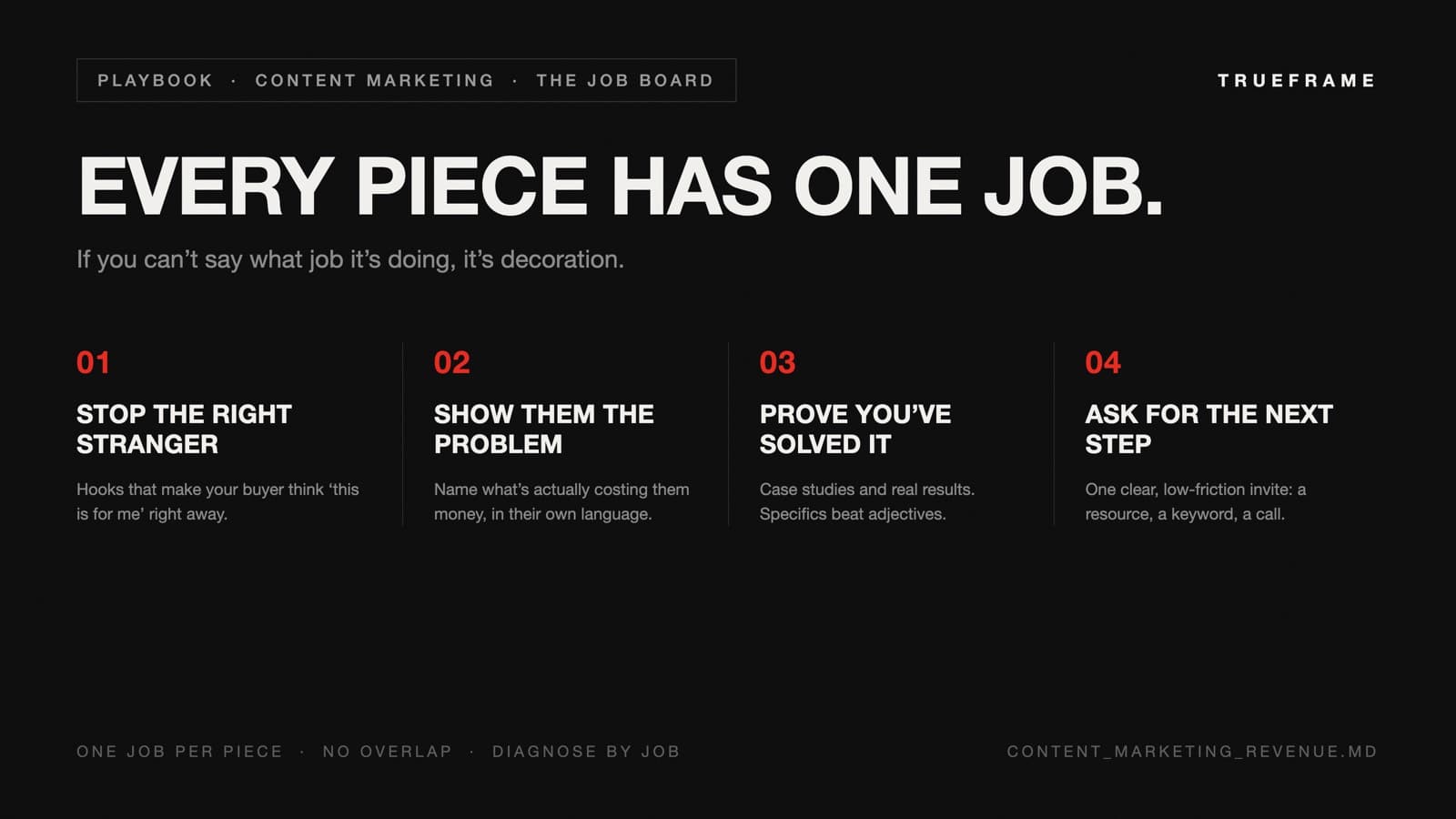
A revenue engine needs four jobs done, and each piece of content should do exactly one of them:
- Stop the right stranger. Hooks and topics that make your buyer think "this is for me" within 2 seconds.
- Show them the problem. Content that names what's actually costing them money, in their language, so they feel understood before they feel sold to.
- Prove you've solved it. Case studies, client results, behind-the-scenes of real work. Specific numbers beat adjectives every time.
- Ask for the next step. A clear, low-friction invite: grab the free resource, reply with a keyword, book a call.
When a piece flops, knowing its job tells you what to fix. A proof piece that nobody watched has a hook problem. A problem piece with great watch time and zero DMs has a CTA problem. Without the job, all you can do is shrug and post again.
3. Build the capture layer before you need it
This is where most content marketing quietly dies. A buyer watches three of your videos, decides you know your stuff, and then has nowhere to go. No lead magnet, no booking link that's easy to find, no reason to hand over an email. They mean to come back. They don't.
The capture layer is boring and it's worth more than any viral hit: a genuinely useful free resource, a DM keyword that triggers a real follow-up, and a booking page that takes under a minute. Build it once and every piece of content you ever publish works harder.
This page is our own capture layer in action. The exact opening lines that stop the scroll, organized so you can pick one and post today.
Get the hooks freeTired of making content that goes nowhere?
Rendered from the shared mid-post template.
See how we build it4. Have the sales conversation inside your content
The most valuable content you can make handles the conversation that happens right before someone buys. The objections, the "how does this actually work", the "what happens after I pay". Put those answers in a video and your leads arrive at the call pre-sold, your sales cycle shortens, and the wrong-fit buyers filter themselves out before they cost you an hour.
For us and several clients, this looks like one well-built VSL or a small set of deep videos sitting between the capture layer and the booking page. One asset, recorded once, selling around the clock.
5. Measure revenue, not reach
Work the numbers backwards from money. Closed deals, then booked calls, then qualified conversations, then the content each one touched first. Ask every single lead how they found you and what they watched or read before reaching out. The answers will surprise you: the quiet post with 200 views books the call while the viral one brings tourists.
Watch saves and DMs from your ideal buyer as leading indicators. A save means "I plan to use this." A DM means the pipeline is working. Follower growth means almost nothing on its own, and treating it as the goal is how you end up with an audience that applauds and never buys.
Pick your lane: the playbook for your business
Everything above is the system. The execution looks different depending on who your buyer is, so we've written the specific playbooks for each type of business we build engines for. Start with yours:
If you run a SaaS or tech company
- Content marketing for SaaS founders: the pipeline playbook
- How to make founder content that drives pipeline, not just views
- How tech founders build a personal brand (without becoming an influencer)
- How B2B founders use YouTube to drive pipeline (not subscribers)
- Why your LinkedIn gets views but no leads (and how to fix the funnel)
- How Alex Hormozi turned free content into a $100M+ machine
If you run a clinic or wellness brand
If you're a coach or creator
Sharpen the craft
Went from posting randomly to a real system that works.
Vincenzo, founder
The short version
- There are two scoreboards: audience and revenue. Pick revenue and play it directly.
- Start from the person who writes the check. Their pre-purchase questions are your content calendar.
- Give every piece one job: stop the buyer, show the problem, prove the result, or ask for the next step.
- Build the capture layer first. A lead magnet, a DM keyword and a fast booking page make every post work harder.
- Put the sales conversation in your content so leads arrive pre-sold.
- Measure backwards from money. Saves and DMs lead, views trail, follower counts mostly lie.
You don't need a big audience to make content marketing pay. You need the right 500 people watching content that was built to sell.
Want to see what revenue-built content looks like for your business specifically? We make a free custom video for a handful of business owners each month.
Apply nowWant this system built for you?
We build and run the whole engine: buyer research, scripts, filming direction, editing, posting, capture layer and the path to booked calls. Your time cost is about 90 minutes a month.
See how it worksSkip the reading. Talk it through instead.
Book a fit call and we'll map out what a content engine looks like for your business. No pitch, no pressure.
Don't miss the next one
Some of what we share is time-sensitive. A format that's working right now, a window that closes fast. We email those the moment they're worth jumping on. Drop your email so you catch them in time.
No spam. Unsubscribe anytime.
Frequently asked questions
What does content marketing that drives revenue look like?
How long does content marketing take to generate revenue?
How do you measure content marketing ROI?
How much content does a founder need to post?
Which platform should a founder start with?
Founded & led by
Benjamin Chua (BenChuchu)
Founder and CEO of Trueframe. 9 years building businesses (started at 16), tens of millions of views generated, and 8 figures in revenue created for the founders and brands he works with. He builds the content systems Trueframe runs.