Why Your Content Gets Views But No Sales (And How to Fix It)
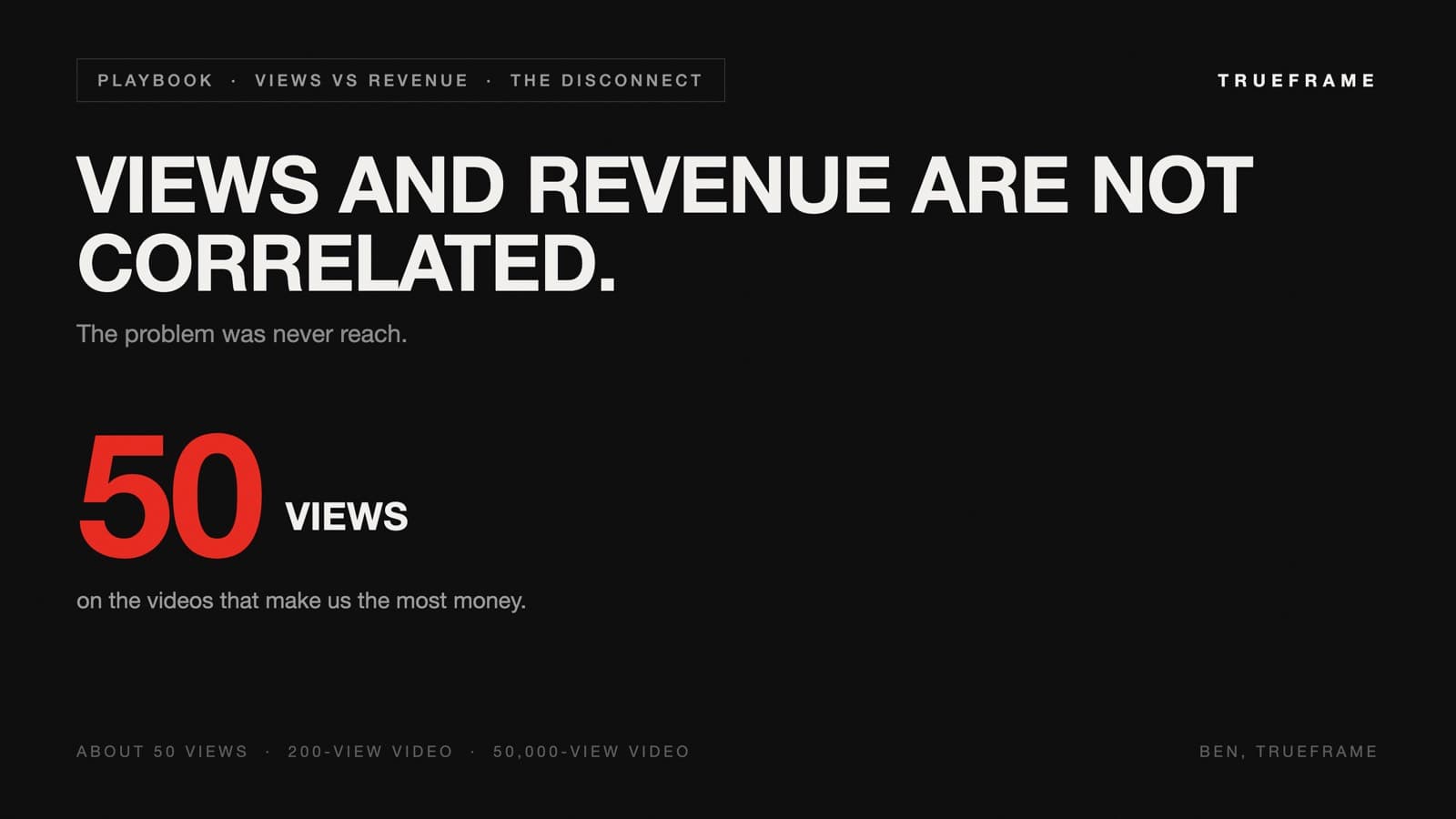
Some of the videos that make us the most money get about 50 views. Views and revenue are not correlated, and once you see why, you stop chasing reach and start building content for the one buyer who actually pays you.

Written by Benjamin Chua, founder of Trueframe.
On this page
- You're playing the media game when you should be playing the business game
- Why the high-view videos don't sell
- 1. Build for one buyer, not the whole timeline
- 2. One video, one action, one reason
- 3. Make content that builds trust, because trust is what converts
- 4. Measure saves, DMs, and booked calls, not views
- The proof: low views, real revenue
- But won't low views mean I'm failing?
You post a video. A few thousand people watch it. Your revenue looks exactly the same on Friday as it did on Monday. So you post another one, and another, and the gap between the view count and the bank account just gets more confusing.
This is the most common thing founders bring us. Content is getting attention. Content is doing nothing for the business. And the usual conclusion is that they need more reach, so they chase a bigger hook, a trending sound, a viral moment, and the deals still don't come.
Here's the uncomfortable part. Views and revenue are not correlated. Some of the videos that make us the most money get about 50 views. The problem was never reach. It's that the content is built for the wrong scoreboard and the wrong person.
Some of my best, the videos that make me the most money, get 50 views. You just need to make the right content for the right person.
Ben, Trueframe
You're playing the media game when you should be playing the business game
There are two completely different games hiding inside the word "content", and most founders play the wrong one without noticing.
The media game is what MrBeast plays. The product is the content itself, and reach is the revenue. More views mean more ad money, so the whole point is to be interesting to the largest possible number of humans. If that's your business model, chase views all day.
The business game is different. Your content is a lead generation tool, a brand building tool, and a trust building tool, all pointed at selling something else on the back end. In that game a video succeeds when one specific buyer watches it and books a call. Reach is a nice side effect, not the goal.
When you judge business-game content with a media-game scoreboard, everything looks broken. The 50,000-view video that brought tourists feels like a win. The 200-view video that booked your best client of the quarter feels like a flop. You end up making more of the wrong thing because the wrong number told you to.
You're not a content creator. You're a business owner who uses content. The metric isn't reach. It's how many of the right people took the next step.
Why the high-view videos don't sell
A video goes wide when it's broadly entertaining, easy to watch, and asks nothing of the viewer. That's exactly the video that doesn't sell. It reaches thousands of people who have no problem you can fix and no budget to pay you, and it never asks the few who do to do anything.
The video that sells does the opposite. It speaks to one buyer so directly that most people scroll past, and the right person feels like you read their mind. Fewer views, far higher intent. That's not a bug in your content. That's content-market-fit working the way it's supposed to.
The posts I make, oftentimes the ones that get the fewest views, get me the sale. There's no correlation. You should be optimizing for saves.
Ben, Trueframe
So the fix isn't to reach more people. It's to build for the exact person who pays you, give them one thing to do, and measure the signals that actually predict a sale. Here's the system.
1. Build for one buyer, not the whole timeline
Content-market-fit is the same idea as product-market-fit. You're not trying to make something everyone likes. You're trying to make something one specific person needs. Write down who that buyer is: their role, their company stage, the problem they were losing sleep over at 11pm last night.
Then make content only that person would love. It reaches fewer people on purpose. The upside is that your other videos start acting as a filter. The people who stick around and follow you are the ones who saw themselves in the specific stuff, and those are the people who buy. Marketing to everyone is how you end up selling to no one.
2. One video, one action, one reason
Founders freeze on content because they think every video has to do everything: teach, entertain, prove authority, and close, all at once. So the video does none of them well. The fix is to give each video exactly one job for the viewer, one small action, then back it with one reason.
One video should get them to do one action. And once you tell them to do that one action, just tell them why they should do it.
Ben, Trueframe
There are only three ways to back up a claim on camera: a stat, a story, or plain logic that walks them from A to B. Pick one per video. The small action, saving the post, replying with a keyword, trying the thing you taught, is what builds a little bit of trust each time, and that trust is what eventually turns into a call.
The exact opening lines we use to make the one right buyer stop scrolling, not the whole timeline. Swipe them for your own content.
Get the hooks free3. Make content that builds trust, because trust is what converts
People don't buy from the account with the most views. They buy from the person they feel like they already know. Someone who has watched five of your videos has spent more time with you than they've spent with most of their real friends this month, and their brain treats it the same way.
That's why the same 200-view video can print money for you and nothing for someone else. You built genuine trust with the exact people who buy. The way you get there is proof, not polish: show real work, real results, the specific process you personally went through. That's the one kind of content nobody can copy, because only you did it.
Tired of making content that gets views and goes nowhere?
Rendered from the shared mid-post template.
See how we build it4. Measure saves, DMs, and booked calls, not views
You get what you measure. Keep views on the dashboard and you'll keep making videos for reach. Swap the scoreboard and the content changes on its own. Track saves and DMs from your ideal buyer as leading indicators. A save means "I plan to use this." A DM means the pipeline is working.
Then work the real numbers backwards from money. Closed deals, booked calls, qualified conversations, and what each person watched first. Ask every lead how they found you. The answers tell you which quiet, low-view videos are actually doing the selling, and you make more of those instead of chasing the next viral hit.
The proof: low views, real revenue
Robert Ta posts B2B reels that rarely go viral. The view counts are modest by influencer standards. Those same reels drive individual enterprise deals worth thousands, some of them five figures. For B2B, even a video that pulls a few hundred views is doing its job if it lands one deal like that.
Hamel Husain is another one. His audience is small next to a mainstream creator, but it's the exact right audience, and it feeds one of the top-rated AI courses on Maven. The subscriber count was never the win. The business behind it is. Low views and real revenue live together all the time once the content is built for the buyer instead of the crowd.
What sets Ben apart is he actually tracks what matters. Not vanity metrics. We went through my entire content funnel together and he pinpointed exactly where leads were dropping off.
Suhaib, founder
But won't low views mean I'm failing?
This is the objection every founder has, and it's worth answering head on. Low views feel like failure because the platforms trained you to read them that way. But a view is not a customer. If your 50-view video books a qualified call and your 50,000-view video books nothing, the 50-view video is the one working.
The trap is comparing your business-game content to media-game numbers and quitting right before it pays off. The founders who win aren't the ones with the biggest audience. They're the ones whose content is built for one buyer, tracked to a booked call, and judged on the only scoreboard that pays the bills.
The short version
- Views and revenue are not correlated. Some of our highest-earning videos get about 50 views.
- You're playing the business game, not the media game. Reach isn't the goal, the right buyer is.
- High-view videos often don't sell because they're built to be interesting to everyone.
- Build content-market-fit for one specific buyer, and let your other videos filter the crowd.
- One video, one action, one reason, backed by a stat, a story, or logic.
- Measure saves, DMs, and booked calls. Views are a leading indicator at best.
You don't need to go viral. You need the right few hundred people watching content built for them.
Keep reading
- Decide whether organic content or paid ads deserves your next investment
- Build a marketing strategy around the problem holding back sales
- How to make founder content that drives pipeline, not just views
- What content marketing actually looks like when it drives revenue
- Why your LinkedIn gets views but no leads
- How B2B founders use YouTube to drive pipeline, not subscribers
- Great hooks aren't written, they're stolen: 10 that did 50M+ views
- Done-for-you video content for founders
Want content built to sell, not just to be watched?
We build and run the whole content engine for founders, from picking the buyer to scripting, editing, and tracking every call to action back to a booked call. You show up for about 90 minutes a month, and we build content-market-fit into every video.
See how it worksSkip the reading. Talk it through instead.
Book a fit call and we'll map out what a content engine looks like for your business. No pitch, no pressure.
Don't miss the next one
Some of what we share is time-sensitive. A format that's working right now, a window that closes fast. We email those the moment they're worth jumping on. Drop your email so you catch them in time.
No spam. Unsubscribe anytime.
Frequently asked questions
Why do my videos get views but no leads?
Should I care about follower count?
Can low-view videos really make money?
How do I measure content that actually drives revenue?
Do I need to go viral to get clients from content?
Founded & led by
Benjamin Chua (BenChuchu)
Founder and CEO of Trueframe. 9 years building businesses (started at 16), tens of millions of views generated, and 8 figures in revenue created for the founders and brands he works with. He builds the content systems Trueframe runs.