How to Build a Founder Website That Books Calls
Most founder websites get built once, get complimented for a week, and never book a single call. Here's the page-by-page system we use instead: one job per page, proof stacked high, and one obvious path to the calendar.

Written by Benjamin Chua, founder of Trueframe.
On this page
You can build a website in a weekend now. A page builder handles the layout, an AI tool writes the copy, and you're live by Friday. None of that gets you a single booked call, because speed was never the part that mattered.
Most founders treat their website as one page wearing five different jobs. The pitch, the case studies, the FAQ, the pricing, and the booking calendar, all stacked on the same homepage, hoping a stranger scrolls all the way down before they leave. Almost nobody does. A visitor decides whether to keep going in the first few seconds, and a page trying to do five jobs at once ends up doing none of them well.
The real fix is more pages, each built around exactly one job. A stranger who found you through a cold ad needs something different from someone who just watched your VSL and is ready to talk. Send both of them to the same page and you're optimizing for neither.
A page that tries to do five jobs at once ends up doing zero of them well.
1. Give every page exactly one job
Before you touch a design tool, map where your traffic actually comes from and what each visitor already knows about you. That map tells you how many pages you need and what each one is for. Most founder funnels need three.
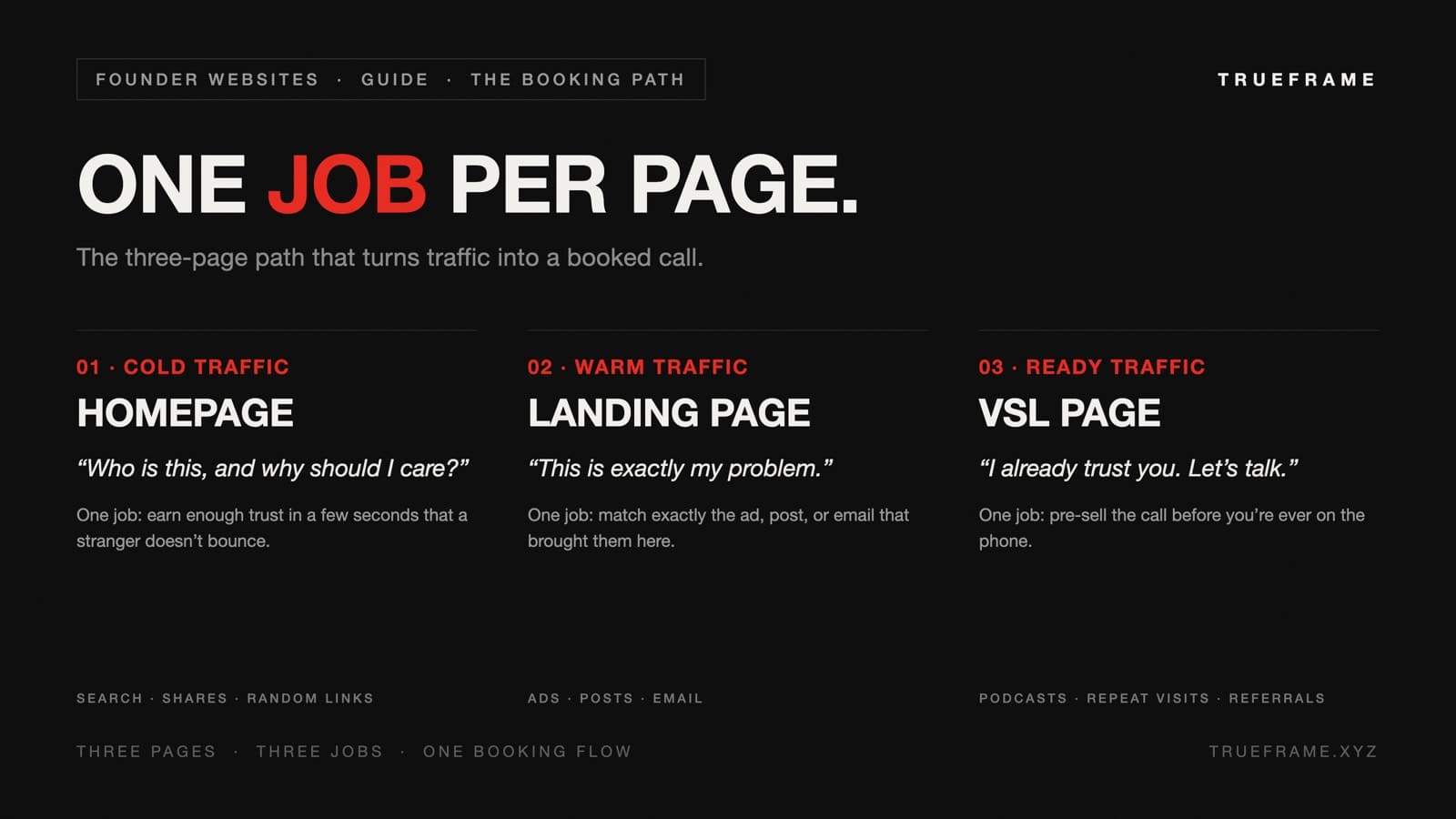
The homepage is for cold traffic, people who've never heard of you and landed through search, a share, or a random link. Its one job is to earn enough trust in a few seconds that they don't bounce. The landing page is for warm traffic tied to a specific offer, an ad, a post, or an email, and its one job is to match exactly what brought them there. The VSL or proof page is for people close to booking, and its one job is to pre-sell the call before you're ever on the phone. Three pages. Three jobs. One booking flow connecting them.
2. Lead with the visitor's pain first
The first thing most founder homepages show is a logo, a tagline, and a hero shot of the founder looking confident. None of that tells a visitor whether the page is relevant to them. The first line above the fold should name the exact problem they already have, in their words, not yours.
The difference shows up fast when you compare them side by side. A generic hero says something like 'Grow your brand with video.' A pain-led hero says 'Your content gets views. Your pipeline still looks the same.' The second one makes a specific visitor feel seen in one sentence. The first one could belong to a thousand different companies.
3. Stack proof high enough that skepticism doesn't win
Every visitor arrives skeptical, because they should. They don't know you yet, and the internet has trained them to expect a page overselling something thin. Proof closes that gap, and it works in layers: aggregate numbers near the top (how many clients, how long you've been doing this), specific case studies with real before-and-after detail in the middle, and third-party testimonials wherever a visitor might still be hesitating.
Skip a layer and skepticism wins by default. A page with numbers but no case studies feels inflated. A page with case studies but no testimonials feels self-reported. Stack all three and the page starts arguing your case for you instead of asking the visitor to take your word for it.
The playbook behind everything on this page: how to turn a website, your content, and your traffic into one funnel instead of three disconnected pieces. Free.
Get the 48 laws free4. Build one obvious path to the booking flow
The path from click to booked call should be short enough that a distracted visitor on their phone can follow it without thinking. That means one call to action, worded the same way, repeated in the nav, in the hero, and at the end of every section, not three different buttons competing for the same click. It means the booking calendar opens fast, without a ten-field intake form standing between the click and the calendar.
We fixed this exact problem for Pantheon Myths, a mythology brand built around a graphic novel. Instagram traffic was arriving with nowhere real to land, just a generic homepage that didn't sell anything. We built a hybrid homepage anchored around a custom 3D book and wired the funnel straight into Shopify, so that traffic finally had one path to a sale instead of bouncing off a page with no next step. A booking flow needs the same single, obvious path.
Most of this is a build problem
We map your traffic sources first, then build the pages in Next.js with real tracking wired into every CTA before launch.
See how the website build works5. Use a VSL to pre-sell the call before you ever talk to them
A VSL, a video sales letter, does the selling before the sales call has to. It states the problem, shows proof, walks through how the offer works, and handles the objections a visitor would otherwise raise on the call. By the time someone books after watching one, they've already said yes in their head. The call becomes a formality instead of a pitch.
This only works on the right page. Put a VSL on the cold-traffic homepage and most visitors won't stick around long enough to watch it. Put it on the page warm, close-to-booking traffic lands on, after an ad, after a podcast mention, after they've read three of your posts, and it does exactly the job it's built for.
6. Track every click so you know what's actually working
Pageviews tell you traffic showed up. They don't tell you whether the page did its job. Tag every call-to-action so a booked call traces back to the exact page, and the exact source, that produced it. Without that, you're redesigning based on guesses. With it, you can see which page is converting and which one is just sitting there looking finished.
I'm very impressed by Benjamin's knowledge and strategy around social media marketing. After a few initial meetings, him and his team have proven themselves to be incredibly savvy, passionate, and resourceful.
Mohsen A., Founder, Pantheon Myths
That's the difference between a website built to be admired and one built to be used. The design still matters. It just isn't the part doing the actual work.
The short version
- Map your traffic first. Most founders need three pages: homepage, landing page, VSL page.
- Give every page exactly one job. A page doing five jobs does none of them well.
- Lead with the visitor's pain before your logo or tagline.
- Stack proof in layers: aggregate numbers, case studies, testimonials.
- One call to action, repeated everywhere, with a calendar that opens fast.
- Track every CTA so you know which page is actually booking calls.
Your website doesn't need to be the best-looking site on the internet. It needs to book the next call.
Keep reading
Want this built for you?
We map your funnel, design and build the site in Next.js, and wire in tracking on every CTA, so the traffic you're already earning turns into calls on your calendar.
See how it worksSkip the reading. Talk it through instead.
Book a fit call and we'll map out what a content engine looks like for your business. No pitch, no pressure.
Don't miss the next one
Some of what we share is time-sensitive. A format that's working right now, a window that closes fast. We email those the moment they're worth jumping on. Drop your email so you catch them in time.
No spam. Unsubscribe anytime.
Frequently asked questions
How many pages does a founder website actually need to book calls?
What should go in the hero section of a founder website?
Do I need a VSL on my website to book calls?
How do I know if my website is actually converting traffic into booked calls?
Should I build my founder website on Squarespace, Webflow, or something custom?
Founded & led by
Benjamin Chua (BenChuchu)
Founder and CEO of Trueframe. 9 years building businesses (started at 16), tens of millions of views generated, and 8 figures in revenue created for the founders and brands he works with. He builds the content systems Trueframe runs.