How to Make UGC Ads That Convert
Most brands have already tried UGC ads. Most of what they made still reads like a commercial with a phone camera. Here's the system we run to ship UGC ads that actually keep converting.

Written by Benjamin Chua, founder of Trueframe.
Every brand running Meta or TikTok ads has already tried UGC. Most of what they made still looks like an ad wearing a UGC costume.
UGC works because it doesn't look produced. A real person, or a well-directed AI avatar, talks straight to camera the way a friend would send you a voice note. The second it looks lit, scripted, or polished, the illusion breaks and the ad gets scrolled past exactly like every other ad on the platform.
Most brands break it one of two ways. They hand a creator a script written like a TV commercial, full sentences, a clean setup, a big smile at the end, and wonder why it still reads as an ad. Or they make one genuinely good UGC ad, run it until it dies, and have nothing ready behind it. Both mistakes come from treating UGC as a single video instead of a system that has to keep producing.
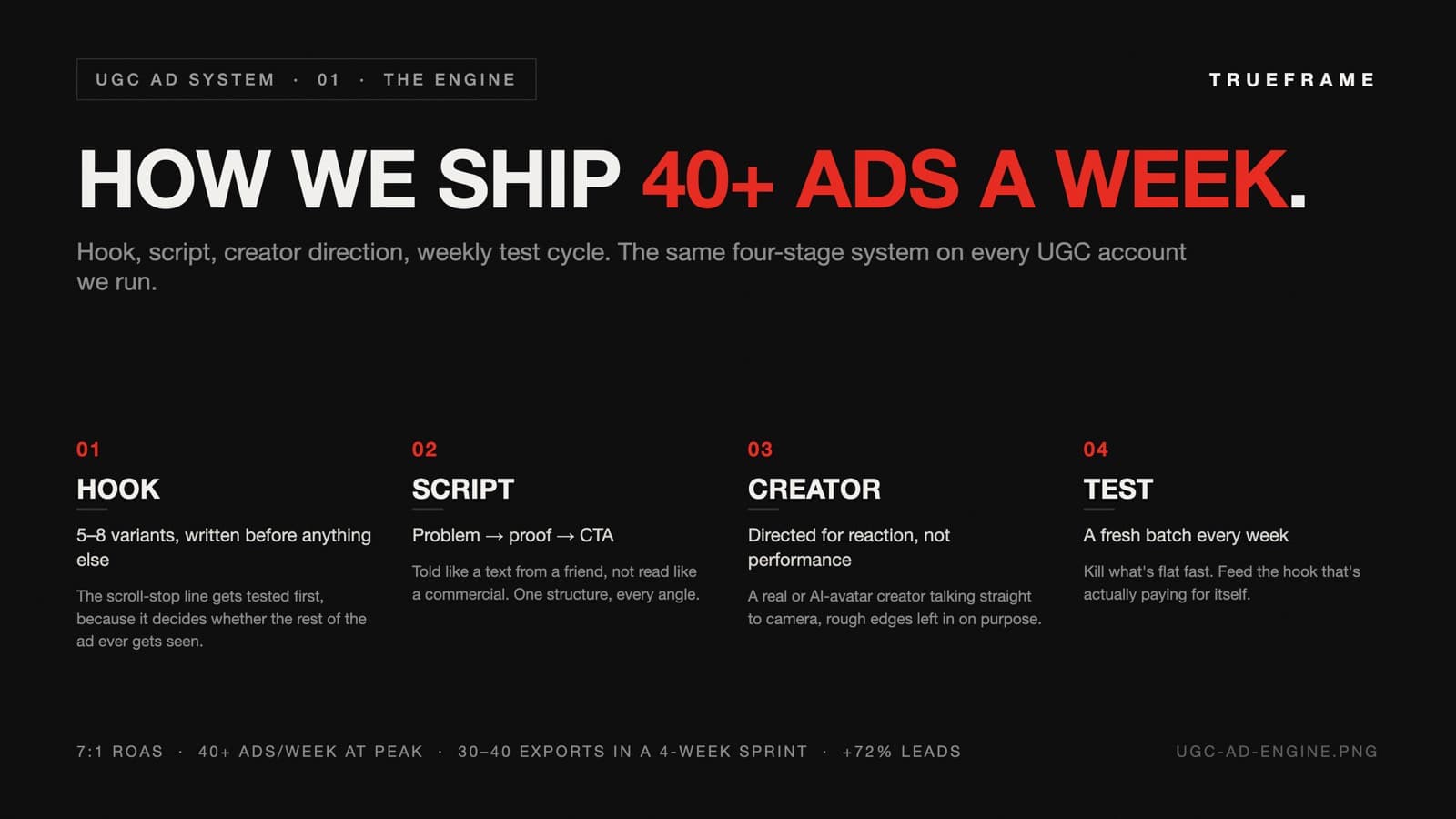
We've used this production process for brands at very different ends of the spectrum. At Siluet, a Pilates and wellness reformer brand, the client reported a 7:1 return on ad spend while more than 40 ads a week were produced at peak. For a B2B SaaS in a competitive vertical, a four-week sprint produced 30 to 40 UGC-style exports, and Meta leads rose 72% week over week.
UGC isn't a video style. It's a volume system. One good ad is luck. Forty good ads a week is a machine.
1. Write the hook before you write anything else
The first line decides whether the rest of the ad ever gets watched. Before you touch a script, write 5 to 8 hook variants for the same core idea: a blunt claim, a question, a wait-what moment, a number, a complaint. Test the hooks against each other before you spend a dollar polishing the body of the ad, because a weak hook kills a strong script every time, and a strong hook can carry a mediocre one.
The mistake is writing one hook you personally like and building the whole ad around it. You are not the audience. The hook that performs is rarely the one that sounds cleverest in a Slack message. It's usually the blunt one you almost talked yourself out of using.
The usual worry is that testing that many hooks reads as spam. It doesn't, because you're not running all 8 at once. You're running them against each other on small spend, watching which one earns the first three seconds, and killing the rest before they ever reach real budget. The audience only ever sees the winner.
The exact opening lines we test against each other before we ever touch a script. Swipe them for your own ads.
Get the hooks free2. Build the script on the UGC formula, not an ad structure
A commercial sells the product. A UGC ad sells a moment: problem, proof, call to action, in that order, told the way a person actually talks. Open on the exact problem your buyer has right now, not a category statement. Show the proof, the product doing the thing, a screenshot, a before-and-after, a number. Close on one specific action, not three.
Keep the lines short enough that a creator can say them without sounding like they're reading off a card. If a sentence needs a breath in the middle, cut it in half. The script should survive being read out loud in one take, because that's exactly what's about to happen on set.
3. Direct the creator for a reaction, not a performance
A script only gets you halfway there. The direction on set is what makes a video feel native instead of acted. Tell the creator the moment you want, not the exact words: react like you just found this, explain it like your friend asked what it does, complain like you actually paid for it. Real or AI-avatar, the same rule applies. The camera should feel a little rough and the framing a little off, because that roughness is the signal that tells the scroller this wasn't made by a studio.
This is where AI-avatar UGC earns its place. When a real shoot would slow the batch down, an AI avatar can deliver the same native, talking-to-camera direction fast enough to keep the weekly batch on schedule. We use whichever gets the hook to camera fastest without losing the native feel, not whichever is cheaper to produce.
4. Ship weekly batches sized to what your media buyer can test
One great UGC ad is not a system. It's a lucky roll. Winning ads fatigue inside two to three weeks on most accounts. If nothing new is ready behind it, cost per result creeps back up and the budget starts protecting nothing. Most performance media buyers need three to five fresh angles a week just to stay ahead of fatigue, not to grow the account, just to hold it steady.
Size the batch to what actually gets tested, not to what looks impressive in a folder. Ten unused ads sitting in a drive do nothing. Five ads a media buyer actually launches this week do everything. If you can't produce that volume in-house, that gap is the whole reason accounts stall out on their best-performing ad instead of building past it.
Set a fixed day for the batch to land, not a rough weekly aim. A media buyer who knows Thursday's fresh angles are coming can plan the week's testing around them. A media buyer who doesn't know when the next batch shows up ends up rerunning the same tired ad because there's nothing else to launch.
5. Track by hook, not by "the ad"
Once a batch is live, the only question that matters is which piece is actually doing the work: the hook, the script structure, or the creator. Tag each variant so you can see performance by hook, not just by ad name, because two ads with the same script and a different opening line can perform completely differently. That's the whole point of testing 5 to 8 hooks instead of shipping one.
The accounts that keep improving are the ones that feed the next batch from this data instead of a guess. Kill the flat hooks fast. Rebuild the next batch around whichever one is actually paying for itself, and let everything else go.
Want a fresh batch every week without hiring for it
We build the hooks, scripts, creator direction, and exports so your media buyer never runs out of something new to test.
See how the UGC ad engine worksThe content engine they built changed everything for us.
Siluet
UGC isn't hard to make once. It's hard to keep making, every week, without the quality sliding. That's the part that actually moves an ad account, not any single ad in it.
The short version
- Write 5 to 8 hook variants before you write a script.
- Structure the script as problem, proof, call to action. One action only.
- Direct for a reaction, not a performance, real creator or AI avatar.
- Ship a fresh batch every week, sized to what your media buyer can actually test.
- Track by hook, not by "the ad," and rebuild the next batch from what's paying for itself.
Keep reading
Want this built for you?
We run the whole UGC ad engine, hooks, scripts, real-creator and AI-avatar UGC, exports, so your account always has a fresh batch ready before the last one fades.
See how it worksSkip the reading. Talk it through instead.
Book a fit call and we'll map out what a content engine looks like for your business. No pitch, no pressure.
Don't miss the next one
Some of what we share is time-sensitive. A format that's working right now, a window that closes fast. We email those the moment they're worth jumping on. Drop your email so you catch them in time.
No spam. Unsubscribe anytime.
Frequently asked questions
What makes an ad actually UGC instead of just a phone-shot ad?
How many hook variants should I test before I pick one?
Should I use real creators or AI UGC?
How often do I actually need new UGC ads?
How do I know which part of the ad, the hook, the script, or the creator, is actually working?
Founded & led by
Benjamin Chua (BenChuchu)
Founder and CEO of Trueframe. 9 years building businesses (started at 16), tens of millions of views generated, and 8 figures in revenue created for the founders and brands he works with. He builds the content systems Trueframe runs.