How to Write a VSL Script: The 5-Part Structure That Sells Before the Call
Most video sales letters get the shoot right and the script wrong. Here's the exact 5-part structure, the objection-handling method, and the delivery rules we use to write VSLs that pre-sell the call instead of filling airtime.

Written by Benjamin Chua, founder of Trueframe.
Most VSL scripts fail before a single frame gets shot. Not because the video looks cheap. Because the script reads like a pitch deck with a voiceover.
A VSL, a video sales letter, is supposed to do one job: get a stranger to book a call already half sold. Most of the ones we get sent to review do the opposite. They open with a logo animation, walk through a feature list, and land on a generic "book a demo" button that could belong to any company on the page.
The problem isn't the camera or the editing. It's that almost nobody scripts a VSL like a sale. They script it like a company update. A prospect who was already skeptical watches ninety seconds of features they don't understand yet, then clicks away before the video ever reaches the part that would have moved them.
We've scripted, shot-directed, and edited VSLs for founders across SaaS and construction tech, on top of building content engines for 40+ founders and brands total. One early-stage B2B SaaS founder we worked with had never scripted a sales video before. We pulled the three objections his prospects raised most on real sales calls, built them straight into the script, and shot a 3 to 5 minute VSL end to end. For the first time, he knew exactly which part of the video was doing which part of the selling.
A VSL script isn't a monologue about your product. It's the conversation your best closer would have on a call, written down and filmed once.
1. Open with proof, not your logo
The first 20 seconds decide whether anyone watches the rest. A prospect clicking into your VSL is already half-skeptical, so the opening job isn't to introduce your company, it's to give them one reason to keep watching. A stat, a result, a name they recognize, a screen recording of the exact problem they're living in right now. We open ours with the same proof we lead every sales conversation with, 8 figures in client revenue. Whatever your version of that is, it goes first.
2. State the promise in one sentence
By 25 seconds in, the viewer should know exactly what they get if they keep watching. Not a mission statement. A specific outcome, in one sentence, in plain language. "By the end of this video, you'll know exactly how we'd get you 3 qualified sales calls a month without hiring anyone" beats "we help businesses grow through innovative solutions" every time, because one of those sentences a stranger could repeat back to a colleague and the other one they'd forget before the video ends.
3. Name the pain before they do
The next 30 seconds are where trust gets built or lost. Describe the exact frustration your buyer is living in, in their words, not yours. Pull it straight from sales call recordings, support tickets, or the DMs people actually send you. Done right, the viewer's reaction is "how did they know that," and that single moment of being understood does more for the sale than any amount of production value.
4. Lay out the plan, not a feature list
This is the longest part of the script, usually about 60 seconds, and it's where most VSLs quietly turn into a product tour. Don't walk through features. Walk through the process the viewer will actually go through if they buy: what happens in week one, what changes by month two, what the whole thing looks like end to end. A plan sounds like a system a stranger can trust. A feature list sounds like a pitch they've already heard.
5. Paint the picture, then give one instruction
The last 45 seconds do two jobs. First, paint a specific picture of after: what their calendar, their pipeline, or their week actually looks like once this is solved, not a vague "grow your business" close. Second, give exactly one instruction. Not "learn more," not three buttons fighting for attention. One clear next step, said out loud and repeated as text on screen. We also drop a phrase somewhere in the middle of the video and ask prospects to mention it when they book. Costs nothing to add and tells you instantly who actually watched.
6. Answer the objections before they're typed
The five parts above are the shape of the script. Objection handling is what runs underneath all of it, mostly inside part four, the plan. Before we write a word, we pull the specific objections a founder's prospects raise most, on price, timing, or whether this will actually work for them, straight from real sales calls. For each one, we name what the prospect probably thinks, say plainly why that assumption is off, state what's actually true, and back it with one specific proof point. That's the exact method we used on the early-stage SaaS founder's VSL. His three most common objections went into the script before a single frame was shot, so his closer stopped fighting the same fight on every call.
One more thing that has nothing to do with the five parts and everything to do with whether they land: read the script, don't perform it from memory. The words carry the sales logic, and founders who freestyle from bullet points usually drop the exact lines doing the convincing. Read it straight, on camera, and let the script do the work it was written to do.
Paste the script, choose your speaking pace, and see the estimated runtime plus the exact word budget for your target length. No signup, and the text stays in your browser.
Open the script timer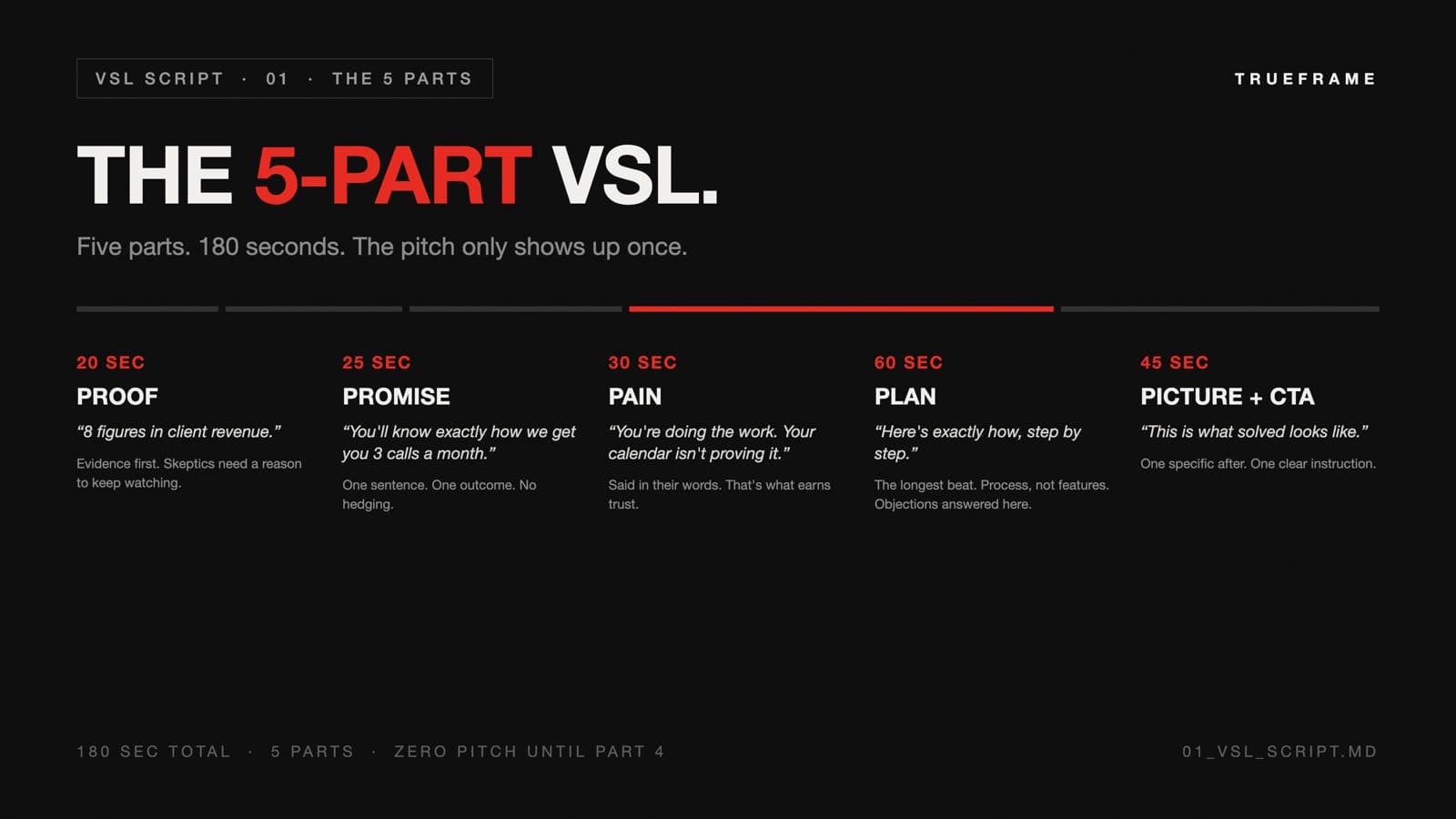
See what a script built to sell actually looks like. We'll make you one, free, so you can judge the work before anything else.
Apply nowWriting your own VSL script is the easy part to get stuck on
We pull your real objections straight from your sales calls, write the script around the 5-part structure, and shoot-direct the whole thing so you just read what's put in front of you.
See how VSL production worksWhat sets Ben apart is he actually tracks what matters. Not vanity metrics. We went through my entire content funnel together and he pinpointed exactly where leads were dropping off. Implemented his suggestions and saw a measurable lift in qualified inbound within weeks. Rare to find someone who thinks this systematically.
Suhaib, founder
The short version
- Open with proof, not your logo. The first 20 seconds decide if anyone keeps watching.
- State the promise in one sentence by 25 seconds in. Specific outcome, plain language.
- Name the pain in the viewer's own words around 30 seconds in. That's what earns trust.
- Spend the longest stretch, about 60 seconds, on the plan. Process, not features.
- Close with a specific picture of after and one instruction in the last 45 seconds.
- Pull real objections from real sales calls and answer them inside the plan, before anyone has to ask.
- Read the script on camera. Don't perform it from memory.
A VSL script isn't hard to write once you stop trying to write an ad. Five parts, one method for objections, and a founder reading it straight into the camera. That's the whole system, and it's the same one we script for every founder we build a VSL for.
Keep reading
Want us to write and shoot it for you?
We pull your real objections, script the whole VSL around the 5-part structure, shoot-direct it, and wire the CTA straight into your booking flow. You read what we give you.
See how VSL production worksSkip the reading. Talk it through instead.
Book a fit call and we'll map out what a content engine looks like for your business. No pitch, no pressure.
Don't miss the next one
Some of what we share is time-sensitive. A format that's working right now, a window that closes fast. We email those the moment they're worth jumping on. Drop your email so you catch them in time.
No spam. Unsubscribe anytime.
Frequently asked questions
What is a VSL script?
How long should a VSL script be?
What is the 5-part VSL structure?
How do you handle objections in a VSL script without sounding defensive?
Should the founder read the script or memorize it and speak freely?
Founded & led by
Benjamin Chua (BenChuchu)
Founder and CEO of Trueframe. 9 years building businesses (started at 16), tens of millions of views generated, and 8 figures in revenue created for the founders and brands he works with. He builds the content systems Trueframe runs.