How Much Does a Done-For-You Kumar Method Video Cost?
The straight answer on pricing, what actually drives the cost of a done-for-you Kumar Method video, the true cost of the cheap and DIY routes, and how one video pays for itself.

Written by Benjamin Chua, founder of Trueframe.
On this page
- What actually drives the cost
- The script written for your niche
- The edit that makes it cinematic
- Strategy and volume
- What it costs, in plain numbers
- Do it yourself: free on paper
- A cheap editor: a few hundred, sometimes less
- Done-for-you: a few hundred for one, low thousands for a system
- The DIY math nobody runs
- What one video is actually worth
- The pushback we hear, answered
- "A few hundred dollars still feels like a lot for one video"
- "Why can't I just brief a cheap editor?"
- "How many do I actually need?"
Here's the honest answer. A done-for-you Kumar Method video runs from a few hundred dollars for a single build up to a few thousand a month for an ongoing content engine. But the sticker price is the wrong thing to fixate on. The real question is what the video is worth once it works, and what the cheap route actually costs you when it doesn't.
If you searched for the price, you're probably weighing three options. Do it yourself, hand it to a cheap editor, or pay someone to build the whole thing. All three cost something. Only one of them costs money. The other two cost your time and your shot at the reach, which for a founder is usually the more expensive bill.
So let's do this properly. What drives the cost, what each route really runs you, and what a single video that works is actually worth. No fake numbers, no vague pitch.
What actually drives the cost
The filming is the easy part. Two scenes on your phone, about 20 minutes, in a room you already have. If the price were only about shooting footage, a Kumar Method video would be cheap and every clone would blow up. They don't. The cost sits in the two parts that decide whether a video lands.
The script written for your niche
The whole format runs on one move: take the thing your audience expects to be boring in your field, and flip it. Kumar is a retired accountant shot like a movie villain. Your version has to find that same contrast in your world, then write it as a short mission with a bit of swagger and one human beat that makes you likeable. Get the angle wrong and the best edit on earth can't save it. This is the part that takes real skill, and it's most of what you're paying for.
The edit that makes it cinematic
The look people assume came from a studio comes from the edit. The lighting choices, the pacing, the push-ins, the colour, the aura-farm images stitched between the talking. That's the difference between a phone video and something that stops the scroll. It's the second hard part, and it's the second thing a cheap editor can't do.
Strategy and volume
The rest of the cost is about scope. One video to test the angle costs less than a batch. A single organic build costs less than an ad-ready version with a conversion ending bolted on. And a one-off costs less per video than an ongoing engine that keeps producing. More strategy and more volume cost more, because they're worth more.
What it costs, in plain numbers
Three routes, three real costs. Here's what each one runs you.
Do it yourself: free on paper
Zero dollars out of pocket. The bill lands in your calendar instead. Learning the format, writing the angle, lighting and reshooting the takes, then editing the cinematic look, is a realistic 15 to 25 hours for a first attempt. And the two hardest parts, the niche script and the edit, are exactly the parts you have no reps in, so most first attempts flop. Free is only free if you don't count the time and the miss.
A cheap editor: a few hundred, sometimes less
Fiverr and freelance editors will cut a Kumar-style video for fifty to a few hundred dollars. The catch is they cut. They don't write your niche angle, and they usually can't build the cinematic edit that makes the format work. You hand them a weak script, you get back a clean version of a weak script, and you still manage the briefs and the revisions. Cheap up front, expensive in flops and hours.
Done-for-you: a few hundred for one, low thousands for a system
A single done-for-you Kumar Method video sits in the few-hundred-dollar range. You shoot about 20 minutes on your phone and we handle the script, the direction, and the edit. That few hundred dollars buys the two parts that decide whether the video works, done by people who've already put up 748,000 and 473,000 views with it. Most founders who call us don't want one video, though. They want a repeatable format, which runs as a monthly engine in the low thousands a month, where the Kumar Method is one of several formats we build for you. The exact number depends on your scope, and we quote it on the call.
See exactly what your Kumar Method video would cost
Book a call and we price it for your niche, free. You shoot about 20 minutes on your phone and we script, direct, and edit the whole thing. We only take five builds a week.
Get your Kumar style video hereThe DIY math nobody runs
Founders reach for do-it-yourself because it looks like the free option. Run the numbers and it usually isn't. Say your time is worth 200 to 500 dollars an hour, which is fair if you're running a business at any real scale. A first DIY attempt at 15 to 25 hours is 3,000 to over 12,000 dollars of your time before you've posted anything.
Then there's the outcome. The two parts you're least equipped to do yourself, the niche script and the cinematic edit, are the two parts that decide the result. So the most likely return on those 15 to 25 hours is a video that gets a few hundred views and goes nowhere. You spent the most expensive resource you have on the attempt with the highest chance of a flop.
The done-for-you route costs you about 20 minutes of filming plus the fee. The DIY route costs you 15 to 25 hours plus the odds of nothing to show for it. When you price your own time honestly, the math isn't close.
What one video is actually worth
Cost only means something next to the return. We ran the format for a client named Betty. One video, shot on her phone, did 331,000 views in its first three days and passed 748,000 in two weeks. It reached 227,453 accounts, 98.8% of them people who didn't follow her, and picked up 9,674 shares in the first week. She spent nothing on ads, and it added about 6,000 new followers to her account.
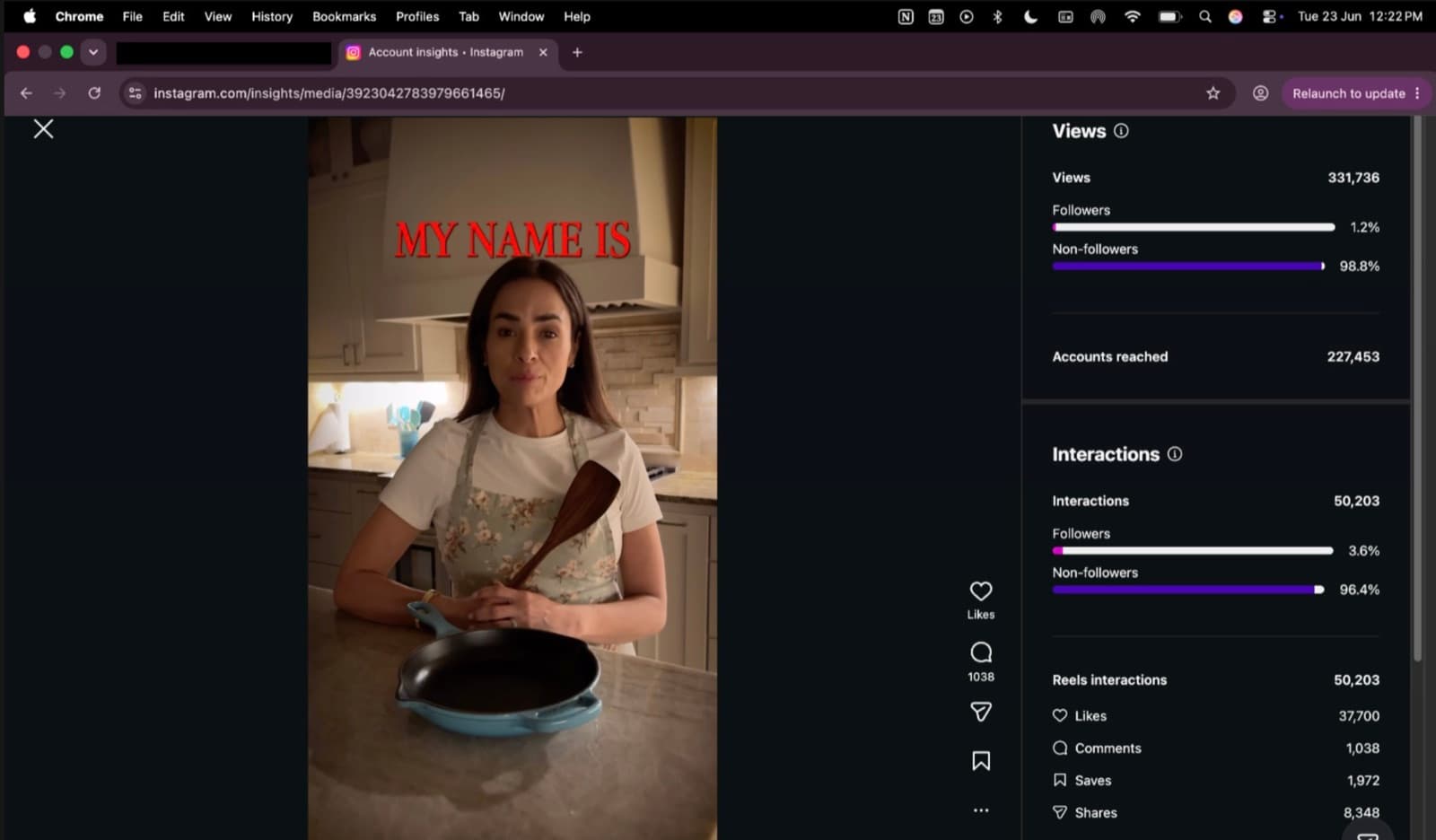
Now put a price on that. If you tried to buy 227,000 qualified impressions through paid ads, you'd spend far more than the video cost, and you still wouldn't get the 6,000 followers. That's the gap between what a working video costs and what it's worth. And Betty wasn't a fluke. We ran the same format for Dr Marion, a plastic surgeon, and her video did 473,000 views in a week and nearly doubled her account to 23.8K followers. Two niches, one format, more than 1.2 million views between them.
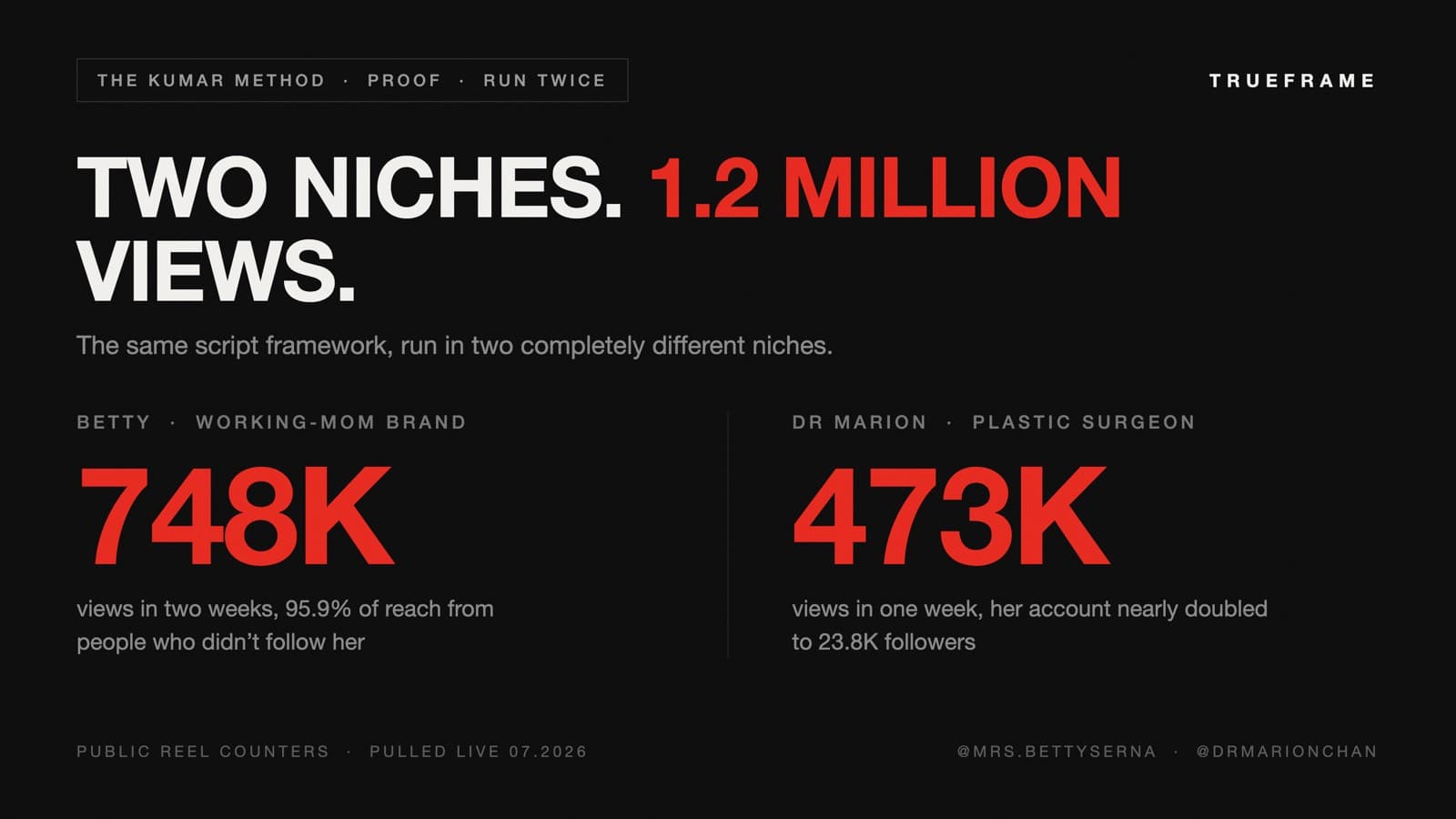
For a founder the return isn't the view count. It's the pipeline a growing audience sends you. One video that books a single client call can be worth more than the whole fee, many times over.
Want the full prompting guide?
Get the one-page prompting guide and both Kumar reference photos by email.
No spam. Unsubscribe anytime.
The pushback we hear, answered
"A few hundred dollars still feels like a lot for one video"
Compare it to the alternative, not to zero. The alternative is a cheap edit of a script that doesn't land, or 15 to 25 hours of your own time with the same risk. Priced against a video that reaches a quarter of a million people, a few hundred dollars is the cheap option. The expensive option is the one that gets ignored.
"Why can't I just brief a cheap editor?"
You can, and if you already have a strong niche script and a clear vision for the edit, a cheap editor might get you most of the way. Most founders have neither, and those are the two parts a cheap editor doesn't do. We wrote a whole piece on the exact reasons these videos flop, and both reasons trace back to those two parts.
"How many do I actually need?"
One can hit. Betty and Dr Marion both popped off a single video. But the founders who get real business results treat it as a format, not a lottery ticket. Start with one to prove the angle works in your niche, then run more to compound the reach and turn viewers into followers and leads. That's why the ongoing engine exists.
The short version
- A single done-for-you Kumar Method video runs in the few-hundred-dollar range. An ongoing engine where it's one of several formats runs in the low thousands a month.
- The cost isn't the filming. It's the two hard parts: the script written for your niche and the edit that makes plain phone footage cinematic.
- A cheap editor cuts clips but can't do those two parts, so a cheap edit of a weak script is still a video nobody watches.
- DIY looks free but costs 15 to 25 hours of founder time plus a high chance of a flop, because the parts you can't do are the parts that decide the result.
- One working video is worth far more than it costs. Betty reached 227,000 accounts and added ~6,000 followers on zero ad spend; Dr Marion nearly doubled her account off one.
- The exact price depends on your scope. We quote it for your niche on a call, free.
Get a real quote for your Kumar Method video
Worst case, we show you exactly how to do it for your niche and you run it yourself. Best case, we're a good fit and we build the whole video for you, the way we did for Betty. Only five builds a week, so grab a spot before they're gone.
Get your Kumar style video hereKeep reading
Don't miss the next one
Some of what we share is time-sensitive. A format that's working right now, a window that closes fast. We email those the moment they're worth jumping on. Drop your email so you catch them in time.
No spam. Unsubscribe anytime.
Frequently asked questions
How much does a Kumar Method video cost?
Why not just use a cheap editor to save money?
How many Kumar Method videos do I need to see results?
What's the ROI on a done-for-you Kumar Method video?
Can I do the Kumar Method myself for free?
Founded & led by
Benjamin Chua (BenChuchu)
Founder and CEO of Trueframe. 9 years building businesses (started at 16), tens of millions of views generated, and 8 figures in revenue created for the founders and brands he works with. He builds the content systems Trueframe runs.