Why Your LinkedIn Gets Views but No Leads (And How to Fix the Funnel)
Plenty of impressions, no booked calls. The problem is rarely reach. It's that there's no funnel underneath the reach. Here's the five-part fix we use to turn LinkedIn views into pipeline you can trace.

Written by Benjamin Chua, founder of Trueframe.
You're posting on LinkedIn. The numbers look great. The pipeline looks the same as it did before you started.
A post does 40,000 impressions. The comments roll in. People you respect react to it. And then you check your calendar and there's not a single new call on it. So you post again, chase a bigger number, and the gap between the views and the revenue gets wider every week.
The reach was never the problem. There's just nothing underneath it.
We've built content engines for more than 40 founders and brands. Hamel Husain hits between 70,000 and 235,000 LinkedIn impressions in his highest-output weeks. A founder we produce for has tracked six figures in qualified pipeline back to specific posts, in his words, from leads who referenced his content as the reason they trusted him enough to reach out. Same platform. One of those is a number. The other is a channel.
Impressions are the top of the funnel. Most founders never build the rest of it.
Here's the fix. Five parts. Each one is a piece of the funnel that sits under the reach you're already getting.
1. Call out the exact buyer, not the feed
A post written for everyone gets scrolled past by everyone. The reason your high-impression posts don't convert is that the wrong people are reading them. A clever take on the industry gets reach because it's broadly interesting. It gets zero leads because the person who'd actually pay you didn't feel spoken to.
Name the buyer in the first line. Their role, their company stage, the problem that was keeping them up last night. A Series A founder watching their CAC climb reads a post that opens with that exact situation and thinks, this person is in my head. That's the moment a viewer becomes a lead.
The worry is that calling out one person shrinks your reach. It does, and that's the point. Fewer of the wrong people, far higher intent from the right ones. Ten of the right buyers beat ten thousand of the wrong ones, and the LinkedIn algorithm rewards a post that holds the right reader anyway.
2. Give them a reason to raise a hand
A post that ends with no ask gives the reader nowhere to go. They liked it, they learned something, they scrolled on. The view happened. The lead didn't, because you never asked for one.
Every post that's meant to convert needs one low-friction next step. Not a cold pitch to book a call. A reason to put a hand up. Comment a word to get the breakdown. Grab the guide. Reply to a question. The point is to turn a passive reader into someone who has signaled intent, because a name you can follow up with is worth more than a hundred silent impressions.
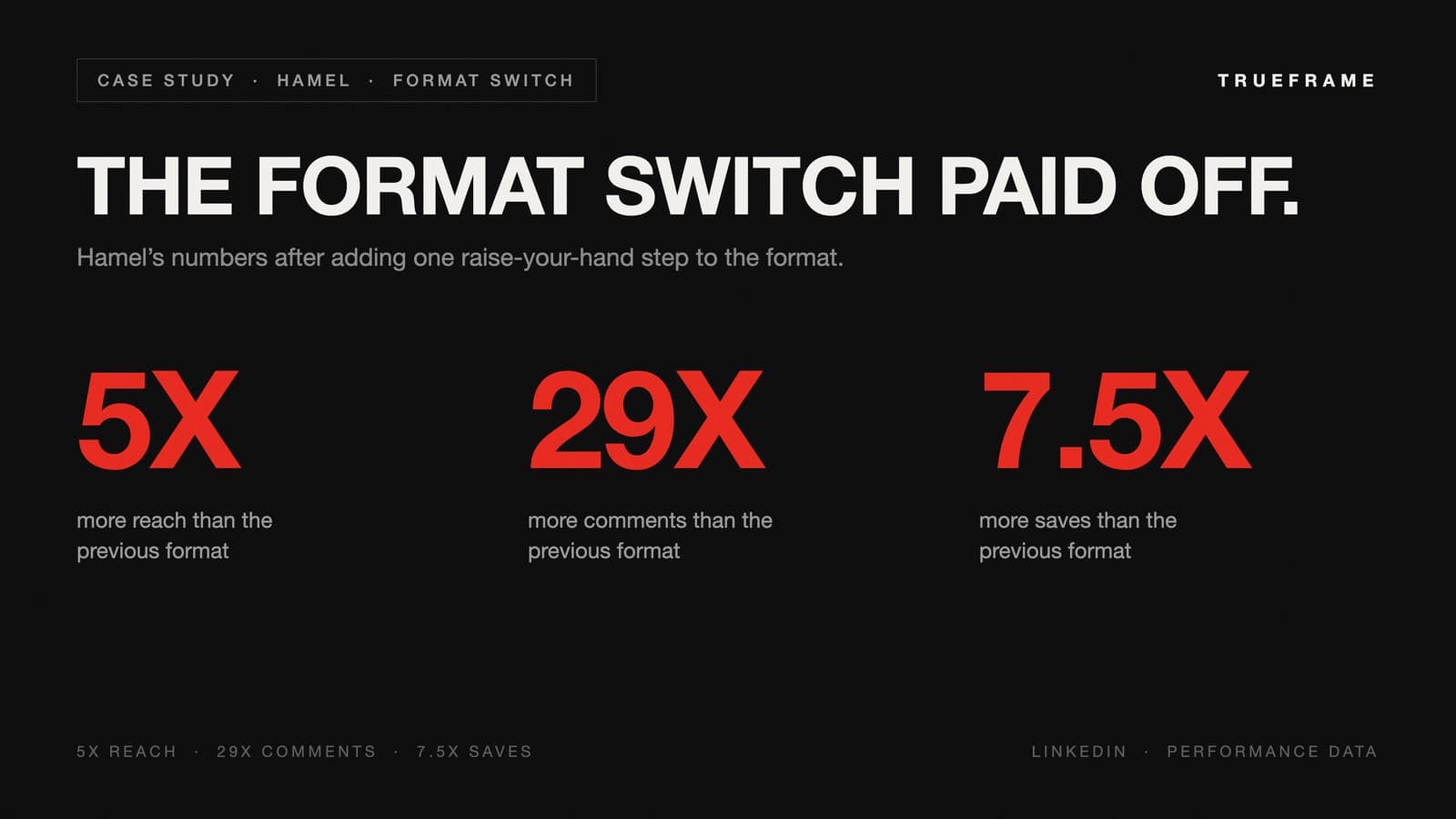
When we switched Hamel to a lead-magnet format built around this exact raise-your-hand step, it pulled 5x the reach, 29x the comments, and 7.5x the saves of his previous format. The content didn't get smarter. It just started asking the reader to do something, and the right readers did it.
See what content built to land clients looks like. We'll make you one, free, so you can judge the work before anything else.
Apply now3. Match the ask to how warm the reader is
Most founders make the same mistake on the call to action. They ask a cold reader to book a sales call. That reader has watched one post. They're not getting on a call with you, so they do nothing, and you conclude the content doesn't convert.
The ask has to fit the temperature. A cold reader takes a guide or a resource. A warm reader who's seen a few of your posts takes a free teardown or a checklist. A hot reader who already trusts you books the call. Offer the call-booking step to a cold audience and you lose them. Offer the resource step and you capture them, then earn the call later.
A founder we produce for ran this across his whole engine and pulled 50+ B2C leads through the same content alongside the six figures of B2B pipeline. Different buyers, different temperatures, different first steps, one funnel feeding all of it.
This is the part most founders never build
We design the funnel under your content, the buyer call-out, the raise-your-hand step, the capture, and the tracking, so your LinkedIn reach turns into booked calls instead of just impressions. You show up for about 90 minutes a month.
See how the done-for-you system works4. Capture the lead, don't leave it in the comments
A comment is not a lead. It's a signal. If forty people comment to get your breakdown and you DM them one at a time when you remember, most of that intent evaporates by the weekend. The post worked. The capture failed.
Build the catch. A comment-to-DM automation that delivers the resource instantly. A link to a page that takes an email before it hands over the guide. A short form behind the call-to-action. The job is to move the person from a public comment into something you own and can follow up with on your terms, not LinkedIn's.
Hamel's lead-magnet funnel works because the capture is wired in. Someone raises a hand, the resource goes out automatically, the contact lands somewhere we can nurture it. The reach was always there. Wiring the capture under it is what turned the saves and comments into a list instead of a feeling.
The exact opening lines we use to make the right buyer stop scrolling and read to the call to action.
Get the hooks free5. Track the post back to the booked call
If you can't tie a deal to the content that started it, you're guessing. And what you can't measure, you eventually stop paying for the moment budgets get tight. Most founders kill content not because it failed, but because they could never prove it worked.
Tag every call to action with a UTM so the click carries its source. Put a where-did-you-find-us question on your booking form. Ask it on the call. When a closed deal traces back to the post that opened the relationship, content stops being a hopeful cost and becomes a line you can defend in a budget meeting and scale on purpose.
What sets Ben apart is he actually tracks what matters. Not vanity metrics. We went through my entire content funnel together and he pinpointed exactly where leads were dropping off.
Suhaib, founder
Tracking is what turns the other four parts into a system. Once you can see which post produced a call, you stop posting on hope and start building more of what already converts.
The short version
- Call out the exact buyer in the first line, not the whole feed.
- End every post with one low-friction reason to raise a hand.
- Match the ask to how warm the reader is. Cold readers don't book calls.
- Capture the lead off LinkedIn into something you own.
- Tag and track every call to action so a deal points back to a post.
Reach feels like the win. It's the entry fee. The founders who get leads from LinkedIn aren't the ones with the biggest numbers. They're the ones who built a funnel under the reach, pointed it at one buyer, and tracked it all the way to a booked call.
You don't need more impressions. You need a funnel underneath the ones you already get.
Keep reading
Want this built for you?
We build and run the whole content engine for founders, from the buyer call-out to the capture to the tracking. You show up for about 90 minutes a month, and we turn your LinkedIn reach into pipeline you can actually see.
See how it worksSkip the reading. Talk it through instead.
Book a fit call and we'll map out what a content engine looks like for your business. No pitch, no pressure.
Don't miss the next one
Some of what we share is time-sensitive. A format that's working right now, a window that closes fast. We email those the moment they're worth jumping on. Drop your email so you catch them in time.
No spam. Unsubscribe anytime.
Frequently asked questions
Why does my LinkedIn get views but no leads?
Do I need a huge following on LinkedIn to get leads?
What should the call to action on a LinkedIn post be?
How do I know which LinkedIn post actually drove a deal?
How long until LinkedIn content starts producing pipeline?
Founded & led by
Benjamin Chua (BenChuchu)
Founder and CEO of Trueframe. 9 years building businesses (started at 16), tens of millions of views generated, and 8 figures in revenue created for the founders and brands he works with. He builds the content systems Trueframe runs.