How Tech Founders Build a Personal Brand (Without Becoming an Influencer)
A technical buyer trusts a person, not a company account. Here's why the founder should be the face, and how to build a personal brand on your engineering depth instead of becoming an influencer.

Written by Benjamin Chua, founder of Trueframe.
On this page
- 1. The founder earns trust the company account never will
- 2. You don't need to be an influencer. You need to be credible in public
- 3. Build on the one unfair advantage nobody can fake: your depth
- 4. Own one lane. Be known for a sharp point of view, not for being agreeable
- A practical lane statement
- 5. Make it sustainable without turning into a content company
- 6. Measure it in pipeline, hiring, and fundraising, not followers
A technical buyer doesn't trust a company. They trust the person who built the thing.
You've got the harder skill. You can build. So the idea of putting your face on the internet feels like a tax on the real work, or worse, like turning into one of those LinkedIn personalities you scroll past. So you let the company account do the talking. It posts product updates to an audience of nobody, and the trust that should be pointed at you goes nowhere.
That's the miss. For a technical buyer, the founder is the most credible voice the business has, and the company logo is the least.
We've built content engines for more than 40 founders and brands. A technical founder we work with has tracked six figures in qualified pipeline back to specific content, every lead pointing to a video as the reason they trusted him enough to reach out. Hamel Husain pulls more than 30% of his YouTube traffic from short clips of him explaining how he thinks. In both cases the person, not the brand, is what people came for.
People don't trust logos. They trust the person who clearly knows what they're talking about.
Here's how a technical founder builds a personal brand that does real work for the business. Six parts. None of them require you to become an influencer.
1. The founder earns trust the company account never will
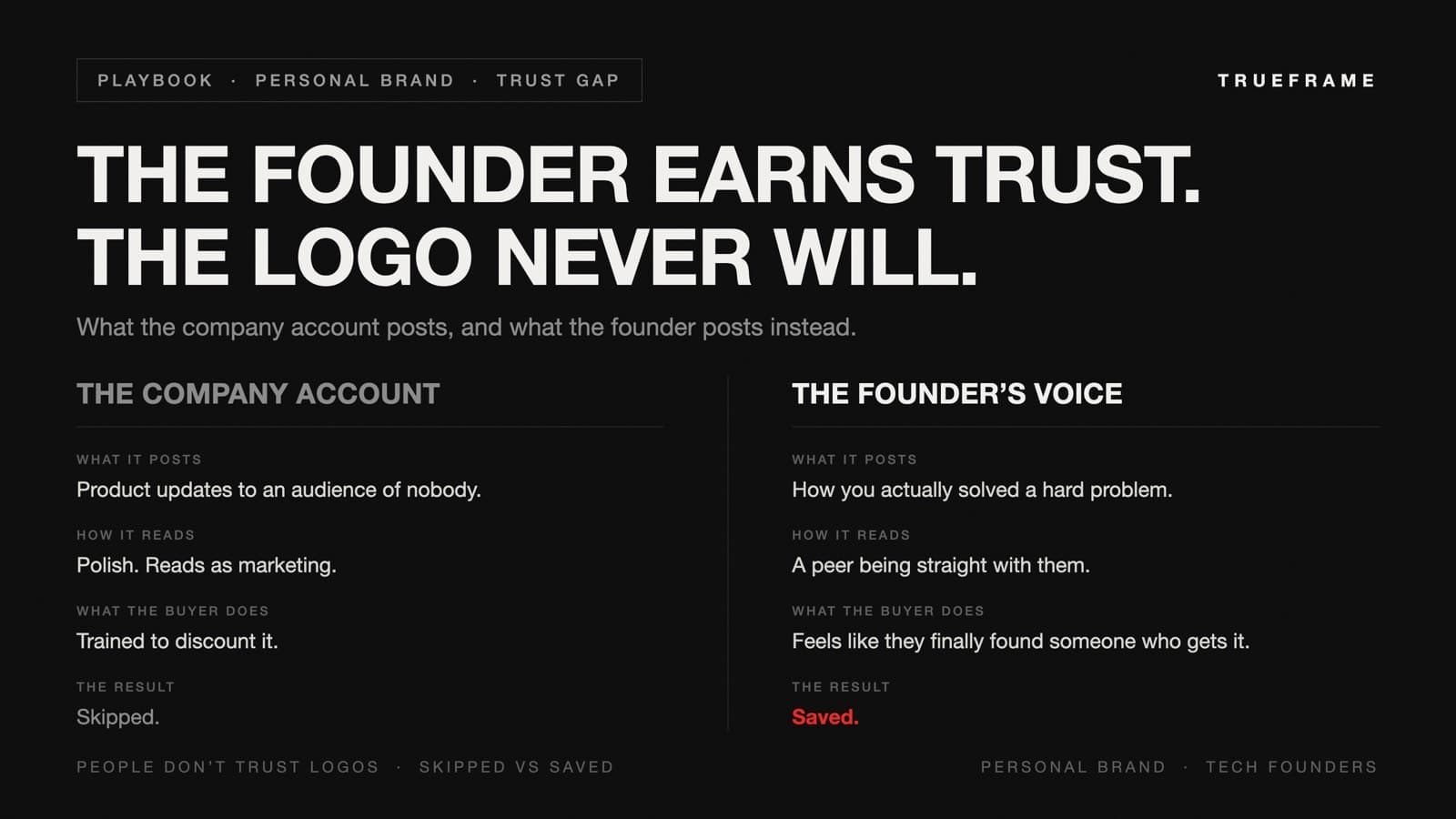
A buyer deciding whether to bet their stack on your product is really deciding whether to trust you. A company account can't carry that. It posts polish, and polish reads as marketing, and marketing is the thing technical people are trained to discount. You posting how you actually solved a hard problem reads as a peer being straight with them. One gets skipped. The other gets saved.
The objection is always, that feels self-promotional. It isn't, because you're not promoting yourself. You're being useful in public about the thing you know better than almost anyone. The buyer who watches you reason through a problem they're stuck on doesn't feel sold to. They feel like they finally found someone who gets it.
2. You don't need to be an influencer. You need to be credible in public
When most engineers picture personal branding, they picture dancing for the algorithm, hot takes for engagement, a feed full of nothing. No wonder it feels cringe. That version is empty on purpose, and empty is exactly what a technical audience smells in a second.
A founder's personal brand is something much simpler. It's your judgement and credibility made visible. The decisions you've made, the tradeoffs you understand, the opinions you've earned the right to hold. You're not building an audience for applause. You're letting the people who'd buy from you, work for you, or fund you see how you think before they ever talk to you. The bar isn't charisma. It's being worth listening to.
Most technical founders never clear even that low bar, because they assume it requires a personality they don't have. It doesn't. It requires saying true, specific things about hard problems. That's a thing you can already do.
3. Build on the one unfair advantage nobody can fake: your depth
A marketer can write a clean post about your space. They can't teach the decision you made at 2am when the architecture you'd bet on started falling over at scale. That hard-won knowledge is the thing no competitor and no agency can copy, and it's the exact thing your buyer is desperate for.
So teach the decisions only a builder would know. Why you chose the boring database over the exciting one. The migration that went sideways and what you'd do differently. The thing everyone in your niche believes that you've found to be wrong in practice. A generalist creator can't produce this. You can produce it without thinking. Your depth is the content other people wish they had.
Hamel's brand is built entirely on this. He doesn't post motivation. He teaches the specific, technical problem his buyers are stuck on, and the depth is what makes people trust him before they ever enroll. The teaching is the brand.
See what content built to land clients looks like. We'll make you one, free, so you can judge the work before anything else.
Apply now4. Own one lane. Be known for a sharp point of view, not for being agreeable
Founders try to be relevant to everyone, so they post a little about everything, and the brand blurs into mush. Nobody remembers the founder who has a balanced take on every topic. The fastest way to be known is to pick one buyer and one point of view, and go narrow enough that it's almost uncomfortable.
Not thoughts on engineering. The specific person you serve and the specific thing you believe about their problem. A slightly contrarian, well-defended technical take beats being agreeable about everything, because agreeable is forgettable and a strong opinion you can back is the thing people quote, argue with, and remember you for. You're not trying to be liked by the whole timeline. You're trying to be the obvious choice for one kind of buyer.
Ten of the right people who think of you the moment a problem shows up are worth more than ten thousand who vaguely know your name. Pick the lane. Own it.
A practical lane statement
Write one sentence: I help [specific technical buyer] make better decisions about [hard problem] because I have learned [earned belief]. A founder who has operated a difficult migration, sold into a regulated workflow, or built through a category change has material a general creator cannot invent. Use that sentence to rule topics in or out.
The exact opening lines we use to make the right technical buyer stop scrolling instead of dismissing one more founder post. Swipe them for your own content.
Get the hooks freeThis is the part most technical founders never get to
We do the research, scripting, and editing so your content shows your judgement and speaks to the exact buyer you want, built on the technical depth only you have. You record, and we run the rest.
See how the done-for-you system works5. Make it sustainable without turning into a content company
The fear underneath all of this is real. You started a company to build a product, not to spend your week in an editor. If a personal brand means becoming a part-time content operation, you're right to refuse. So don't build it that way.
The founder films in one short session, roughly 90 minutes a month, and a system handles everything after that. The scripting, the editing, the packaging, the posting, the tracking. You stay the source of the thinking. You never touch the production line. The moment content depends on your spare hours it dies the first sprint that runs long, so it can't depend on your hours.
Consistency beats intensity. The founder who shows up every week for a year beats the one who films ten videos in a burst and then disappears the moment a release eats the calendar. Depth compounds, but only if it keeps running.
6. Measure it in pipeline, hiring, and fundraising, not followers
Follower count is the wrong scoreboard, and it's the one that makes personal branding feel like vanity. The real returns show up somewhere else. Inbound that already trusts you. Strong engineers who apply because they've watched you think and want to work for the person, not just the salary. Investors who take the call warm because they've followed your reasoning for months.
Tag every call to action so a booked call traces back to the exact piece of content that drove it. For the rest, watch how the conversations change. When a candidate quotes a video back to you in an interview, or a buyer shows up already sold, or a VC says they've been reading your stuff, the brand is working. That's the scoreboard. Followers are just the number that's easiest to count and least worth counting.
My trust online has increased and it's only getting better.
Stephan, founder and CTO
This is the difference between a personal brand as vanity and a personal brand as an asset. Vanity is a number you hope means something. An asset is trust you can see show up in your pipeline, your hiring, and your raise.
The short version
- For a technical buyer, the founder earns the trust a company account never will.
- You don't need to be an influencer. You need to be credible in public.
- Build on your unfair advantage. Teach the decisions only a builder would know.
- Own one lane and one sharp point of view. Agreeable is forgettable.
- Run it on one short filming session a month, not a content side-job.
- Measure it in pipeline, hiring, and fundraising, not followers.
Followers feel like the point. They aren't. The technical founders who win aren't the ones with the biggest audience. They're the ones whose buyers, hires, and investors already trust them before the first conversation, because they made their judgement visible instead of hiding behind the company account.
Your product can be copied. Your depth and your judgement can't. Build the brand around the founder.
Keep reading
- The best personal branding agencies for tech founders, compared
- How founders get recommended by ChatGPT, Claude and Perplexity
- How Adam Robinson bootstrapped RB2B to $5M ARR with a LinkedIn account
- How to make founder content that drives pipeline, not just views
- Why your LinkedIn gets views but no leads
- Content marketing for SaaS founders: the pipeline playbook
- Done-for-you personal branding for tech founders
Want this built for you?
We build and run the whole content engine for technical founders, from strategy to scripting to editing to tracking. You record in one short session a month, and we turn your depth into a personal brand that builds trust before the first call.
See how it worksSkip the reading. Talk it through instead.
Book a fit call and we'll map out what a content engine looks like for your business. No pitch, no pressure.
Don't miss the next one
Some of what we share is time-sensitive. A format that's working right now, a window that closes fast. We email those the moment they're worth jumping on. Drop your email so you catch them in time.
No spam. Unsubscribe anytime.
Frequently asked questions
Do tech founders actually need a personal brand?
I'm an engineer, not a creator. Do I have to be on camera?
Isn't personal branding just vanity, or kind of cringe?
How is this different from just posting on LinkedIn?
How do I tell if my personal brand is doing anything for the business?
Founded & led by
Benjamin Chua (BenChuchu)
Founder and CEO of Trueframe. 9 years building businesses (started at 16), tens of millions of views generated, and 8 figures in revenue created for the founders and brands he works with. He builds the content systems Trueframe runs.