How to Repurpose One Podcast Into 20+ Pieces of Content
You record an hour of your best thinking and it dies in a feed. Here's the system we use to turn one recording into 20+ pieces of content and weeks of distribution, without recording more.

Written by Benjamin Chua, founder of Trueframe.
You record an hour of your best thinking. Then you let it die.
The episode goes up on Spotify. A few hundred people press play. By next week it's buried under the new one. You spent an hour saying genuinely useful things and the business looks exactly the same on Friday as it did on Monday.
The recording isn't the problem. What you do with it after is.
Podcast repurposing is not exporting the same clip everywhere. It is choosing the moments that stand alone, cutting the full idea for a long highlight, then packaging the sharpest part for a short clip. The episode remains the depth asset. Each cut has a separate discovery job.
For one established VC interview podcast, we built the YouTube packaging and distribution workflow around every approved episode. A founder we work with ran his own podcast-to-clips experiment and hit 600,000 views in 10 days, on about an hour a week, at zero cost. Across 9 years and 40-plus founders and brands, the content we produce has done 17 million-plus views. The common thread is never recording more. It's getting more out of each recording.
One hour of input. Twenty-plus pieces out. Weeks of distribution.
Here's the exact system we use to turn a single podcast into 5 to 8 long clips and around 14 short ones. Six steps. None of them are about working harder on camera.
1. Record it like an asset, not an episode
Most podcasts are recorded to be listened to once. That's the mistake. You're not making one episode. You're making the raw material for 20-plus pieces of content, so record it that way.
Film it on video, every time. A talking head with motion clips into YouTube, TikTok, and Reels. A waveform does not. Frame both people so each can stand alone in a vertical crop. Get clean audio. The episode is the source file the whole month gets built from, so the half hour you spend on setup pays you back 20 times over.
The objection here is, won't filming make my guests nervous. A little, for the first few minutes. Then they forget the camera's there. The interview podcasts we work on film every guest, including senior investors and operators, and that footage is what makes YouTube distribution possible.
2. Mine the recording for moments, not minutes
After the recording, you're hunting for moments. The strong opinion. The specific number. The short story that makes a point. The line a listener would screenshot and send to a friend. A one-hour episode usually holds 20 to 25 of these.
Read the transcript and mark every spot where the energy spikes or a real point lands. Ignore the throat-clearing, the cross-talk, and the parts where you're just getting to the point. You're not trying to use the whole hour. You're trying to find the 20 minutes inside it that are actually worth watching.
People worry they'll run out of good moments. The opposite is true. The problem is almost always too many candidates, not too few. Cut the bar high. A clip that makes one clear point beats three that wander.
The same step-by-step system we use to turn one founder recording into a month of clips, written up so you can run it yourself.
Get the system free3. Cut two tiers from the same hour
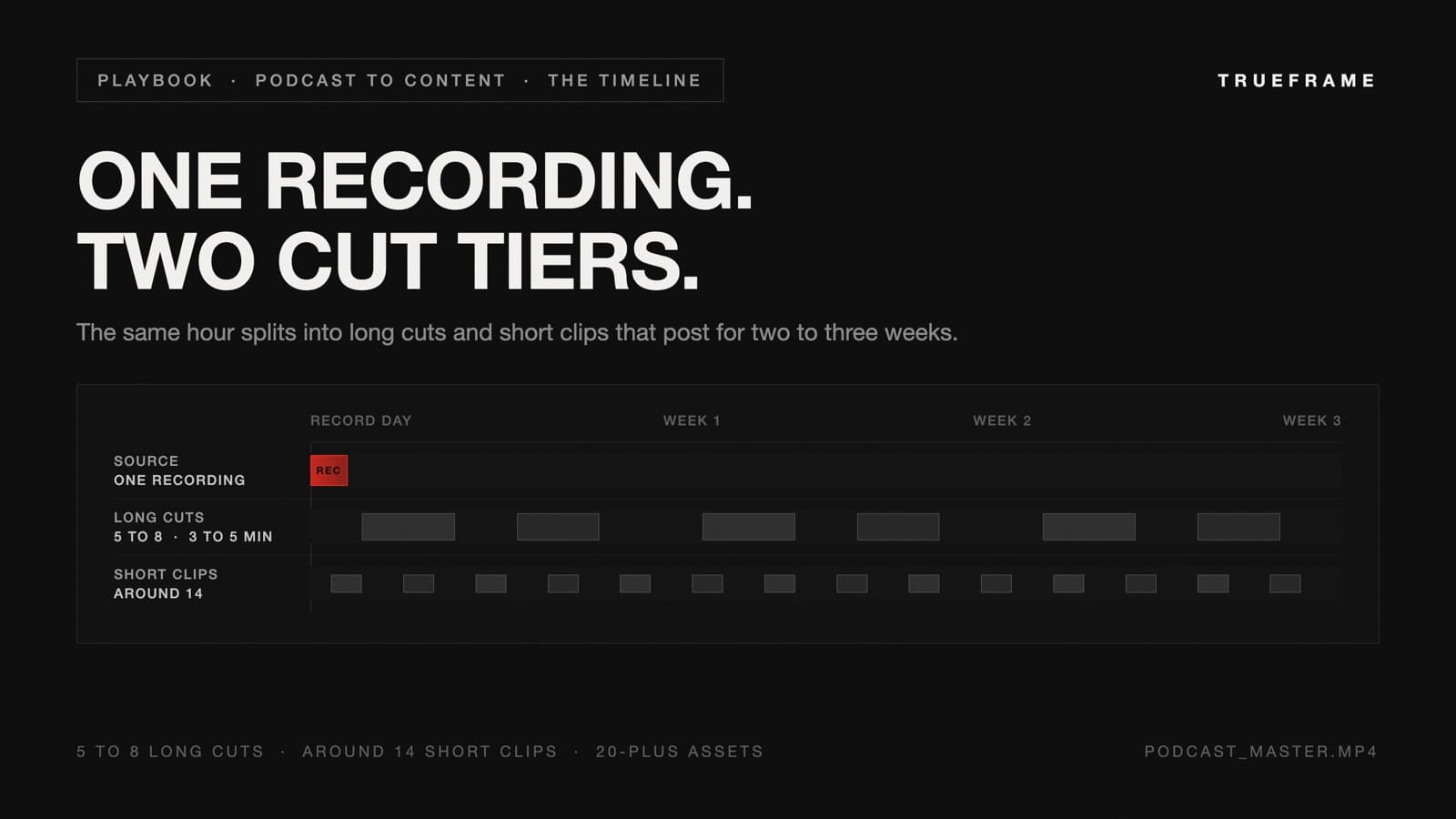
One recording feeds two different formats, and you cut both from the same marked moments. The split is what gets you to 20-plus.
The first tier is 5 to 8 YouTube highlight cuts, 3 to 5 minutes each. Each one takes a single full idea, a complete answer or a story with a payoff, and tops and tails it so it reads as a standalone video. The second tier is around 14 short clips, 30 to 60 seconds, built for TikTok, Reels, and Shorts. These are the sharpest 30 seconds of a moment, with a hook on the front and captions burned in.
That math is what turns one sit-down into a month of posting. The VC channel we run does exactly this per episode, which is how a bi-weekly recording schedule keeps a daily feed full.
This is the part most founders never get to
We take your raw recording and cut the 5 to 8 long clips and the 14 short ones, package them, and post them. You record the episode. We turn it into a month of content.
See how the done-for-you system works4. Package every clip so it stands on its own
A clip pulled out of an episode has no context. The viewer didn't hear the question, doesn't know who's talking, and will scroll in two seconds if you make them work for it. Packaging is what closes that gap.
Open on the strongest line, not the windup. Put a one-line hook on screen that tells the viewer what they're about to get. Add a short context strap so a stranger knows who this person is and why they should care. Burn in clean captions, because most people watch on mute. Give each clip a title that names the problem it solves. Same footage, packaged right, is the difference between 200 views and 200,000.
Founders push back here with, isn't that over-producing a clip. No. The packaging is the marketing. A great moment with no hook and no captions is a great moment nobody finishes watching.
5. Sequence the drops so one recording lasts weeks
You don't dump 20 clips in one day. You stagger them. The whole point of sweating one asset is that it keeps the feed full while you go back to running the business.
Anchor the calendar with the long YouTube cuts, one or two a week. Fill the days in between with the short clips across TikTok, Reels, and Shorts, spaced out so a single episode covers two to three weeks of posting. Then the next recording picks up where the last one tapers off. Consistency is the channel that ships every week for a year, not the one that posts 20 clips in three days and then goes quiet.
6. Track which clips actually move the business
Twenty clips a week is only worth it if you can see which ones work. So track them. Not just views. Watch for the clips that drive saves, follows, and booked calls, and tag your call to action so a lead can be traced back to the clip that brought them in.
Once you can see which moments convert, the next recording gets easier. You already know which topics and formats earn the right clicks, so you lean the conversation toward more of them. Volume of the right clips compounds. Volume of random ones just fills a feed.
What sets Ben apart is he actually tracks what matters. Not vanity metrics. We went through my entire content funnel together and he pinpointed exactly where leads were dropping off.
Suhaib, founder
That's the line between a podcast as a hobby and a podcast as a channel. A hobby is something you hope is working. A channel is something you can measure, defend in a budget meeting, and scale on purpose.
The short version
- Record on video, framed and miked like a source file for 20-plus clips.
- Mine the hour for the 20 to 25 moments worth watching, not the whole episode.
- Cut two tiers from it: 5 to 8 long clips and around 14 short ones.
- Package every clip with a hook, context, and captions so it stands alone.
- Stagger the drops so one recording covers two to three weeks.
- Track which clips drive saves, follows, and booked calls, then make more.
You're already doing the hard part. You sit down and say an hour of useful things. The founders who grow aren't the ones who record more. They're the ones who get a month of distribution out of the hour they already recorded.
Sweat the asset. One recording is a month of content if you cut it right.
Keep reading
Want this run for you?
We turn one podcast a week into 5 to 8 long clips and around 14 short ones, packaged, posted, and tracked. You record the episode. We turn it into weeks of reach you can measure.
See how it worksSkip the reading. Talk it through instead.
Book a fit call and we'll map out what a content engine looks like for your business. No pitch, no pressure.
Don't miss the next one
Some of what we share is time-sensitive. A format that's working right now, a window that closes fast. We email those the moment they're worth jumping on. Drop your email so you catch them in time.
No spam. Unsubscribe anytime.
Frequently asked questions
How many pieces can I really get from one podcast?
Doesn't chopping a podcast into clips look low effort?
Do I need video, or is audio enough?
How much of my time does this take each week?
How do I know which clips are worth posting?
Won't posting clips compete with the full episode?
Founded & led by
Benjamin Chua (BenChuchu)
Founder and CEO of Trueframe. 9 years building businesses (started at 16), tens of millions of views generated, and 8 figures in revenue created for the founders and brands he works with. He builds the content systems Trueframe runs.