5 Viral Video Formats Printing Views Right Now (Steal Them This Week)
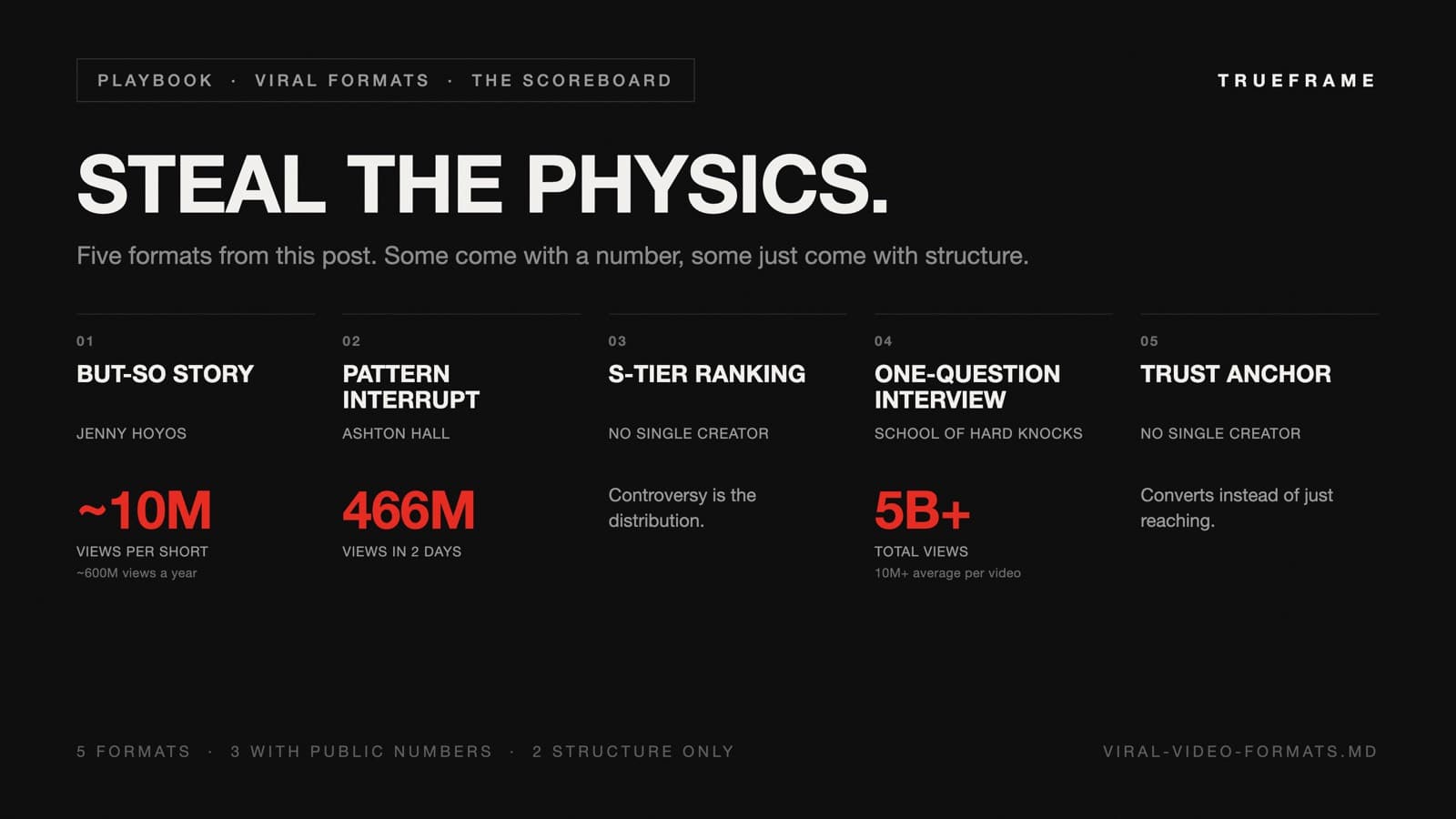
Formats are the closest thing short-form has to a cheat code. These five are pulling millions of views right now. The videos are below, so you can watch each one land, then plug your topic in.

Written by Benjamin Chua, founder of Trueframe.
Last week I broke down 10 viral hooks on LinkedIn. The hook gets the click. The format is what keeps people watching after the click, and it's the part almost nobody studies.
So I went and did the study. I pulled apart the short-form formats printing the most absurd numbers right now, watched the outliers, and broke down why each one works. These aren't theories. Every format below has public numbers behind it, and I've embedded the actual videos so you can watch them land before you steal anything.
A viral video is luck. A viral format is physics. Steal the physics.
The companion piece. 10 opening lines that did 50M+ combined views, each turned into a fill-in-the-blank template.
Format 1: The but-so micro story
Jenny Hoyos averages around 10 million views per YouTube Short and did roughly 600 million views in a single year on budget food videos. Her signature series: remaking fast food for $1.
The engine underneath is one writing rule. Every sentence connects with "but" or "so". Never "and then". "I'm making a $1 chicken sandwich, BUT Chick-fil-A sells theirs for $5, SO if mine tastes better, they have a problem." Each "but" opens tension, each "so" pays it off, and the chain never gives the viewer a clean place to leave.
The second trick is that the payoff is visible in the first frame. The $1 sandwich sits right next to the brand she's challenging. Premise and stakes land in under 3 seconds. Here's how you steal it.
- Write your script, then replace every "and then" with "but" or "so". If a sentence can't connect, cut it.
- Show the end result in the first shot. The viewer should see where this is going and stay to find out how.
- Make it a named, repeatable series. One-off videos build views. Series build audiences.
Format 2: The pattern interrupt
In early 2025, Ashton Hall posted a morning routine video that did 466 million views in two days after one repost, and his account did roughly a billion Reel views in the month that followed. Dunking his face into a bowl of ice water. Rubbing a banana peel on his skin. The internet lost its mind.
Strip away the memes and there's a precise mechanic, which Kallaway breaks down well: a stunning visual that doesn't belong, a matching sound that punctuates it (the splash, the snap), and speed. The interrupt lasts one to two seconds, just long enough to short-circuit the scroll reflex before the actual content starts.
You don't need an ice bowl. You need one visually wrong moment at the top of the video that earns the next 3 seconds. Here's how you steal it.
- Find a visual from your actual work that looks out of place on a feed. A founder signing a termination letter. A whiteboard getting wiped clean. Pouring coffee out instead of drinking it.
- Pair it with one crisp sound. Audio punctuation is half the interrupt.
- Keep it under 2 seconds, then get to the substance. The interrupt buys attention, it doesn't replace content.
- Rotate 2 or 3 interrupts across videos so they don't go stale.
Format 3: The S-tier ranking
Tier lists have escaped gaming and are now printing views in food, real estate, beauty, sports, and software. The structure: rank items in a category from S down to F on a simple template, and let the controversy do the distribution.
Three rules make it work. Hold the S-tier slots open until the end so people watch through to see what wins. Open by giving a beloved item a brutally low score, because outrage is the most reliable comment engine that exists. And remember the commentary carries the format. Nobody shares a scoreboard, they share the reasoning that made them argue. Here's how you steal it.
- Rank something only an insider could rank: CRMs for agencies, lead sources for clinics, content platforms for founders.
- Give one popular favorite a D. Defend it with a real reason. Read the comments.
- Reveal your S-tier last, every time.
Formats are free. Execution is the moat.
Every founder reading this list nods along. Almost none will script, film, and post any of it, because running a content engine is a full-time job. That's the job we take. You show up on camera, we run everything else.
See how the engine worksFormat 4: The one-question street interview
School of Hard Knocks built one of the biggest short-form machines in the world on a single question: "How did you get rich?" Their videos average over 10 million views, the account network has passed 5 billion total views, and the business behind it reportedly cleared $700K in revenue in a single month.
The genius is that the question IS the format. Zero ideation cost, infinite repeatability, and every answer is a new story with built-in curiosity. The viewer never knows if the guy in the suit is a hedge fund manager or a scaffolding contractor, and that uncertainty is the retention. Here's how you steal it.
- Pick one question your buyers genuinely want answered. "What did your first $10K month look like?" "What's the worst money you've spent on marketing?"
- Ask it to people with visible proof: clients, peers at events, guests on your podcast. You don't need strangers on a street.
- Cut everything except the surprising parts. The format dies at conversational pace.
Format 5: The trust anchor
This one is less visible and more valuable than the other four, because it converts instead of just reaching. The structure: line one hooks interest, line two proves you're worth listening to. "Here's the content strategy that took my client to 2 million views" hits different when the next line is "and here are the receipts."
The anchors rank in descending power: direct results (numbers you can show), effort (hours, reps, interviews invested), borrowed credibility ("this is the method a $100M founder uses"), and association (names your audience already trusts). Pick the strongest one you can honestly claim. The whole format collapses if the proof is inflated, because the comments will check. Here's how you steal it.
- Write your hook as normal, then add one proof line directly after it before any teaching starts.
- Use real numbers you can screenshot. Receipts beat adjectives.
- If you don't have results yet, anchor on effort: "I watched 40 hours of viral videos so you don't have to" is a legitimate anchor.
Which one should you run first?
Same answer I gave for the tech founder formats: the one closest to what you already have. Sitting on client results? Trust anchor, this week. Have opinions that start arguments? Ranking format. Talk to interesting people anyway? One-question interview. The but-so rewrite applies to all of them, so start doing that today regardless.
And steal the structure, not the content. Jenny Hoyos doesn't own "but, so". Hall doesn't own the pattern interrupt. These are mechanics, and mechanics are free.
The short version
- But-so micro story: chain every sentence with but or so, show the payoff in frame one, make it a series.
- Pattern interrupt: one visually wrong moment plus one crisp sound, under 2 seconds, then substance.
- S-tier ranking: insider category, controversial low score early, S-tier revealed last.
- One-question interview: a single repeatable question your buyers actually care about.
- Trust anchor: hook, then one line of receipts before you teach anything.
- Run one format 5 to 10 times before judging it.
The hooks article gives you the first line. This gives you the next 59 seconds. Between the two, the only thing left is pressing record.
The companion swipe file. The exact opening lines that stop the scroll, organized so you can pick one and post today.
Get the hooks freeWant to see one of these formats built around your business before committing to anything? Apply and we'll make you one, free.
Apply nowKeep reading
Want this run for you?
We build and run content engines for founders and personal brands. Formats, scripts, filming direction, editing, posting, and the numbers that tell us what to double down on. Your time cost is about 90 minutes a month.
See how it worksSkip the reading. Talk it through instead.
Book a fit call and we'll map out what a content engine looks like for your business. No pitch, no pressure.
Don't miss the next one
Some of what we share is time-sensitive. A format that's working right now, a window that closes fast. We email those the moment they're worth jumping on. Drop your email so you catch them in time.
No spam. Unsubscribe anytime.
Frequently asked questions
What makes a video format 'viral' instead of just popular?
Do these formats work for B2B and founder content?
Should I copy these formats exactly?
How many formats should I run at once?
Founded & led by
Benjamin Chua (BenChuchu)
Founder and CEO of Trueframe. 9 years building businesses (started at 16), tens of millions of views generated, and 8 figures in revenue created for the founders and brands he works with. He builds the content systems Trueframe runs.