Why Kumar Method Videos Flop (and How to Make One That Doesn't)
The Kumar Method is the most copyable viral format on Instagram right now. That's the trap. The easier a format is to copy, the more clones it gets, and the algorithm buries clones. Here's why most copies flop, and the two parts that decide whether yours lands.

Written by Benjamin Chua, founder of Trueframe.
On this page
- The six reasons Kumar Method copies flop
- 1. They reskin Kumar instead of bringing their own concept
- 2. They copy the aesthetic, not the structure
- 3. There's no real contrast
- 4. They make it about the topic, not a character on a mission
- 5. The script isn't actually sharp
- 6. The execution is flat, or over-produced, and they're late
- Proof it lands when the two hard parts are right
- The two parts that decide whether it lands
- Have us do the part that flops, or learn it free
The Kumar Method is the most copyable viral format on Instagram right now. That's exactly why most copies flop. The easier a format is to copy, the more people copy it, and the algorithm buries copies. So you do the moody lighting, the dramatic music, the slow delivery, and it gets a few hundred views and dies. Here's why, and the two things that actually decide whether one lands.
A format this easy to copy gets flooded with carbon copies. The audience scrolls past anything that looks like a ripoff, and the algorithm suppresses an idea once it sees the same one over and over. Both punish the clone. That's the whole reason most Kumar Method videos flop.
The six reasons Kumar Method copies flop
1. They reskin Kumar instead of bringing their own concept
This is the big one. Most people keep Kumar's exact premise and just swap the job title. Same villain energy, same line shape, same idea, with their field pasted on top. To the audience that reads as a knockoff, and a knockoff is the fastest way to get scrolled past. The algorithm does the same thing from the other side: once it has seen the same concept fifty times, it stops pushing the fifty-first. The fix isn't to copy him better. It's to copy the machinery and bring your own idea. Copy the method, never the man.
2. They copy the aesthetic, not the structure
People see the dark side-lighting and the dramatic score and think that's the format. So they recreate the look and wonder why it flops. The look is the easy ten percent. The actual engine is contrast plus character, and that lives in the structure, not the color grade. You can nail the moody aesthetic perfectly and still die, because the aesthetic was never the part doing the work. The ninety percent that matters is how the thing is written and built underneath the look.
3. There's no real contrast
The whole format runs on one trick: a boring label, cinematic execution. Kumar works because a retired accountant shot like a movie villain makes your brain do a double take. The mismatch is the hook. Most copies kill it by picking a premise that's already interesting. A fitness coach shot like an athlete isn't a surprise, it's just what you expected. No mismatch, no double take, no hook. The more boring and unexpected the label you're flipping, the harder the contrast hits.
4. They make it about the topic, not a character on a mission
Kumar didn't post tips. He announced a goal, becoming the biggest accounting influencer in the world, and let you follow along. That's the difference between a video people scroll and a video people follow. A tips video gives information and gets forgotten. A character with a clear mission and some stakes makes you want to see what happens next. Most copies default to teaching something, which is the boring version, when the format is built to make you a character people root for.
5. The script isn't actually sharp
A lot of copies get the structure roughly right and still fall flat because the writing is dull. The lines aren't funny, they aren't surprising, they don't make you want to send it to someone. Sharp packaging gets attention. Only substance holds it. A great hook with a limp script gets a three-second watch and a scroll. The exact lines that make people laugh, screenshot, and share are written for your specific niche, and that writing is the part that does the heavy lifting. It's also the part we write for you.
6. The execution is flat, or over-produced, and they're late
Two opposite failures live here. The flat version skips the two-scene contrast, the dark cinematic take and the honest lights-on take, and delivers everything in one flat tone with no pauses, so nothing lands. The over-produced version goes the other way and polishes it into something soulless, all gloss and no human. The format needs both: cinema and a real person. And on top of all of it, most people show up to the trend late, as clone number four hundred, long after the pattern-interrupt stopped surprising anyone. Right format, wrong week.
Copy the method, never the man. The clones get read as knockoffs and get buried. The version that travels borrows the machinery, contrast, character, cinematic production, and wraps it around your own concept in your own niche.
Proof it lands when the two hard parts are right
We ran the Kumar Method for a client named Betty, in a completely different niche from accounting. She shot the A-roll on her phone. We rewrote the script so it was actually sharp, gave it a concept that rode the format without copying Kumar, then edited and assembled the whole thing. One video, zero ad spend.
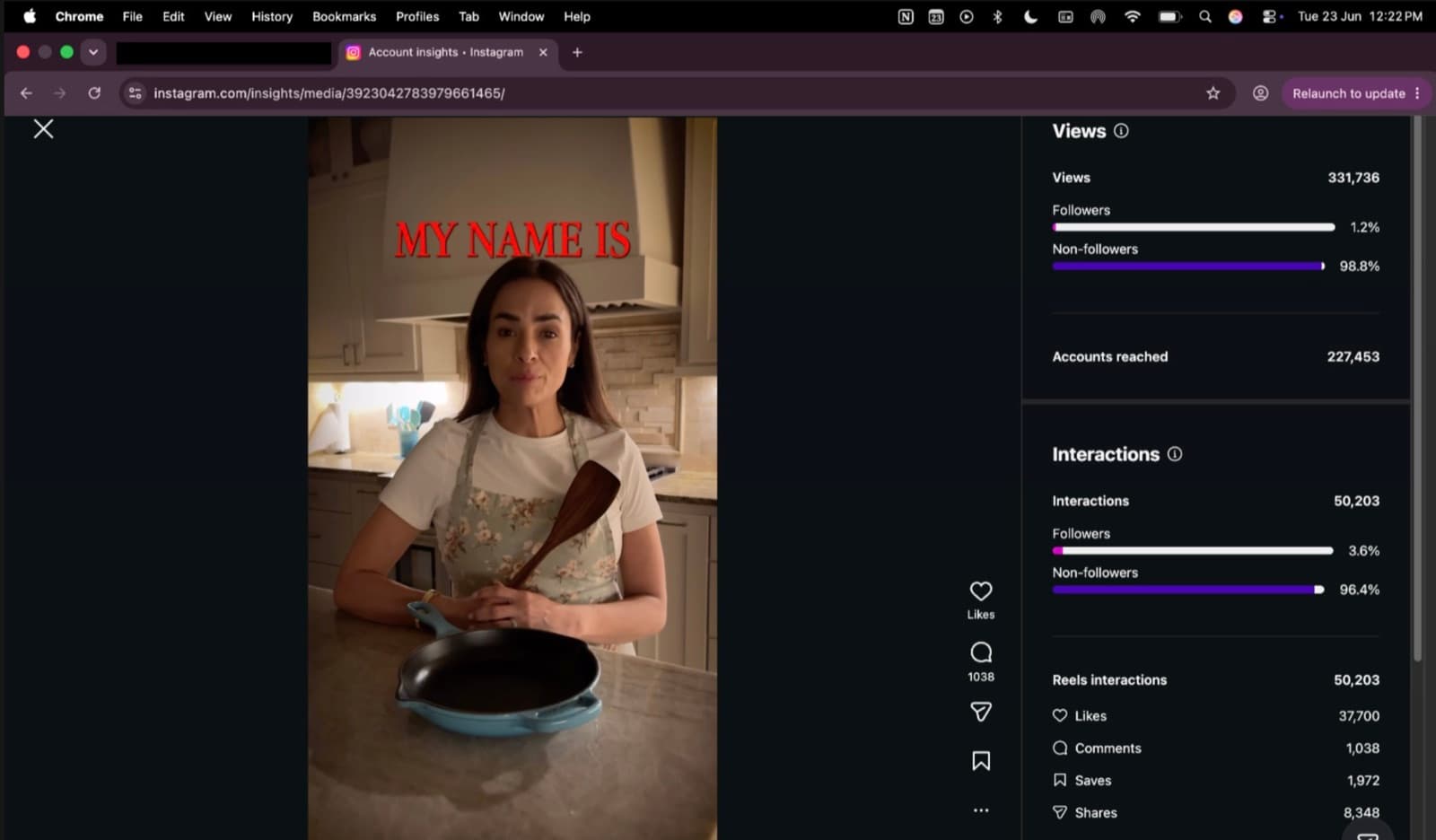
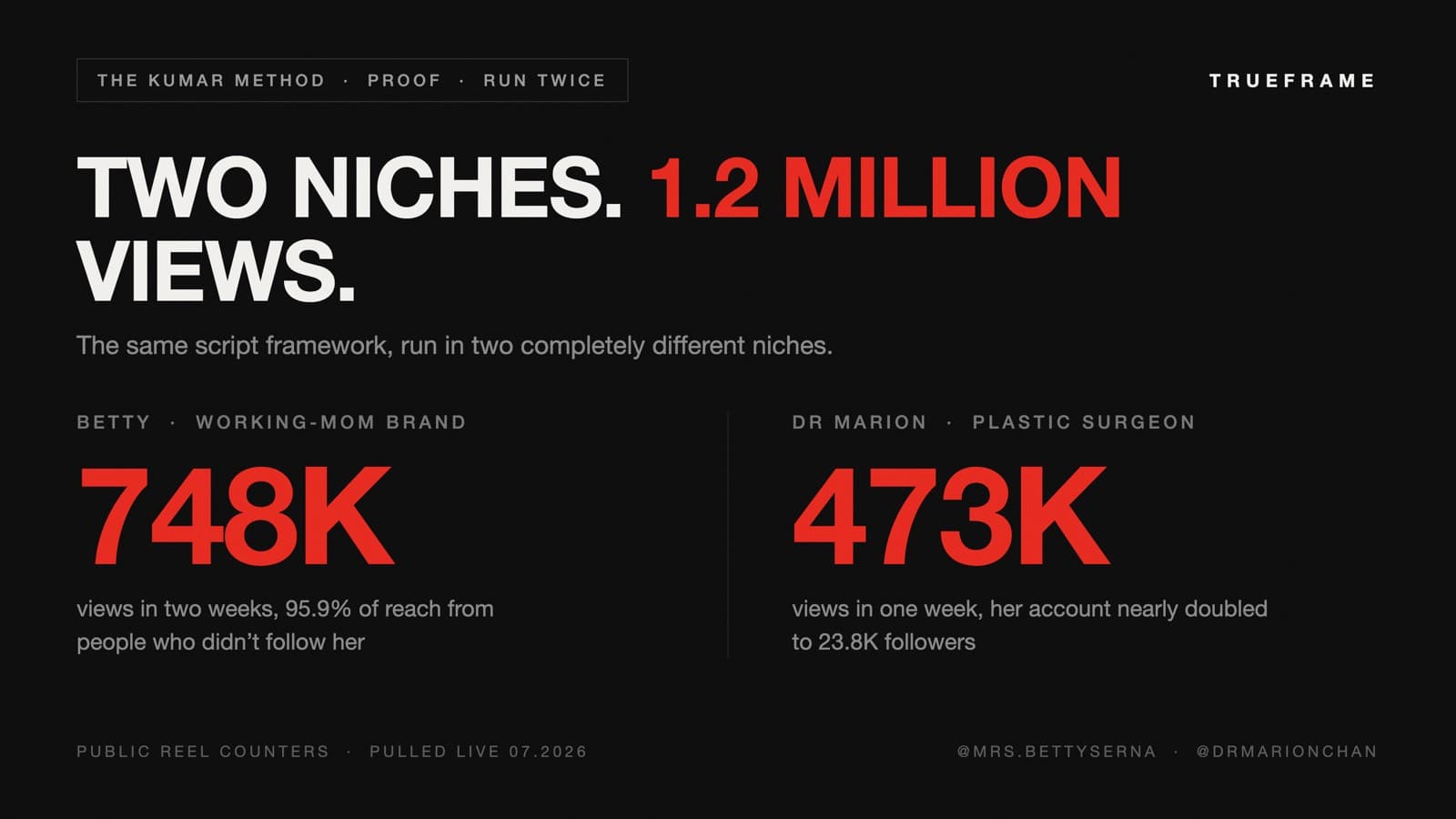
331,000 views in the first three days, 748,000 by week two. 9,674 shares inside the first week. And 98.8% of the launch reach was people who didn't follow her yet. That last number is the one that matters, because it means the algorithm kept pushing the video to new feeds instead of recycling it to people who already knew her. None of that came from the lighting. It came from a script written for her niche and an edit that put cinema on top of plain phone footage. Those are the two parts the flops get wrong, and the two parts we got right for her.
Then it happened again. Dr Marion, a specialist plastic surgeon, ran the same two hard parts and did 473,000 views in a week. Her account nearly doubled to 23.8K followers. Two clients, two niches, zero flops, because the script and the edit were right both times.
Want a video like Betty's, done right?
You shoot about 20 minutes on your phone. We write the script for your niche, direct it, and build the whole cinematic video. We only take five Kumar Method builds a week while the format is hot.
Get your Kumar style video hereThe two parts that decide whether it lands
Strip away the six failure modes and you're left with two things that actually move the needle. The first is the script written for your specific niche: the concept that rides the format without copying the man, the real contrast, the character on a mission, and lines sharp enough that people share them. The second is the edit that puts cinema on plain phone footage: the two-scene contrast, the lighting choices, the pacing, the push-ins, the color. Most people get both of these wrong, which is why most copies flop. They're also exactly the two parts we do for clients.
We teach the shape of the method openly, the call-out, the broken expectation, the mission, the two scenes on a phone. The exact script for your niche, the fill-in lines that make people laugh and screenshot, stays the part we write for you, because that writing is what separates a video like Betty's from another clone that dies at four hundred views.
Want the full prompting guide?
Get the one-page prompting guide and both Kumar reference photos by email.
No spam. Unsubscribe anytime.
Have us do the part that flops, or learn it free
Here's the offer, and it costs nothing to find out if it's a fit. Book a call and we go through the whole method for your niche, live, on the call. Worst case, you walk away knowing exactly how to do the Kumar Method yourself and you go run it. Best case, we're a good fit, and we build the entire video for you the way we did for Betty. You shoot the A-roll, we handle the rest. We only take five of these a week, because the build is hands-on and the format won't stay hot forever.
Book a call and learn the Kumar Method, free
Worst case, we show you exactly how to do it for your niche and you run it yourself. Best case, we're a good fit and we build the whole video for you, the way we did for Betty. You shoot the A-roll, we handle the rest. Only five builds a week, so grab a spot before they're gone.
Get your Kumar style video hereThe short version
- The Kumar Method is the most copyable format on Instagram, so it's flooded with clones, and the audience and algorithm both bury clones. That's why most copies flop.
- The biggest mistake is reskinning Kumar instead of bringing your own concept. Copy the method, never the man.
- People copy the moody aesthetic, not the structure. The look is the easy ten percent. Contrast plus a character on a mission is the ninety percent that matters.
- No real contrast means no hook. Pick a label people expect to be boring, then shoot it cinematic. A premise that's already interesting kills the double take.
- Sharp packaging gets attention, only substance holds it. A weak script flops even with great production. Showing up late as clone four hundred flops too.
- The script for your niche and the edit that makes phone footage cinematic are the two parts that decide whether it lands. They're the two parts we do for you. Betty did 748K views on zero spend, and Dr Marion did 473K in a week.
Keep reading
Don't miss the next one
Some of what we share is time-sensitive. A format that's working right now, a window that closes fast. We email those the moment they're worth jumping on. Drop your email so you catch them in time.
No spam. Unsubscribe anytime.
Frequently asked questions
Why did my Kumar Method video flop?
Do Kumar Method copies still work?
What's the biggest mistake people make copying Kumar?
Can the Kumar Method work in my niche?
Is it too late to do the Kumar Method?
Founded & led by
Benjamin Chua (BenChuchu)
Founder and CEO of Trueframe. 9 years building businesses (started at 16), tens of millions of views generated, and 8 figures in revenue created for the founders and brands he works with. He builds the content systems Trueframe runs.