How B2B Founders Use YouTube to Drive Pipeline (Not Subscribers)
Subscribers and views are the wrong scoreboard for a B2B founder on YouTube. Here's how to use the channel as a high-intent search engine that turns watch-time into qualified pipeline.

Written by Benjamin Chua, founder of Trueframe.
On this page
- 1. Treat YouTube as a search engine, not a feed
- 2. Make videos for what your buyer searches, not for thought leadership
- 3. Use depth to close. A 12-minute teardown does what a clip can't
- 4. You don't need to become a YouTuber to win on YouTube
- 5. Use YouTube for mid-funnel and retargeting, not just discovery
- Stop counting subscribers. Start counting booked calls
Most B2B founders treat YouTube like a popularity contest. That's why it does nothing for their pipeline.
You start a channel. You watch the subscriber count. It crawls. A video gets a few thousand views, the number barely moves, and you decide YouTube is a young person's game that doesn't apply to a serious B2B company. So the channel goes quiet, and the one place your buyer actually goes to research a problem sits empty.
The channel wasn't the problem. The scoreboard was. You were counting subscribers when the only thing that pays you is booked calls.
YouTube is the most underrated pipeline channel in B2B, and it's underrated for one reason. Founders judge it by the metrics that matter for entertainers, not the metrics that matter for someone trying to fill a pipeline.
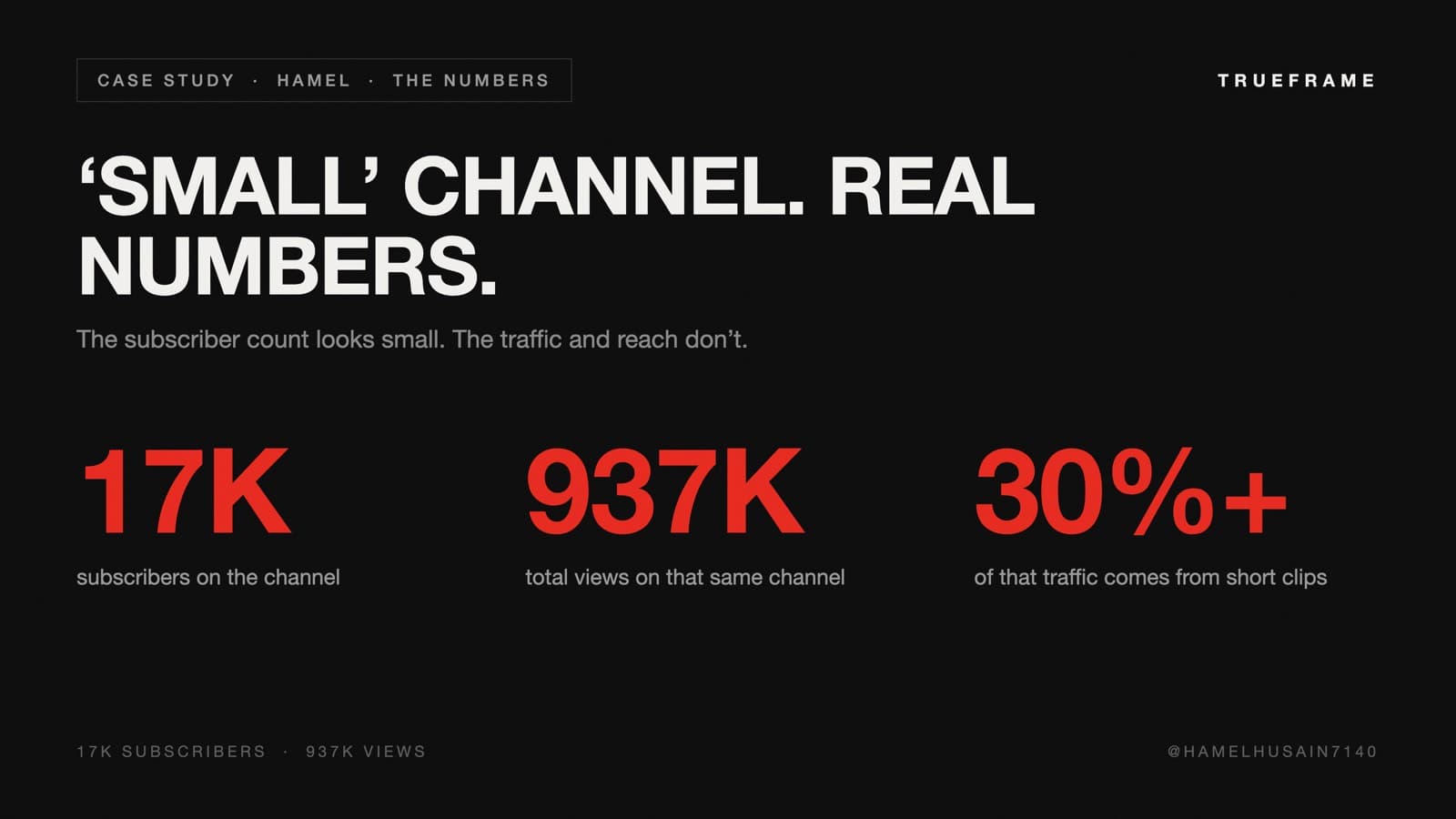
We've built content engines for more than 40 founders and brands. One B2B founder we produce for has tracked six figures in qualified pipeline back to specific videos, every lead pointing to a piece of content as the reason they trusted him enough to reach out. Hamel Husain pulls more than 30% of his YouTube traffic from short clips, on a channel sitting at 17K subscribers and 937K views. Neither of those wins came from chasing a bigger number.
On YouTube, a B2B buyer searching for their exact problem is worth more than ten thousand subscribers who'll never buy.
Here's how a B2B founder actually uses YouTube as a pipeline channel. Five shifts. None of them are about going viral or hitting a subscriber milestone.
1. Treat YouTube as a search engine, not a feed
This is the shift that changes everything. TikTok and Instagram are feeds, where content gets fed to people who weren't looking for it and disappears in a day. YouTube is the second largest search engine in the world. Your buyer types a problem into the search bar and YouTube serves them an answer, sometimes one you posted two years ago.
That changes what good content even means. On a feed you fight for attention from people who didn't ask. On YouTube you show up for someone who is actively searching for help with the exact problem your product solves. That person isn't browsing. They're researching a purchase. The intent is already there before they hit play.
A video on YouTube is evergreen in a way a feed post never is. A post gets its views in the first 48 hours and then it's gone. A YouTube video keeps getting found through search for years, which means the work you do this month keeps pulling in buyers long after you've forgotten you made it. That's the difference between renting attention and owning a sales asset.
2. Make videos for what your buyer searches, not for thought leadership
Most founder channels are full of broad thought-leadership videos. The future of the industry. My take on where things are heading. Big-picture content nobody is searching for, that gets a polite few hundred views and drives zero pipeline.
Your buyer doesn't search for your worldview. They search for the specific problem in front of them right now. How to do the thing they're stuck on. Whether to choose option A or option B. Why the approach they tried isn't working. Make the videos that answer those searches and you stop competing for attention and start intercepting demand that already exists.
The objection is always, that feels too narrow, won't a how-to video get fewer views? Yes, and that's the point. A narrow search-intent video reaches fewer people and far higher intent. The person who searched the exact problem you solve is closer to a sale than ten thousand people who watched your hot take and forgot it by lunch.
The exact opening lines we use to make a searching B2B buyer keep watching instead of bouncing to the next result. Swipe them for your own videos.
Get the hooks free3. Use depth to close. A 12-minute teardown does what a clip can't
A B2B buyer with a real budget on the line doesn't get convinced in 60 seconds. A short clip can earn a follow. It can't carry the weight of someone deciding to bet part of their business on you. That decision needs depth, and depth is exactly what YouTube is built for.
Give a serious buyer a long-form video where you reason through their problem in full, where you show the tradeoffs and the edge cases and the way you actually think, and watch-time turns into trust. Twelve minutes of you being genuinely useful does more for a complex sale than a hundred clips. By the time that buyer books a call, they've already spent more time with you than most prospects spend in a first sales meeting.
That's the part founders miss when they chase clip virality. Short clips are great for reach. They are not where a B2B deal gets won. The long-form teardown is the asset that does the convincing, and YouTube is the one platform where someone will happily give you twelve minutes because they came looking for exactly this.
See what content built to land clients looks like. We'll make you one, free, so you can judge the work before anything else.
Apply nowThis is the part most B2B founders never get to
We do the research, scripting, and editing so your channel is built around what your buyer searches and the depth that actually closes them. You record for about 90 minutes a month, and we run the rest.
See how the done-for-you system works4. You don't need to become a YouTuber to win on YouTube
The fear underneath every founder who avoids YouTube is the same. You started a B2B company to run a business, not to become a creator with a content calendar and a thumbnail obsession. If a channel means turning into a part-time YouTuber, you're right to refuse. So don't build it that way.
You don't need editing skills, a studio, or a personality for the algorithm. You need to know your buyer's problem better than anyone, which you already do. The founder films in one short session a month and a system handles the scripting, the editing, the SEO-optimized titles and thumbnails, the posting, and the tracking. You are the source of the thinking. You are not the production line.
Consistency beats intensity here more than anywhere, because YouTube rewards a back catalog. The founder who ships search-intent videos every week for a year ends up with dozens of evergreen assets pulling in buyers on autopilot. The one who films ten videos in a burst and quits has a graveyard. Depth compounds, but only if the channel keeps running, and it only keeps running if it doesn't depend on your spare time.
5. Use YouTube for mid-funnel and retargeting, not just discovery
Most founders think of YouTube only as a top-of-funnel discovery play. That's half the value. The bigger lever in B2B is the middle of the funnel, the long stretch between a buyer first hearing about you and signing.
A B2B sales cycle is long, and most of it is the buyer quietly building conviction before they ever talk to you. Your YouTube library is what they binge in that window. They watch three or four videos, see how you handle the objections they were about to raise, and show up to the call already half-sold. You can also retarget the people who visited your site with your best long-form videos, so the buyers already considering you keep getting deeper proof instead of another generic ad.
This is why the channel keeps paying off long after a video goes up. It's not just finding new buyers. It's warming the ones already in your pipeline, answering their doubts before the sales call, and turning a cold lead into someone who walks in already trusting you.
Before working with Ben and True Frame, I was spinning my wheels. I was creating content without strategy. Ben and his team built me a system requiring minimal time from me while generating serious results. I've tracked over six figures in converted pipeline revenue from qualified leads who referenced my specific content as trust building and helpful.
Robert T., founder
That's the whole game. Not a viral video. Not a subscriber milestone. Qualified buyers who referenced a specific video as the reason they reached out, traced all the way to revenue you can see.
Stop counting subscribers. Start counting booked calls
Subscriber count is the number that's easiest to see and least worth managing the channel by. It tells you how many people clicked a button once. It tells you nothing about whether the right buyer found the right video and booked a call.
Tag every call to action so a booked call traces back to the exact video that drove it. Watch how many sales conversations open with a buyer quoting something you said on camera. When a prospect shows up to a call referencing your twelve-minute teardown, the channel is working, no matter what the subscriber count says. That's the scoreboard for B2B. Everything else is vanity.
The short version
- Treat YouTube as a search engine, not a feed. Your buyer is actively searching for their problem.
- Make videos for what your buyer searches, not for broad thought leadership.
- Use depth to close. A 12-minute teardown does what a 60-second clip can't.
- You don't need to become a YouTuber. Film 90 minutes a month, let a system run the rest.
- Use YouTube mid-funnel and for retargeting, not just discovery.
- Count booked calls, not subscribers.
Subscribers feel like the point on YouTube. For a B2B founder they almost never are. The channels that drive real pipeline aren't the ones with the biggest numbers. They're the ones built around the buyer who's searching, deep enough to close a serious deal, and tracked all the way to a booked call.
You don't need a million subscribers. You need the right buyer finding the right video, then booking a call.
Keep reading
Want this built for you?
We build and run the whole YouTube channel for B2B founders, from search-intent strategy to scripting to editing to tracking. You record in one short session a month, and we turn your channel into pipeline you can actually see.
See how it worksSkip the reading. Talk it through instead.
Book a fit call and we'll map out what a content engine looks like for your business. No pitch, no pressure.
Don't miss the next one
Some of what we share is time-sensitive. A format that's working right now, a window that closes fast. We email those the moment they're worth jumping on. Drop your email so you catch them in time.
No spam. Unsubscribe anytime.
Frequently asked questions
Does YouTube actually work for B2B, or is it just a B2C thing?
How many subscribers do I need before this pays off?
Won't a YouTube channel eat all my time?
Long-form or short clips, which one should a B2B founder do?
How do I know if YouTube is actually driving deals and not just views?
Founded & led by
Benjamin Chua (BenChuchu)
Founder and CEO of Trueframe. 9 years building businesses (started at 16), tens of millions of views generated, and 8 figures in revenue created for the founders and brands he works with. He builds the content systems Trueframe runs.