Before-and-After Content for Aesthetic Clinics: US and Australia
A signed release does not make a comparison accurate, balanced or lawful. Govern the patient, capture, claim, context and final use as one record.

Written by Benjamin Chua, founder of Trueframe.
On this page
- Why before-and-after content is easy to get wrong
- Gate 1: permission and privacy are use-specific
- Gate 2: standardise the capture
- Gate 3: review the claim the viewer receives
- Gate 4: Australia and the US are different
- Gate 5: approve the exact final use
- When not to use the comparison
- A safer content mix does not depend on transformations
This is an operational guide, not legal advice or a compliance certificate. Rules vary by service, profession, state, territory, platform and exact use. The clinic's authorised reviewers remain responsible for the final decision.
Before-and-after content is not one permission problem. It is five linked controls: the patient and privacy basis, the capture conditions, the implied claim, the surrounding context and the exact approved publication. If one gate fails, do not publish the comparison.
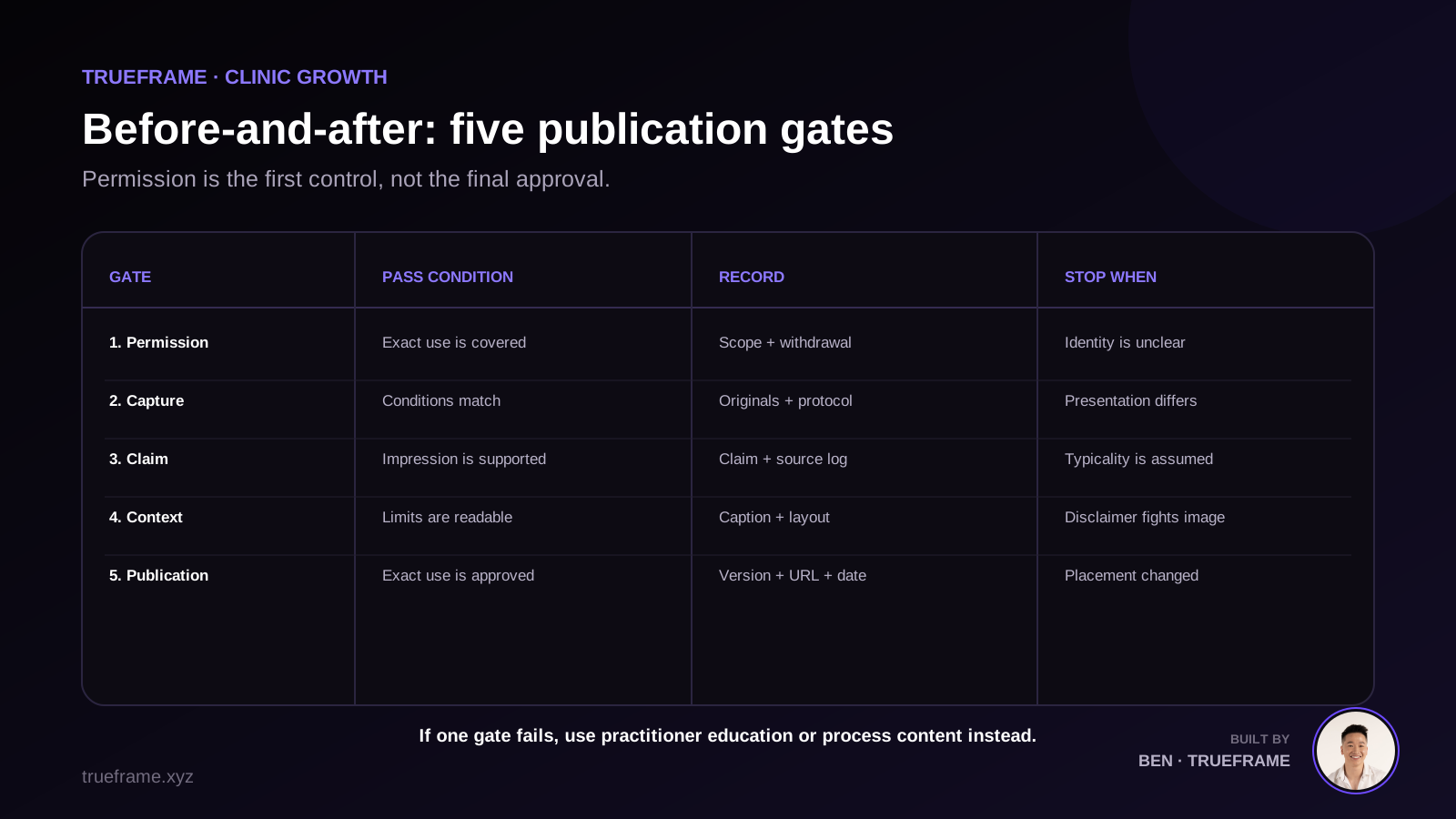
Swipe sideways to inspect the full graphic.
Why before-and-after content is easy to get wrong
A comparison can use two genuine photographs and still mislead. Different lighting, lens distance, posture, expression, makeup, clothing, timing, swelling, hydration, crop or colour treatment can make the apparent change larger or smaller. The caption can also imply typicality, certainty or causation the images do not establish.
Benjamin Chua
Clinic content control
6
printable pages
PDF · Version 1.0 · Updated Sept 2026
Clinic Before-and-After Consent, Capture and Approval Checklist
Record the permission scope, standardise the images, review the claims and approve the exact final placement before use.
- Separate permission, capture, claims, context and publication gates
- A standardised photo record for lighting, angle, timing and edits
- US and Australia review prompts plus a withdrawal and archive log
| Gate | Pass condition | Evidence kept |
|---|---|---|
| 1. Patient and privacy | The exact use has the required consent or authorization and privacy basis | Signed scope, identity record, withdrawal route and reviewer |
| 2. Capture | Images use a documented, consistent protocol and preserve originals | Date, interval, device, lens, distance, angle, lighting, pose and unedited files |
| 3. Claim | Express and implied claims are accurate, supported and not overstated | Claim log, source, case facts and clinical review |
| 4. Context | Labels, timing, limitations, risk and surrounding copy support an accurate overall impression | Final caption, layout, call to action and placement |
| 5. Publication | The exact final asset and destination are approved and monitored | Version, approver, date, URL, expiry and removal status |
Gate 1: permission and privacy are use-specific
A treatment consent form and a marketing authorization do different jobs. The record should name the information and images, intended channels, audience, paid or organic use, duration, editing scope, whether withdrawal is possible and what happens to material already distributed. Use the clinic's legally reviewed form and process rather than copying a generic release from another market.
For US covered entities, HHS explains that the HIPAA Privacy Rule generally requires written authorization before protected health information is used or disclosed for marketing, subject to limited exceptions. HHS also says media personnel generally cannot enter treatment areas where PHI is accessible without prior written authorization from each affected individual, and later blurring is not a substitute for preventing the access in the first place.
- Separate treatment consent from public marketing permission or authorization.
- Do not pressure a person to agree while treatment access or care feels dependent on the decision.
- Offer a documented way to ask questions, decline and request withdrawal where applicable.
- Store the originals and permission record with role-based access.
- Keep bystanders, charts, screens, labels, conversations and other patient information out of the capture area.
Gate 2: standardise the capture
Create a repeatable photography protocol for each body area and view. The aim is not perfect studio aesthetics. It is a comparison where the presentation itself does not manufacture the result. If a condition cannot be reproduced, record the difference and consider whether the pair should be used at all.
| Variable | Record | Avoid |
|---|---|---|
| Timing | Capture dates, interval and relevant stage named by the clinical reviewer | An unlabeled interval that implies an immediate or permanent result |
| Device and lens | Same device, lens and focal setting where practical | Wide-angle distortion or unexplained device change |
| Distance and framing | Marked camera and subject position with consistent crop | Closer after image or selective crop |
| Lighting and background | Same light direction, intensity and neutral background | Dramatic shadow in one image only |
| Pose and expression | Repeatable position, expression and muscle state | Different posture, smile, flex or head angle |
| Preparation | Consistent makeup, clothing, hair and skin preparation where relevant | A styling change that creates the apparent outcome |
| Edits | Original files plus a logged, identical processing recipe | Retouching, reshaping, filters or unequal correction |
Build the capture and review system before the filming day
Trueframe plans privacy-safe shot lists, capture standards, source logs, scripts, edits and exact final approval around the clinic's own authorised reviewers.
See video content for aesthetic clinicsGate 3: review the claim the viewer receives
The claim is not limited to the words. The image order, difference in presentation, headline, emoji, music, voiceover, caption and booking prompt all contribute to the overall impression. Ask what a reasonable viewer may believe about the cause, magnitude, timing, typicality, permanence and suitability of the result.
| Possible impression | Question for the reviewer | Safer operating response |
|---|---|---|
| This result is typical | What evidence supports representativeness? | Do not imply typicality from a selected case; add accurate context without relying on a disclaimer to cure the image |
| The service caused the whole change | What else changed during the interval? | Record relevant confounders and remove the pair if attribution cannot be presented accurately |
| The outcome is guaranteed | Does any visual or phrase imply certainty? | Remove certainty and explain that an individual consultation is required |
| The result is immediate or permanent | Are timing and duration clear and supported? | Label the interval and avoid permanence claims without evidence |
| The viewer is suitable | Does the call to action skip assessment? | Route to a consultation, not a promised treatment outcome |
Gate 4: Australia and the US are different
| Issue | Australia | United States |
|---|---|---|
| Advertising standard | Regulated health-service advertising must not be false, misleading or deceptive, create unreasonable expectations or encourage unnecessary use | FTC principles require advertising claims to be truthful, not misleading and appropriately substantiated; state and professional rules may add duties |
| Cosmetic procedure guidance | Specific Ahpra and National Board guidance applies to advertising higher-risk cosmetic procedures | Requirements vary by service, provider type, state and applicable federal jurisdiction |
| Testimonials | Clinical testimonials in regulated health-service advertising are prohibited; a caption or patient story can create a separate issue | Permission and disclosure do not replace privacy compliance or claim substantiation |
| Therapeutic goods | TGA rules can prohibit public advertising of prescription-only therapeutic goods, including direct or indirect references | FDA, FTC and state requirements can apply depending on the product, service and claim |
| Patient information | Use applicable privacy, health-record, professional and consent requirements | HIPAA may apply to covered entities and business associates, alongside state privacy and professional rules |
Australia's higher-risk cosmetic procedure guidance includes specific expectations for images and social media, so read the current source for the exact procedure and content. In the US, do not reduce the review to HIPAA. HIPAA privacy authorization and FTC claim substantiation answer different questions, and state rules can be more specific.
Gate 5: approve the exact final use
Approval must attach to the actual crop, sequence, caption, on-screen text, audio, link, audience and channel. A pair approved for an educational page is not automatically approved for a paid social ad. Material changes, new placements or a new claim require a new review.
- Match the final asset to the patient and permission or authorization record.
- Compare the final files with the originals and capture log.
- List every express and implied claim with its supporting source or case fact.
- Review labels, timing, limitations, headline, caption, audio and call to action together.
- Check the current rules for the region, profession, procedure, therapeutic goods and platform.
- Record the final approver, version, date, placements, review date and removal owner.
- Monitor the live post, comments and reuse so later context does not create a new issue.
When not to use the comparison
- The permission scope, identity or withdrawal status cannot be confirmed.
- Original files or capture conditions are missing.
- Lighting, pose, expression, styling or edits materially change the apparent result.
- The post needs a small disclaimer to counter a large misleading impression.
- The case is being presented as typical without supporting evidence.
- The service, therapeutic-good reference, testimonial context or audience creates unresolved regulatory risk.
- The clinic cannot keep the exact final asset and approval record together.
Not publishing one comparison is cheaper than building a system around material the clinic cannot defend. Use practitioner education, process standards, consultation explanations and access content instead.
A safer content mix does not depend on transformations
| Format | What it can show | Review focus |
|---|---|---|
| Practitioner decision | What information changes a recommendation | No remote diagnosis or guarantee |
| Consultation walkthrough | What happens and what to prepare | Privacy-safe filming and accurate process |
| Standards and process | How the clinic controls documentation and hand-offs | No patient information in frame |
| Suitability boundary | Why a practitioner may advise against rushing | Balanced, non-diagnostic explanation |
| Access answer | Location, timing, booking and follow-up | Accurate operational information |
Keep one record per approved comparison
- Use-specific permission or authorization and privacy basis.
- Original files and a repeatable capture log.
- Express and implied claim review with sources.
- Exact caption, layout, audio, call to action and placement.
- Final approver, review date, publication URLs and withdrawal status.
Build a safer clinic content system
Sources and review date
We use primary official sources for rules and platform guidance. This article is general information, not medical or legal advice.
- Guidelines for advertising a regulated health service · Ahpra and National BoardsReviewed 12 August 2026
- Guidelines for advertising higher risk non-surgical cosmetic procedures · Ahpra and National BoardsReviewed 12 August 2026
- Advertising health services and cosmetic injections: frequently asked questions · Therapeutic Goods AdministrationReviewed 12 August 2026
- Marketing and the HIPAA Privacy Rule · U.S. Department of Health and Human ServicesReviewed 2 September 2026
- Film crews, treatment areas and prior written authorization · U.S. Department of Health and Human ServicesReviewed 2 September 2026
- Health Products Compliance Guidance · U.S. Federal Trade CommissionReviewed 2 September 2026
Skip the reading. Talk it through instead.
Book a fit call and we'll map out what a content engine looks like for your business. No pitch, no pressure.
Don't miss the next one
Some of what we share is time-sensitive. A format that's working right now, a window that closes fast. We email those the moment they're worth jumping on. Drop your email so you catch them in time.
No spam. Unsubscribe anytime.
Frequently asked questions
Can aesthetic clinics post before-and-after photos in Australia?
Can med spas post before-and-after photos in the United States?
Is patient consent enough for before-and-after marketing?
Can clinics edit before-and-after photos?
Should a before-and-after post say results vary?
How long should a clinic keep the consent and image record?
Founded & led by
Benjamin Chua (BenChuchu)
Founder and CEO of Trueframe. 9 years building businesses (started at 16), tens of millions of views generated, and 8 figures in revenue created for the founders and brands he works with. He builds the content systems Trueframe runs.