Aesthetic Clinic Content Marketing Costs: What You Actually Pay
The honest price is not one agency fee. It is production, internal time, review, distribution, tools and the work left with the clinic.

Written by Benjamin Chua, founder of Trueframe.
On this page
Aesthetic clinic content marketing can cost a few hundred dollars for isolated editing or several thousand dollars each month for a managed system. The useful number depends on what the quote actually removes from the clinic, what remains internal and whether distribution, review and conversion work are included.
| Buying model | Working range | Usually included | Usually left with the clinic |
|---|---|---|---|
| Supplied-footage short edit | $150-$750/video | One vertical edit, captions, music and limited revisions | Idea, script, filming, approval, posting and measurement |
| Short-form content batch | $1,500-$6,000/month | Several edits from supplied or remotely recorded footage | Scope varies; often strategy, capture and distribution |
| Ongoing content system | $2,000-$10,000+/month | Some mix of research, strategy, scripts, direction, editing and review | On-site production, media and conversion work may be separate |
| On-site capture or campaign | $3,000-$50,000+/project | Defined concept, production and post-production | Ongoing publishing, optimisation and media unless stated |
| In-house editor | $70,980 US median annual wage before extras | One editing role | Strategy, filming, software, benefits, management and other content roles |
These are broad planning ranges, not aesthetic-clinic averages or Trueframe quotes. They combine current public marketplace and production-pricing data with the scope patterns already published in our general video cost guide. Currency, location, crew, volume and ownership change the total quickly.
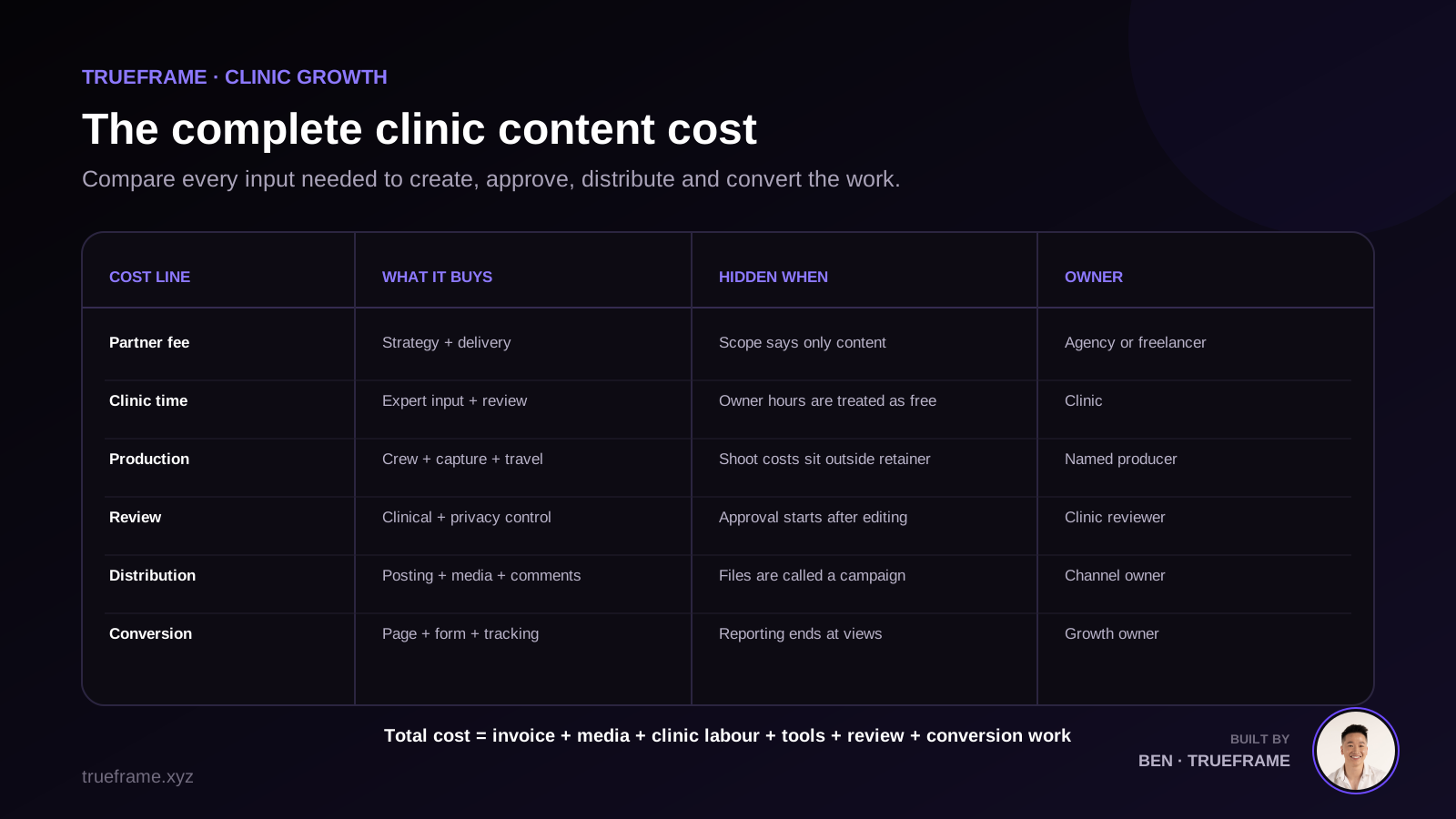
Swipe sideways to inspect the full graphic.
Start with total operating cost, not the retainer
Benjamin Chua
Clinic buying worksheet
6
printable pages
PDF · Version 1.0 · Updated Sept 2026
Clinic Content Quote Comparison and ROI Worksheet
Normalise competing quotes, expose work left with the clinic and calculate the consultation economics required to support the spend.
- A line-by-line quote normaliser for strategy, filming, editing and distribution
- A total-cost calculator including clinic time, review and media
- Break-even consultation formulas and a 90-day evidence scorecard
A lower agency fee can still be the expensive option when it leaves the clinic owner writing scripts, the practitioner re-recording weak briefs, the front desk posting manually and an external reviewer rebuilding claims at the end. Put a value on the time and rework that each quote leaves behind.
Monthly total cost = partner fees + media + clinic labour + production expenses + software + review costs + landing-page or tracking work.
| Cost line | Questions to ask | Common omission |
|---|---|---|
| Strategy and research | Who chooses the audience, questions, messages and monthly priorities? | A calendar of topics with no decision logic |
| Scripts and clinical input | Who interviews the practitioner, drafts the claims and records sources? | Clinic rewrites every script after delivery |
| Capture | Remote or on-site, how many hours, who supplies crew, location and equipment? | Travel, overtime, reshoots or clinic disruption |
| Post-production | How many masters, cutdowns, captions, formats and revision rounds? | Platform versions and accessibility captions |
| Review and approvals | Who prepares the source log and routes the exact final version? | Regulated review begins only after the edit is finished |
| Distribution | Who posts, writes captions, manages comments and supplies media? | A folder of files with no publishing owner |
| Measurement and conversion | Who owns tracking, landing pages, enquiry attribution and the review meeting? | Reporting stops at views or clicks |
What each buying model is really for
Editing-only freelancer
Buy editing when the clinic already has a reliable research, scripting, filming, approval and publishing workflow. The editor should receive clean footage, an approved brief and a clear version list. If those inputs are missing, the low hourly rate often produces more management work than savings.
Specialist monthly partner
Buy a managed content system when consistency and ownership are the problem. The scope should name the monthly decisions, capture cadence, deliverables, approval steps, analytics and what the clinic still owns. A vague promise of 'social media management' is not enough.
Campaign or capture project
Buy a project when the clinic needs a defined bank of assets, launch package or higher-production campaign. Confirm how many finished outputs the shoot creates, which usage rights apply and who turns the assets into an ongoing calendar after delivery.
In-house hire
An internal hire makes sense when the clinic has enough recurring work, management capacity and complementary skills to keep the role productive. An editor is not automatically a strategist, producer, camera operator, copywriter, compliance owner, media buyer and conversion analyst.
Compare the complete clinic content system
Trueframe scopes strategy, scripting, filming direction, editing, review routing and measurement around the work the clinic actually needs removed.
See the clinic video systemNormalise two quotes before choosing
- Convert each quote to the same period, currency and tax basis.
- List the exact number and definition of finished assets, not just 'content'.
- Mark who owns research, scripts, filming, approval, posting, comments and reporting.
- Add excluded production, travel, talent, studio, software, usage and media costs.
- Estimate clinic hours for the owner, practitioner, front desk and reviewer.
- Write the first 90-day evidence gate and the earliest point the clinic can stop or rescope.
- Compare total operating cost and residual work, then compare the invoice.
| Scope item | Quote A | Quote B | Clinic decision |
|---|---|---|---|
| Twelve short videos | Editing from supplied footage | Research, scripts, direction and edits | Are the inputs already owned internally? |
| Filming | Not included | One remote session | Can the practitioner self-record reliably? |
| Approval workflow | Two edit revisions | Source log plus final approval route | Who owns regulated review before editing? |
| Publishing | Files delivered | Captions and scheduled posts | Does the clinic have a publishing owner? |
| Measurement | Monthly views report | Page, enquiry and consultation review | Which evidence changes next month's plan? |
Calculate a responsible break-even point
Do not divide the fee by the treatment's headline price. Use the clinic's own contribution after direct treatment costs, then account for the steps between an enquiry and a new patient. Keep the assumptions visible so the team can replace them with real numbers.
Maximum acquisition cost per enquiry = contribution per new patient × enquiry-to-booking rate × attendance rate × consultation-to-new-patient rate × acceptable acquisition share.
Illustrative only: if contribution is $1,000, 30% of enquiries book, 80% attend, 50% become new patients and the clinic is willing to invest 25% of contribution in acquisition, the implied ceiling is $30 per enquiry. Change every input to the clinic's records. The example is not a benchmark or forecast.
Australia and US costs are not interchangeable
Exchange rates and crew rates are obvious differences. The less visible difference is review work. Australian clinics may need Ahpra, National Board and TGA analysis around regulated services, higher-risk procedures, testimonials and therapeutic goods. US clinics may need HIPAA authorization controls, state professional review and substantiation for objective claims. A quote that ignores the applicable workflow may look cheaper because the risk and rework sit with the clinic.
| Question | Good evidence | Warning |
|---|---|---|
| Did the system ship? | Approved assets published on the promised cadence | A large backlog of drafts or repeated reshoots |
| Did it help patient decisions? | Saves, relevant questions, useful page visits and source-labelled enquiries | Views with no connection to clinic intent |
| Did it reduce clinic load? | Fewer owner hours and clearer approvals after the first cycle | The clinic still briefs and fixes every step |
| Did the path convert? | Qualified enquiries and consultations reconciled to clinic records | Platform leads reported as patients |
| Did the team learn? | Next month's choices follow named winning or weak messages | The same calendar repeats regardless of evidence |
The buying rule
- Compare the work removed, not the number of files delivered.
- Keep media, production, internal time and review visible as separate cost lines.
- Use public ranges for planning, then demand a quote tied to exact scope.
- Calculate break-even from contribution and real conversion rates, not headline treatment revenue.
- Commit to a 90-day evidence gate without expecting guaranteed bookings.
Continue the buying decision
Sources and review date
We use primary official sources for rules and platform guidance. This article is general information, not medical or legal advice.
- Video Production Pricing Guide 2026 · ClutchReviewed 2 September 2026
- How much does hiring a video editor cost? · UpworkReviewed 2 September 2026
- Film and video editors and camera operators · U.S. Bureau of Labor StatisticsReviewed 2 September 2026
- Guidelines for advertising a regulated health service · Ahpra and National BoardsReviewed 12 August 2026
- Guidelines for advertising higher risk non-surgical cosmetic procedures · Ahpra and National BoardsReviewed 12 August 2026
- Advertising health services and cosmetic injections: frequently asked questions · Therapeutic Goods AdministrationReviewed 12 August 2026
- Film crews, treatment areas and prior written authorization · U.S. Department of Health and Human ServicesReviewed 2 September 2026
Skip the reading. Talk it through instead.
Book a fit call and we'll map out what a content engine looks like for your business. No pitch, no pressure.
Don't miss the next one
Some of what we share is time-sensitive. A format that's working right now, a window that closes fast. We email those the moment they're worth jumping on. Drop your email so you catch them in time.
No spam. Unsubscribe anytime.
Frequently asked questions
How much does aesthetic clinic content marketing cost?
Why do two clinic content quotes differ so much?
Should ad spend be included in an agency retainer?
Is a freelancer cheaper than a content agency?
How should a clinic calculate content ROI?
Does a higher content budget guarantee more bookings?
Founded & led by
Benjamin Chua (BenChuchu)
Founder and CEO of Trueframe. 9 years building businesses (started at 16), tens of millions of views generated, and 8 figures in revenue created for the founders and brands he works with. He builds the content systems Trueframe runs.