Instagram Reels for Aesthetic Clinics: 7 Formats That Build Trust
A practical Reels system for clinics that need useful ideas, a repeatable filming day and a safer route from attention to a consultation.

Written by Benjamin Chua, founder of Trueframe.
On this page
- Why most aesthetic clinic Reels underperform
- The seven Reel formats
- 1. The real patient question
- 2. The practitioner decision
- 3. The consultation walkthrough
- 4. The suitability boundary
- 5. The process and standards Reel
- 6. The myth and mechanism check
- 7. The clinic access answer
- Build the 30-day matrix
- Film twelve Reels without turning the clinic into a set
- Australia and the US need different review lanes
- Measure trust as a path
The best aesthetic clinic Reels do not begin with a trend. They begin with a decision a prospective patient is already trying to make. Build each video around one question, one credible answer, one piece of supporting context and one next step.
The 30-second answer
- Use seven repeatable formats instead of inventing a new concept every week.
- Make the practitioner the source of judgement and let editing improve clarity, not manufacture authority.
- Separate educational content, patient material and promotional offers into different review lanes.
- Measure the path from Reel to useful action, not views in isolation.
- In Australia and the US, build privacy and advertising review into the brief before filming.
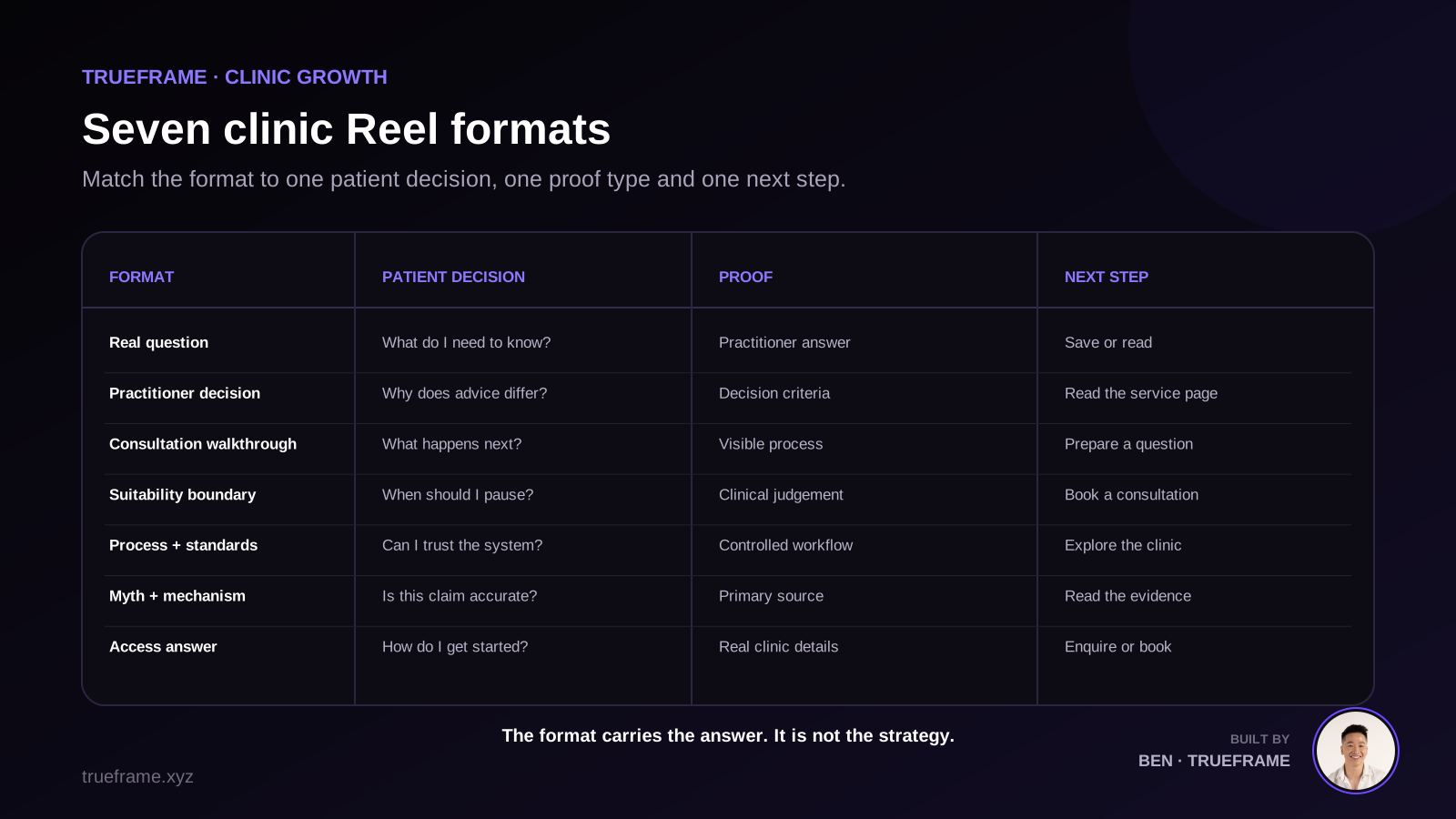
Swipe sideways to inspect the full graphic.
Why most aesthetic clinic Reels underperform
Most weak clinic feeds have one of two problems. The videos are generic enough to come from any clinic, or they lean so hard on transformations and promotional language that they create approval risk. Both problems come from starting with the asset instead of the patient decision.
Benjamin Chua
Clinic content planner
6
printable pages
PDF · Version 1.0 · Updated Sept 2026
30-Day Clinic Reels Matrix
Choose the right format, question, proof, reviewer and next action for a full month of clinic Reels.
- Seven trust-building Reel formats and when to use each one
- A four-week topic grid with hooks, proof and next actions
- A filming-day checklist, approval lane and weekly scorecard
| Weak approach | Why it stalls | Better brief |
|---|---|---|
| A trend with a treatment name added | The trend supplies attention but no reason to trust this practitioner | Use the trend only if it frames a real misconception the practitioner can correct |
| A silent treatment montage | It shows activity without explaining suitability, standards or judgement | Add one decision the viewer should understand before a consultation |
| A dramatic result with little context | The viewer cannot assess capture conditions, limits or relevance | Use a governed comparison workflow and balanced context, or choose another format |
| A broad 'five tips' list | The advice is easy to copy and often too shallow to change a decision | Answer one narrow question with a specific mechanism and boundary |
| A hard booking pitch on every post | The feed feels transactional before it has earned confidence | Match the call to action to intent: save, read, ask or book |
The seven Reel formats
1. The real patient question
Open with the exact question the clinic hears in consultations, then answer it in plain language. Good prompts include what a consultation is for, why two people may receive different recommendations, what information affects suitability, and when a practitioner may advise against proceeding. Do not diagnose a viewer or promise an outcome.
2. The practitioner decision
Explain one judgement call that separates a careful consultation from a menu of procedures. The structure is simple: what the practitioner looks at, why it matters, and what changes the decision. This shows expertise without leaning on patient praise.
3. The consultation walkthrough
Show the stages of a consultation using an empty room, staff member or controlled demonstration. Explain what happens before a recommendation, what information the clinic collects and what questions a person should bring. Keep real patient information, screens, charts, labels and voices out of frame unless the clinic has a documented lawful basis and approval for the exact use.
4. The suitability boundary
A useful practitioner is willing to say when a service may not be the next step. Frame the Reel around a boundary, such as why timing, medical history, expectations or another concern can change the plan. The aim is not remote screening. It is showing that the clinic has a decision process.
5. The process and standards Reel
Show what the clinic controls: preparation, documentation, team hand-off, equipment checks, consultation rooms or aftercare communication. Avoid filming identifiable patient information in the background. A checklist-driven filming route is safer and faster than hoping the editor can blur every risk later.
6. The myth and mechanism check
Take one common claim and separate what is known, what depends on the person and what the Reel cannot answer. In the US, objective health claims need appropriate support. In Australia, regulated health advertising and therapeutic-goods rules can shape the words, images and product references. Link the supporting public source when the claim matters.
7. The clinic access answer
Not every high-intent video needs a clinical claim. Explain how to prepare for a consultation, where the clinic is, what to bring, how long to allow, who the person will meet or what happens after an enquiry. These posts remove practical uncertainty and can drive action without outcome hype.
Turn one filming session into a month of useful clinic video
Trueframe plans the questions, scripts the openings, directs the filming, edits the variants and keeps the clinic's reviewer in control of the final material.
See video content for aesthetic clinicsBuild the 30-day matrix
A monthly plan should balance intent, not merely formats. Start with twelve Reels across four weeks. Give every week one discovery question, one trust question and one action question. Reuse the seven formats, but do not repeat the same promise or treatment cue.
| Week | Discovery | Trust | Action |
|---|---|---|---|
| 1 | Myth and mechanism: correct one common misconception | Practitioner decision: what changes a recommendation | Access answer: what happens after an enquiry |
| 2 | Real patient question: answer one narrow concern | Process and standards: show one controlled workflow | Consultation walkthrough: what to prepare |
| 3 | Suitability boundary: explain when not to rush | Practitioner decision: compare two decision paths without diagnosing | Access answer: who the person meets and what the visit covers |
| 4 | Myth and mechanism: source one high-interest claim | Process and standards: show the team hand-off | Real patient question: answer the objection most likely to delay booking |
Film twelve Reels without turning the clinic into a set
- Collect real questions from consultations, front-desk calls, search queries and comments, then remove patient identifiers.
- Choose twelve questions and assign one format, one answer owner and one reviewer to each.
- Write the opening and bullet logic, not a stiff paragraph the practitioner must memorise.
- Create a privacy-safe shot list before the camera enters any clinical area.
- Film direct answers first, then capture controlled supporting footage after the room has been checked.
- Edit the master answer, then create platform variants without changing the approved meaning.
- Review the exact caption, crop, on-screen text, audio, link and comments plan before publishing.
Australia and the US need different review lanes
| Question | Australia | United States |
|---|---|---|
| Patient praise | Clinical testimonials in regulated health-service advertising are prohibited; clinic-controlled social use needs close review | HIPAA, FTC, state professional rules and platform policy may apply; permission alone does not substantiate an outcome claim |
| Treatment or product language | Ahpra, National Board and TGA rules can overlap; prescription-only therapeutic goods must not be advertised to the public | FTC truth-in-advertising, FDA jurisdiction and state rules can apply depending on the service and claim |
| Filming in treatment areas | Use documented consent, privacy controls and the clinic's applicable state, territory and professional requirements | If HIPAA applies, HHS says prior written authorization is generally required before media access where PHI is accessible |
| Final approver | Nominated clinical or legal reviewer using current official guidance | Privacy, compliance and clinical owner using current federal, state and professional requirements |
A content calendar is not an approval record. Keep the exact final asset, sources, consent or authorization basis, reviewer, decision and date together.
Measure trust as a path
| Stage | Useful signals | Question to ask |
|---|---|---|
| Discovery | Qualified local reach, watch-through, new profile visits | Did the right local audience stop? |
| Understanding | Saves, shares, treatment-page visits, relevant comments | Did the answer help a real decision? |
| Intent | Appointment-link clicks, calls, direct enquiries with the topic named | Did the viewer take a sensible next step? |
| Conversion | Qualified enquiries, booked consultations, attendance by source where available | Did the path produce demand the clinic can serve? |
| Operations | Approval time, filming time, edit revisions, moderation issues | Can the clinic repeat the system safely? |
Use this rule on every Reel
- One patient decision, not five tips.
- One practitioner answer, not generic clinic copy.
- One piece of proof or process context.
- One region-appropriate approval lane.
- One next action that matches the viewer's intent.
Build the rest of the clinic content system
Sources and review date
We use primary official sources for rules and platform guidance. This article is general information, not medical or legal advice.
- Instagram and Facebook Reels ads · Meta for BusinessReviewed 2 September 2026
- Guidelines for advertising a regulated health service · Ahpra and National BoardsReviewed 12 August 2026
- Guidelines for advertising higher risk non-surgical cosmetic procedures · Ahpra and National BoardsReviewed 12 August 2026
- Advertising health services and cosmetic injections: frequently asked questions · Therapeutic Goods AdministrationReviewed 12 August 2026
- Marketing and the HIPAA Privacy Rule · U.S. Department of Health and Human ServicesReviewed 2 September 2026
- Film crews, treatment areas and prior written authorization · U.S. Department of Health and Human ServicesReviewed 2 September 2026
- Health Products Compliance Guidance · U.S. Federal Trade CommissionReviewed 2 September 2026
Skip the reading. Talk it through instead.
Book a fit call and we'll map out what a content engine looks like for your business. No pitch, no pressure.
Don't miss the next one
Some of what we share is time-sensitive. A format that's working right now, a window that closes fast. We email those the moment they're worth jumping on. Drop your email so you catch them in time.
No spam. Unsubscribe anytime.
Frequently asked questions
What should an aesthetic clinic post on Instagram Reels?
How often should an aesthetic clinic post Reels?
Can an Australian clinic use patient testimonials in Reels?
Can a US clinic film patients for Instagram?
Do clinic Reels need trends and trending audio?
How do you measure whether clinic Reels are working?
Founded & led by
Benjamin Chua (BenChuchu)
Founder and CEO of Trueframe. 9 years building businesses (started at 16), tens of millions of views generated, and 8 figures in revenue created for the founders and brands he works with. He builds the content systems Trueframe runs.