How to Choose an Aesthetic Clinic Marketing Agency
The best agency is not the one with the longest service list. It is the one that can name the clinic's bottleneck, prove relevant work and own the hand-offs it promises.

Written by Benjamin Chua, founder of Trueframe.
On this page
- Why the usual agency selection process fails
- Score seven things, not one sales call
- 1. Diagnosis and strategy
- 2. Relevant evidence
- 3. Regulated review and privacy workflow
- 4. Creative and production quality
- 5. Lead-to-consultation ownership
- 6. Measurement and learning
- 7. Access, communication and exit
- Use a 90-day pilot brief
- Red flags that deserve a pause
Choose an aesthetic clinic marketing agency by the system it can operate, the evidence it can show and the ownership it leaves with the clinic. A polished proposal is not enough. Ask the agency to diagnose one real leak, show the work behind a relevant result and explain how the final claim, asset, lead and booking will be governed.
The shortlist rule
- The agency can identify the bottleneck before prescribing every channel.
- Its proof names the client, period, baseline, metric source and limitation where public permission exists.
- The clinic keeps account ownership and final clinical, privacy and legal approval.
- Reporting separates attention, leads, qualified enquiries, consultations and revenue evidence.
- The first 90 days have deliverables, access, decision gates and a clean exit path.
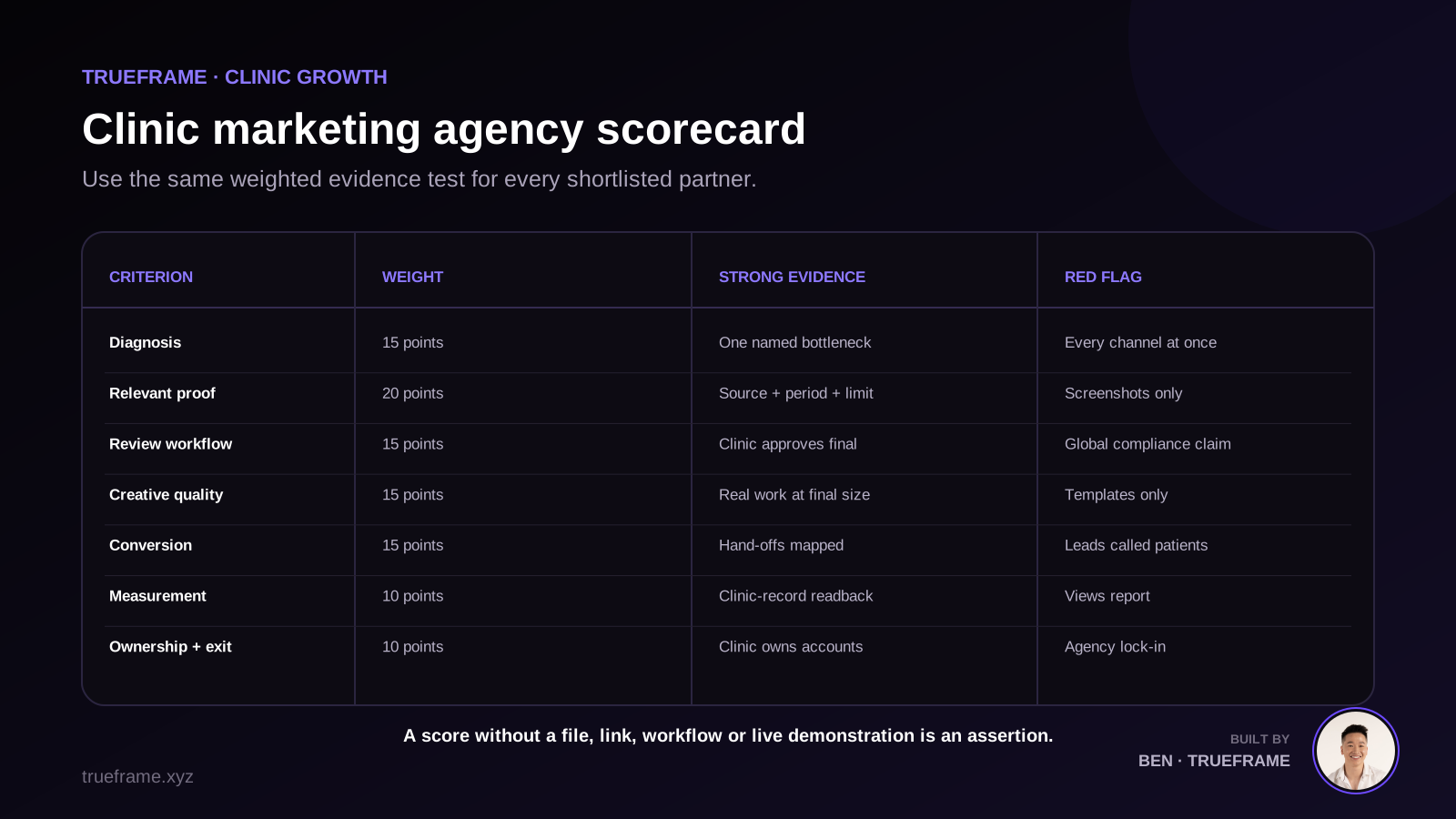
Swipe sideways to inspect the full graphic.
Why the usual agency selection process fails
Clinic owners often compare channel lists, posting volume and a few screenshots. That favours the agency with the biggest deck, not the partner best able to operate the booking path. It also hides a common scope problem: one supplier owns ads, another owns social, a third owns the site and nobody owns the leak between them.
Benjamin Chua
Clinic agency scorecard
6
printable pages
PDF · Version 1.0 · Updated Sept 2026
Aesthetic Clinic Marketing Agency Evaluation Scorecard
Score shortlisted agencies on evidence, operating ownership, review workflow, conversion and measurement before signing.
- A weighted 100-point comparison across seven buying criteria
- An evidence request list and live sales-call questions
- A 90-day pilot brief with access, ownership and exit checks
| Weak signal | Why it misleads | Ask for instead |
|---|---|---|
| 'We specialise in aesthetics' | A niche label does not prove judgement or results | Two relevant examples with the brief, final work, period and measurement source |
| A large follower count | It may be old, paid, unrelated or driven by one spike | Baseline, timeframe, published assets and the limit of the result |
| A guaranteed number of leads | Lead definitions and quality can be manipulated | The complete lead-to-consultation definitions and reconciliation method |
| Twenty posts per month | Volume says nothing about purpose, review or conversion | A content matrix tied to patient decisions and clinic capacity |
| One blended monthly price | Media, production, software and clinic time disappear | A line-by-line operating scope and excluded costs |
Score seven things, not one sales call
| Criterion | Weight | What a strong answer shows |
|---|---|---|
| Diagnosis and strategy | 15 | A specific bottleneck, patient decision, channel role and first test |
| Relevant evidence | 20 | Source-backed work with timeframe, baseline and stated limitations |
| Regulated review and privacy workflow | 15 | Named clinic approver, source log, consent or authorization controls and version record |
| Creative and production quality | 15 | Real examples, consistent craft and a repeatable capture system |
| Lead-to-consultation ownership | 15 | Message, page, form, response and booking hand-offs are mapped |
| Measurement and learning | 10 | Stable definitions, clinic-record reconciliation and decision-led reporting |
| Access, communication and exit | 10 | Clinic-owned accounts, clear roles, source files and handover terms |
Score each criterion from zero to five, multiply by its weight and divide by five. More important than the final total is the evidence beside the score. A five without a link, file, workflow or live demonstration is still an assertion.
1. Diagnosis and strategy
A strong agency should be able to explain why the clinic is not getting the desired result without pretending to know everything from a discovery call. It should separate hypotheses from confirmed evidence and request the data needed to decide between them.
- What is the first commercial outcome and the capacity limit behind it?
- Which patient decision is the current marketing failing to support?
- What evidence would make you choose content, search, paid media or conversion work first?
- What would you deliberately not do in the first 90 days?
2. Relevant evidence
Ask to inspect the public asset and the measurement story together. The agency should distinguish what it produced, what the client or platform reported, what period changed and what the evidence does not show. Organic reach is not paid return. Leads are not patients. A screenshot without a source or date is not a case study.
A useful proof sentence names the subject, work, baseline, result, period, source and limitation in one place.
For example, Trueframe's public Dr. Marion Chan case study records first-full-month reach of 430,563 from a 48,840 baseline and personal-account growth from 12,043 to 26,164 followers over five weeks. Those are content-distribution results. They are not patient, revenue, ranking or paid-ad results.
Want a straight diagnosis before another channel retainer?
Trueframe reviews the clinic position, content, paid acquisition, local search, website, booking path and measurement, then tells you where the system is actually leaking.
See the Australian clinic growth system3. Regulated review and privacy workflow
The agency should not present itself as the clinic's legal or clinical authority. It should show how the applicable rules shape research, filming, claims, images, patient material, offers, product references, comments and final approval. The clinic's nominated reviewer stays responsible for the exact final use.
| Ask | Strong evidence | Red flag |
|---|---|---|
| Who approves the final material? | Named clinic owner plus versioned approval record | Agency says its template is compliant everywhere |
| How are claims sourced? | Claim log linked to current primary sources | Copy is based on competitor ads |
| How is patient material handled? | Consent or authorization scope, storage controls and withdrawal process | Verbal permission or 'we can blur it later' |
| What happens when guidance changes? | Review dates, update owner and affected-content audit | Evergreen content is never rechecked |
4. Creative and production quality
Inspect the work at the size and platform where patients see it. Look for clear sound, readable captions, consistent colour, clean framing and a practitioner who sounds like a person rather than a stock script. Then ask whether the process can reproduce the quality every month without exhausting the clinic.
5. Lead-to-consultation ownership
The proposal should state where the agency's responsibility ends. If it promises consultations, it must explain the landing page, form, lead routing, response, qualification, scheduling and clinic-record reconciliation it will operate or coordinate. If it only supplies creative, the proposal should say so plainly.
6. Measurement and learning
Ask for the report before signing. A useful report separates visibility, useful actions, enquiries, qualified enquiries, booked consultations, attendance and any revenue evidence the clinic can lawfully reconcile. It should end with what the agency recommends keeping, fixing, stopping and testing next.
7. Access, communication and exit
The clinic should know which accounts it owns, what access the agency receives, where source files live, what happens to tracking and audiences after the engagement, and what the handover includes. Do not discover at cancellation that the domain, ad account or creative history sits under somebody else's login.
| Asset | Clinic should retain | Record before work begins |
|---|---|---|
| Domain and website | Administrative ownership and backups | Registrar, host, repository or CMS owners |
| Ad accounts | Business ownership, billing visibility and partner access controls | Business ID, account ID and access list |
| Analytics and tags | Property ownership and historical data | Property IDs, events and destinations |
| Creative | Contracted usage rights and finished files | Source-file and raw-footage terms |
| Leads and CRM | Lawful access, export and retention controls | System of record and deletion process |
Use a 90-day pilot brief
- Name one primary commercial outcome and the clinic's capacity boundary.
- Define the exact channels, deliverables, approvals and internal owners.
- Capture the baseline before the agency changes campaigns or pages.
- Set early gates for access, tracking, filming and first approved publication.
- Define leads, qualified enquiries, bookings and attendance separately.
- Schedule weekly operating reviews and a 30, 60 and 90-day decision.
- Write the handover, data, creative and account-access terms before launch.
Red flags that deserve a pause
- Guaranteed rankings, ad approval, patient numbers or revenue without control of the full system.
- Bulk content or location pages created primarily to manipulate search or AI answers.
- Case-study metrics with no timeframe, baseline, source or limitation.
- The agency owns the clinic's domain, primary ad account or only copy of the source files.
- Patient content is treated as usable because somebody signed a generic release.
- Reporting blends platform leads, booked consultations and patients into one number.
- A twelve-month commitment begins before access, tracking and approval feasibility are proven.
Google's own hiring guidance recommends interviewing an SEO, asking for previous work, expected results, timeframe and measurement, and checking third-party recommendations against official guidance. The same discipline applies to the rest of clinic marketing. Specific work and transparent limits beat proprietary-sounding claims.
The final decision
- Send the same evidence request and scorecard to every candidate.
- Choose the partner that best understands the bottleneck and the hand-offs it must own.
- Keep final approval, account ownership and clinic data under clinic control.
- Commit to a clear operating period, not guaranteed outcomes.
- Make exit and handover part of the buying decision, not a later negotiation.
Prepare the agency brief
Sources and review date
We use primary official sources for rules and platform guidance. This article is general information, not medical or legal advice.
- Do you need an SEO? · Google Search CentralReviewed 2 September 2026
- Optimizing your website for generative AI features on Google Search · Google Search CentralReviewed 2 September 2026
- Guidelines for advertising a regulated health service · Ahpra and National BoardsReviewed 12 August 2026
- Guidelines for advertising higher risk non-surgical cosmetic procedures · Ahpra and National BoardsReviewed 12 August 2026
- Advertising health services and cosmetic injections: frequently asked questions · Therapeutic Goods AdministrationReviewed 12 August 2026
- Marketing and the HIPAA Privacy Rule · U.S. Department of Health and Human ServicesReviewed 2 September 2026
- Health Products Compliance Guidance · U.S. Federal Trade CommissionReviewed 2 September 2026
Skip the reading. Talk it through instead.
Book a fit call and we'll map out what a content engine looks like for your business. No pitch, no pressure.
Don't miss the next one
Some of what we share is time-sensitive. A format that's working right now, a window that closes fast. We email those the moment they're worth jumping on. Drop your email so you catch them in time.
No spam. Unsubscribe anytime.
Frequently asked questions
What should I look for in an aesthetic clinic marketing agency?
Should I choose a specialist aesthetic marketing agency?
What results should a clinic agency guarantee?
How long should an aesthetic clinic test an agency?
Should the clinic own its ad accounts, analytics and website?
How do we compare two agency proposals?
Founded & led by
Benjamin Chua (BenChuchu)
Founder and CEO of Trueframe. 9 years building businesses (started at 16), tens of millions of views generated, and 8 figures in revenue created for the founders and brands he works with. He builds the content systems Trueframe runs.