Aesthetic Clinic Marketing Plan: A Practical Template for Owners
This is the planning document your clinic can actually operate: one commercial goal, clear channel jobs, an approval owner, a monthly rhythm and a scorecard tied to bookings.

Written by Benjamin Chua, founder of Trueframe.
On this page
- 1. Write the commercial brief first
- 2. Give every channel one primary job
- 3. Map the path from first touch to attended consultation
- 4. Put compliance inside the operating plan
- 5. Build the budget in three layers
- Foundation
- Operating cadence
- Variable acquisition
- 6. Run a simple monthly cadence
- 7. Use a scorecard that separates attention from revenue
A marketing plan is not a list of channels. It is a set of decisions about who the clinic wants to reach, what each channel must do, what the clinic can deliver and what evidence will change the next month's spend.
Most clinic plans fail because they are either too vague to run or too detailed to survive contact with the front desk. This template sits in the middle. It is specific enough to assign work and measure outcomes, but short enough for the owner, practitioner, marketer and booking team to use every month.
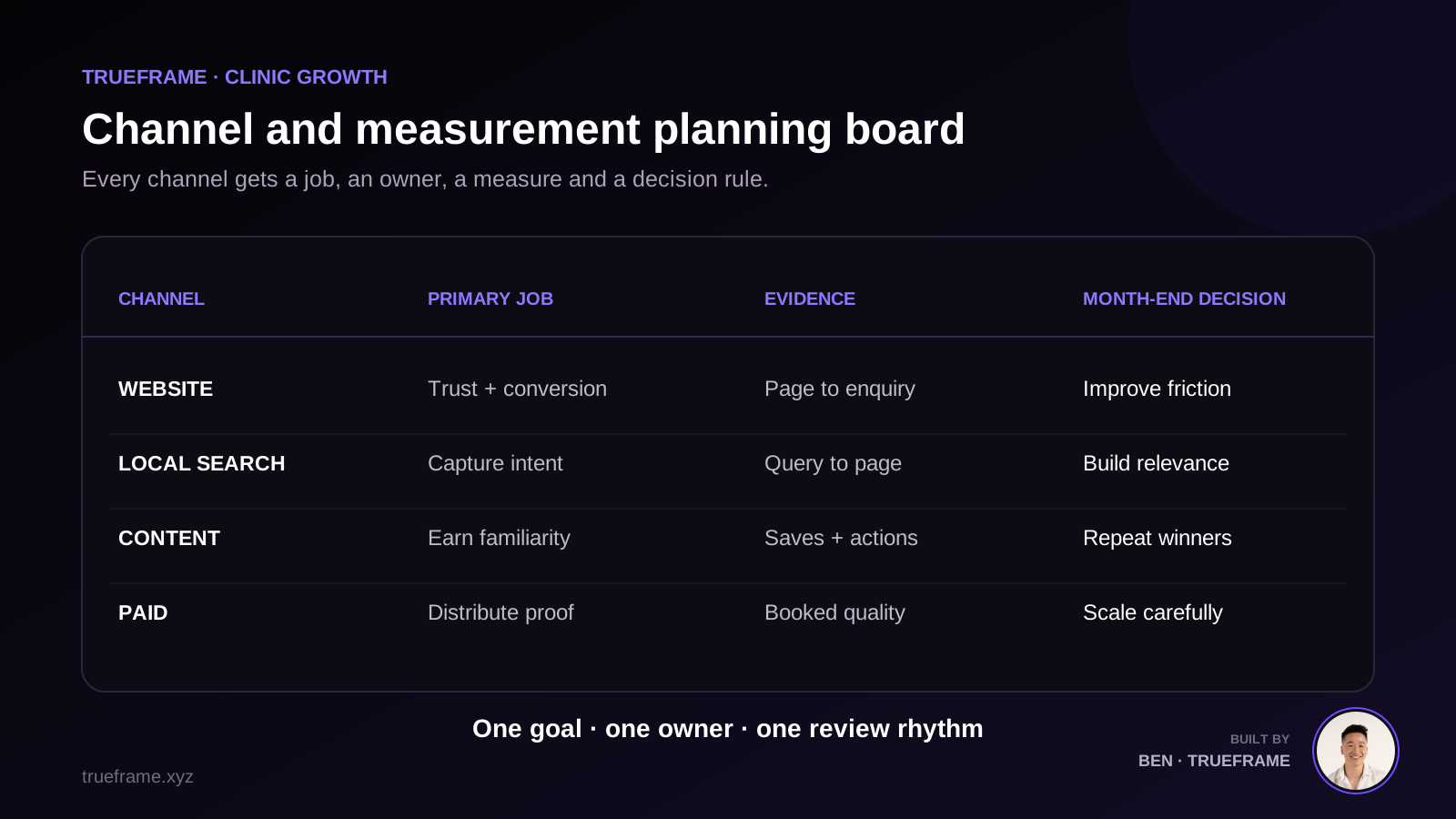
Swipe sideways to inspect the full graphic.
1. Write the commercial brief first
Use one page. Name the clinic's priority commercial outcome for the next 90 days, the available consultation capacity, the patient segment, the priority services and the market position. The aim is not to lock the clinic into one message forever. It is to stop five suppliers from solving five different problems.
For the next [90 days], the clinic needs to [commercial outcome].
We can responsibly serve [capacity] new consultations per [week or month].
The priority patient is [specific person and context], considering [priority service or problem].
We want to be known for [credible position or clinical philosophy].
The main conversion action is [book a consultation, call, or submit an enquiry].
The owner of the full path is [name], and the final clinical advertising reviewer is [name].
A position is not a slogan. It should influence who appears in the content, which services get detailed pages, which enquiries the front desk prioritises and which ads the clinic refuses to run. If it changes nothing operationally, it is decoration.
2. Give every channel one primary job
Channels overlap, but each needs a primary role. This keeps reporting honest. A practitioner video may assist a Google search weeks later. A treatment page may convert someone introduced by Instagram. The plan should recognise that journey without giving every channel credit for everything.
| Channel | Primary job | Early-stage use | Established-clinic use |
|---|---|---|---|
| Website | Trust, education and conversion | Core practitioner, treatment, location and booking pages | Deeper treatment library, campaign pages and conversion testing |
| Google Business Profile | Capture local intent | Accurate profile, verification, tracked links and useful images | Review operations, updates, local prominence and multi-location governance |
| Organic content | Build familiarity and demonstrate judgement | Create a credible launch bank and answer first questions | Run repeatable practitioner series tied to priority services |
| Paid acquisition | Distribute proven messages | Small controlled tests after the booking path works | Scale tested messages by capacity and booked-consult quality |
| Email or SMS | Follow up with consent | Operational reminders and helpful pre-consult information | Segmented education and reactivation within consent and policy limits |
| Partnerships | Earn relevant local trust | Build a small network of aligned referrers | Develop measured collaborations with documented advertising review |
3. Map the path from first touch to attended consultation
Draw the patient path on one line: search, social post or referral; landing page or profile; enquiry; response; booking; confirmation; attendance. Then write the owner, system and failure point under each step. Marketing cannot compensate for unanswered messages, unclear suitability screening or a booking tool that is painful on mobile.
- Add campaign tags to controlled links without creating duplicate canonical pages.
- Capture source information in a way the front desk can maintain consistently.
- Define a response-time expectation during clinic hours and a clear after-hours message.
- Record the reason qualified prospects do not book, not only the number that disappear.
- Keep clinical records and sensitive health information in the appropriate clinic systems, not a general marketing spreadsheet.
4. Put compliance inside the operating plan
Regulated advertising is not a separate legal paragraph at the end of the plan. It changes the briefs, source material, filming, editing, comments policy, offer approval and influencer arrangements. Ahpra prohibits testimonials about clinical aspects of regulated health services in advertising. Higher-risk cosmetic procedure guidance adds specific expectations for images, social media and advertising content. TGA rules also matter when advertising health services that involve therapeutic goods.
Name the sources the clinic uses, the date they were checked, who reviews each content class and the turnaround time. Keep a record of approved final copy and creative. This article is general information and not legal advice. Where the interpretation is uncertain, the plan should escalate rather than guess.
Need one owner across the full plan?
Trueframe builds the strategy, content, acquisition, website, local-search and measurement system around one clinic goal, with your clinical reviewer kept in the approval loop.
See the Australian clinic growth system5. Build the budget in three layers
Foundation
One-off or occasional work: positioning, website architecture, treatment pages, analytics, Business Profile setup, core brand assets and initial content production. These assets should support more than one campaign cycle.
Operating cadence
Recurring work: content planning and production, local-search maintenance, reporting, site updates, comment moderation and approval management. This is what keeps the system alive after launch week.
Variable acquisition
Spend that can rise or fall: media, creator partnerships, events and other tests. Give each test a hypothesis, landing page, conversion event, review date and stop condition. A percentage copied from an industry blog is not a budget strategy.
| Decision | Evidence required | Common trap |
|---|---|---|
| Start | Capacity, working booking path, approved creative, tracking and a clear hypothesis | Launching because a competitor appears to be running ads |
| Continue | Enough qualified signal to justify another learning cycle | Keeping a campaign alive because the cost per click looks low |
| Scale | Consistent qualified enquiries, acceptable booking quality and operational capacity | Scaling form fills before checking whether people book or attend |
| Stop or rebuild | Poor-fit demand, broken economics, weak conversion or unresolved compliance risk | Changing five variables at once and learning nothing |
6. Run a simple monthly cadence
- Week 1: review the prior month by query, page, campaign, enquiry and booking quality.
- Week 1: choose one or two commercial messages and the patient questions that support them.
- Week 2: draft and clinically review the content, landing pages, offers and creative.
- Week 2 or 3: film the practitioner in one focused session and complete production.
- Weeks 3 and 4: publish, distribute, monitor comments and track the booking path.
- Every week: share enquiry objections and front-desk feedback with the marketing owner.
- Month end: decide what to keep, improve, stop and test next.
7. Use a scorecard that separates attention from revenue
| Layer | Measures | What the measures answer |
|---|---|---|
| Visibility | Relevant search impressions, local profile actions, target-market reach | Are the right people finding the clinic? |
| Trust and intent | Treatment-page engagement, saves, qualified questions, appointment-link clicks | Is the content helping a real decision? |
| Conversion | Enquiries by source and page, response time, booked consultations | Does the path turn intent into a booking? |
| Operations | Attendance, capacity, lead quality, recurring objections | Can the clinic serve the demand being created? |
| Compliance | Approval time, rejected drafts, moderated comments, policy updates | Is the workflow controlling avoidable risk? |
Treat attribution as useful evidence, not perfect truth. A person may see a video, search the clinic name, read a treatment page and call. Record what you can, keep definitions stable and look for repeated patterns. False precision is not better management.
Your one-page plan
- One 90-day commercial outcome and a defined capacity limit.
- One priority patient, a short service focus and a credible market position.
- One primary job for each channel and a mapped path to the booking.
- One named operational owner and one named clinical advertising reviewer.
- Three budget layers with evidence rules for starting, continuing and scaling.
- A weekly operating check and monthly keep, improve, stop and test review.
Turn the plan into an operating system
Sources and review date
We use primary official sources for rules and platform guidance. This article is general information, not medical or legal advice.
- Guidelines for advertising a regulated health service · Ahpra and National BoardsReviewed 12 August 2026
- Guidelines for advertising higher risk non-surgical cosmetic procedures · Ahpra and National BoardsReviewed 12 August 2026
- Advertising health services and cosmetic injections: frequently asked questions · Therapeutic Goods AdministrationReviewed 12 August 2026
- Tips to improve your local ranking on Google · Google Business Profile HelpReviewed 12 August 2026
Skip the reading. Talk it through instead.
Book a fit call and we'll map out what a content engine looks like for your business. No pitch, no pressure.
Don't miss the next one
Some of what we share is time-sensitive. A format that's working right now, a window that closes fast. We email those the moment they're worth jumping on. Drop your email so you catch them in time.
No spam. Unsubscribe anytime.
Frequently asked questions
What should an aesthetic clinic marketing plan include?
How much should an aesthetic clinic spend on marketing?
Which marketing KPIs matter most for an aesthetic clinic?
How often should the plan be reviewed?
Can a marketing agency approve clinic compliance?
Founded & led by
Benjamin Chua (BenChuchu)
Founder and CEO of Trueframe. 9 years building businesses (started at 16), tens of millions of views generated, and 8 figures in revenue created for the founders and brands he works with. He builds the content systems Trueframe runs.