SEO for Aesthetic Clinics in Australia: From Local Search to Booking
Clinic SEO is not a suburb-keyword exercise. It is the work of making the clinic, practitioner, services, location and booking path clear enough for both patients and search systems to trust.

Written by Benjamin Chua, founder of Trueframe.
On this page
- 1. Build the factual local foundation
- 2. Give each search intent one clear owner
- 3. Make treatment pages useful enough to deserve the query
- 4. Build practitioner credibility as a real content layer
- 5. Handle reviews without turning them into prohibited advertising
- 6. Earn local authority without buying a citation package
- 7. Defer state pages until the data justifies them
- 8. Measure query to page to booking
A prospective patient searching for a clinic is already doing commercial work. They are comparing location, practitioner credibility, treatment information, risk, availability and trust. Good SEO makes that comparison easier. Weak SEO produces a collection of keyword pages that answer none of it.
For an Australian aesthetic clinic, local SEO connects four entities: the real clinic, the real practitioners, the services they provide and the physical location where people can attend. The website, Google Business Profile and external references should tell the same factual story.
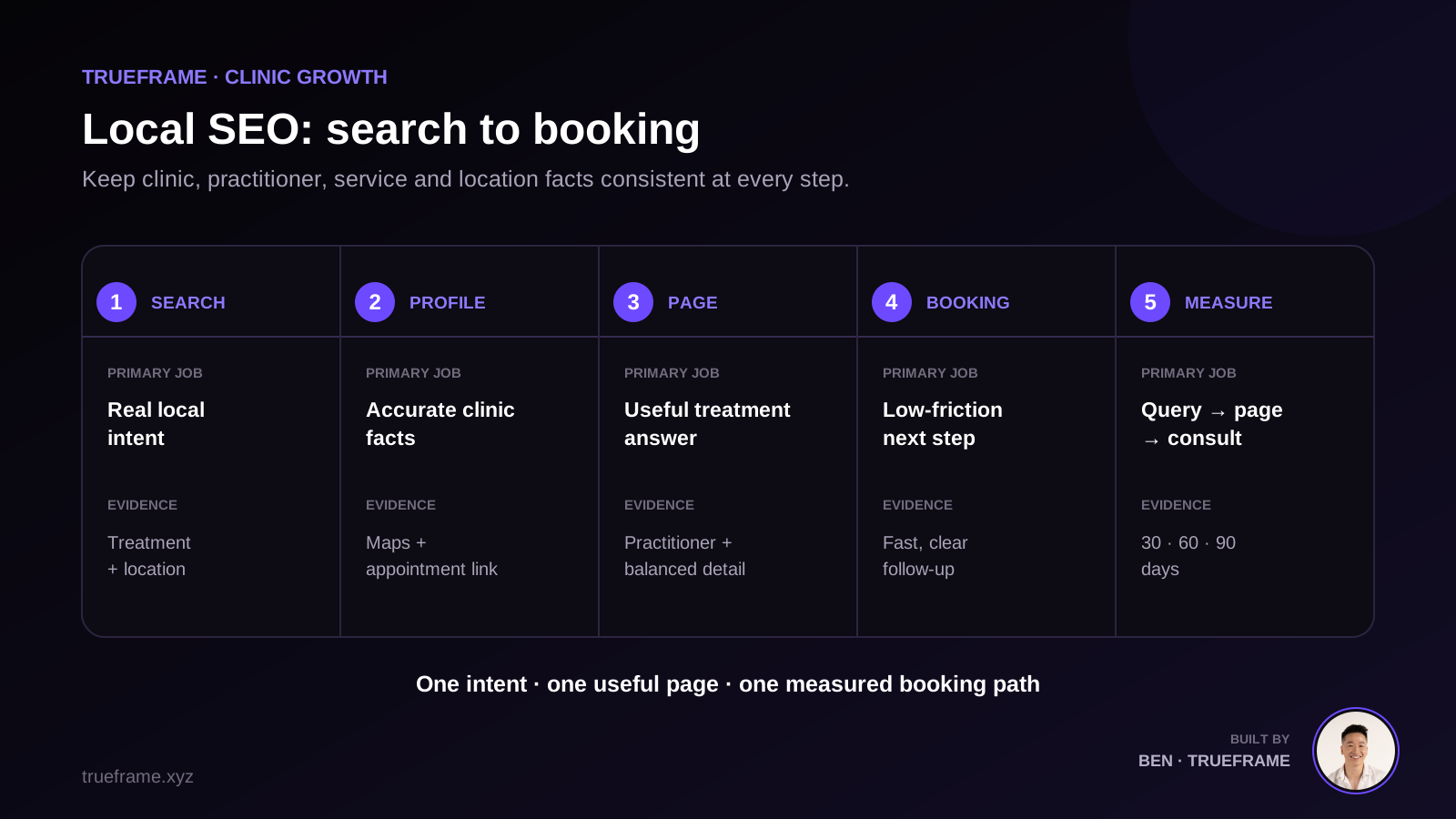
Swipe sideways to inspect the full graphic.
1. Build the factual local foundation
Use the clinic's real name, address, phone, hours and website consistently. Google Business Profile guidelines say the business should be represented as it is recognised in the real world, with an accurate address or service area. Do not insert treatments or suburbs into the profile name unless they are genuinely part of the business name.
- Claim and verify the profile under an account the clinic controls.
- Choose the most accurate primary category and only relevant secondary categories.
- Keep opening hours, holiday hours, phone, address and appointment links current.
- Use original, useful images of the actual clinic and practitioners, subject to consent and advertising review.
- Link the profile to a relevant, fast page with campaign tagging for measurement.
- Set a process for monitoring suggested edits, duplicate listings and ownership access.
Google says local results are mainly based on relevance, distance and prominence. Distance is not something a clinic can optimise away. The controllable work is giving complete, accurate information, building real prominence and making the clinic relevant to the query through useful content.
2. Give each search intent one clear owner
Keyword cannibalisation often begins with good intentions. The clinic publishes a service page, a blog guide, a suburb page and a campaign page that all target the same phrase. Search systems then have several weak candidates instead of one strong answer. Assign ownership before writing.
| Intent | Owning page | Support pages |
|---|---|---|
| Clinic or brand name | Home or location page | Practitioner pages and profile references |
| Specific treatment plus location | Substantial treatment page | Related practitioner, risk, recovery and comparison guides |
| Practitioner name or credential | Practitioner profile | Authored articles and relevant treatment pages |
| General patient question | Detailed informational guide | Treatment page with a concise answer and internal link |
| A real additional location | Distinct location page | Relevant local treatment and practitioner information |
Use canonical metadata, clean internal links and a sitemap, but do not expect technical tags to rescue duplicate content. The page itself needs a distinct purpose. Campaign landing pages can be valuable for conversion while their canonical and indexation strategy is decided deliberately.
3. Make treatment pages useful enough to deserve the query
A thin page with a service name, a stock image and a booking button offers little reason to rank or convert. A strong treatment page explains the service in plain language, identifies the practitioner, states qualifications accurately, explains consultation and suitability, gives balanced information about limitations and risks, answers practical questions and offers an appropriate next step.
- Use the real language patients use without forcing a phrase into every heading.
- Show who performs or supervises the service and link to a complete practitioner page.
- Separate factual information, clinic process and commercial calls to action clearly.
- Include original clinic knowledge: common questions, decision criteria and how consultations work.
- Keep claims and images inside the clinic's advertising review workflow.
- Add a prominent, mobile-friendly booking or enquiry action that matches the stage of the page.
Need SEO connected to the rest of clinic marketing?
Trueframe builds the local-search, treatment-page, content, acquisition, booking and measurement system together so each query has one useful destination.
See the Australian clinic growth system4. Build practitioner credibility as a real content layer
Patients often choose the practitioner before the clinic. Give each practitioner a durable page with their name, role, relevant qualifications, registrations, scope, clinical interests, professional memberships where factual, and authored or reviewed resources. Avoid vague superiority claims. Link practitioner pages to the services they genuinely provide and link articles back to the reviewer.
This is also where the content operation can create compounding value. A considered practitioner explanation can become a video, a transcript-informed guide, a treatment-page section and an answer used by the front desk. The facts remain consistent while the format changes for the audience.
5. Handle reviews without turning them into prohibited advertising
Google says reviews and positive ratings can contribute to local prominence, and responding to reviews can help the business stand out. Regulated health services have an additional problem: Ahpra restricts using testimonials about clinical aspects in advertising. The clinic needs a review policy designed for both systems.
- Do not offer incentives for positive reviews or gate review requests by satisfaction.
- Do not copy clinical reviews onto the clinic website or turn them into social creative.
- Review whether responding to, liking, pinning or sharing a clinical comment would amount to using it in advertising.
- Use a neutral operational response process that protects privacy and avoids discussing patient details.
- Escalate uncertain review content to the clinic's nominated reviewer.
6. Earn local authority without buying a citation package
Useful local references come from real relationships and accurate listings: professional associations, relevant directories, building or precinct listings, local media, event partners, community organisations and suppliers where appropriate. The goal is not a high count of identical directory entries. It is a credible web footprint that confirms the clinic exists, where it is and why it matters in that market.
Audit incorrect names, phone numbers, old addresses and duplicate listings. Seek links when the clinic has contributed something worth referencing, such as an expert resource, local event, original data or professional education. Avoid paid link schemes and mass location pages.
7. Defer state pages until the data justifies them
A national guide and the real clinic location should come first. After six to eight weeks, inspect Australian query and page data. If a state or city shows distinct demand, a local page may be useful only when it can include real local context, official sources, practitioner or service relevance and a genuinely different answer.
Changing Australia to Victoria, New South Wales and Queensland across the same article is not localisation. It is duplication, and at scale it can resemble doorway abuse.
8. Measure query to page to booking
| Review | Search checks | Commercial checks |
|---|---|---|
| 30 days | Indexing, canonical selection, crawl issues, early query impressions | Tracked appointment links, form events and source capture working |
| 60 days | Query-to-page ownership, local-profile changes, treatment-page movement | Qualified enquiry patterns and front-desk feedback by page |
| 90 days | Clicks, CTR, positions, internal cannibalisation and unexpected query drift | Booked-consultation quality, assisted journeys and next content priority |
Search Console reports should be read by query and page together. Sitewide averages hide whether the intended treatment page owns the phrase or a generic blog post is drifting into it. Keep campaign tags on controlled Business Profile and outreach links, then combine that evidence with the clinic's booking system without moving sensitive clinical data into marketing tools.
The local SEO operating model
- Make the real clinic facts consistent across the website, profile and credible external references.
- Assign one useful page to each search intent before publishing more content.
- Build treatment pages around patient decisions and practitioner credibility, not keyword density.
- Manage reviews with both local-search value and Ahpra testimonial restrictions in mind.
- Create state or suburb content only when local data and distinct usefulness support it.
- Review search query to landing page to booked consultation at 30, 60 and 90 days.
Build the search-to-booking path
Sources and review date
We use primary official sources for rules and platform guidance. This article is general information, not medical or legal advice.
- Tips to improve your local ranking on Google · Google Business Profile HelpReviewed 12 August 2026
- Guidelines for representing your business on Google · Google Business Profile HelpReviewed 12 August 2026
- Creating helpful, reliable, people-first content · Google Search CentralReviewed 12 August 2026
- Spam policies for Google web search · Google Search CentralReviewed 12 August 2026
- Guidelines for advertising a regulated health service · Ahpra and National BoardsReviewed 12 August 2026
Skip the reading. Talk it through instead.
Book a fit call and we'll map out what a content engine looks like for your business. No pitch, no pressure.
Don't miss the next one
Some of what we share is time-sensitive. A format that's working right now, a window that closes fast. We email those the moment they're worth jumping on. Drop your email so you catch them in time.
No spam. Unsubscribe anytime.
Frequently asked questions
How long does SEO take for an aesthetic clinic?
Should every treatment have its own page?
Should an aesthetic clinic make a page for every suburb?
Do Google reviews help local SEO for clinics?
Can Trueframe guarantee first-page clinic rankings?
Founded & led by
Benjamin Chua (BenChuchu)
Founder and CEO of Trueframe. 9 years building businesses (started at 16), tens of millions of views generated, and 8 figures in revenue created for the founders and brands he works with. He builds the content systems Trueframe runs.