Aesthetic Clinic Website Checklist: Trust, Compliance and Conversion
A premium-looking clinic website can still fail the patient, regulator, search engine and front desk. Use this checklist to audit what the site actually needs to do.

Written by Benjamin Chua, founder of Trueframe.
On this page
- 1. Mobile speed and technical foundation
- 2. Clinic identity and local clarity
- 3. Practitioner credibility
- 4. Treatment information and balanced risk context
- 5. Testimonials, reviews and proof
- 6. Booking and front-desk experience
- 7. Tracking, privacy and source attribution
- 8. Accessibility and readability
- 9. Internal links and page ownership
The clinic website has four jobs: make the right service easy to understand, make the practitioner easy to verify, make the next step easy to take and make the source of that action measurable. Aesthetic polish supports those jobs. It does not replace them.
Run this audit on a phone first. Open the site as a new patient who has one concern, little clinical knowledge and three other clinic tabs open. Then repeat it as the clinic owner, reviewer, front desk and search engine. Each sees a different failure.
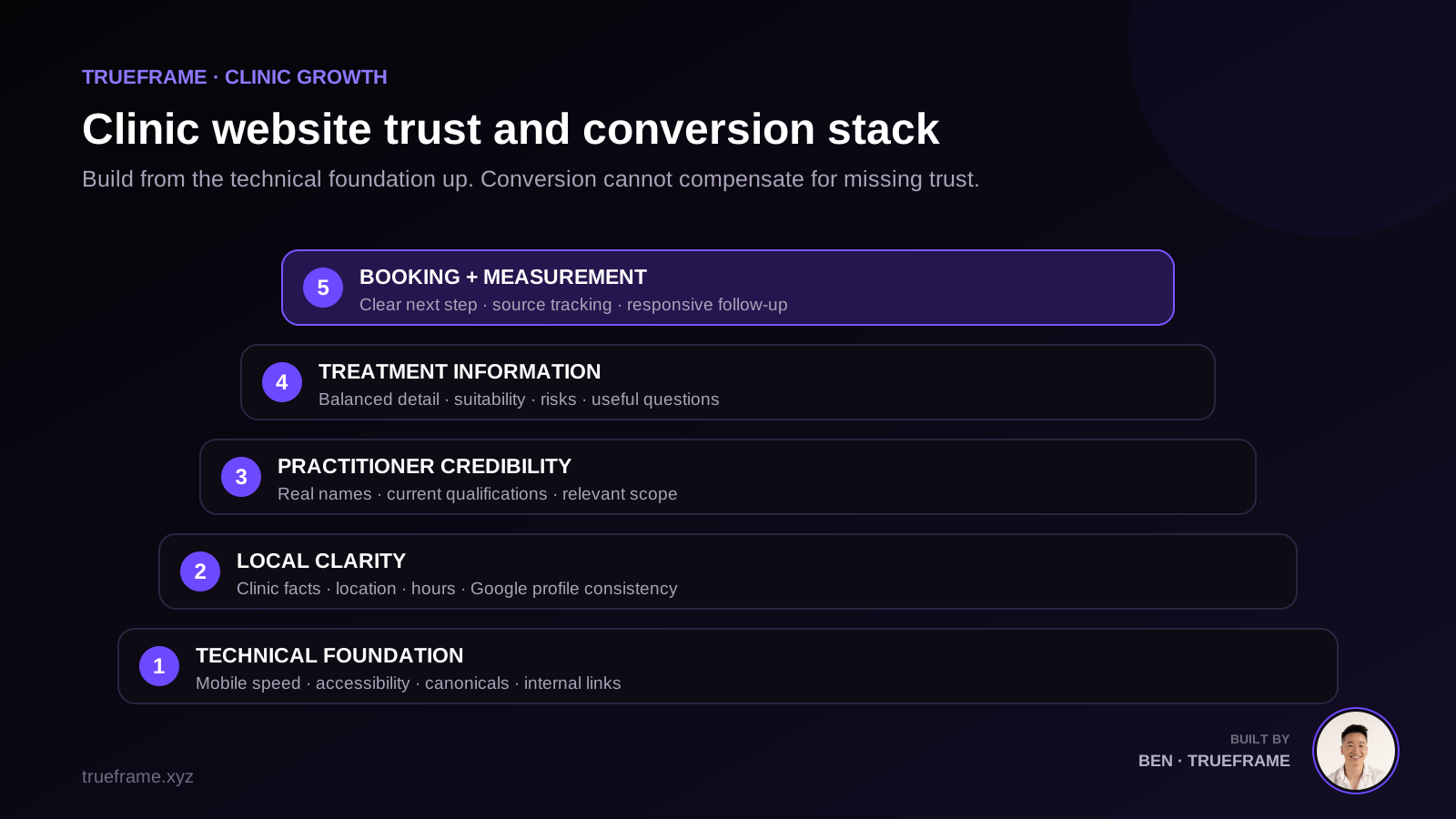
Swipe sideways to inspect the full graphic.
1. Mobile speed and technical foundation
- The primary page content loads quickly on a normal mobile connection.
- Images use appropriate dimensions and formats without causing layout shifts.
- Buttons, navigation and forms work at a 390px viewport without horizontal overflow.
- Every indexable page has a unique title, description and self-referencing canonical where appropriate.
- The XML sitemap contains the intended clinic, practitioner, treatment and guide pages.
- Broken links, redirect chains, duplicate pages and accidental noindex tags are resolved.
- Analytics and booking scripts do not block the page or collect more data than required.
Performance is a patient experience issue before it is an SEO issue. A person arriving from Maps or Instagram on a phone should not wait through a large hero video before learning where the clinic is or what it does. Load essential information first and lazy-load supporting media below it.
2. Clinic identity and local clarity
- The clinic's real name, address, phone and opening hours are easy to find and consistent with Google Business Profile.
- The page states whether the clinic is accessible by appointment, how to arrive and what a first consultation involves.
- The location page contains useful local information, not a paragraph of repeated suburb names.
- The Business Profile and appointment links point to relevant, tracked website destinations.
- Additional locations have genuinely distinct pages and governance, not cloned doorway pages.
3. Practitioner credibility
The person providing a regulated service should not be a mystery. Give each practitioner a durable profile with their real name, current role, relevant qualifications and registrations, scope, professional interests and the services they actually provide. Link authored and clinically reviewed resources to them where accurate.
- Qualifications and memberships are spelled correctly and remain current.
- The site does not imply a title, specialisation or superiority the practitioner cannot substantiate.
- Practitioner images are current, professional and used with permission.
- Treatment pages link to the responsible practitioner rather than only a generic team grid.
- Contact and booking paths make it clear whether a specific practitioner can be requested.
4. Treatment information and balanced risk context
A treatment page should help someone prepare for a consultation, not make the consultation sound unnecessary. Explain what the service is, who may or may not be suitable, who provides it, what the clinic's assessment covers, relevant limitations, risks and recovery considerations, and the next step. Use language a patient can understand without stripping away material context.
| Page element | Pass condition | Red flag |
|---|---|---|
| Headline | Names the service or patient question plainly | Promises a perfect, permanent or identity-changing result |
| Suitability | Explains assessment and that individual suitability varies | Implies the service is appropriate for everyone |
| Practitioner | Identifies the responsible provider and relevant credentials | Uses an anonymous 'expert team' claim |
| Benefits and limits | Balanced, sourced and understandable | Benefits dominate while limitations are hidden in fine print |
| Images | Accurate context, consistent presentation and approved use | Filters, inconsistent comparisons or unrealistic presentation |
| Product references | Reviewed against current TGA guidance | Prescription product promotion or a coded workaround |
| Next step | Invites an appropriate consultation or enquiry | High-pressure countdown or unnecessary-treatment urgency |
5. Testimonials, reviews and proof
Do not use a patient outcome story simply because the clinic has written consent. Ahpra prohibits testimonials about clinical aspects in advertising regulated health services, and the clinic website is advertising. That can include positive statements about the reason for treatment, treatment experience, outcome or practitioner skill. Higher-risk cosmetic procedure guidance adds further context.
Use other trust signals: accurate qualifications, transparent process, original educational content, clinic standards, relevant independent accreditations where factual, clear contact details and evidence-backed explanations. If the clinic displays awards, statistics or claims, keep the substantiation and date on file.
Need the website rebuilt around this checklist?
Trueframe designs and builds fast clinic websites, treatment pages and tracked booking paths for Australian clinics. We are Singapore-based and can serve Australian clinics remotely.
See website design for aesthetic clinics6. Booking and front-desk experience
- The main call to action matches the decision stage, such as request a consultation or ask a question.
- The action is visible on mobile without appearing on every line of the page.
- Forms request only the information needed at that stage and explain what happens next.
- Confirmation messages set a realistic response expectation and provide urgent-care direction where appropriate.
- Calls and messages route to an owner during stated hours, with a tested after-hours path.
- The clinic records recurring questions and booking failures so the site can improve.
Conversion optimisation in healthcare should reduce confusion and friction, not manufacture pressure. A lower form-completion rate can still be a better outcome if the page helps unsuitable people understand that a clinical assessment is needed and improves the quality of consultations that do book.
7. Tracking, privacy and source attribution
- Campaign links use consistent UTM naming for source, medium and campaign.
- Analytics records meaningful events such as appointment-link clicks and completed enquiries.
- The front desk can preserve source information through to the booking system.
- Consent, privacy notices and cookie controls reflect the tools actually used.
- Sensitive health information and free-text clinical details are not exposed to general advertising platforms without a lawful, reviewed basis.
- Reports separate sessions, enquiries, booked consultations and attended consultations.
8. Accessibility and readability
- Headings follow a logical order and communicate the page structure.
- Text contrast remains readable and essential information is not hidden in low-opacity styling.
- Images have useful alternative text when they communicate information.
- Forms have labels, clear errors and keyboard-accessible controls.
- Tables can be scrolled on mobile and retain row and column headings for screen readers.
- Videos have captions or transcripts where practical, and motion does not block access.
9. Internal links and page ownership
Every important page should be reachable through normal internal links. Treatment pages should link to practitioners, relevant risk or preparation guides and the booking path. Informational guides should link back to the commercial treatment page without competing for the same title and intent. The service hub, sitemap and related-content system should include new pages when they launch.
The 20-minute owner audit
- Open the site at 390px and complete the primary booking path yourself.
- Verify the clinic facts match Google Business Profile and real-world signage.
- Check every priority treatment names the practitioner and presents balanced information.
- Remove testimonial shortcuts and review images, product references and offers in context.
- Test forms, phone links, confirmations, source capture and response ownership.
- Fix readability, accessibility, internal links, canonicals and sitemap inclusion before adding more pages.
Build the rest of the clinic website system
Sources and review date
We use primary official sources for rules and platform guidance. This article is general information, not medical or legal advice.
- Guidelines for advertising a regulated health service · Ahpra and National BoardsReviewed 12 August 2026
- Guidelines for advertising higher risk non-surgical cosmetic procedures · Ahpra and National BoardsReviewed 12 August 2026
- Advertising health services and cosmetic injections: frequently asked questions · Therapeutic Goods AdministrationReviewed 12 August 2026
- Tips to improve your local ranking on Google · Google Business Profile HelpReviewed 12 August 2026
- Creating helpful, reliable, people-first content · Google Search CentralReviewed 12 August 2026
Skip the reading. Talk it through instead.
Book a fit call and we'll map out what a content engine looks like for your business. No pitch, no pressure.
Don't miss the next one
Some of what we share is time-sensitive. A format that's working right now, a window that closes fast. We email those the moment they're worth jumping on. Drop your email so you catch them in time.
No spam. Unsubscribe anytime.
Frequently asked questions
What pages should an aesthetic clinic website have?
Should clinic websites show qualifications?
Can an Australian clinic put testimonials on its website?
What makes a clinic website convert better?
How should a clinic measure website performance?
Founded & led by
Benjamin Chua (BenChuchu)
Founder and CEO of Trueframe. 9 years building businesses (started at 16), tens of millions of views generated, and 8 figures in revenue created for the founders and brands he works with. He builds the content systems Trueframe runs.