How One Founder Interview Becomes 9 LinkedIn Pieces, Step by Step
Henning Lategahn is a second-time founder who told us social media is something he's not very good at. We turned one recorded interview with him into 3 posts, 3 videos and 3 carousels. Here's every step, in the order it happened.

Written by Benjamin Chua, founder of Trueframe.
On this page
- Who is the founder in this example?
- What are the steps, in order?
- What happens before the interview?
- What happens on interview day?
- How do we decide what the interview becomes?
- How do we write the posts?
- How do we cut the videos?
- How do we build the carousels?
- How does a founder review 9 pieces without a meeting?
- When does it all go out?
One recorded founder interview became 9 LinkedIn pieces for Henning Lategahn: 3 written posts, 3 videos and 3 carousels. The interview is the part everyone pictures. Most of the result comes from a long onboarding form before it and a short set of rules for each format after it.
The short version
- The founder's side was an onboarding form that took him about 90 minutes, one recorded interview on 10 Nov, some photos, and his feedback on the finished set.
- Every piece is built from his own stories and analogies. Michy, the product he's building, only shows up where he brought it up himself.
- Each format has its own rules. Posts tell one story in order. Videos stay under two minutes with captions on. Carousels run 7 slides with one point per slide.
- He reviewed everything on a hosted page that shows each piece the way it will look on LinkedIn, with a recorded walkthrough in place of a call.
- Posting starts on 23 Nov. Nothing is live yet, so there are no performance numbers in this post.
Who is the founder in this example?
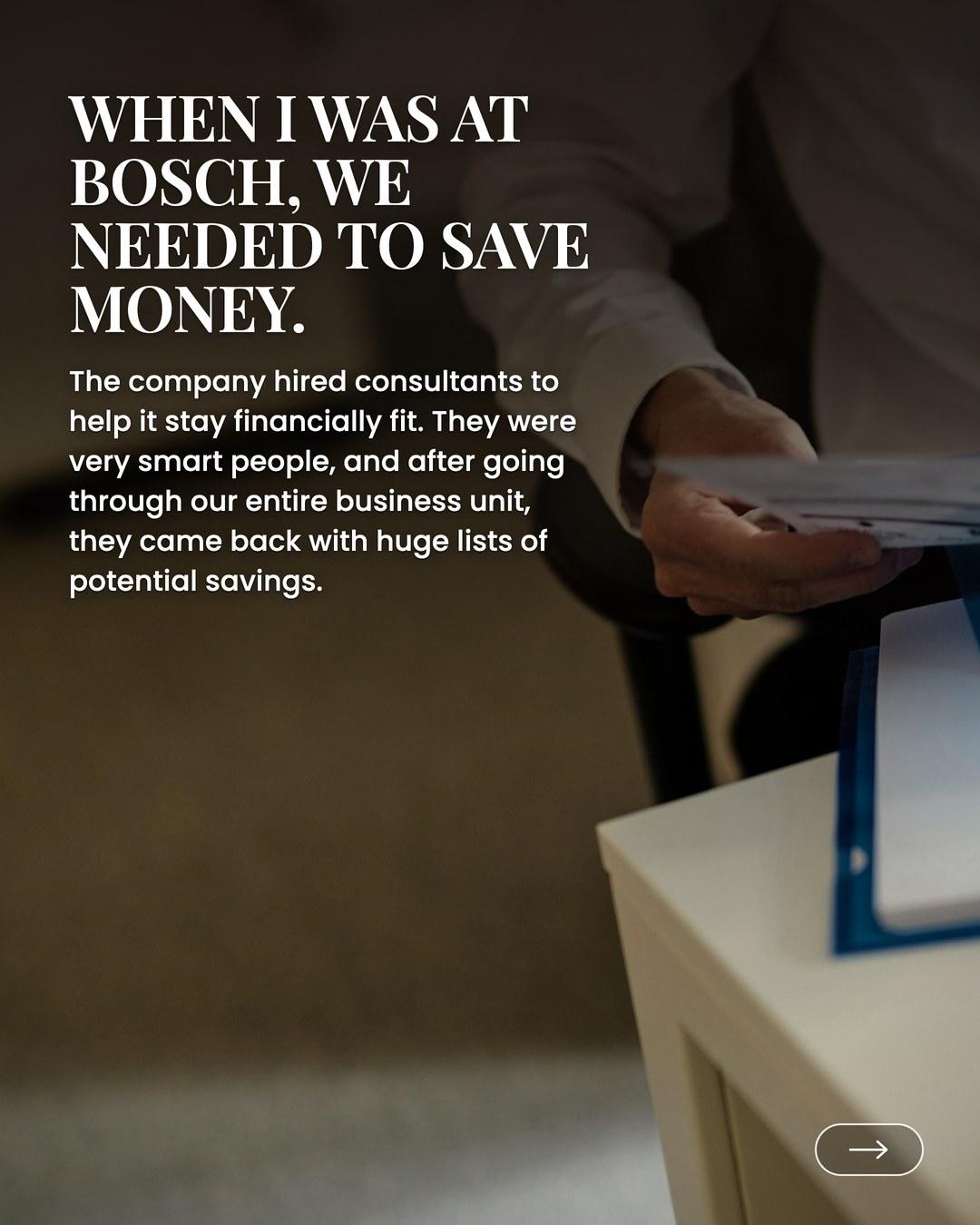
Henning Lategahn is a second-time founder based in Germany. After his PhD he founded a company supplying software and data to the automotive industry for autonomous driving. It had its first customer 6 weeks after founding, grew to about 30 people over about 7 years, and was sold to Bosch, where he stayed for about 3 years. A few months ago he started Nerando. He's building Michy, a tool that helps founders see cash and forecasting problems coming.
So he has stories. What he didn't have was a way to get them onto LinkedIn. In his words, social media "is something I'm not very good at myself, and I clearly needed some support from professionals." We had a discovery call on 19 Oct and started with a pilot.
“They totally understood every nuance of what I said during the interviews, and were able to compile this into very compelling content.”
What are the steps, in order?
Here's the whole pilot on one board. The source on the left, the 9 pieces it turned into, and the dates along the bottom.
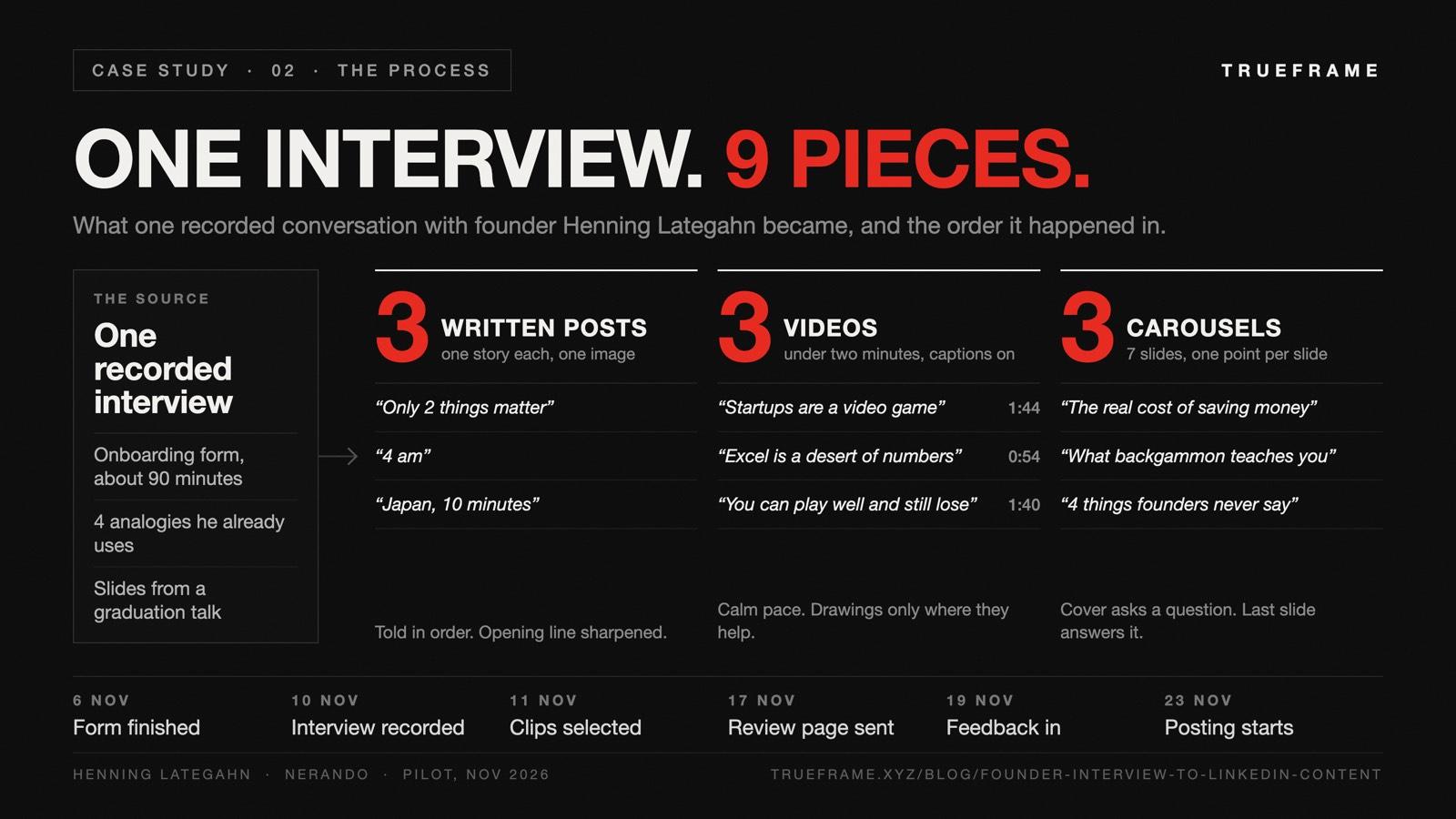
Swipe sideways to inspect the full graphic.
| When | Step | What happened |
|---|---|---|
| 19 Oct | Discovery call | Where it started. The pilot followed. |
| 30 Oct | Kickoff email | We asked him to complete the onboarding form before the interview. |
| 6 Nov | Form finished | It took him about 90 minutes. He also sent 4 analogies he uses for Michy. |
| 10 Nov | Interview recorded | 8am his time. He got the raw footage the same day. |
| 11 Nov | Clips selected | Yvonne from our team found the strong clips for the videos. |
| 13 Nov | Video walkthrough | He was travelling with limited internet, so Yvonne recorded a walkthrough in place of a review call. |
| 17 Nov | Review page sent | All 9 pieces, shown the way they'll look on LinkedIn, with a second recorded walkthrough. |
| 19 Nov | Feedback in | He picked a version of video 1 and sent more photos. |
| 20 Nov | Recap call | He recorded his testimonial the same day. |
| 23 Nov | Posting starts | Three pieces a week until 11 December. |
What happens before the interview?
The work starts with a form, and it's a long one. On 30 Oct we sent Henning a kickoff email asking him to complete our onboarding form before the interview, with specific answers. Some of the questions are answered on video. Those help us capture personality, and that feeds the copy later.
He finished it on 6 Nov. His review: "That form was a form. Took some 90mins or so. Think it is a good foundation to get started." Ben replied the next day that clients who spend 60 to 120 minutes or more on the form get much better results. So 90 minutes is right where we want a founder to land.
Along with the form he sent 4 analogies he uses when he explains Michy, the ones that in his words "seem to land" in discussions. That's the most useful thing a founder can hand us. He's already tried those lines on real people and watched which ones work.
The form is why one interview is enough. By the time we hit record, we already know which stories to ask about.
What happens on interview day?
We recorded the interview on 10 Nov at 8am his time. You can tell what it covered from what came out of it: his first half year as a founder, a cash flow crunch in 2018, and a decision about Japan he made in about 10 minutes at a conference.
The same day he shared slides from a university graduation talk where he describes a startup as a video game with levels. And the same day Yvonne sent him the raw, unedited interview footage, so he had the full recording before we'd cut a single clip.
How do we decide what the interview becomes?
On 11 Nov Yvonne went through the recording and found the strong clips for the videos. From there the material sorted itself by shape. Stories went to written posts. Ideas he explained well on camera went to video. Arguments that take a few steps went to carousels.
- 3 written posts, titled "Only 2 things matter", "4 am" and "Japan, 10 minutes".
- 3 videos, "Startups are a video game" (1:44), "Excel is a desert of numbers" (0:54) and "You can play well and still lose" (1:40).
- 3 carousels of 7 slides each, "The real cost of saving money", "What backgammon teaches you about running a startup" and "4 things founders never say out loud about their numbers".
How do we write the posts?
Benjamin Chua
Post-workshop production worksheet
5
printable pages
PDF · Version 1.0 · Updated Oct 2026
The Founder Content First-Cycle Worksheet
Inventory your sources, map one buyer question, brief one interview, assign every handoff an owner and record the first 30-day cycle.
- A source inventory with permission and accuracy status
- A buyer-question map with evidence and intended use
- A 45-minute interview brief
- A handoff table with owners, due dates and an explicit approval record
- A 30-day cycle calendar and a first-cycle review
Each written post is one story, told in the order it happened. We don't blend three anecdotes into one lesson. "4 am" is the 2018 cash flow crunch: Henning refreshing his inbox at 4 am, holding his daughter. That night is what led to Michy, and the post gets there the way he told it.
Two more rules. We sharpen the opening line. And every post gets one image whose title matches that opening line, so the picture and the first sentence say the same thing.
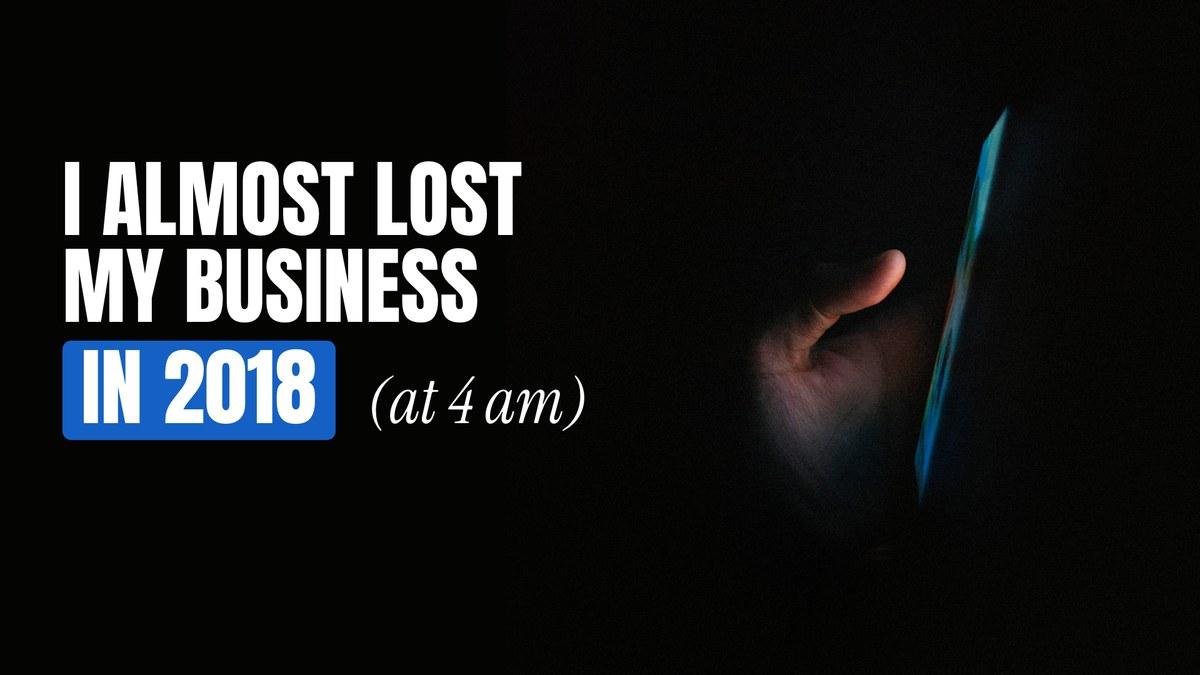
The other two work the same way. "Only 2 things matter" is his first half year as a founder, when the whole job was to build something people want and sell it. He tells it through Super Mario levels. "Japan, 10 minutes" is about deciding to open a Japan subsidiary in about 10 minutes at a conference, and it carries his line "Risk is the currency you spend to buy success."
The image rule creates homework. Our mockups used interview stills and his LinkedIn photos, so we asked him for 3 or 4 recent photos. Ben then asked for candid and travel shots too, since every written post needs an image.
How do we cut the videos?
All three videos are under two minutes: 1:44, 0:54 and 1:40. Captions stay on screen because most people watch LinkedIn with the sound off. Each video has a text hook, a quote in a blue box at the top of the frame.
The look came from his style brief. He asked for a calm pace and illustrations only where they help. So the palette is deep navy and blue, and the cutaways are simple drawings: game levels in the startup video, spreadsheet cells in the Excel one.
We cut two versions of video 1 and let him choose. More on that in the review step.
How do we build the carousels?
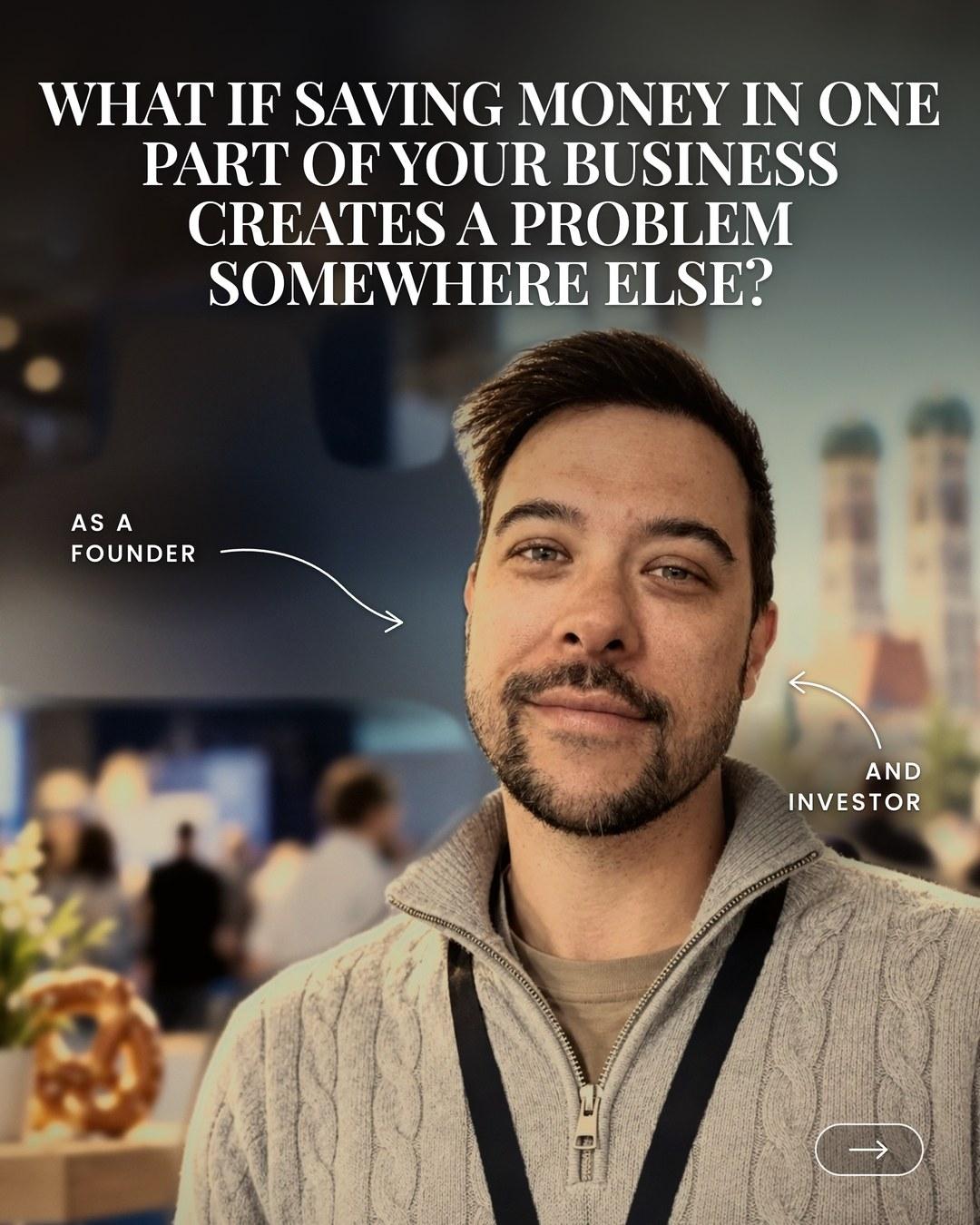
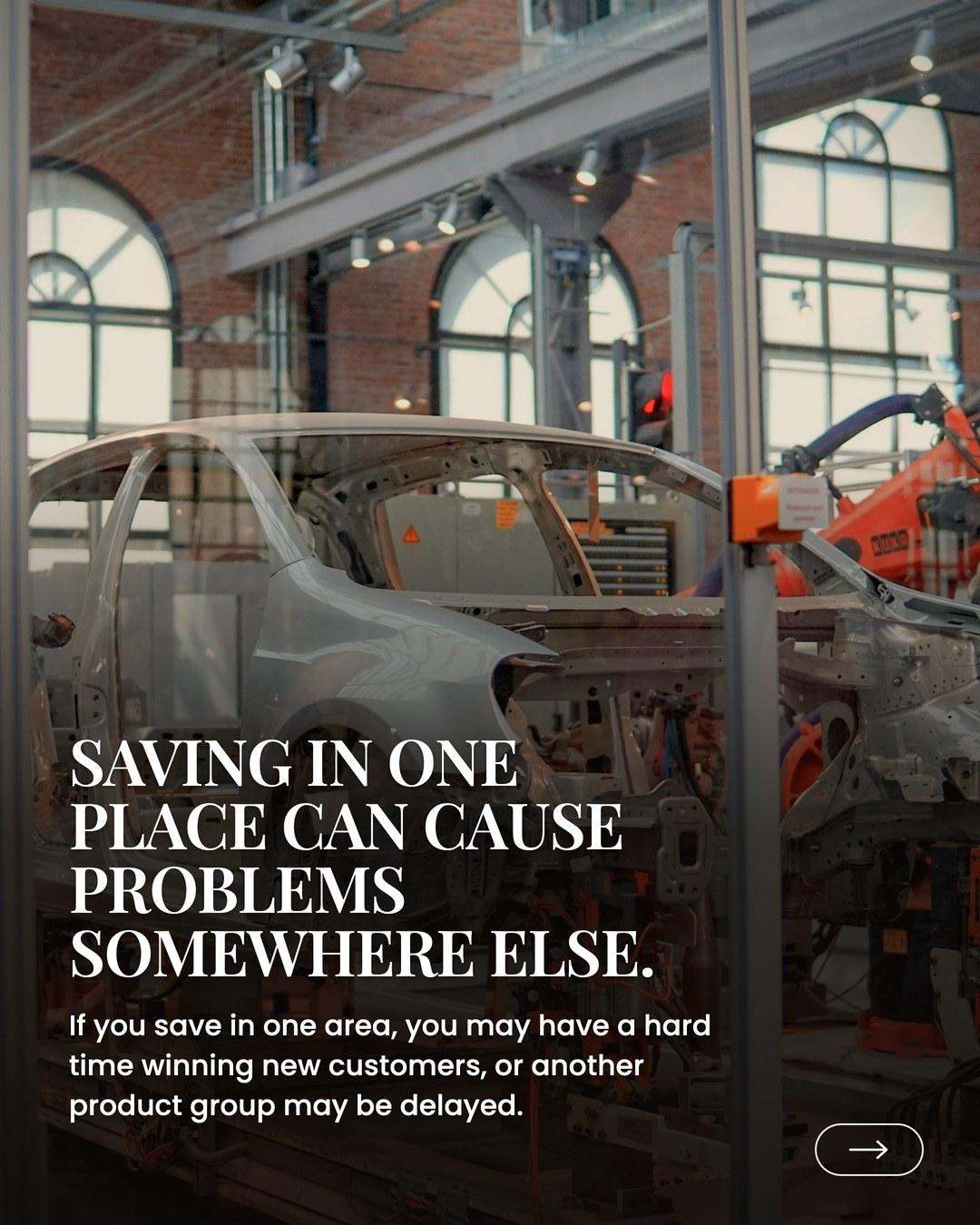
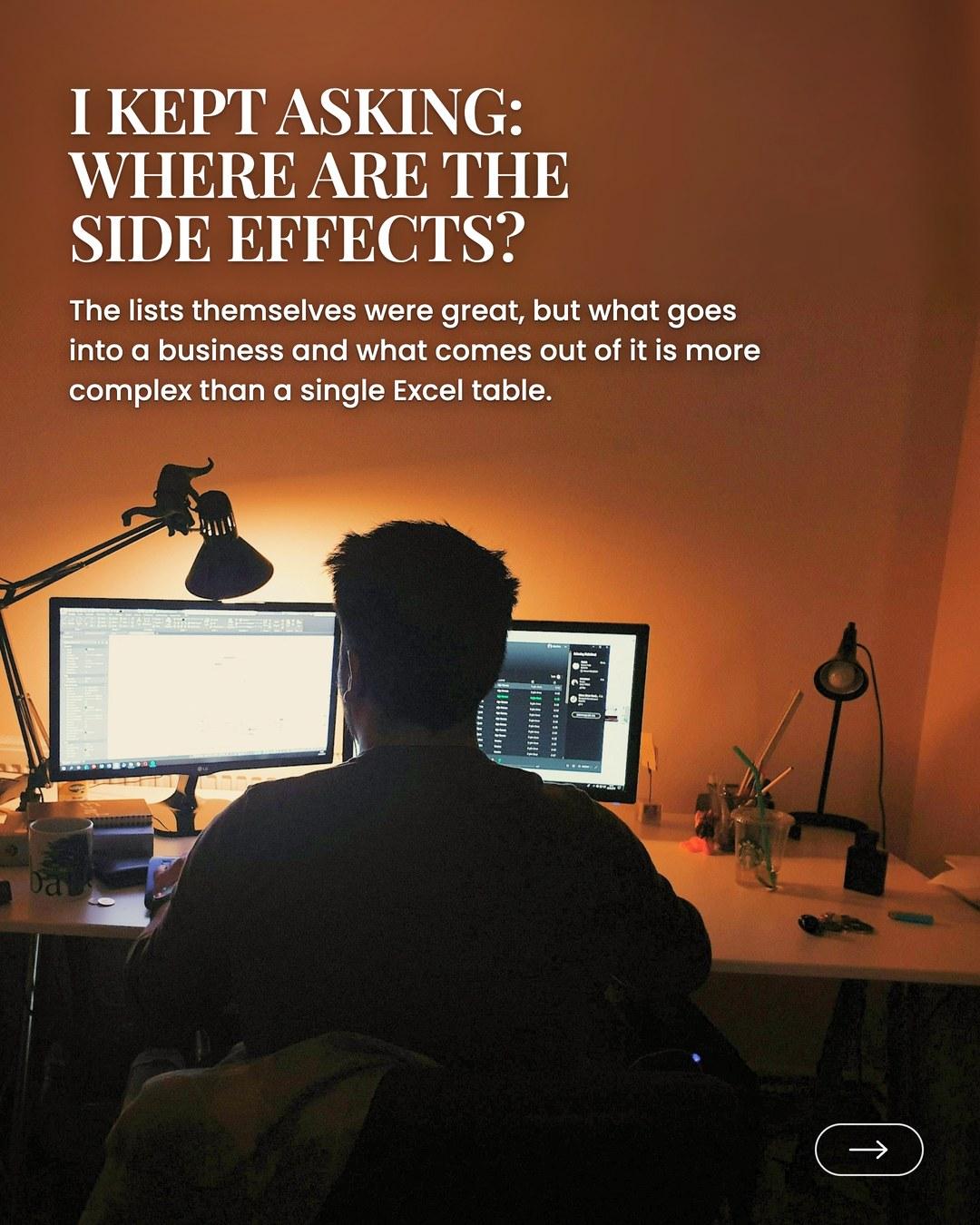
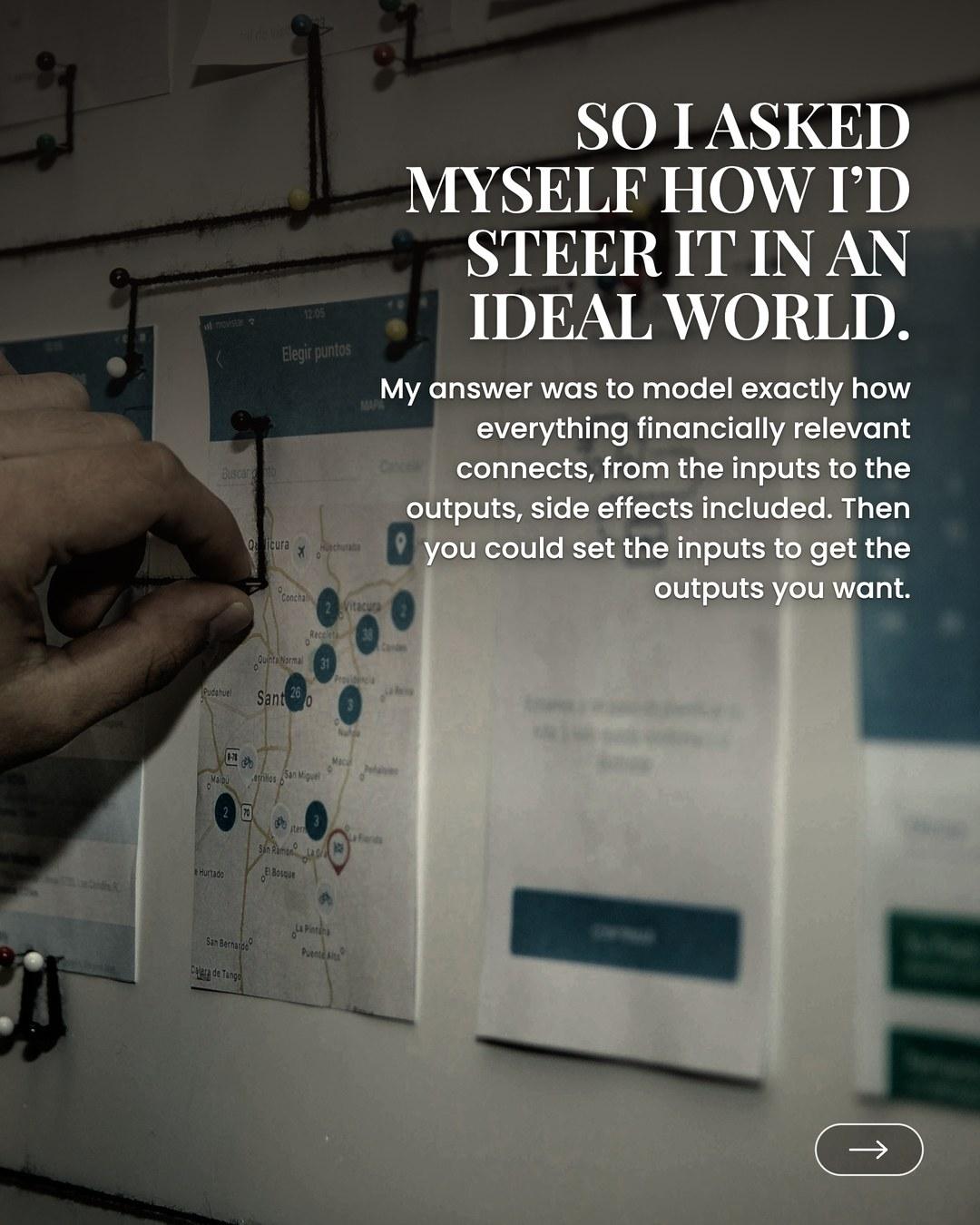
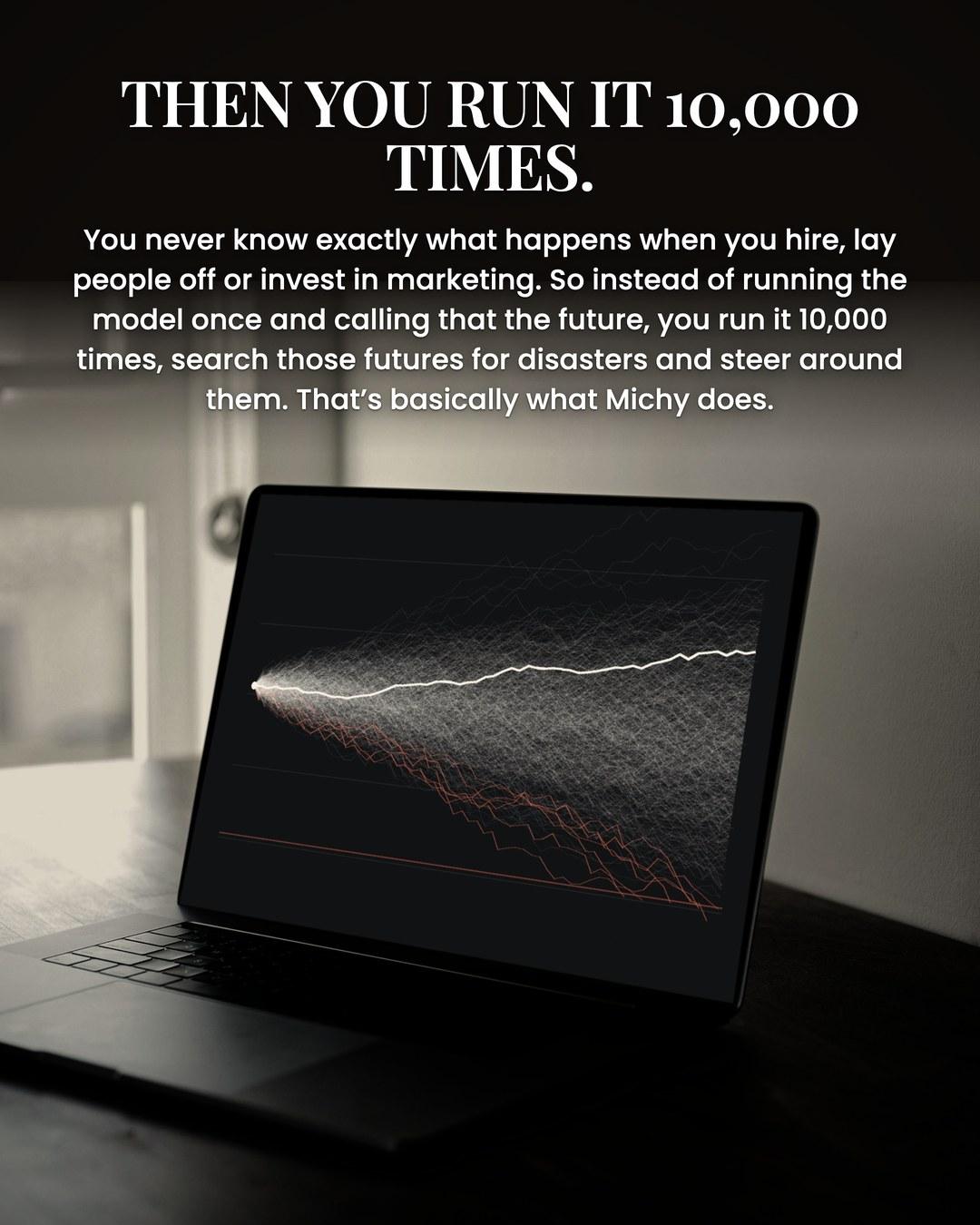
Each carousel is 7 slides with one point per slide. The cover poses a question and the last slide answers it. The cover of "The real cost of saving money" asks what happens if saving money in one part of your business creates a problem somewhere else. The last slide answers with what Michy does, which is run a model 10,000 times.
The carousels are built from his interview and his analogy notes. Michy appears only where he mentioned it himself, so the product turns up when the story reaches it and stays out of the way otherwise. We deliver them as PDFs because that's how LinkedIn shows carousels.

How does a founder review 9 pieces without a meeting?
Henning was travelling with limited internet on 13 Nov. A review call wasn't going to work, so Yvonne recorded a video walkthrough he could watch on his own time.
On 17 Nov, a week after the interview, she sent a recorded walkthrough of all the deliverables plus a hosted review page. The page shows each piece the way it will look on LinkedIn, with copy and download buttons and a posting calendar. Video 1 was there in two versions for him to choose between.
His reply came on 19 Nov.
Awesome! Very good. I like Version B better. (A is also good but B slightly better). Good job on all of them.
Henning Lategahn, by email, 19 Nov 2026
We had a recap call on 20 Nov. The same day he recorded the testimonial above on his iPhone and moved to an ongoing engagement.
When does it all go out?
The posting plan runs from 23 November to 11 December, three pieces a week on Mondays, Wednesdays and Fridays. If one goes out late, the rest move back. We'd rather keep the order than hit the dates.
As we publish this on 21 November, none of the 9 pieces has been posted. We have no reach, engagement or lead numbers to show you and we won't guess at them. What we can show is the work, the steps, and what the client said when he saw it.
More from this pilot
Got the stories but no way to get them onto LinkedIn?
That's where Henning started. See how we work with tech founders: one form, one recorded interview, then finished posts, videos and carousels for you to review.
See how it works for tech foundersSkip the reading. Talk it through instead.
Book a fit call and we'll map out what a content engine looks like for your business. No pitch, no pressure.
Don't miss the next one
Some of what we share is time-sensitive. A format that's working right now, a window that closes fast. We email those the moment they're worth jumping on. Drop your email so you catch them in time.
No spam. Unsubscribe anytime.
Frequently asked questions
How much of my time does it take to get LinkedIn content from one interview?
How long does it take to go from the interview to finished content?
What if I'm not good at social media?
Will the content sound like me or like an agency wrote it?
What results did Henning's LinkedIn content get?
Founded & led by
Benjamin Chua (BenChuchu)
Founder and CEO of Trueframe. 9 years building businesses (started at 16), tens of millions of views generated, and 8 figures in revenue created for the founders and brands he works with. He builds the content systems Trueframe runs.