From Virtually No Sales to 60 Book Sales in 10 Days: The Pantheon Myths Content Case Study
Mohsen Ashraf left a 15-year corporate career to write mythology graphic novels. His content got views and his book barely sold online. Here's exactly what we changed, in what order, with the numbers we can stand behind.
Written by Benjamin Chua, founder of Trueframe.
On this page
- Where did Pantheon Myths start?
- Why didn't the old content sell?
- What did we build in the first 30 days?
- The content engine: formats before scripts
- The purchase path: one click to checkout
- What month one looked like on the page
- What actually produced the 60 sales in 10 days?
- What didn't work?
- What can other founders copy from this?
- When should you not run this play?
Pantheon Myths went from virtually no online sales to 60 book sales in 10 days by doing three things in order: six weeks of short-form content to find the hooks that worked, a purchase path cut down to one click into Shopify checkout, and purchase-optimized Meta ads built from the winning hooks at $10 a day per buyer angle.
The short version
- Starting point: a 174-page mythology graphic novel, a Kickstarter that funded at 147% with 103 backers, convention sales that worked, online sales that didn't.
- Diagnosis: the content had no direct ask, the site had two competing CTAs and too many clicks to checkout, and paid spend went to boosted posts.
- Month one (1 June to 2 July 2026): 27 posts, 38,507 reel plays, team-edited reels averaging 2,287 plays vs 1,203 for Mohsen's own.
- The first ad test failed: $16 spent, 10 clicks, zero purchases, because it optimized for checkout starts without a purchase event.
- The relaunch on 23 July ran the winning hooks as purchase-optimized ads straight into checkout. Mohsen's count: 60 sales within 10 days.
- The sales came from the content system plus paid distribution. They did not come from follower growth, and we won't pretend otherwise.
Where did Pantheon Myths start?
Mohsen Ashraf spent about 15 years at Apple, left two years before we met, and wrote Pantheon, a 174-page full-colour graphic novel that smashes world mythologies into one story. He knew how to make the book. The Kickstarter funded at 147% with 103 backers. He sold 30 to 40 copies in person at MCM Comic Con in late May 2026, which tells you the product lands when he's in the room.
Online was a different story. He'd tried making content himself, hired freelance social media help, and run boosted posts. An Instagram account that sat around 8,000 followers through our first month, 135 email subscribers who had received exactly one intro email and one newsletter, and a Shopify store that mostly sat still. In his own words from the testimonial: sales were low, engagement was low, and he was burnt out wondering whether he'd make it in the space.
“I went from virtually no sales to predictable sales every week. Within 10 days, I had 60 sales of my book.”
He had a discovery call with us on 12 May 2026, we ran a paid strategy session on 21 May, and he signed on for the content engine on 25 May. Everything below happened between 28 May and 12 August, when we published that testimonial.
Benjamin Chua
Founder content sprint toolkit
5
printable pages
PDF · Version 1.0 · Updated Oct 2026
10-Day Content-to-Sales Sprint Planner
Plan the ten days from first script to first paid sale: purchase-path audit, format picks, angle-by-offer test grid and a daily read sheet.
- A purchase-path audit that counts clicks to checkout and checks the purchase event
- A day-by-day sprint plan from offer lock to scale decision
- A buyer-angle by offer test grid with a cut rule
- A daily read sheet that keeps Shopify orders and Ads Manager honest
Why didn't the old content sell?
The content wasn't bad. It had no job. When we audited his posts, his site and his spend in the strategy session, the problems were all in the path from a view to a purchase, and none of them were about production quality.
| What we found | Why it cost sales | What we changed |
|---|---|---|
| No direct ask in the content | Posts entertained mythology fans and then ended. Nobody was told what to buy or where. | Every third post carries a CTA: the free first issue, a giveaway, or the shop. The rest stay pure value. |
| Two competing CTAs on the homepage | Visitors split between reading free and buying, and most did neither. | One primary action: order the signed copy. The free issue moved to its own capture page. |
| Page to page to checkout | Each extra click is a place to leave. Baymard's running average across 50 studies puts cart abandonment above 70% even once people reach the cart. | Ads and CTAs send buyers straight to Shopify checkout. The landing page only exists for people who need convincing. |
| Boosted posts instead of conversion ads | Boosts optimize for engagement. Meta finds people who like, not people who buy. | No boosts. Proper conversion campaigns optimized for Purchase, after the funnel was live. |
| One offer at one price | A $20 book can't carry much ad cost. There was nothing for the person buying a present. | A $78 Gift Edition (signed copy, handwritten note, art poster, artifact necklace) with 1, 3 and 5-pack pricing. |
| A dormant email list | 135 subscribers had never been told how to buy the book. | Free-issue capture page rebuilt. Nurture sequence queued behind the funnel work. |
One more call shaped everything after it. Mohsen sells to two very different buyers: adult mythology nerds who buy for themselves after a few touches, and gifters, the parents, aunts and uncles buying for a teenager who loves Percy Jackson. Gifters convert off a single good call-out and skip the nurture cycle. We decided to build for them first.
The four places a content funnel leaks between the view and the purchase, with the fix for each.
Read the guideWhat did we build in the first 30 days?
Three things ran in parallel from the 28 May kickoff: a content engine Mohsen could keep up with, a conversion site with a one-click purchase path, and a tracking setup that would let ads learn from real purchases. Here's each one.
The content engine: formats before scripts
We locked three launch formats at kickoff and Mohsen scripted six videos the same day from our templates. The division of labour was simple. Mohsen writes from the format, films on an iPhone 15 with a lav mic, uploads raw footage and posts to his own TikTok and Instagram. Trueframe reviews scripts, edits everything, writes captions and hashtags, and runs the outlier research. Four posts a week, no pre-cutting on his side, and we send low-energy footage back for a reshoot.
- Myth-drop episodic series. "Mind-blowing myth drops until I hit 10K followers." Green-screen composite, animated title card, episode numbers, epic-fantasy scoring. The first one, Gandalf is Odin in disguise, posted on 6 June and was his best performer in the first week.
- Corporate to Comics. The founder story: how a banker and Apple executive ended up writing comics. Voiceover delivery, B-roll from his Apple years, filmed in two parts.
- Pantheon storytelling. In-media-res hooks from the book itself with trailer-feel edits. "A god has been murdered" became the site's opening line too.
- Ranking videos and hot takes, added in week two once the first three formats were running.
Two production rules did more for results than any edit. Hold the mic in front and project, locked after the first batch came back too quiet. And limit AI imagery: Mohsen's audience wants authentic historic art and real photos, so the edits use sourced art and keep AI for the odd transition.
The purchase path: one click to checkout
I rebuilt the site through June around a single idea: the fewest possible clicks between a reel and a paid order. A homepage with the 3D book-opening sequence and one buy action, a /gift page for the $78 Gift Edition with 1, 3 and 5-pack pricing, a /free-issue capture page, and a separate /founders page for a two-cover collectible we later paused to keep the ad test clean. Campaign pages sit off the main navigation and are noindexed so they never compete with the main site.
Shopify went live on 16 July with the single copy at $19.99 and the Gift Edition at $78. One Meta pixel is shared between the site and the store, and the Purchase event fires through Shopify's pixel and Conversions API rather than from the site, so no order is counted twice. That detail turned out to be the whole game.
What month one looked like on the page
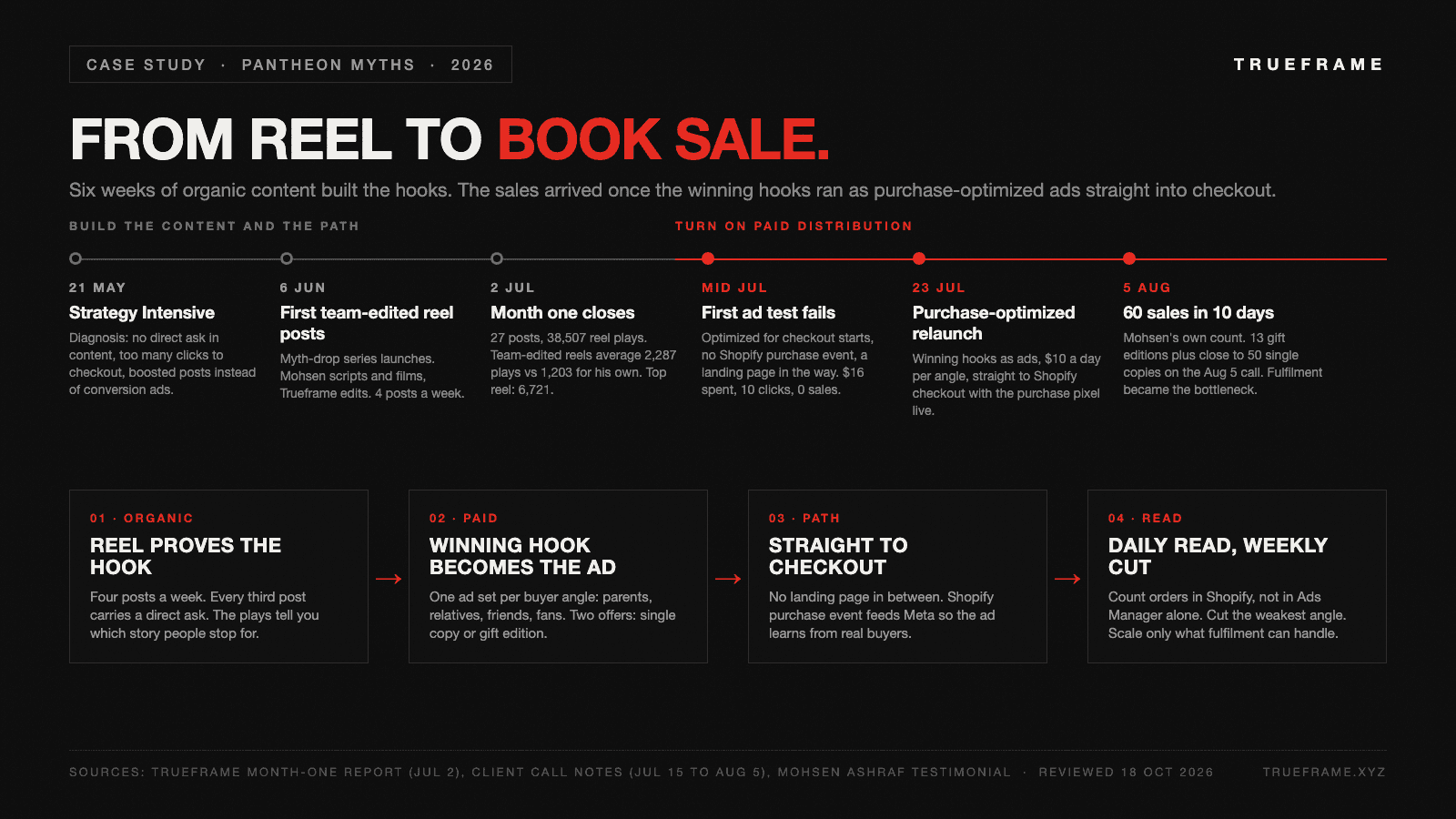
Swipe sideways to inspect the full graphic.
| Measure | Number | Note |
|---|---|---|
| Posts published | 27 | 23 reels (two of them collab posts) and 4 carousels |
| Total reel plays | 38,507 | Across all 23 reels |
| Team-edited reels | 10 reels, 22,869 plays | Average 2,287 plays per reel |
| Mohsen's own reels | 13 reels, 15,638 plays | Average 1,203 plays per reel |
| Team vs own | About 1.9x | Same account, same month, same person on camera |
| Top reel | 6,721 plays | "I quit Apple after 15 years", posted 13 June |
| Next best | 2,922 and 2,802 | Gandalf is Odin (6 June) and Why Odin has so many names (28 June) |
Two honest notes on that table. The plays are public Instagram counts taken on one evening, 2 July, so they're consistent with each other but they aren't Meta Insights. And Mohsen's own lane includes his convention vlogs and travel reels, which have a different job from the scripted series. The 1.9x gap is real, and it's partly format, partly edit.
What month one did not do is sell many books. The content built the hooks, the audience signals and the proof of which stories people stop for. The purchase path was ready. The missing piece was distribution to buyers, and that's where the next three weeks went.
What actually produced the 60 sales in 10 days?
Purchase-optimized Meta ads built from the winning organic hooks, sending buyers straight into Shopify checkout. Mohsen is explicit about this in his testimonial: the scripts and the edits came first, and the sales changed once the ads started running. We'd be misleading you if we told you the reels alone did it.
On the 15 July call we agreed the first campaign: $10 a day per ad set, four buyer angles (parents, relatives, friends, fans) against two offers (single copy and Gift Edition). It launched that week and it flopped. By 23 July it had spent about $16, produced 10 link clicks and no purchases. Three causes, all ours: it optimized for Initiate Checkout instead of Purchase, the Shopify purchase event wasn't connected to the campaign, and buyers went through a landing page before the cart.
The relaunch was live by the 23 July call, with Purchase optimization, the Shopify pixel feeding real orders back to Meta, and the ads pointing directly at checkout. Within a week Mohsen was reading me order counts off his phone on our call, from US and UK buyers. In Ads Manager the gift-to-relatives-and-parents angle and the self-buyer angle did almost all the work, and gift-to-friends barely moved. His problem that week was packing boxes fast enough, and he asked us to lower spend for a few days so he could catch up on back orders.
By the 5 August call he'd raised the single-copy price and shipping charge in the meantime and volume held. That's the window behind his line: within 10 days, 60 sales of the book.
Attribution, stated plainly: the sales followed the purchase-optimized ad relaunch on 23 July. The content system supplied the hooks, the scripts, the footage and the proof of which angles to run. Follower growth was not the mechanism, and none of this came from search or AI recommendations.
Want to know whether your offer could run this play?
Book a fit call. We look at your offer, your margin, your purchase path and your capacity to film, then tell you honestly whether an Installed Founder Content Engine would pay back for you. If it wouldn't, we say so.
What didn't work?
Plenty, and the misses are the useful part of a case study. Here's the list we'd hand a founder before they try this themselves.
- The first ad campaign. Optimizing for checkout starts with no purchase event and a landing page in the way wasted a week. Fix the event before you spend a dollar.
- The friends angle. Gift-to-friends produced 2 purchases while gift-to-relatives-and-parents produced 12 on the same budget. We cut it and put the money behind parents.
- The first filming batch. Shot horizontal by mistake and too quiet. We kept it for version one and locked vertical, mic-in-hand and a mic check before every batch.
- Boosted posts and link-in-bio. Both were running before we met. Both stopped.
- A finished edit that never posted. The Noah's flood video was delivered on 24 June and was still unposted on 2 July. When the client posts on his own accounts, the queue is only as good as his week.
- Meta rewrote our ads. On 27 August Meta's own system replaced eight live creatives with auto-cropped versions and Shop fields, then failed them with a processing error. We restored each ad to its last verified creative the next day. Check your ads after any platform-side change.
- TikTok ads. We ran them for a period and later stopped. Paid media for this client is Meta only now.
- Scaling into a packing bottleneck. Sales outran one person's ability to ship gift boxes. Fulfilment capacity is part of the funnel.
What can other founders copy from this?
The sequence, more than any single tactic. Mohsen's product is a graphic novel, and the play works for any expert-led offer where the founder is the reason people buy: a book, a course, a workshop, a productized service. Here's the ten-day version we now run as a sprint.
- Day 1: lock one offer and one buyer. Write the price, the margin per unit and the one person you're selling to. For Pantheon that was the Gift Edition and the parent of a mythology-obsessed teenager.
- Day 2: audit the purchase path. Count the clicks from a reel to a paid order. Anything above two is a leak. Make sure the Purchase event fires from the store, not the site, so nothing double counts.
- Day 3: pick three formats and script six videos. One story format (why you do this), one value format (the myth-drop equivalent for your field), one proof format. Every third script carries a direct ask.
- Days 4 to 6: film the batch in one session, post four a week, and get the first edits live. Judge formats by plays and comments, not by how you felt filming.
- Day 7: pick the winning hook. The reel people stopped for becomes your first ad. Keep the opening line word for word.
- Day 8: launch purchase-optimized ads at $10 a day per buyer angle. Three or four angles, one or two offers, all pointing straight at checkout.
- Day 9: read the orders in the store, not just in Ads Manager. On one day Ads Manager counted nearly twice as many gift purchases as Shopify showed, because some people clicked a gift ad and bought a single copy.
- Day 10: cut the weakest angle, check fulfilment can handle double, and decide whether to scale. If you can't ship it, don't buy it.
Hormozi's Value Equation explains why the gift edition did the heavy lifting. Same dream outcome (a present the kid actually loves), higher perceived likelihood (signed copy, note, poster), and almost zero effort for the buyer because the ad goes straight to checkout. We didn't change the book. We changed the offer around it and the number of steps to buy it.
When to spend on reach, when to spend on conversion, and how the two compound when you run them in the right order.
Read the comparisonWhen should you not run this play?
If your margin per unit can't absorb the cost of a purchase, paid distribution will lose money no matter how good the content is. If you can't film a batch every week or two, the organic half stalls and you're left buying attention with nothing to retarget. And if you can't ship or deliver at double today's volume, fix that first. Mohsen hit the packing wall in week one of sales, and he's a fast operator.
What keeps paying after the sprint is the library. Every hook that worked is now a tested ad, the founder story is filmed, the reviewer videos from August run as ads with his face nowhere in them, and the next launch starts with a warm list instead of 135 silent subscribers. That compounding is the part a one-off campaign never gets.
Expert-led offer, content that gets views, sales that don't move?
That's the exact gap we closed for Pantheon Myths. See how the Installed Founder Content Engine works for personal brands, then book a fit call and we'll tell you honestly whether it would pay back for you.
See the content engine for personal brandsKeep reading
Sources and review date
Primary sources, first-party data and review dates are listed below. Client-reported results and Trueframe analysis are labelled in the article.
- Learn about Meta pixel · Meta Business Help CentreReviewed 18 October 2026
- About Conversions API · Meta Business Help CentreReviewed 18 October 2026
- Pixels and customer events · Shopify Help CenterReviewed 18 October 2026
- Cart abandonment rate statistics (50 studies, updated 22 September 2025) · Baymard InstituteReviewed 18 October 2026
- $100M Offers and $100M Leads (the Value Equation) · Alex Hormozi, Acquisition.comReviewed 18 October 2026
Skip the reading. Talk it through instead.
Book a fit call and we'll map out what a content engine looks like for your business. No pitch, no pressure.
Don't miss the next one
Some of what we share is time-sensitive. A format that's working right now, a window that closes fast. We email those the moment they're worth jumping on. Drop your email so you catch them in time.
No spam. Unsubscribe anytime.
Frequently asked questions
How did Pantheon Myths get 60 book sales in 10 days?
Did the sales come from organic content or paid ads?
Why didn't the first Meta ad campaign work?
How much content did it take?
Can this work for a book or a low-ticket product?
What did Mohsen do himself and what did the agency do?
How long before you should expect sales from founder content?
Founded & led by
Benjamin Chua (BenChuchu)
Founder and CEO of Trueframe. 9 years building businesses (started at 16), tens of millions of views generated, and 8 figures in revenue created for the founders and brands he works with. He builds the content systems Trueframe runs.