How Much Time Does a Founder Need to Spend on Content?
Filming is the smallest part of the bill. The hours that leak are preparation, approvals and the decisions nobody agreed in advance. Here is how we budget founder time inside a done-for-you engine, with two schedules you can copy and a case study from a surgeon who ships close to a video a day.

Written by Benjamin Chua, founder of Trueframe.
On this page
- Why isn't the answer 'one hour a month'?
- Where does founder time actually go?
- Which decisions should a founder never delegate?
- What should you hand off?
- Which schedule fits a founder's calendar: weekly or batched?
- Pattern A: a small weekly commitment
- Pattern B: a concentrated recording cycle
- What does this look like for a real founder?
- How do you keep review time from eating the savings?
- Do you need to budget time after the content is made?
- How do you know if outsourcing is actually saving time?
A founder working with a content team needs about 5 to 10 hours per four-week cycle: explaining ideas, checking claims, recording and approving what goes out under their name. Production, editing and coordination can be delegated. Judgment cannot. Filming is usually the smallest line; preparation and approvals are where the hours hide.
The short version
- Budget six jobs, not one: preparation, interviews, recording, approvals, coordination and distribution.
- Keep the decisions that depend on your expertise. Delegate everything repeatable.
- A weekly pattern costs about 5 founder hours per four weeks. A concentrated cycle costs about 10.
- Silence is not approval. Agree who can sign off what before the first draft lands.
- Track actual hours in the first cycle. The gap between plan and reality tells you what to fix.
Why isn't the answer 'one hour a month'?
Because nobody who promises that is counting the whole job. A one-hour interview can be exactly one hour. It still needs someone to gather the questions before it and check the edit after it. If those jobs land on you unscheduled, content starts leaking into the rest of your week and you conclude content takes too long.
I run a done-for-you content engine, so I have a commercial interest in telling you content takes very little of your time. I'd rather tell you the real number. Hormozi's Value Equation puts time delay and effort in the denominator of any offer, and content is no exception: the honest way to shrink the effort is to remove jobs from your plate, not to pretend they don't exist.
So the useful question is where your hours go, which of them need you, and which a colleague or a provider should own.
Where does founder time actually go?
Benjamin Chua
Founder content planning tool
4
printable pages
PDF · Version 1.0 · Updated Oct 2026
Founder Content Time Budget Worksheet
Budget every founder hour across nine content jobs, assign owners, set approval rules and compare planned hours with your first real cycle.
- A nine-job time table split across founder, colleague and provider
- Approval and delegation rules so silence never becomes approval
- A pattern chooser: weekly sessions, concentrated cycle or written-first
- A first-cycle review that compares planned hours with actual hours
Into six buckets. Every content program we've run for a founder has all six, whether or not anyone planned for them. The table shows who should own each one when a team is doing the production.
| Bucket | What it includes | Founder | Team or provider |
|---|---|---|---|
| Preparation | Intake, positioning, current buyer questions, approved examples | Supplies judgment and examples | Gathers, documents, drafts prompts |
| Interviews | Being asked the questions so ideas come out without a blank page | Shows up and talks | Runs the interview, captures everything |
| Recording | Camera time, breaks, retakes | Records | Directs, handles setup and teleprompter |
| Approvals | Reviewing drafts and edits, flagging claims | Checks meaning and accuracy | Fixes, tracks versions, learns from feedback |
| Coordination | 'Is this hook OK?' 'Can we use this story?' | Answers only pre-agreed exceptions | Owns the schedule and the decisions it can |
| Distribution | Replies to key comments, sending pieces to prospects | Light touches where it matters | Publishes, routes, reports |
Ask any provider to show these six separately. 'We do everything' is too vague to put in a calendar. 'You give us four 30-minute slots and one 40-minute review a month, we own the rest' is a plan you can protect.
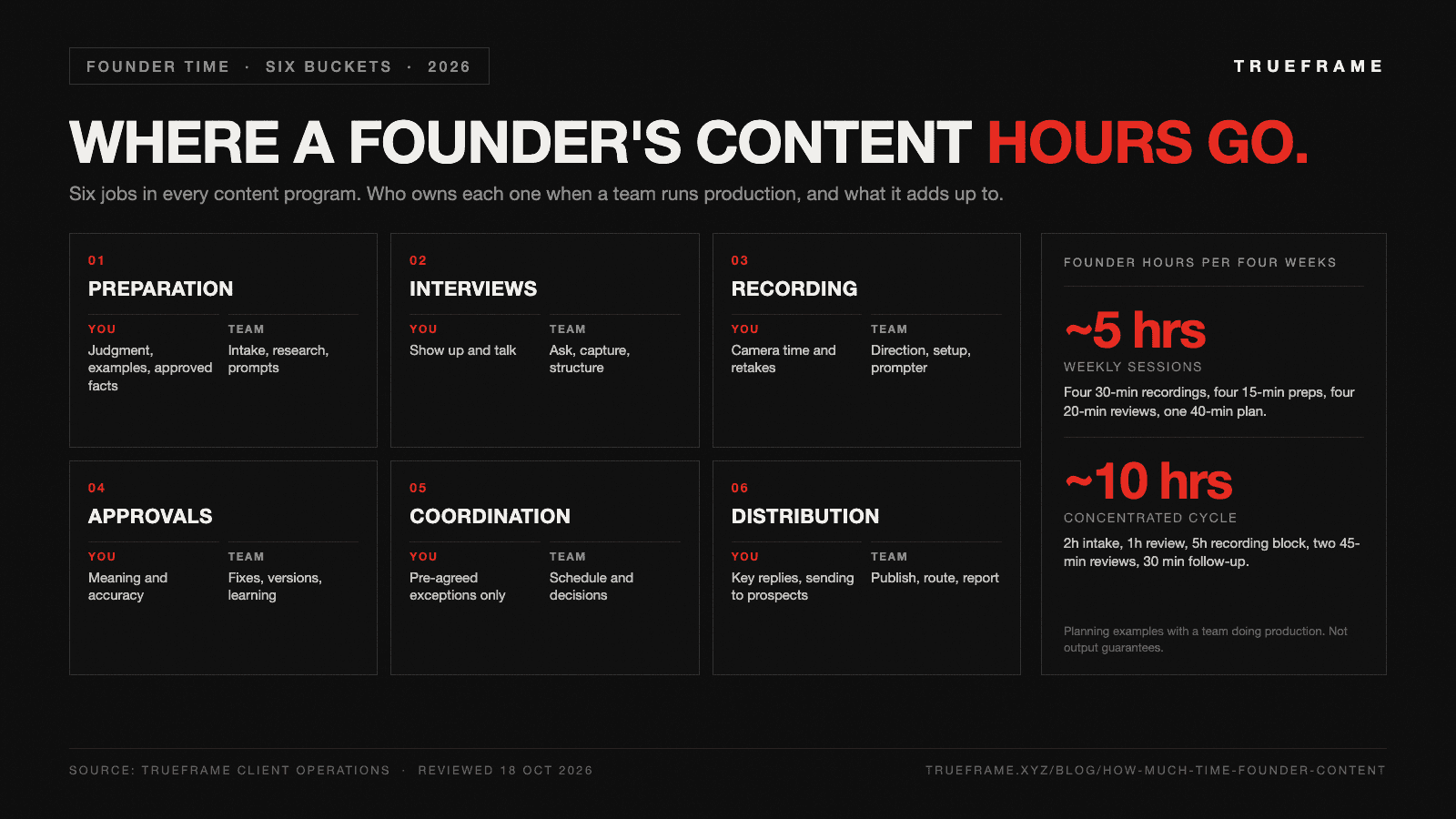
Swipe sideways to inspect the full graphic.
Which decisions should a founder never delegate?
The judgment behind a decision. Why you recommend one approach over another. What makes a customer a bad fit. Where the standard advice stops working. 'We help teams improve onboarding' is a sentence anyone can write. Explaining why you delay automation until the handover is clear shows how you think, and that is the part buyers are actually buying.
An interviewer can draw that reasoning out. An editor can make it easier to follow. Neither should invent it because you were unavailable. Google's own guidance on helpful content asks whether a page shows first-hand experience; a ghostwritten opinion fails that test for the reader long before it fails it for the algorithm.
You also keep responsibility for material factual claims. If a colleague has the expertise and authority to review those, decide that in advance and write the scope down. Silence is not approval. A missed deadline should trigger a reminder, a reschedule or a named delegate reviewing within their agreed scope. It should never trigger publication by default.
What should you hand off?
Everything repeatable. You should not become the project coordinator because your face is in the video. Research, turning an interview into drafts, recording prompts, editing, version control, the publishing calendar: a provider can own all of it, and the agreed scope says which pieces they do.
Your internal team can feed the machine too: questions from sales, approved material, changes to the offer. That saves you from being the only person who knows where everything is.
The handoff fails when the brief is thin. A folder of recordings with no note about the audience creates a dozen avoidable decisions for the editor, and every one of them comes back to you as a Slack message. A short brief stating the buyer, the question, the answer and the evidence beats ten meetings about style.
If routine decisions keep returning to you, the problem is usually a missing decision rule, not a shortage of founder effort. Write the rule once and the questions stop.
The video above is the system in practice: the founder shows up for interviews and approvals, the team turns one session into weeks of output. Watch for how little of his calendar it takes once the brief and the decision rules exist.
Which schedule fits a founder's calendar: weekly or batched?
Either, as long as you can protect it. Here are two realistic patterns. They are planning examples, not production guarantees, and both assume a team handles production and coordination.
Pattern A: a small weekly commitment
| Activity over four weeks | Founder time |
|---|---|
| Four 30-minute interviews or recording sessions | 2 hours |
| Four 15-minute preparation slots | 1 hour |
| Four 20-minute review slots | 1 hour 20 minutes |
| One 40-minute planning review | 40 minutes |
| Total | 5 hours |
This suits a business whose topics shift often, or a founder who explains ideas better in short bursts. The risk is the recurring slot. If each one gets cancelled because another meeting feels more urgent, the 'manageable' plan produces nothing. Protect the slot like a client call.
Pattern B: a concentrated recording cycle
| Activity for one cycle | Founder time |
|---|---|
| Intake interview and source gathering | 2 hours |
| Review questions and approved examples | 1 hour |
| Setup, recording and breaks | 5 hours |
| Two 45-minute content reviews | 1 hour 30 minutes |
| Follow-up corrections and planning | 30 minutes |
| Total | 10 hours |
Ten founder hours across the cycle. Not a promise that ten hours yields a fixed number of finished pieces; that depends on preparation, complexity and how the recording goes. Batching makes scheduling easier and makes a missed recording date hurt more, so keep a backup date and decide what keeps publishing if the session moves.
This is the pattern our Installed Founder Content Engine intensive runs on: one guided remote shoot day of roughly four to six hours per six to twelve months of content, with intake and reviews around it. Pattern B above is roughly what that asks of you.
What does this look like for a real founder?
Dr Marion Chan is a plastic and reconstructive surgeon in Melbourne with three kids and a full surgical practice. When we started with her in June 2026 she had 12,043 Instagram followers and disliked the DIY posting she'd been doing. Her time budget is close to Pattern B.
She writes rough script ideas in her own words. We review and proofread every script before she films, which catches compliance problems and weak hooks before a camera is switched on. She films several scripts in a single afternoon at her clinic and uploads the footage. We edit, route and schedule. She approves each post before it publishes. That is the whole founder job: ideas, one filming afternoon, approvals.
In her first full month, reach across her two accounts was 430,563 against a May baseline of 48,840, about 8.8x. Her followers went from 12,043 on 4 June to 26,164 on 7 July. One reel, 'This is a Message', reached 367,252 people. The content shipped close to one video a day while her week stayed hers.
“The actual reel or video that they give you in the end just far exceeds my expectations of how I could have dreamed of it being.”
Robert Ta, an AI founder we worked with, put the time point directly in his written testimonial: Ben and his team built him a system requiring minimal time from him while generating serious results, and he tracked over six figures in converted pipeline from qualified leads who referenced his content. That pipeline came from his content and podcast clips, not from a trick. The design that made it possible was the same: he supplied the thinking, the team supplied the hours.
How a surgeon with a full practice ships close to a video a day: scripts, batch filming, proofreading, routing and sign-off.
Read the case studyHow do you keep review time from eating the savings?
Open-ended feedback consumes more founder time than recording. Agree where feedback goes, when it's due and what kind of review is happening. Review meaning and accuracy first; debate visual preferences later, because if the message changes the polish gets redone anyway.
Give specific corrections. 'This sounds wrong' leaves the writer guessing. 'We recommend this for businesses with an existing sales process; add that condition before the example' tells them what to fix. A good provider uses repeated feedback to stop repeating mistakes, so you should not be correcting the same description of your offer every cycle.
Keep one current reference for the offer and approved facts. When the business changes, update it and tell whoever owns the queue. Otherwise an accurate recording becomes an inaccurate post three months later.
Do you need to budget time after the content is made?
Yes, a little. A content bank is only useful while it stays true. Some explanations age slowly: how you diagnose a problem, why you turn certain clients away. Prices, features, availability and anything tied to a date age fast. Separate the two during planning.
Agree who checks scheduled posts and what stops publication. If the offer changes, the correction has to reach every affected piece, including captions and links. You don't need to inspect every scheduling screen. You do need a named owner and a way to flag changes. 'Recorded once' is not 'safe to publish forever'.
There's a longer argument for staying consistent, too. The LinkedIn B2B Institute's 95-5 heuristic holds that most of your potential buyers are out of market at any moment, so the content has to keep building memory until their buying window opens. That is a reason to budget a sustainable number of hours rather than a heroic one.
Want us to tell you honestly whether an engine would pay back?
Book a fit call. We look at your offer, your calendar and your sales process, then tell you plainly whether the Installed Founder Content Engine would pay for itself in your situation, or whether you should spend the time elsewhere.
How do you know if outsourcing is actually saving time?
Track your real hours during the first cycle, including interruptions, repeated explanations and late reviews. If the planned five hours became twelve, find out why. Thin brief? Provider misunderstood the offer? You changed direction after approving? The estimate was optimistic? Each cause has a different fix.
Two questions do most of the diagnosis. Where did the last unexpected thirty minutes go? Which decision is still waiting on you that could have been a rule? Answer those and you usually know what to change.
Don't judge the arrangement only on hours. Saving an hour on review is worthless if the published explanation confuses buyers. And count energy, not just time: a five-hour recording block is not five desk hours. Build recovery into the day instead of booking a board meeting straight after.
Finally, be honest about whether content deserves the hours at all. For some businesses, direct sales, partnerships or referrals will beat a content program for a long time. Make the content commitment fit its real job. If you're weighing a done-for-you engine against doing it in-house, our comparison of a content agency versus an in-house hire runs the numbers, and the guide to choosing a personal branding agency gives you the questions to ask about any provider's process before you commit.
Related guides
Sources and review date
Primary sources, first-party data and review dates are listed below. Client-reported results and Trueframe analysis are labelled in the article.
- $100M Offers (the Value Equation: time delay and effort) · Alex Hormozi, Acquisition.comReviewed 18 October 2026
- Creating helpful, reliable, people-first content · Google Search CentralReviewed 18 October 2026
- Advertising effectiveness and the 95-5 rule · LinkedIn B2B Institute and Ehrenberg-Bass InstituteReviewed 18 October 2026
Skip the reading. Talk it through instead.
Book a fit call and we'll map out what a content engine looks like for your business. No pitch, no pressure.
Don't miss the next one
Some of what we share is time-sensitive. A format that's working right now, a window that closes fast. We email those the moment they're worth jumping on. Drop your email so you catch them in time.
No spam. Unsubscribe anytime.
Frequently asked questions
How many hours a month should a founder spend on content?
Can I outsource content completely?
How much filming time does Trueframe's intensive need from a founder?
What if I'm uncomfortable on camera?
Does batching a year of content lock every idea for a year?
Why does my planned 5 hours of content time become 12?
Founded & led by
Benjamin Chua (BenChuchu)
Founder and CEO of Trueframe. 9 years building businesses (started at 16), tens of millions of views generated, and 8 figures in revenue created for the founders and brands he works with. He builds the content systems Trueframe runs.