What a Done-for-You Personal Branding Agency Actually Does Each Month (Inside Our Engine)
Most agency pages describe outcomes. This one describes the work. Here is the four-week cycle we run for founders, what they do with their two to four hours, what we do with the rest, and how quality is controlled at every handoff.

Written by Benjamin Chua, founder of Trueframe.
On this page
- What does a done-for-you personal branding agency actually do each month?
- Week 1: how do the strategy and the POV doc get updated?
- Where do the topics come from each month?
- Week 2: what happens in the directed recording block?
- Week 3: how do editing and QA actually work?
- Week 4: how does publishing work, and who approves it?
- What happens in the analytics review?
- What does the founder do, and what does the agency do?
- What are the deliverables each month?
- How is quality controlled across the whole month?
- When should you not hire an agency to run this?
- How do you audit an agency against this calendar?
A done-for-you personal branding agency runs a repeating monthly cycle. It keeps a living strategy and POV doc, mines the founder's real calls for topics, writes scripts, directs one short recording block, edits and quality-checks every piece, publishes on a schedule, then reviews the numbers and rewrites. The founder gives expertise and two to four hours. The agency does everything else.
The month in one glance
- Week 1: strategy and POV doc updated, topics mined from last month's calls, scripts written and approved.
- Week 2: one directed recording block of 60 to 90 minutes, coached live.
- Week 3: briefs, edits, editor self-check and a single client-ready sign-off, with feedback on the frame in Frame.io.
- Week 4: scheduled publishing with an approval gate, then a review of retention, saves, lead requests and booked calls.
- Founder time: two to four hours a month in the standard cycle. We tell you when your situation needs more.
- Produced, approved, scheduled and live are tracked as different states. A piece is done when the live link opens.
What does a done-for-you personal branding agency actually do each month?
It runs a cycle, and the cycle matters more than any single video. Strategy feeds topics, topics feed scripts, scripts feed one recording block, the recording feeds briefs and edits, edits pass quality gates, published pieces feed a review, and the review rewrites the strategy for next month. Every stage has an owner, an output and a gate it has to pass before it moves.
Most agency pages describe outcomes and skip the work. Buyers deserve to see the machine before they rent it, so here's ours. The retainer version runs the full four-week cycle every month. Our current engagement, the Installed Founder Content Engine, compresses the recording stage into one guided remote shoot day of four to six hours that covers six to twelve months of content, then runs editing, publishing and review monthly from that bank. Where the two differ I'll say so.
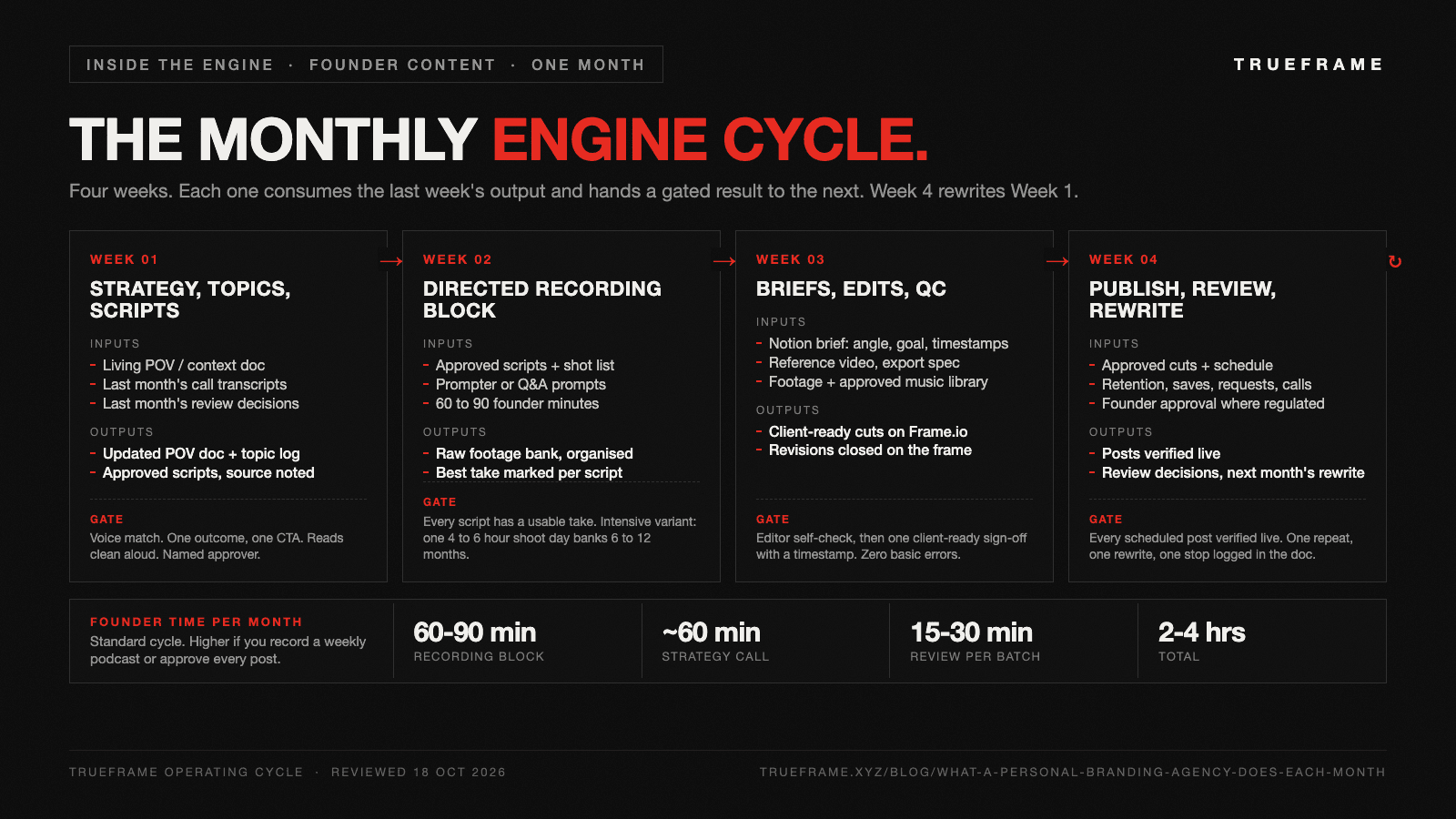
Swipe sideways to inspect the full graphic.
Week 1: how do the strategy and the POV doc get updated?
Week 1 opens with the founder's living context doc, which is where the strategy actually lives. Every client has one. It holds the audience, the content pillars, the beliefs the founder will defend, the stories they tell well, the topics they won't touch, the voice and visual rules, and a dated feedback log. Hormozi's branding material calls this a point-of-view doc. It's the first thing anyone on the team reads before touching that founder's work.
Nothing in it is written once and left. When Dr Marion Chan told us which procedures belong on her personal account and which on the clinic account, that went in the same day. When Australian medical advertising rules meant no patient testimonials anywhere, including nice comments under posts, that became a rule every editor and scheduler reads. When Hamel Husain's audience turned out to care about a wider set of AI topics than we'd planned for in late 2025, the pillars were rewritten and the next month's scripts followed.
- Audience and account routing: who the content is for and which account each topic belongs on.
- Beliefs, mechanisms and stories: the positions the founder holds and the examples that make them land.
- Taboos and compliance: the claims, words and visuals that never ship for this founder.
- Voice and visual rules: sentence rhythm, fonts, grade, reference creators.
- Feedback log: every correction, dated, so the same mistake doesn't come back in month three.
Benjamin Chua
Founder content operating toolkit
6
printable pages
PDF · Version 1.0 · Updated Oct 2026
Founder Content Engine Monthly Operating Calendar
A week-by-week operating calendar with the founder time budget, topic mining log, quality gates and an agency audit scorecard, usable with any agency or an in-house team.
- A four-week calendar with owner, output and the gate each week has to pass
- A founder time budget worksheet in hours, with the two-to-four-hour ceiling
- A topic mining log and the publishing state tracker we use internally
- An agency audit scorecard with green and red answers for each question
Where do the topics come from each month?
From the founder's own conversations, recorded. Every client, sales and strategy call runs with an AI notetaker, and the transcript is mined within seven days for five things: the problems the other person named, the objections they raised, the real questions they asked, the exact phrases they used, and the stories that came up. A question a buyer asked out loud is a topic with demand attached. A phrase a buyer used becomes a hook that sounds like the audience instead of a copywriter.
Hamel runs cohort office hours with engineers asking real questions about AI evals. Those sessions are his topic bank. Robert Ta records a weekly podcast in a format we scripted with him, and the clips come from what he actually said. When a founder has no recorded conversations yet, the onboarding and strategy calls are recorded for exactly this reason, and month one's topics come from there.
Scripts are written by the end of Week 1 and pass a script gate before anyone briefs an editor: the script matches the founder's voice and a pillar from the doc, it has one outcome and one call to action, it reads clean out loud, and a named approver has signed it. I write or oversee the scripts personally because this is where quality is cheapest to fix. Some founders prefer to draft. Dr Marion writes hers in Notion and we review before she films. On camera she put it this way: "they proofread your scripts as well, which is a total game changer."
Week 2: what happens in the directed recording block?
One block, 60 to 90 minutes, run by us. The founder gets the approved scripts ahead of time, a shot list, and a teleprompter or prompt sheet set up before the call starts. We coach framing, lighting and delivery live and direct retakes. Hooks get filmed two or three times so there's a clean best take. For founders who freeze on a teleprompter, we switch to live question-and-answer prompting, which for several reserved founders has produced better footage than any script read.
Frequency varies, and we set it on the fit call. The standard cycle is one block a month. Robert records a weekly podcast and films a few scripted shorts between calls, so his recording time is higher by choice. Hamel's raw material is largely recordings he already makes for his course, so his block is about packaging new series rather than filming from scratch. In the Installed Founder Content Engine the block becomes one guided shoot day of four to six hours that banks six to twelve months of footage, and monthly founder time drops to review plus one strategy conversation.
| Founder task | Typical time | When | Who sets it up |
|---|---|---|---|
| Directed recording block | 60 to 90 minutes | Week 2 | Trueframe: scripts, shot list, prompter, live direction |
| Strategy call | About 60 minutes | Week 1 or 4 | Trueframe brings the review and next month's plan |
| Script approval | 15 to 30 minutes | Week 1 | Scripts arrive in the founder's voice, source call noted |
| Review of client-ready cuts | 15 to 30 minutes per batch | Week 3 | Frame.io links, comments pinned to the frame |
| Publishing approval | Zero to a few minutes per post | Week 4 | Optional gate. Mandatory for regulated professions |
| Total | Roughly 2 to 4 hours | Per month | Higher if you record a weekly podcast or approve every post |
Week 3: how do editing and QA actually work?
Every edit starts from a brief in Notion, the single document the editor works from. It states the angle and goal, links the exact footage with timestamps and a reference video, gives a scene table with the hook, body and CTA, the words on screen and the specific B-roll, and specifies export dimensions, file naming and a due date with a due time. If a link doesn't open or a B-roll entry says "something relevant," the brief fails its gate before an editor sees it.
Editors carry at most three active briefs at once. A new format or new client gets six hours, a recurring format four, a revision two. Inside those hours the editor cuts filler and silences over half a second, checks that every B-roll clip shows what is being said at that moment, applies the grade and music from the approved library, adds hook text and captions, then reads every caption against the script word by word with the sound on.
- Audio in sync, levels treated, noise removed.
- Cuts match what is being said. No jump to a clip of the founder zoned out.
- Grade applied, music mixed under the voice.
- Captions checked against the transcript. No half-typed words, no wrong technical terms.
- Hook and CTA templates applied as briefed. Exported in the right dimensions with the right file name.
The editor runs that self-check, uploads to Frame.io and updates the Notion status. Then one content manager reviews the cut and marks it client-ready. One person, every video, with a timestamp. If a basic error reaches a founder, the chain failed, and "I thought someone else checked it" is not an answer. For technical audiences we add a terminology pass. Hamel's viewers are engineers, so a misspelled model name is a basic error, not a style note.
Founder feedback happens in Frame.io, where a comment is pinned to the exact frame and every version stacks on the same asset. That's a quality control, not a tooling detail. Feedback in a chat thread gets scrolled past; feedback on frame 0:37 gets fixed at 0:37. Revisions are acknowledged and assigned within 12 hours, and the learning from each round is written back into the founder's doc so it doesn't recur.
That short is the thinking behind this week. IKEA ships standard parts with standard assembly steps instead of hiring better carpenters for each order. Our briefs, hour budgets, self-check and single sign-off are the same idea. The founder's voice is the variable. The production system is not.
Week 4: how does publishing work, and who approves it?
Approved cuts are scheduled, and we track six states: produced, approved, uploaded, scheduled, published and verified live at the destination. Most delivery disputes between agencies and founders come from treating those as one thing. A post is done when someone has opened the live link.
Whether the founder approves each post is decided in onboarding. For most founders, approval happens at the cut and the schedule runs without them. For regulated professions it's a blocking gate. Dr Marion approves every post before it goes live because the compliance risk sits with her registration. Cadence is set per account from what the audience shows us. For her it's three posts a week on weekdays, reels of 45 to 90 seconds, because weekend engagement was consistently weaker and longer reels trade reach for depth.
Each idea gets rebuilt for its platform rather than cross-posted as is. Hamel's lead-magnet shorts run on TikTok with a redirect to Instagram, where a comment keyword triggers delivery. The same idea on LinkedIn became a flashcard carousel. Same thinking, different container, because the capture mechanism differs on each platform.
What happens in the analytics review?
A weekly look and a monthly deep review. The weekly pass checks what shipped against what was scheduled and flags anything that outperformed or died early. The monthly review is where strategy changes. On some accounts it's a call; on others a recorded walkthrough the founder watches when convenient. The decisions go into the context doc either way.
We read the measure that fits the platform. On YouTube it's the audience retention report, which YouTube Studio breaks into intro, top moments, spikes and dips, so a hook that loses most of the audience in ten seconds gets rewritten rather than reposted. On Instagram it's saves and shares before likes, because a save means the viewer expects to need you later. On lead-magnet formats it's keyword comments and delivered requests. Then booked calls, kept separate from pipeline, kept separate from revenue. Views are an input to the review, never its output.
The review earns its place when it changes the next month. In April 2026 we tested a new top-of-funnel lead-magnet format for Hamel against the one he'd been running. The new format produced 5x the reach, 29x the comments and 7.5x the saves. That rewrote his content mix for the following months, and shorts now drive 30%+ of his YouTube traffic. None of that happens if the month ends at "published" instead of "reviewed."
The more communication with me, the better. Please bug me, say hey, like, you owe me this.
Hamel Husain
What does the founder do, and what does the agency do?
| Week | Founder does | Agency does | Gate before the next week |
|---|---|---|---|
| 1. Strategy and scripts | Approves scripts. Answers two or three voice questions. | Updates the POV doc, mines last month's calls, writes scripts, assigns an approver. | Voice match, one outcome, one CTA, reads clean aloud. |
| 2. Recording | Shows up for 60 to 90 minutes. Retakes on direction. | Prompter, shot list, live coaching, footage intake. | Every script has a usable best take. |
| 3. Edit and QC | Reviews client-ready cuts on Frame.io. Comments on the frame. | Briefs, assigns within WIP caps, edits, self-check, client-ready sign-off, revisions. | Sign-off with a timestamp. No basic errors. |
| 4. Publish and review | Optional post approval. Joins the monthly review. | Schedules per platform, verifies live links, pulls the numbers, writes next month's rewrite. | Every scheduled post verified live. Decisions logged in the doc. |
Want this cycle run for your brand?
The content agency for personal brands page shows how the engine fits around a founder, what we measure and who it's for. Read it, then decide if a fit call is worth 15 minutes.
See how the engine worksWhat are the deliverables each month?
Scope varies by engagement, and I'd be wary of any agency that quotes a fixed list before knowing your offer and audience. In the Installed Founder Content Engine the floor is 12 finished shorts a month, about 144 across 12 months, with scheduling and posting on the primary platforms, plus 90 days of Meta ads management and a funnel cleanup covering the landing page, pixel, qualifiers and VSL usage. Past retainers were shaped differently. Robert's included 12 scripted shorts, two long-form YouTube videos with full packaging and a monthly podcast edit cut into clips. Hamel's includes long-form edits of office hours and guest episodes, eight or more short pieces a month and LinkedIn carousels.
- Finished, captioned, graded short-form edits at the agreed minimum, every month.
- Scripts in the founder's voice, with the source call or question noted on each.
- An updated context doc and topic log the founder can read at any time.
- Scheduling and posting, with live links verified and a publishing state per piece.
- A monthly review with decisions, not a dashboard screenshot.
- In the current engine: 90 days of Meta management and the funnel cleanup, front-loaded.
The same four-week cycle can run month to month or be front-loaded into one recording intensive. This guide compares the two on founder time, message shelf life and exit terms.
Read the comparison“Finally found a team after going through 6 terrible agencies.”
Robert shows what the cycle produces when it runs long enough. He started with no content presence anywhere. We scripted, he recorded, we handled everything after. He has since tracked six figures of B2B pipeline from qualified leads who referenced his specific content, plus 50+ B2C leads through the engine. One format test alone produced 366 lead-magnet requests, 262 saves and 74 shares. All of it came from podcast clips and short-form content, not one viral moment.
How is quality controlled across the whole month?
With gates that are binary and owners that are singular. A script can't be briefed until it passes the script gate. A brief can't be assigned until every link opens and every field is filled. An editor can't upload until the self-check is done. A cut can't reach the founder until one named person has marked it client-ready. Each is a checkbox in Notion with a timestamp, so when something slips we can see which handoff failed, and the fix goes into the SOP before the next assignment.
We also track the system itself. The weekly scoreboard carries on-time delivery with a 90% target, first-pass approval with a 70% target, revision rounds per deliverable with a ceiling of 1.2, and blockers open longer than 24 hours with a target of zero. Out-of-sync audio, a half-typed caption or a wrong aspect ratio reaching a founder is a failure of the chain, not a matter of taste. Style preferences are feedback. Basic errors are defects.
“The actual reel or video that they give you in the end just far exceeds my expectations of how I could have dreamed of it being.”
Dr Marion's account is where the gates were tested hardest, because a compliance miss there has consequences beyond a bad post. Her first full month of Trueframe content, June 2026, reached 430,563 people across her two accounts against a 48,840 baseline from her own posting in May, 8.8x. Her personal account went from 12,043 followers on June 4 to 26,164 on July 7. Every one of those posts passed her approval gate before it went live.
When should you not hire an agency to run this?
Hormozi's Value Equation is a useful lens: value rises with the dream outcome and the likelihood of achieving it, and falls with time delay and effort. A done-for-you engine cuts your effort to a few hours a month and raises the likelihood through a system that has run many times. It does nothing for the dream outcome if your offer doesn't convert warm attention into clients yet. Without a proven offer and a good close rate on warm calls, fix the offer first. Content will send you people and they'll leave with nothing to buy.
Three more disqualifiers. If you have no capacity to take more clients, more demand is a cost. If you want a reference replicated exactly rather than interpreted for you, we're the wrong shop. And if you can't give 60 to 90 minutes a month on camera, no agency can make founder-led content for you, because the founder has to be in it.
How do you audit an agency against this calendar?
Ask for the artifact of each week, not the description of it. Every stage above leaves something behind: a doc, a log, a brief, a review thread, a schedule, a set of decisions. An agency that runs a real cycle can show all of them for last month in a few minutes. One that can't is selling you edits with a strategy slide on top. The operating calendar above has the full scorecard. Here's the short version.
| Ask to see | Green | Red |
|---|---|---|
| Your current strategy or POV doc | Dated, specific to you, with a feedback log | A pitch deck or a generic pillar list |
| Where last month's topics came from | Each topic traces to a call, question or objection | "Our team brainstorms trending topics" |
| The recording plan | Scripts, shot list and prompter set before you join | You're asked what you want to talk about on the call |
| A brief an editor worked from | Angle, goal, timestamps, reference, exports, due time | A Slack message with a Drive link |
| The review thread on one video | Comments pinned to frames, versions stacked, revisions closed | Feedback in email or chat, versions as new files |
| Publishing status for each piece | Produced, approved, scheduled, published, verified live, separately | "It's all been posted" |
| The last monthly review | Retention, saves, requests and calls, with a decision for next month | A views graph with no decision attached |
Want to know whether an engine like this would pay back for you?
Book a fit call. We'll look at your offer, your close rate on warm calls, your capacity and what you already have recorded, then tell you honestly whether a founder content engine would pay back. If it wouldn't yet, we'll say what to fix first.
Related guides
Sources and review date
Primary sources, first-party data and review dates are listed below. Client-reported results and Trueframe analysis are labelled in the article.
- Alex Hormozi Books: $100M Offers and $100M Leads (the Value Equation) · Acquisition.comReviewed 18 October 2026
- Measure key moments for audience retention · YouTube HelpReviewed 18 October 2026
- About Instagram Insights · Meta Business Help CentreReviewed 18 October 2026
- Creating helpful, reliable, people-first content · Google Search CentralReviewed 18 October 2026
- Frame.io V4 Knowledge Center (review, comments and version management) · Adobe Frame.ioReviewed 18 October 2026
Skip the reading. Talk it through instead.
Book a fit call and we'll map out what a content engine looks like for your business. No pitch, no pressure.
Don't miss the next one
Some of what we share is time-sensitive. A format that's working right now, a window that closes fast. We email those the moment they're worth jumping on. Drop your email so you catch them in time.
No spam. Unsubscribe anytime.
Frequently asked questions
What does a personal branding agency do every month?
How many hours a month does the founder need to give?
Who writes the scripts, the founder or the agency?
How does an agency control quality on founder content?
What deliverables should I expect from a done-for-you content engine each month?
How do I know if a personal branding agency is actually doing the work?
Founded & led by
Benjamin Chua (BenChuchu)
Founder and CEO of Trueframe. 9 years building businesses (started at 16), tens of millions of views generated, and 8 figures in revenue created for the founders and brands he works with. He builds the content systems Trueframe runs.