How Robert Ta Turned a Weekly Podcast Into Six Figures of Pipeline
Robert Ta came to us with zero content and six dead agencies behind him. One weekly recording later, he had tracked over six figures of B2B pipeline back to specific videos he posted.

Written by Benjamin Chua, founder of Trueframe.
Robert Ta had been through six agencies before us. None of them worked.
His words, not ours: "Finally found a team after going through 6 terrible agencies." By the time he reached us he had zero content presence. Nothing on YouTube, nothing short-form, no audience anywhere. He runs an AI alignment startup, Clarity AI, and he had real things to say. He just had nothing to show for the effort he'd already spent trying.
Eighteen months later he had tracked over six figures of B2B pipeline back to specific videos he posted. Same founder. Same hour a week. The only thing that changed was what happened to each recording after he hit stop.
Six dead agencies. Zero starting presence. Over six figures of tracked pipeline from one weekly recording.
Here's what was actually broken, what we built instead, and the numbers that came out the other side.
The situation: content without a plan
Robert wasn't lazy and he wasn't camera-shy. He was producing. The problem was that none of it was pointed at anything. He puts it plainly: "Before working with Ben and True Frame, I was spinning my wheels. I was creating content without strategy."
That's the trap six agencies left him in. They filmed things. They edited things. Nobody asked who each piece was for, what it was supposed to do, or whether anything it produced ever turned into a lead. So he had output and no results, which is the most expensive kind of busy a founder can be.
One early format was a good example. He'd been doing street interviews, the man-on-the-street style. It got some attention and went nowhere useful, because the people watching weren't the people who buy enterprise AI. The content was working hard for the wrong audience.
What we built
We didn't tell him to post more. We built him a system that took one weekly recording and turned it into a full content engine, with a quality gate on the front and tracking on the back. Five parts.
- Ben scripts every piece personally as the quality gate. Nothing ships that doesn't say something worth saying to the people Robert actually wants to reach. That single check is what six agencies skipped.
- One podcast a week becomes a Hormozi-style clip machine. From a single recording we cut 5 to 8 YouTube highlights of 3 to 5 minutes each, plus around 14 short clips for TikTok, Reels, and Shorts. Roughly 20 assets a week, all from one hour of his time.
- Full YouTube packaging on every long cut. Titles, thumbnails, descriptions, tags. The footage is only half the job. The packaging is what decides whether a clip gets 200 views or 200,000.
- We pivoted him off the street-interview content into procedural, how-to content. Walk-throughs and explainers that the right buyer actually searches for, instead of clips that entertained the wrong crowd.
- We tracked it. Every piece had a job, and leads got traced back to the specific videos that brought them in, so we could see what worked and make more of it.
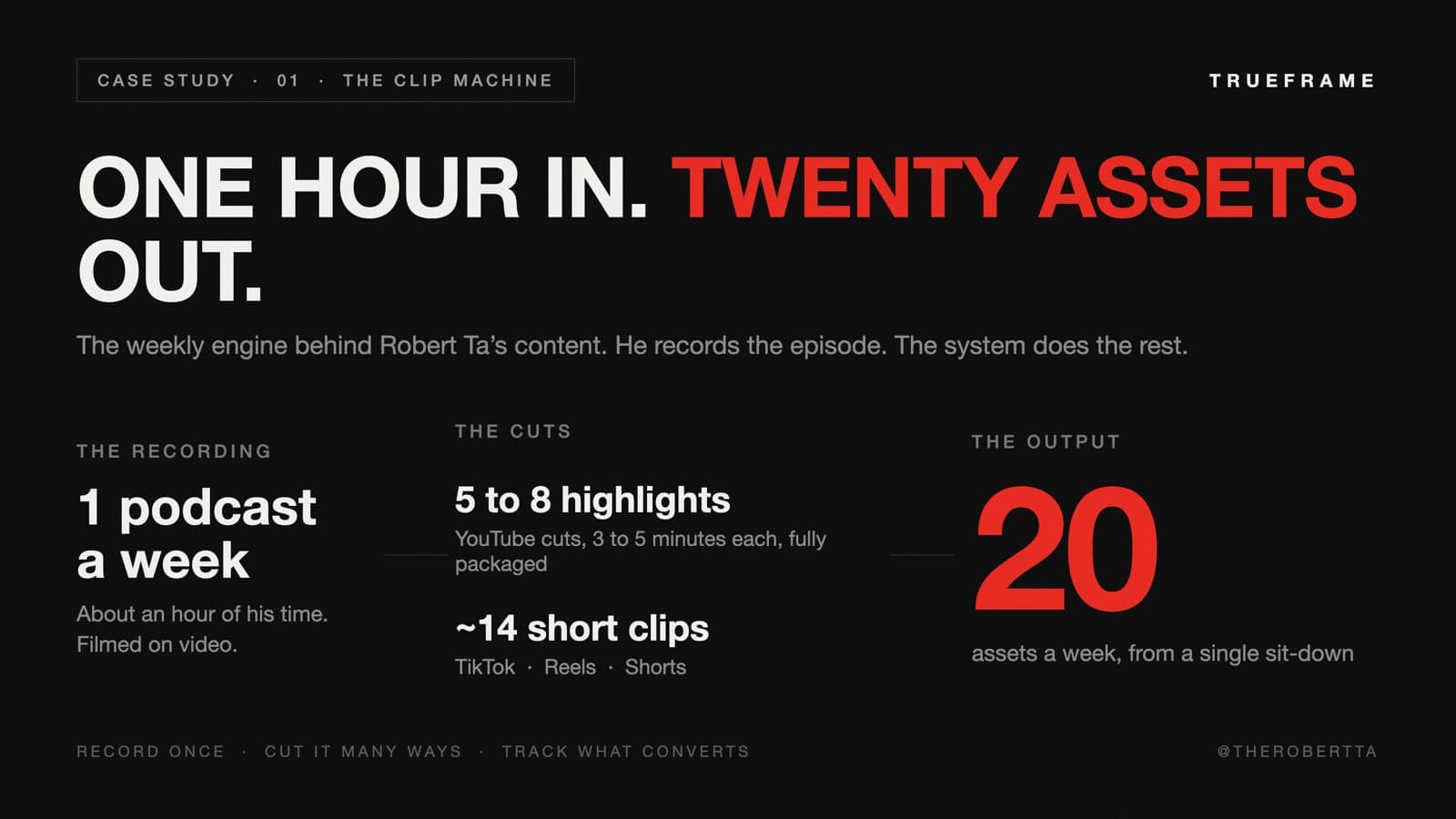
The whole thing was built to need almost none of his time. He records the episode. The system does the rest. That was the brief: serious results, minimal founder hours.
Robert walks through what changed, in his own words, and the pipeline he tracked back to his content.
The results
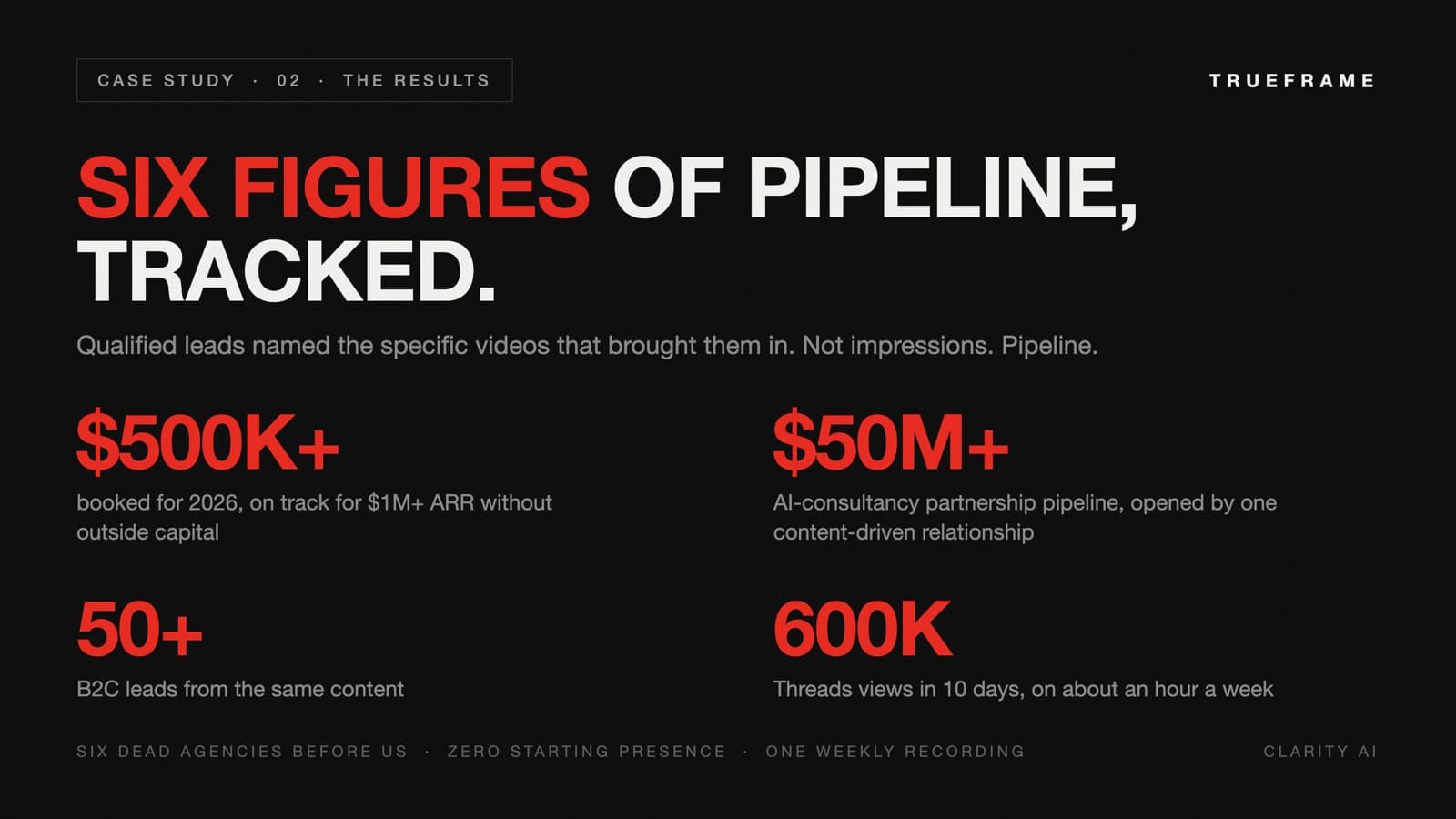
The headline number is the one Robert tracks himself. Over six figures of B2B pipeline, traced back to qualified leads who named his specific videos as the reason they trusted him enough to reach out. Not impressions. Pipeline.
Over six figures of B2B pipeline, from qualified leads who referenced his specific videos by name.
It didn't stop at B2B. The content also brought in 50-plus B2C leads. On the back of it, his startup booked $500K-plus for 2026 and is on track for $1M-plus in ARR without raising outside capital. The videos pulled in VC introductions, and some of those VCs ended up joining his raise. One content-driven relationship opened a $50M-plus AI-consultancy partnership pipeline.
Those are big numbers for content that started from zero. They come from the same simple loop running every week: record once, cut it into many pieces, package each one, point it at the right buyer, and track what converts so the next recording is sharper than the last.
He even proved the format on his own. Robert ran a Threads experiment alongside the work we do and hit 600,000 views in 10 days, on about an hour a week, at zero cost. Same mechanic, different platform. When the system is right, the founder barely has to be in the room.
Before working with Ben and True Frame, I was spinning my wheels. I was creating content without strategy. Ben and his team built me a system requiring minimal time from me while generating serious results. I've tracked over six figures in converted pipeline revenue from qualified leads who referenced my specific content as trust building and helpful.
Robert Ta, founder of Clarity AI
The short version
- Six agencies failed Robert because they made content with no strategy behind it.
- He started with zero presence on every platform.
- We built one system: Ben scripts as the quality gate, one weekly podcast becomes 5 to 8 long clips and about 14 short ones, with full YouTube packaging.
- We pivoted him off street interviews into procedural how-to content the right buyer actually searches for.
- Result: over six figures of B2B pipeline, 50-plus B2C leads, $500K-plus booked for 2026, a path to $1M-plus ARR without outside capital, VC intros who joined his raise, and a $50M-plus partnership pipeline.
- He proved the format himself with 600,000 Threads views in 10 days at zero cost.
The lesson isn't that Robert got lucky. It's that he was already doing the hard part the whole time. He sat down and said useful things on camera. What he was missing was a system that turned one recording into a month of the right content and tracked it all the way to a booked call. You can see his channel at @therobertta if you want to watch the format in action.
Record once. Cut it many ways. Track what converts. That's the entire engine behind six figures of pipeline.
Want this run for you?
We take one podcast a week and turn it into 5 to 8 long clips and around 14 short ones, scripted, packaged, posted, and tracked back to pipeline. You record the episode. We build the engine.
See how it worksKeep reading
Skip the reading. Talk it through instead.
Book a fit call and we'll map out what a content engine looks like for your business. No pitch, no pressure.
Don't miss the next one
Some of what we share is time-sensitive. A format that's working right now, a window that closes fast. We email those the moment they're worth jumping on. Drop your email so you catch them in time.
No spam. Unsubscribe anytime.
Frequently asked questions
What did Robert Ta actually do to get this result?
How does one weekly podcast turn into enough content to grow?
Why did six other agencies fail him first?
Does this only work for an AI startup like his?
Founded & led by
Benjamin Chua (BenChuchu)
Founder and CEO of Trueframe. 9 years building businesses (started at 16), tens of millions of views generated, and 8 figures in revenue created for the founders and brands he works with. He builds the content systems Trueframe runs.