Should Your Aesthetic Clinic Be the Cheapest or the Most Expensive?
Neither. Your clinic needs a clear reason for its price. A low price needs a cost model that can carry it. A high price needs a service the right patients value. Here is how to work out which one you can actually deliver.

Written by Benjamin Chua, founder of Trueframe.
Your aesthetic clinic does not have to be the cheapest or the most expensive. It has to have a clear reason for its price. A low price needs an operating model that can carry it. A premium price needs a service the right patients value enough to pay for. A focused middle position works when the buyer and the economics are both clear.
The short version
- Being literally the cheapest or dearest in your city is optional. Knowing why someone would choose you at your price is not.
- Start with contribution: price excluding tax minus variable cost. It pays the fixed costs. It is not profit.
- In our worked example a 20% discount cuts contribution by 40% and needs 67% more completed appointments just to stand still.
- Check capacity before you plan to make it up in volume. A price cut cannot create room hours.
- A higher price needs a demand assumption too. Write the downside into the plan.
The problem usually starts the same way. An owner looks at three competitor menus, picks a number in the middle and calls it a pricing strategy. Their rent, appointment length, practitioner costs and spare capacity may be nothing like the clinics they copied. The fee tells them almost nothing about whether their own clinic can deliver it sustainably. So start with your economics, then decide what you offer, who values it and how you will explain the fee.
Can a low-cost, premium or mid-priced clinic all work?
Yes, with different requirements. A low-cost clinic can make access and straightforward pricing part of its appeal, but only with genuine cost advantages: efficient admin, sensible procurement, a focused menu or cheaper premises. A discount on an expensive delivery model does not create those advantages. It just removes margin. And clinical assessment, appropriate appointment time, infection control and follow-up cannot become optional to make a low price work. Safety and suitability are baseline obligations at every price.
| Position | What has to be true | What breaks it | Honest patient-facing reason |
|---|---|---|---|
| Low cost | Real cost advantages in admin, procurement, menu focus or premises | Discounting a high-cost delivery model, or cutting assessment time to hit the price | Clear, simple pricing and access, with the same baseline care |
| Premium | A specific difference the intended patient values and you can reliably deliver | Fittings, furniture and the word 'premium' standing in for a real service difference | More time, continuity with one practitioner, a defined review arrangement |
| Focused middle | A defined service range for a specific local audience at a fee that supports careful delivery | Picking the middle number from three competitor menus and calling it strategy | This is what we do, this is who it suits, this is what the fee covers |
Benjamin Chua
Clinic pricing tool
6
printable pages
PDF · Version 1.0 · Updated Oct 2026
Clinic Pricing and Capacity Worksheet
Work out your variable cost, contribution, break-even appointments and capacity ceiling for one service, then plan a price test you can review.
- A cost-floor table that separates variable cost, fixed cost and owner labour without double counting
- A three-scenario grid for current price, discount and increase with appointments needed and capacity ceiling
- A price-test plan with effective date, existing-agreement check and the numbers to review afterwards
A premium clinic needs a difference that matters to its patients. That might be more time for a complex consultation, continuity with a particular practitioner, a clearly defined review arrangement or appointment access that fits their lives. Describe what is actually provided. A high fee and expensive furniture do not establish better clinical outcomes, and under Australian advertising rules you cannot imply they do.
Australia's own business.gov.au pricing guidance lists nine approaches, from cost-plus to premium to penetration, says they can be combined, and tells you to weigh costs, customer value and competitors together. It also says to review prices at least once a year. Nowhere does it say the middle must fail.
What does delivering one appointment really cost?
Take one service and write down what changes when you deliver one more of it. Consumables are easy to see. Payment processing, laundry, incremental practitioner labour and review time are easier to miss. Classify costs according to your actual agreements: a salaried practitioner and one paid per appointment produce different cost patterns.
Keep fixed costs separate. Rent, core salaries, insurance, software, equipment commitments and admin keep running when the diary is empty. Owner labour needs a cost too. A business that only works because you provide unpaid time has a misleading price floor. Some expenses need an allowance rather than a per-visit invoice: training, maintenance, equipment replacement. Your accountant's treatment is right for the accounts. For this decision, make sure the cost has not vanished just because the bill arrives once a year.
Contribution per appointment = price excluding applicable tax minus variable cost per appointment. Contribution pays the fixed costs. It is not net profit. And do not count a salary in both the per-appointment figure and the fixed-cost total, or in neither.
What does a 20% discount actually require?
Here is a hypothetical four-week planning example for a non-prescription skin appointment. It is not a benchmark, not a recommended price and not based on any real clinic. Amounts are Australian dollars excluding tax for the internal calculation. Consumer-facing prices must show the required total.
Assume the service collects A$300 per completed appointment and carries A$150 of variable cost, including every cost that changes per visit. Assume those costs stay flat across the prices being compared, including a fixed per-transaction payment cost. If your processing fee is a percentage, recalculate it for each price. Since 1 October 2026, Australian businesses can no longer add a surcharge for card payments, so that cost sits inside your price whether you model it or not.
| Current price | 20% discount | 10% increase | |
|---|---|---|---|
| Fee excluding applicable tax | A$300 | A$240 | A$330 |
| Variable cost per appointment | A$150 | A$150 | A$150 |
| Contribution per appointment | A$150 | A$90 | A$180 |
| Contribution from 100 appointments | A$15,000 | A$9,000 | A$18,000 |
| Appointments needed to reach A$15,000 | 100 | 167 | 84 |
| Change in appointments needed | Baseline | 67 more (+67%) | 16 fewer |
A 20% price cut produces a 40% cut in contribution per appointment here. You need 167 appointments to match the original A$15,000 because 15,000 divided by 90 is 166.67, rounded up to whole appointments. That is 67 extra completed visits in four weeks. The discount has to create enough suitable demand, enough people who actually show up, and enough delivery capacity to support them. More enquiries alone will not do it.
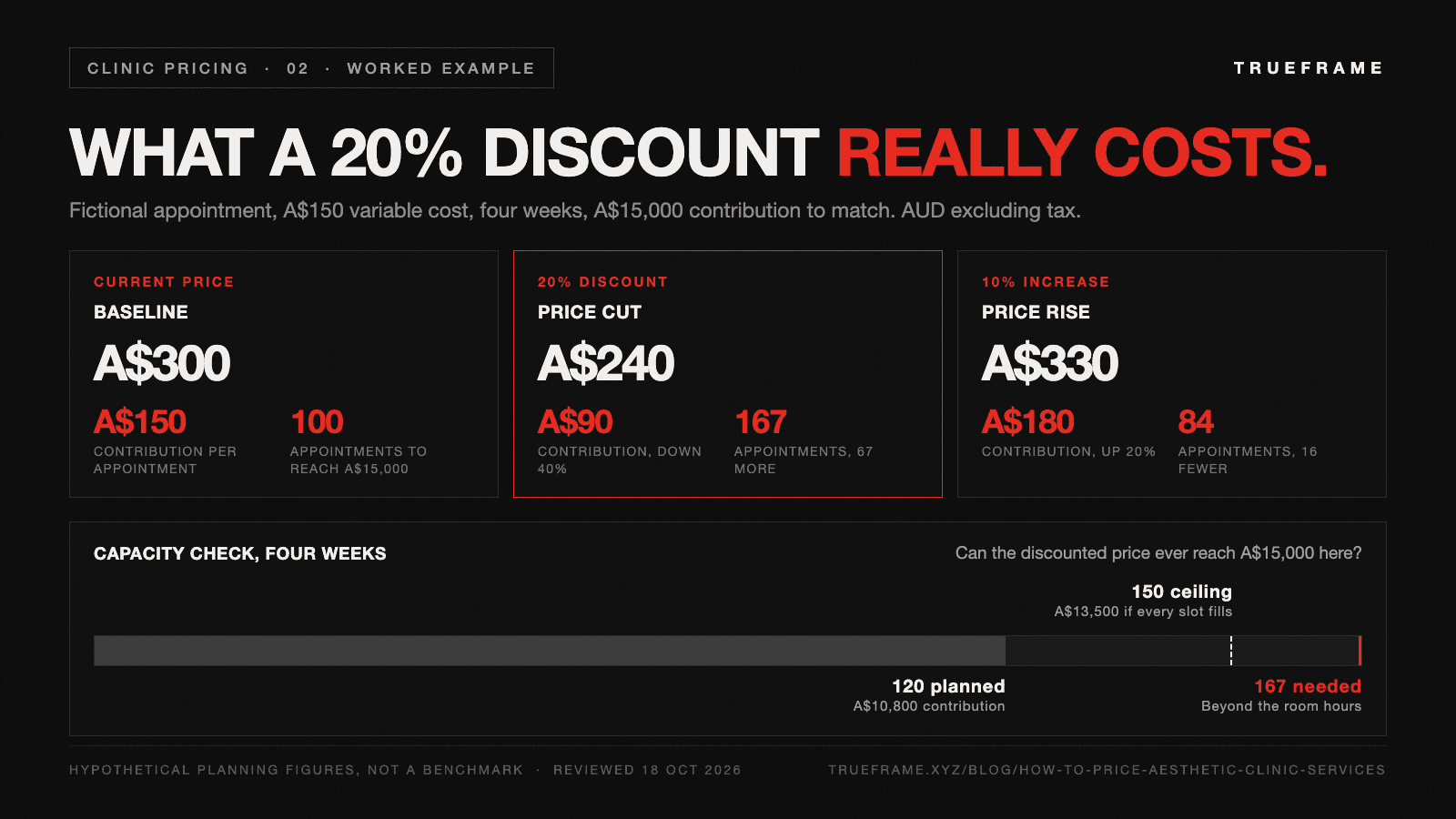
Swipe sideways to inspect the full graphic.
Do I have the capacity to make it up in volume?
Check before you plan on it. Suppose the clinic has 150 service hours available across those four weeks after other commitments, and each appointment needs one hour including the room turnaround. That hour is an assumption for this fictional service, not advice about clinical timing. The theoretical maximum is 150 appointments. The owner plans for 120 completed visits after allowing for unfilled slots and normal uncertainty. That is a planning figure for this example, not a utilisation target for anyone else.
At the discounted price, 120 appointments produce A$10,800 of contribution. Filling every theoretical slot produces A$13,500. Neither reaches the original A$15,000. A price cut cannot solve that. The owner would need a different cost structure or more suitable capacity, with its costs included. Squeezing the work to force more appointments into the day is not a responsible answer.
If this single-service operation carries A$10,000 of fixed costs over the four weeks, break-even is 67 appointments at A$150 contribution and 112 at A$90. At 120 discounted appointments, A$10,800 less A$10,000 leaves A$800 after these specified operating costs. That is not net profit after tax, financing or anything else we left out. A real multi-service clinic needs more care again: you cannot allocate all the rent to one service and then allocate it again to another. Use the full service mix to check whether total contribution covers the clinic's fixed costs.
Six Australian clinics, one treatment name, prices from A$150 to A$299. The research method for working out what competitors actually sell before you compare numbers.
Read the comparison guideWhat does a higher price require?
A demand assumption, and an honest one. Raising the fee to A$330 lifts contribution to A$180 with the same A$150 variable cost. Reaching A$15,000 then takes 84 appointments. That looks great on a spreadsheet. It does not prove that 84 suitable patients will book and complete at that price. Demand may fall. Existing patients will have questions. A difference that sounds valuable to you may matter very little to them.
Before you change the fee, talk to patients about what they understood, what they valued and what made the decision hard. Keep that separate from clinical suitability. Feedback helps you find unclear inclusions and access problems. It is never permission to sell unnecessary treatment. Then write the downside into the plan: at 70 appointments and A$180 contribution, the total is A$12,600, which is less than the original 100-appointment scenario. Keeping that possibility visible makes the decision honest.
How do I change a price in a way I can defend?
- Write the reason in one sentence. 'Our current fee does not cover the practitioner and review time inside this service' is a decision you can examine. 'Everyone else charges more' is not.
- Set a clear effective date and honour existing agreements. Check prepayments, quoted plans, deposits and cancellation terms. Do not invent a universal notice period, and do not use the change as a deadline that pressures anyone into treatment.
- Explain the fee and what it covers identically on the website, in the booking system and at the front desk. ACCC rules require the total price as a single figure, including taxes and unavoidable charges. Your internal ex-tax calculation is not a consumer-ready price.
- Review completed appointments, collected fees, refunds, variable costs, contribution and clinician workload over a defined period. Log staffing, hours and demand changes beside the price change.
- For regulated health services, check the offer against Ahpra's rules on misleading claims, inducements and encouraging unnecessary use. Clear discount terms alone do not settle whether an offer is appropriate.
One pattern we see in clinics that get this right: the price change arrives with an explanation patients can repeat. When we built a content system for Dr Marion Chan, a plastic surgeon in Melbourne, the work was explaining what her practice does inside a heavily regulated category. Reach across her two accounts went from a 48,840 May baseline to 430,563 in the first full month, 8.8 times the baseline, and her account grew from 12,043 to 26,164 followers in five weeks. That is distribution proof only. It says nothing about her bookings, revenue or pricing, and nothing here should be read as a treatment claim.
“The actual reel or video that they give you in the end just far exceeds my expectations of how I could have dreamed of it being.”
Price settled, capacity available, explanation missing?
That is the point where content starts paying back. Book a fit call and we will look at your clinic's situation and tell you honestly whether a content engine makes sense now or later. Pricing and clinical decisions stay with your clinic and its advisers.
The pricing rule
- Pick a position you can explain, then prove your cost model can carry it.
- Calculate contribution before you touch the menu, and keep fixed costs separate.
- Model the discount, the increase and the demand downside side by side.
- Check room hours before promising yourself volume.
- Change prices with a written reason, an effective date and a review period.
Keep going on clinic pricing and offers
Sources and review date
We use primary official sources for rules and platform guidance. This article is general information, not medical or legal advice.
- Choose a pricing strategy · business.gov.auReviewed 18 October 2026
- Price displays · Australian Competition and Consumer CommissionReviewed 18 October 2026
- Advertising and the law (section 133 of the National Law) · Ahpra and National BoardsReviewed 18 October 2026
- Guidelines for advertising a regulated health service · Ahpra and National BoardsReviewed 12 August 2026
Skip the reading. Talk it through instead.
Book a fit call and we'll map out what a content engine looks like for your business. No pitch, no pressure.
Don't miss the next one
Some of what we share is time-sensitive. A format that's working right now, a window that closes fast. We email those the moment they're worth jumping on. Drop your email so you catch them in time.
No spam. Unsubscribe anytime.
Frequently asked questions
Should a new aesthetic clinic start cheap to get patients?
Does charging more make my clinic look better?
How do I calculate what one appointment costs my clinic?
Can I discount quiet appointment slots?
What number should I watch after changing a price?
Is a mid-priced aesthetic clinic doomed to fail?
Founded & led by
Benjamin Chua (BenChuchu)
Founder and CEO of Trueframe. 9 years building businesses (started at 16), tens of millions of views generated, and 8 figures in revenue created for the founders and brands he works with. He builds the content systems Trueframe runs.