How to Create an Aesthetic Clinic Offer Patients Can Understand
A discount beside a treatment name is not an offer. An offer tells someone what the appointment is for, who they will see, what is included, what they pay and what happens if treatment is not right for them. Here is how we build one with clinic teams.

Written by Benjamin Chua, founder of Trueframe.
On this page
- What decision does the appointment help someone make?
- How do I make the included work visible?
- What does the work outside the room cost?
- How do I separate a consultation fee from a deposit or a credit?
- How do I replace vague promises with specific information?
- What has to happen before the offer becomes marketing?
- How do I test the offer in the next two weeks?
A useful aesthetic clinic offer makes the decision easy to understand. Someone should be able to tell what the appointment is for, who they will see, what is included, what they will pay and what happens if treatment is not appropriate or they choose not to proceed. Putting a discount beside a treatment name does almost none of that work. The fee might not even change.
The short version
- Start with the decision the appointment helps someone make, not with everyone who wants better skin.
- Make the included work visible to the owner, the practitioner and the patient, and make all three descriptions agree.
- Cost the work outside the room. A 45-minute consultation can be 90 minutes of practitioner time.
- Keep fee, deposit and credit distinct, and write down what happens when no treatment is recommended.
- Replace vague internal briefs with specific instructions before anyone writes marketing copy.
Take a page that says 'Personalised skin consultation, A$250'. A patient may still wonder whether that buys an assessment, a sales conversation, a treatment or a deposit. They may assume the fee comes off a later procedure. Your receptionist spends half the booking call correcting those assumptions. The offer starts improving the moment those details are clear, and the price can stay exactly where it is.
What decision does the appointment help someone make?
Start there. Avoid defining the audience as everyone who wants better skin, because that gives your team no direction at all. A more useful starting point is adults weighing their options who want to understand what an assessment involves before deciding whether to proceed. Your clinicians then define the appropriate scope, suitability criteria and referral boundaries.
Write down what the person should understand by the end: the options discussed, the limits of the assessment, the expected commitment, whether further assessment is needed, and, where relevant, why the clinic is not recommending treatment. That gives the appointment a purpose that stands on its own. You can judge whether you delivered it without needing another sale. And choose an offer your clinic can already deliver competently. Marketing cannot widen a practitioner's scope or make an unsuitable service appropriate.
Benjamin Chua
Clinic offer design tool
6
printable pages
PDF · Version 1.0 · Updated Oct 2026
Clinic Offer Builder Worksheet
Write the internal brief for one appointment, cost the work outside the room, separate fee from deposit, and record who approved what before it goes public.
- A nine-field offer brief: purpose, practitioner, appointment, output, delivery, follow-up, exclusions, further care, price and terms
- A time and cost table for the work outside the room, with net figure after listed costs
- A vague-to-clear editing table, patient-understanding checklist and approval record
How do I make the included work visible?
Get the three views to agree. An owner sees the consultation as a block in the calendar. The practitioner sees preparation, the appointment, records and follow-up. The patient sees a fee and wants to know what it buys. If a written summary is included, say what it covers and when it arrives. If follow-up questions are included, define the channel, the period and the kind of question. If a new concern needs a new appointment, say so before someone assumes unlimited access.
Do not present ordinary professional responsibilities as expensive bonuses. Careful assessment and informed decision-making are not optional upgrades reserved for a top tier. Extra time or a particular service arrangement can have value, so explain the actual difference and cost it. Avoid inventing a large 'bonus value' for something that has never been sold on its own.
| Decision | Example internal specification |
|---|---|
| Purpose | Assess the person's questions within the practitioner's scope and explain appropriate options and limits |
| Practitioner | Name the actual practitioner and verify their role, relevant qualifications and registration where applicable |
| Appointment | A planned 45-minute consultation, with preparation and documentation budgeted separately |
| Included output | A plain-language summary of what was discussed, including the option of no treatment or referral where appropriate |
| Delivery | Summary within two business days, if the clinic can reliably support that timeframe |
| Follow-up | A defined channel for clarification over seven days; budget up to 15 minutes of practitioner time and say what needs another appointment |
| Exclusions | Treatment, unrelated new assessments and open-ended messaging are outside this consultation |
| Further care | A separate recommendation, quote and consent process where appropriate; the patient can decline |
| Price and terms | One clear total fee, payment timing, and explained cancellation and rescheduling terms |
The follow-up limit is a service boundary, not an instruction to ignore a clinical concern. Your clinical team needs an escalation process. Admin staff can organise the response. They should never be asked to make clinical judgments through a marketing inbox. And a person who gets a clear explanation and decides to do nothing should still have received the service described. If the appointment only feels valuable after another purchase, revisit its purpose and how you explain the fee.
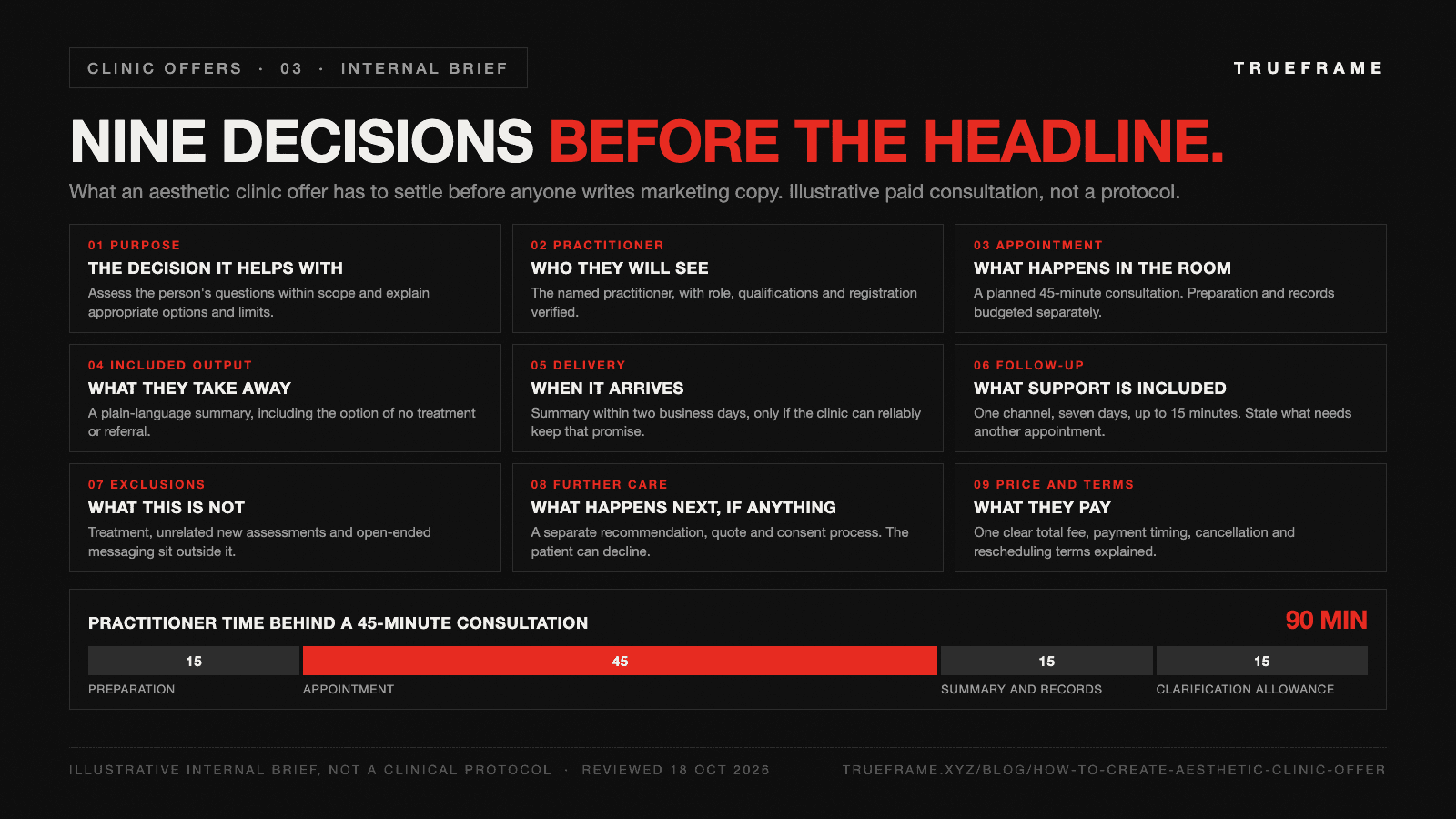
Swipe sideways to inspect the full graphic.
What does the work outside the room cost?
More than the calendar shows. Here is a hypothetical time budget for the example above. The timetable is illustrative and your clinic's requirements may differ. The point is to count every minute you have promised.
| Practitioner work | Planned time |
|---|---|
| Preparation | 15 minutes |
| Appointment | 45 minutes |
| Written summary and records | 15 minutes |
| Allowance for included clarification | 15 minutes |
| Total | 90 minutes |
If six practitioner hours are available after other commitments and breaks, four of these appointments use all six hours with no slack for overruns. Planning three uses four and a half hours and leaves ninety minutes. That is a capacity calculation, not a clinical scheduling recommendation. The room may be occupied for a different stretch than the practitioner. Track both if each one limits you.
For a simple internal cost check, assume A$250 of net revenue per consultation after any applicable tax. That is a planning figure, not an advertised fee.
| Specified cost | Amount |
|---|---|
| 90 minutes of practitioner labour at an illustrative A$60 per hour including on-costs | A$90 |
| Allocated room and administrative support | A$30 |
| Materials | A$10 |
| Assumed payment-processing cost | A$5 |
| Total listed costs | A$135 |
| Left from A$250 net after listed costs | A$115 |
That A$115 is not profit. Insurance, other overhead, marketing and anything left out of these allocations still has to be covered, and the labour rate is an assumption, not a wage benchmark. Some of these lines are allocations rather than costs caused by one more appointment, so treat this as a service-cost check, not a pure contribution margin. In the clinic-wide accounts, do not count the same salary or rent twice. And do not assume everyone will buy a later service. That assumption hides whether the appointment itself is sustainable, and it puts pressure on the clinical decision.
The financial side of the offer: contribution, break-even, capacity, and a worked example of what a 20% discount really requires.
Read the pricing guideHow do I separate a consultation fee from a deposit or a credit?
By writing down what each one does. A fee pays for a defined service. A deposit is an advance payment governed by its stated terms. A redeemable credit changes what may be owed on a later eligible purchase. The labels on a menu do not tell the patient how the money works, and clinics in the same city use all three for appointments with the same name.
- For each arrangement, write down what happens if the patient attends and no treatment is recommended.
- Write down what happens if they decline, cancel, reschedule or are referred elsewhere.
- Distinguish a completed consultation from a missed appointment.
- Do not copy a blanket non-refundable clause from another clinic. Have your actual terms checked for your service and obligations.
- Never use a credit expiry date to push someone into a clinical decision.
A standalone fee can make the consultation's purpose easier to explain. That does not mean every free consultation is rushed or every credit arrangement is inappropriate. Each needs clear funding, scope and terms, and the clinical recommendation must stay independent of the commercial arrangement. For patient-facing prices, ACCC rules require the total to be shown as a single figure including taxes and unavoidable charges. The internal A$250 net figure above has to become a correct total before it goes on a page.
How do I replace vague promises with specific information?
Run this editing exercise with the team. Every vague brief on the left is one we have heard in a clinic meeting. The right-hand column is the instruction that actually helps the writer, the receptionist and the practitioner tell the same story.
| Vague internal brief | Clearer instruction for the offer |
|---|---|
| 'Make it feel premium' | State who conducts the appointment, the included work and the support actually available |
| 'Add more bonuses' | Identify a genuine unanswered question and decide whether answering it belongs in the service |
| 'Get them started' | Explain the next decision while preserving the options to decline, wait or seek another opinion |
| 'Show amazing results' | Explain the assessment process, relevant evidence and limits without promising an individual outcome |
| 'Make the price look smaller' | Show the full commitment and explain what each payment covers |
These instructions also expose gaps that copy cannot fix. If nobody owns the promised follow-up, changing the headline will not make it happen. A more expensive offer needs a difference the intended patient understands and values: longer discussion time, continuity, a clearly scoped review arrangement. Check that you can deliver the difference and that people actually value it. Safety does not belong on a premium-only list. Neither does truthful information.
What has to happen before the offer becomes marketing?
A review of the actual wording. For regulated health services, Ahpra's advertising rules prohibit misleading claims, unreasonable expectations, inducements without terms and encouraging unnecessary use. Cosmetic-procedure guidance adds requirements on top. TGA guidance, updated 18 June 2026, says a health-service advertisement can also advertise therapeutic goods, including through substitute phrases, and that prescription medicines cannot be referred to directly or indirectly. Calling something a consultation does not prevent indirect promotion of a prescription medicine if the overall impression does that job. The TGA's own compliant example is a plain invitation to a consultation to discuss treatment options for a named condition, with no reference to any product.
Review the exact wording and the overall impression with the people responsible for clinical and advertising decisions. An internal offer brief is useful preparation. It does not establish that a public advertisement is compliant. Our Ahpra and TGA advertising guide covers the approval workflow in detail.
This is also where content earns its place. Once the offer is clear, the job is explaining it, repeatedly, in a format patients actually watch. When we built a content system for Dr Marion Chan, a plastic surgeon in Melbourne working inside that regulatory environment, reach across her two accounts went from a 48,840 May baseline to 430,563 in the first full month, 8.8 times the baseline, and her account grew from 12,043 to 26,164 followers in five weeks. That is distribution proof only. It says nothing about her bookings, revenue or any treatment outcome, and we never present it as if it did.
“The actual reel or video that they give you in the end just far exceeds my expectations of how I could have dreamed of it being.”
How do I test the offer in the next two weeks?
- Week one: agree one consultation brief, its costs and the booking explanation. Ask the receptionist and the practitioner to describe it separately, then resolve the differences before the public page changes.
- Week two: during normal appointments, log recurring questions, time spent, late summaries and follow-up requests. Ask whether people understood the fee and the included work, using your existing feedback processes. This does not require publishing patient stories.
- Review informed declines and no-treatment outcomes alongside completed appointments. They show the decision process working. Increasing treatment uptake regardless of suitability is not a goal.
- Fix the specific delivery problem the fortnight exposes, then keep reviewing. Two weeks can show confusion or an unrealistic workload. It cannot prove long-term demand, profitability or clinical quality.
Offer clear, capacity available, nobody outside the clinic knows?
Book a fit call. We will look at your clinic's situation and tell you honestly whether a content engine would pay back now, or whether you should fix something else first. Clinical decisions stay with your practitioners.
The offer rule
- Define the decision the appointment helps with, and who it is for.
- Write the included work so the owner, practitioner and patient all describe it the same way.
- Count the minutes and the costs outside the room before you set the fee.
- Keep fee, deposit and credit separate, with the no-treatment outcome written down.
- Review the exact wording against Ahpra and TGA rules before it becomes marketing.
Keep going on clinic pricing and offers
Sources and review date
We use primary official sources for rules and platform guidance. This article is general information, not medical or legal advice.
- Price displays · Australian Competition and Consumer CommissionReviewed 18 October 2026
- Advertising and the law (section 133 of the National Law) · Ahpra and National BoardsReviewed 18 October 2026
- Guidelines for advertising a regulated health service · Ahpra and National BoardsReviewed 12 August 2026
- Advertising health services that involve therapeutic goods (updated 18 June 2026) · Therapeutic Goods AdministrationReviewed 18 October 2026
Skip the reading. Talk it through instead.
Book a fit call and we'll map out what a content engine looks like for your business. No pitch, no pressure.
Don't miss the next one
Some of what we share is time-sensitive. A format that's working right now, a window that closes fast. We email those the moment they're worth jumping on. Drop your email so you catch them in time.
No spam. Unsubscribe anytime.
Frequently asked questions
Does a strong aesthetic clinic offer need a treatment package?
Should every aesthetic consultation be paid?
What if patients only ask about price?
What can an aesthetic clinic promise in an offer?
How is a consultation fee different from a deposit or a credit?
Can I use urgency or a deadline to get patients to book treatment?
Founded & led by
Benjamin Chua (BenChuchu)
Founder and CEO of Trueframe. 9 years building businesses (started at 16), tens of millions of views generated, and 8 figures in revenue created for the founders and brands he works with. He builds the content systems Trueframe runs.