Aesthetic Clinic Pricing in Australia: How to Compare Competitor Fees Properly
We checked six Australian clinic menus for one named treatment. The prices doubled across the sample and so did the appointment behind them. Here is how to compare fees without copying the wrong number.

Written by Benjamin Chua, founder of Trueframe.
On this page
- What do six clinic menus actually show about pricing?
- Which competitors belong in my comparison?
- What should I record before I compare a single number?
- How do I handle consultation fees, deposits and credits?
- Should I rank competitors by price per minute?
- How do I turn the comparison into a decision?
- What do Australian rules require when I explain my own prices?
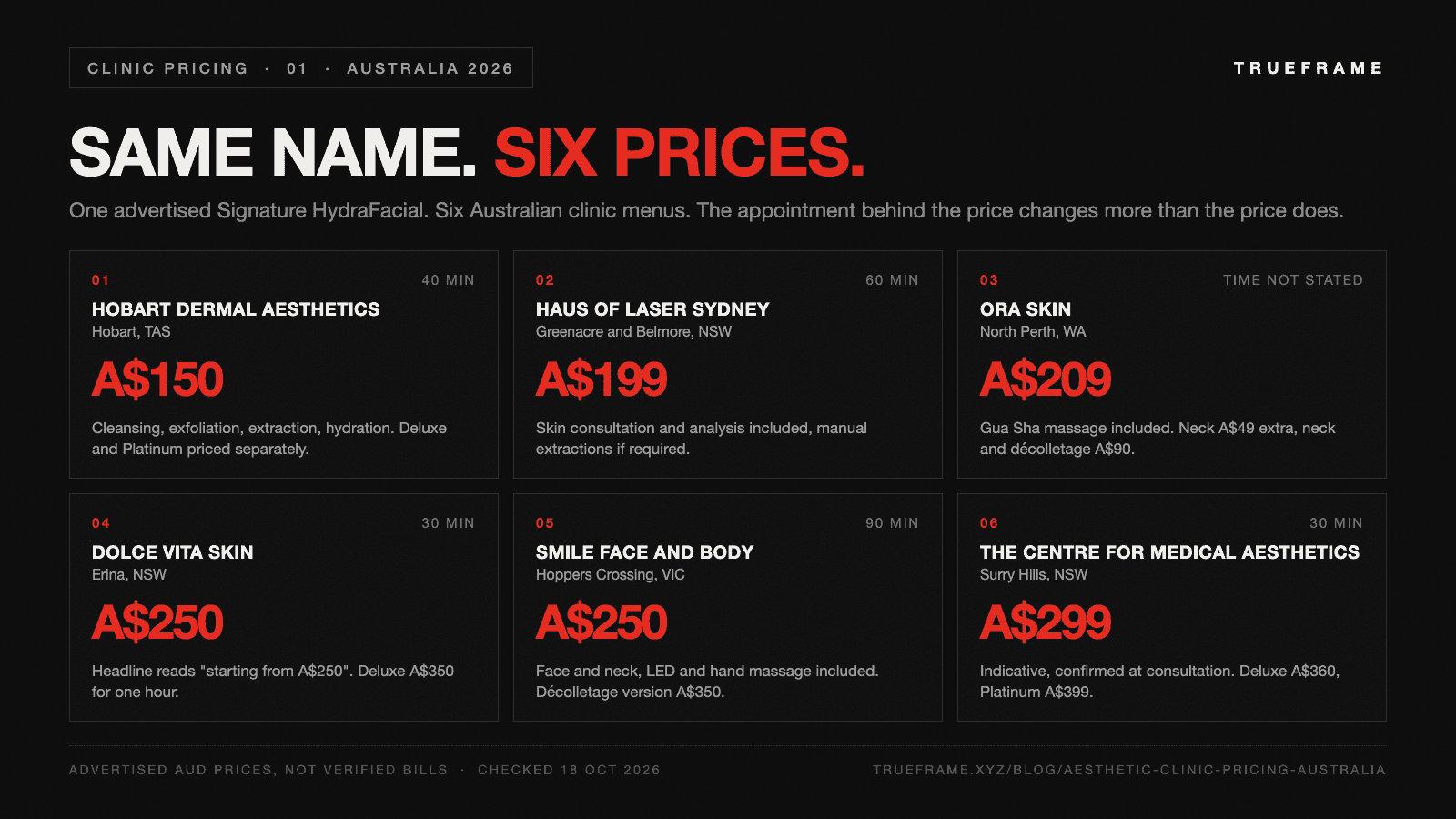
To compare aesthetic clinic prices in Australia, record what each advertised fee buys before you compare the number: the exact appointment, minutes, inclusions, practitioner and payment terms. On 18 October 2026, six Australian clinics advertised a Signature HydraFacial from A$150 to A$299, and the appointments behind those prices ran from 30 to 90 minutes.
The short version
- A treatment name is a label, not a fixed bundle. Record the appointment behind the price first.
- Build your sample from clinics your patients could actually visit, and keep a list of who you excluded and why.
- Keep fees, deposits and redeemable credits in separate columns. Never stack them without checking the booking path.
- Do not rank clinics by price per minute. Use duration to raise a question about your own scheduling.
- End the exercise with one decision: fix the explanation, recheck your costs, or review the price.
This gets missed in the obvious moment. An owner sees a lower advertised price on another clinic's website and asks whether their own clinic is too expensive. The better question is what the other clinic is selling for that price, and whether it is the same thing you sell.
| Provider | Advertised Signature price | Listed time | What changes the comparison |
|---|---|---|---|
| Hobart Dermal Aesthetics, Hobart TAS | A$150 | 40 minutes | Cleansing, exfoliation, extraction and hydration. Deluxe and Platinum are priced separately. |
| Haus of Laser Sydney, Greenacre and Belmore NSW | A$199 | 60 minutes | Includes a skin consultation and analysis, manual extractions if required, moisturiser and sunscreen finish. |
| Ora Skin, North Perth WA | A$209 | Not stated | Includes a Gua Sha massage. Neck is A$49 extra, neck and décolletage A$90. |
| Dolce Vita Skin, Erina NSW | A$250 | 30 minutes | Page headline says 'starting from A$250'. Deluxe is A$350 for one hour. |
| Smile Face and Body, Hoppers Crossing VIC | A$250 | 90 minutes | Face and neck, with LED and a hand and arm massage included. Décolletage version is A$350. |
| The Centre for Medical Aesthetics, Surry Hills NSW | A$299 | 30 minutes | Prices stated as indicative and confirmed at consultation. Deluxe A$360 (60 min), Platinum A$399 (75 min). |
None of these six lines was labelled an introductory offer on the day we checked. That does not tell us how long each price has applied. Tax treatment was not explicit on the selected service lines, and we did not complete a checkout or ask for a quote. These are advertised menus, not verified bills. Prices and terms can change at any time, so check the source pages before you rely on a figure.
Benjamin Chua
Clinic pricing research tool
6
printable pages
PDF · Version 1.0 · Updated Oct 2026
Clinic Competitor Price Comparison Worksheet
Record each competitor's appointment, inclusions, payment terms and unknowns, check your own economics, then land on one decision.
- A two-part capture grid for appointment, minutes, inclusions, extras and conditions
- Fee, deposit and credit fields so payment terms never get stacked by accident
- Your own economics check and a one-decision page with owner and due date
Swipe sideways to inspect the full graphic.
What do six clinic menus actually show about pricing?
They show that the variation sits behind the shared name. The cheapest line in the sample is a 40-minute appointment. One of the two A$250 lines is 30 minutes for the face. The other is 90 minutes for face and neck with LED and a massage included. If you run the 90-minute version and price-match the 30-minute version, you have not matched a competitor. You have halved what each room hour earns before you have covered a single cost.
Patients may care about those differences. They may also value something that costs you very little, such as understanding exactly what happens in the room before they book. Haus of Laser lists a skin consultation and analysis inside its Signature price. TCMA lists a free 30-minute HydraFacial consultation as a separate appointment. Both are ways of removing uncertainty, and both change what a patient compares.
What the pages don't show matters as much. None of them establishes practitioner time versus room time, aftercare, turnover, or what happens if you cancel. A comparison that only captures the headline price captures the least informative part of the offer.
Which competitors belong in my comparison?
The clinics your patients could realistically visit instead of you. A menu from another state can show you a good way to explain an appointment. It tells you very little about the alternatives your own enquiries are weighing up.
Start with your catchment. Choose services people could reasonably compare with yours, and include different operating models if they compete for the same enquiry. A medical clinic and a skin studio can both lose the same patient to each other even if they would never describe themselves as competitors.
Write down why each clinic is in the sample. 'It came up first in Google' is a discovery method. It isn't a reason. Then keep a second list of clinics you excluded and why. 'Price not published' is an honest research result. Filling that cell with a guess makes the whole sheet less useful, and it quietly biases your sample toward clinics that publish menus. Those clinics are not automatically cheaper, dearer or more transparent in the room than the ones that quote after assessment.
What should I record before I compare a single number?
Record the price basis: what has to happen for someone to pay that amount. Does the fee apply to one appointment, a prepaid course, a new patient only, a specific practitioner or a smaller area? Which steps are required and which are optional additions? A headline price can be accurate for one path through the menu without describing what most patients end up paying.
- If the price says 'from', record it as a starting price. Do not convert it into a final price for your scenario unless the provider's terms support that.
- For a package, record the full commitment and the number of appointments. An effective per-visit price hides the cash outlay if you show it alone, and it says nothing about whether every session is appropriate for a given patient.
- Write down the listed minutes and what the page says they measure. Treatment time, appointment time and 'approximately' are three different things.
- List inclusions in the provider's own words. Then list extras with their prices, as Ora Skin does with neck and décolletage.
- Keep the URL and the date you checked beside every row. When a menu changes, you want to know which conclusion to revisit without starting again.
Once you know what competitors sell, work out what your own appointment costs to deliver and what a 20% discount really requires. Worked AUD example included.
Read the pricing guideHow do I handle consultation fees, deposits and credits?
Keep them in separate columns, because they are different financial arrangements with the same word on the menu. At TCMA, the A$100 complexion consultation is a deposit redeemable against treatment only, and explicitly not against skincare products. Its A$150 and A$250 doctor consultations are not redeemable at all. At Hobart Dermal Aesthetics, the A$50 dermal therapist consultation is redeemable on the day for treatment and/or skincare products. Three clinics, four arrangements.
| Provider | Arrangement | Redeemable? | What it means for a comparison |
|---|---|---|---|
| TCMA | A$100 complexion consultation deposit | Against treatment only, not products | A deposit, not a fee. Record what it buys and the eligible spend. |
| TCMA | A$150 and A$250 doctor consultations | Not redeemable | A standalone paid appointment. Do not add it to a treatment price without checking the booking path. |
| TCMA | Free 30-minute HydraFacial consultation | Not applicable | A separate appointment from the paid treatment. Note the conditions the page gives. |
| Hobart Dermal Aesthetics | A$50 dermal therapist consultation | On the day, for treatment and/or products | A conditional credit. Terms govern it, not your assumptions. |
| Haus of Laser Sydney | Skin consultation and analysis inside the A$199 Signature | Included | The consultation is part of the treatment price, so there is nothing to add. |
Your sheet needs three fields for each path: the amount paid now, what it buys, and whether any of it can be credited later. A credit has conditions. Record the eligible purchases, the time allowed and any limits the page states. If cancellation or refund terms are missing, write 'unknown'. Do not write your own version of what seems normal.
Do not add a consultation charge to every treatment price either. Check whether that appointment requires a separate consultation, includes one, or follows a different booking path. If the public page doesn't answer that, the total stays unconfirmed. For your own clinic, the explanation should be simple enough for reception to repeat word for word, and a patient who decides against treatment should still understand what they paid for.
Should I rank competitors by price per minute?
No. Dividing a fee by the advertised minutes is easy and it produces a confident, misleading number. The minutes on a menu might be treatment time, appointment time or an estimate. They may exclude room preparation, cleaning, notes and follow-up. Different services also use different equipment, consumables and staffing. Use duration to raise a question about your own scheduling, never to declare which clinic is better value.
Here is an entirely made-up planning example, with no real clinic in it. Clinic A schedules a 45-minute service in a 60-minute room slot. Clinic B offers a 60-minute service and needs 15 minutes of turnover afterwards. Their room requirements are 60 and 75 minutes. In five available room hours, the theoretical maximum is five of A's appointments or four of B's, assuming every slot fills, everyone arrives on time and nothing else gets in the way.
| Clinic A | Clinic B | |
|---|---|---|
| Service length | 45 minutes | 60 minutes |
| Room requirement including turnover | 60 minutes | 75 minutes |
| Theoretical maximum in five room hours | 5 appointments | 4 appointments |
| Gross receipts if both charge A$240 | A$1,200 | A$960 |
| What this proves about profit | Nothing yet | Nothing yet |
Neither figure is profit. Tax where it applies, labour, consumables, equipment, acquisition and overhead still have to come out. The calculation tells the owner to check their scheduling economics. It does not tell a patient which appointment to choose, and it does not prove the shorter service should cost less.
How do I turn the comparison into a decision?
Group the closest matches and keep clearly different services in their own section so they don't distort the comparison. Then write one sentence describing what your clinic currently sells: the appointment, who delivers it, the main inclusions and the price basis. Avoid the word 'premium' until you can explain the difference in plain terms.
Now name the question the research raised. You might find your website never mentions work that is already inside the fee. You might find an optional extra is being read as a compulsory cost. You might find your appointment takes more staff time than your pricing model assumed. Those are three different problems. Clearer copy fixes the first two. It cannot rescue an appointment that loses money at realistic booking levels.
A competitor menu cannot show you their supplier terms, rent, utilisation, wages or other income, and it cannot tell you how many people actually pay the displayed price. A small local sample helps you ask a better question. Your own operating figures and enquiry behaviour have to answer it.
What do Australian rules require when I explain my own prices?
Show the amount someone should expect to pay for the stated appointment. The ACCC requires businesses to display the total price as a single figure, and that figure has to be the minimum total cost including taxes and any unavoidable or pre-selected extras. If you also show a partial price, the total has to be at least as prominent. A 'was' price is misleading if the item was not sold at that price for a reasonable period right before the sale, and a special that runs for an extended period can effectively become the normal price. Keep records behind any advertised saving.
For regulated health services, Ahpra's advertising rules sit on top of consumer law. They prohibit misleading advertising, inducements without stated terms, testimonials about clinical aspects, unreasonable expectations of benefit and encouraging unnecessary use. A clear discount does not make the surrounding claims acceptable. Keep treatment decisions with the practitioner and give people room to decline.
One more thing an owner can take from this exercise: the clinics that are easiest to compare are the ones that explain the appointment plainly. That is also what your patients are trying to do. When we ran a content system for Dr Marion Chan, a plastic surgeon in Melbourne, the job was exactly that, turning what happens in her practice into content people could understand inside a tightly regulated category. Reach across her two accounts went from a 48,840 May baseline to 430,563 in the first full month, 8.8 times the baseline, and her account grew from 12,043 to 26,164 followers in five weeks. That is distribution proof. It says nothing about her bookings, her revenue or her pricing, and we don't present it that way.
“The actual reel or video that they give you in the end just far exceeds my expectations of how I could have dreamed of it being.”
Clear offer, unclear explanation?
If your clinic's appointment and price are settled and the problem is that nobody outside the clinic understands them, book a fit call. We will look at your situation and tell you honestly whether a content engine would pay back. Pricing and clinical decisions stay with your clinic.
The comparison rule
- Record the appointment, minutes, inclusions and payment terms before you record the price.
- Sample the clinics your patients actually consider, and list the ones you left out.
- Fees, deposits and credits go in separate columns with their conditions.
- Duration raises a scheduling question. It never settles a value ranking.
- Finish with one decision, an owner and a date.
Keep going on clinic pricing and offers
Sources and review date
We use primary official sources for rules and platform guidance. This article is general information, not medical or legal advice.
- Hobart Dermal Aesthetics treatment menu (Hobart, TAS) · Hobart Plastic SurgeryReviewed 18 October 2026
- Haus of Laser Sydney HydraFacial packages (Greenacre and Belmore, NSW) · Haus of Laser SydneyReviewed 18 October 2026
- Ora Skin HydraFacial Syndeo menu (North Perth, WA) · Ora SkinReviewed 18 October 2026
- Dolce Vita Skin HydraFacial Syndeo menu (Erina, NSW) · Dolce Vita SkinReviewed 18 October 2026
- Smile Face and Body HydraFacial page (Hoppers Crossing, VIC) · Smile Face and BodyReviewed 18 October 2026
- The Centre for Medical Aesthetics consultation and treatment fees (Surry Hills, NSW) · The Centre for Medical AestheticsReviewed 18 October 2026
- Price displays · Australian Competition and Consumer CommissionReviewed 18 October 2026
- Guidelines for advertising a regulated health service · Ahpra and National BoardsReviewed 12 August 2026
Skip the reading. Talk it through instead.
Book a fit call and we'll map out what a content engine looks like for your business. No pitch, no pressure.
Don't miss the next one
Some of what we share is time-sensitive. A format that's working right now, a window that closes fast. We email those the moment they're worth jumping on. Drop your email so you catch them in time.
No spam. Unsubscribe anytime.
Frequently asked questions
What is the average price of aesthetic treatments in Australia?
Should my clinic charge the same as nearby clinics?
Does a higher price mean a better treatment?
How do I compare a clinic that only quotes after a consultation?
How often should I redo a competitor price comparison?
Can I publish a competitor price comparison on my clinic website?
Founded & led by
Benjamin Chua (BenChuchu)
Founder and CEO of Trueframe. 9 years building businesses (started at 16), tens of millions of views generated, and 8 figures in revenue created for the founders and brands he works with. He builds the content systems Trueframe runs.