How Founder Content Shortens B2B Sales Cycles: Prospects Who Arrive Pre-Sold
Most of a B2B sales cycle happens in rooms you are not in. Here is how founder content does the convincing there, how to build the clip library your sales team sends, and the four numbers that prove it is working.

Written by Benjamin Chua, founder of Trueframe.
On this page
- Why do B2B sales cycles take so long in the first place?
- What does a pre-sold prospect sound like on the first call?
- Which five mechanics actually shorten the cycle?
- 1. Champion ammo
- 2. Self-qualification
- 3. First calls at third-meeting depth
- 4. Buying-committee sync
- 5. Proof content as nurture
- How do you build a sales enablement clip library?
- How should AEs send clips at each stage?
- What should you measure to prove content is shortening the cycle?
- What happened when we ran this for Robert Ta?
- When will founder content fail to shorten your cycle?
Founder content shortens B2B sales cycles by doing the convincing before the first call. Buyers watch a founder explain the problem, the method and the trade-offs on their own time, then arrive already qualified, already trusting, and carrying clips they can forward to the CFO and CTO. The first call starts where a third meeting usually would.
The short version
- Buyers make first contact around 61% of the way through their journey and most have already ranked their shortlist. Content is what ranks you while you are not in the room.
- Five mechanics shorten the cycle: champion ammo, self-qualification, first calls at third-meeting depth, buying-committee sync and proof as nurture.
- Build a clip library tagged three ways, stage, objection and persona, and give AEs one send rule per stage.
- Measure days to close, show rate, how often buyers say they have seen your videos, and assisted opportunities. Judge on 90-day cohorts.
- Robert Ta tracked over six figures of B2B pipeline to qualified leads who named his specific videos. That is what pre-sold looks like in a CRM.
Why do B2B sales cycles take so long in the first place?
Most of the cycle happens where you cannot see it. 6sense's 2025 B2B Buyer Experience Report puts the point of first contact at 61% of the way through the buying journey. Buyers evaluate about five vendors, 94% said they had ordered their shortlist by preference before engaging a seller, and the pre-contact favorite wins roughly 80% of the time.
Read that as a sales leader and the problem is obvious. By the time your AE gets a reply, most of the deciding is finished. Whatever the buyer learned about you in the weeks before that reply came from what you had already published, or from your competitor's version of it.
The second half of the problem is timing. John Dawes's 95-5 paper for the LinkedIn B2B Institute argues that up to 95% of business buyers are out of market for a given purchase at any one time. They buy phone systems, payroll software and content agencies every few years. So the memory you build while they are not buying is the memory that activates when they are.
Your demo is the fast part. The slow part is the weeks a buyer spends building the case internally without you, where every question they cannot answer alone becomes another meeting on the calendar. Founder content answers those questions while you sleep. That is the whole mechanism.
Benjamin Chua
B2B sales enablement toolkit
5
printable pages
PDF · Version 1.0 · Updated Oct 2026
Sales Enablement Clip Library Template
Tag every founder clip by stage, objection and persona, give your AEs send rules for each stage, and log the four numbers that show the cycle moving.
- A three-way tagging schema: stage, objection, persona
- A clip inventory worksheet with naming convention and a pass test
- AE send rules for every stage, with a message template
- A measurement sheet for days to close, show rate, content mentions and assisted opportunities
What does a pre-sold prospect sound like on the first call?
They open with some version of "I've been watching your stuff." In our own pipeline, the messages that turned into the biggest engagements followed the same pattern: a founder finds a video, watches three or four more, reads the whole site, then sends a message that starts with that sentence. They rarely liked or commented on anything. They just consumed until they trusted us enough to reach out.
Here is a recent one. On 16 October 2026 an online-education operator based in Bali asked an AI assistant to find agencies who do personal branding in the United States and the UK. It recommended us. She read our pages, booked a call, and bought a paid strategy session on that same call. She had already compared, already decided what she wanted, and used the call to confirm. That is a first call at third-meeting depth.
Robert Ta, founder of Clarity and Epistemic Me, is the clearest client example we have. He tracks the source of every qualified lead, and the ones who became over six figures of B2B pipeline named his specific videos as the reason they trusted him enough to reach out. Here he is on what changed.
“I've tracked over six figures in converted pipeline revenue from qualified leads who referenced my specific content as trust building and helpful.”
Which five mechanics actually shorten the cycle?
Pre-sold is the outcome. Underneath it are five separate mechanics, and each one removes a specific kind of delay. If you only build for one, you only get one.
1. Champion ammo
Your champion has to sell you in rooms you will never enter: the budget review, the CTO's architecture call, the Slack thread where someone asks why not build it in-house. A 40-slide deck does not get forwarded into those rooms. A three-minute clip of the founder explaining why this costs what it costs, or what breaks if the problem is left alone, does. Every clip you publish is a message your champion no longer has to write.
2. Self-qualification
Contrarian takes and plain talk about scope and price do the filtering before anyone books. A founder who says on camera "we will not run your content if you cannot give us 90 minutes a month" loses the people who were never going to buy and gains credibility with the ones who were. Fewer exploratory calls, higher show rate, and discovery calls that start with fit already established. Hormozi's Value Equation in $100M Offers is the useful lens here: content that raises perceived likelihood of the outcome and cuts the buyer's felt effort is doing qualification work for you.
The framework for mapping every "why does it cost that much?" to a piece of content that handles the objection before the call. Includes the five most common B2B objections and a fill-in calendar.
Get the objections playbook3. First calls at third-meeting depth
When a buyer has watched three or four founder videos, the first 20 minutes of the usual first call are already done. Who you are, what you believe, how the method works, who it is for. Skip them. Open with their situation and what would need to be true for this to pay back. We coach AEs to ask one question at the top of every first call: "what have you already seen from us?" The answer tells you which meeting you are actually in.
4. Buying-committee sync
HBR's 2015 piece on the consensus sale describes the modern purchase as a group decision with different priorities in the room, and the deal stalling when the group cannot agree. The practical fix is that the CFO, the CTO and the day-to-day user all watch the same three clips. They form the same picture of the problem and the method, so you stop getting asked to present again to someone who missed the last meeting. Each of those repeat presentations is usually two weeks of calendar.
5. Proof content as nurture
Between touches, most AEs send check-ins. "Just following up." Those extend cycles because they give the buyer nothing new to react to. Send proof instead: a case clip, a customer walkthrough, a founder answer to the exact question left open on the last call. Hormozi's $100M Leads frames lead nurture as giving value until the buyer is ready. In practice that means every silence gets a clip that moves the internal conversation, and none of them say "checking in."
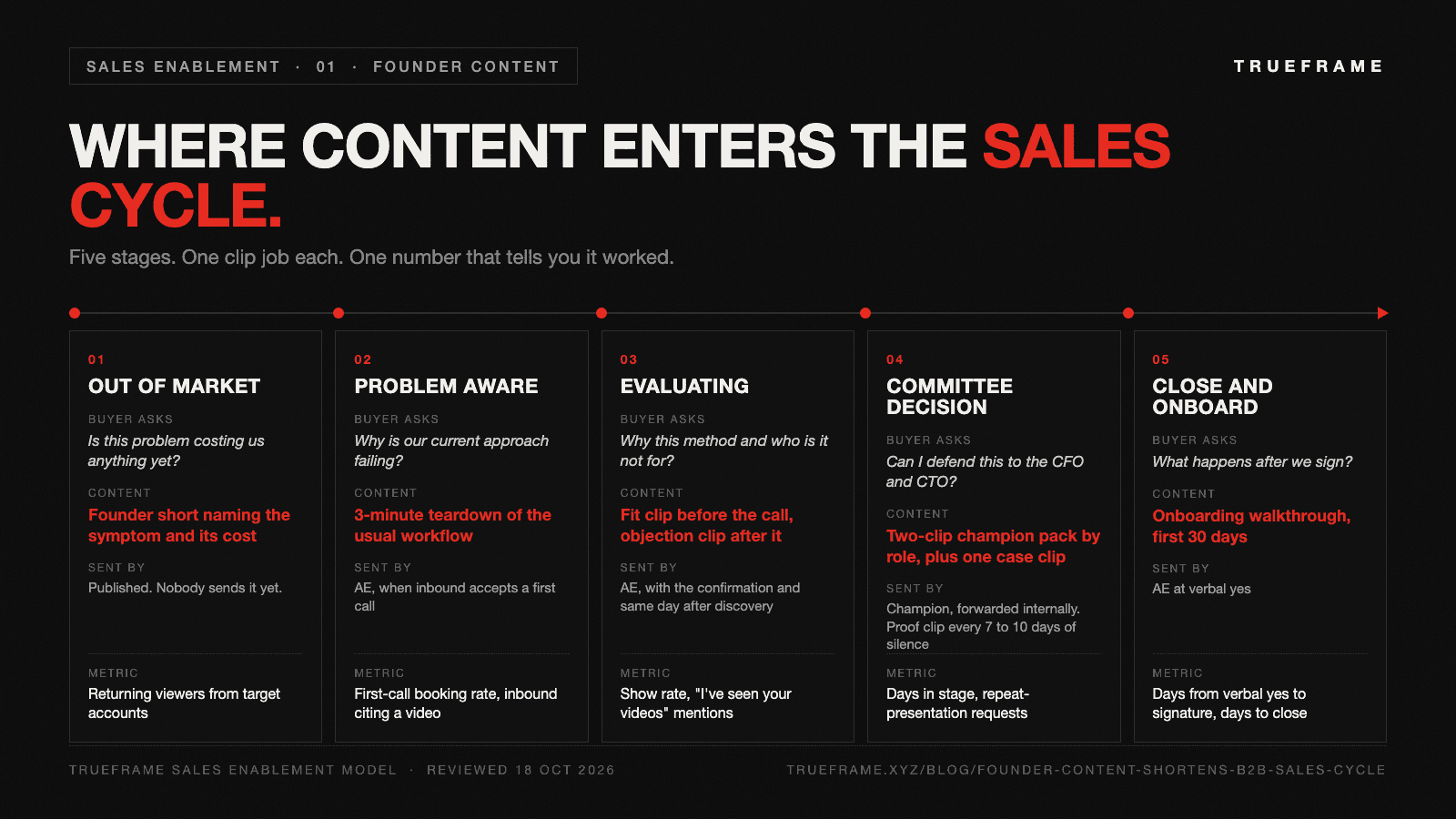
Swipe sideways to inspect the full graphic.
How do you build a sales enablement clip library?
Cut the long-form you already have into clips and tag every one three ways: stage, objection, persona. You do not need a filming day to start. Most B2B teams are sitting on 20 hours of webinars, podcast episodes and recorded customer calls that nobody has mined. Our Robert Ta scope turns one weekly podcast into 5 to 8 YouTube highlights of 3 to 5 minutes plus around 14 shorts, which is roughly 20 library candidates a week from one hour of founder time.
- Stage: out of market, problem aware, evaluating, committee decision, closing, onboarding.
- Objection: price, timing, build versus buy, security and data, "we tried this before", switching cost, "we have no time".
- Persona: economic buyer (CFO or CEO), technical evaluator (CTO or engineering lead), end user, internal champion.
- Format: 45-second short, 3-minute highlight, 10-minute deep dive. Shorter clips get forwarded. Longer clips get watched by the one person who needs to be convinced.
Name every file so the tag is the filename: stage, objection, persona, length, then a plain title. Keep one shared folder, one link per clip, and a single line beside each: "send this when..." Thirty clips, five per stage, is enough to start. Retire a clip the day the product, the price or the claim in it changes, because a stale clip in a champion's inbox costs more than no clip.
| Sales stage | Buyer question | Content asset | Metric |
|---|---|---|---|
| Out of market | Is this problem costing us anything yet? | Founder short naming the symptom and its cost | Returning viewers, follows from target accounts |
| Problem aware | Why is our current approach failing? | 3-minute teardown of the usual workflow | Inbound that references the video, first-call booking rate |
| Evaluating | Why this method and not the alternatives? | Comparison clip with honest trade-offs and who it is not for | Show rate on first calls, "I've seen your videos" mentions |
| Committee decision | Can I defend this to the CFO and CTO? | Two-clip champion pack by role plus one case clip | Days in stage, repeat-presentation requests |
| Closing | What happens after we sign? | Onboarding walkthrough and first-30-days clip | Days from verbal yes to signature |
| Onboarding | Did we choose right? | Customer result clip at day 30 | Expansion and referral conversations opened |
Want us to look at your cycle before you build any of this?
Book a fit call. We will look at your current sales stages, your existing recordings and your sales team's habits, then tell you honestly whether an installed founder content engine would pay back for you or whether a lighter fix would do.
How should AEs send clips at each stage?
One clip per message, under three minutes, with one sentence on why this clip for this person right now. The library only shortens the cycle if sales actually sends from it, so the rules have to be simple enough to follow on a busy Thursday.
- Before the first call: send the "who this is for and who it is not" clip with the calendar confirmation. This is the clip that lifts show rate, because the buyer has a reason to turn up or a reason to cancel early, and both are wins.
- After discovery: send the clip that answers the objection they actually raised, the same day. Never a generic recap. If no clip answers it, that is next week's filming topic.
- When the champion has to sell upward: send a two-clip pack addressed by role, one for the CFO and one for the CTO, plus a one-paragraph summary they can paste into Slack without editing.
- During silence: one proof clip every 7 to 10 days, each one answering a different open question. No check-ins, no "any update?"
- At verbal yes: send the onboarding walkthrough so the signature is the only thing left to decide.
- Never attach five clips to one email, and never send a clip you have not watched this month.
Hi [first name], you raised [objection] on our call today.
Here are three minutes of [founder name] on exactly that: [clip link]
Worth watching before [next step date]. Then we can decide together whether this is a fit.
(One clip. One reason. One next step.)
What should you measure to prove content is shortening the cycle?
Four numbers, logged in the CRM from day one: days to close, show rate, how often buyers say they have seen your videos, and assisted opportunities. Each one answers a different question, so do not collapse them into a single content score.
- Days to close: opportunity created to closed-won. Compare deals with at least one logged content touch against deals with none, by quarter cohort. One fast deal proves nothing. A cohort gap that holds for two quarters does.
- Show rate: first calls attended divided by first calls booked, split by whether the pre-call clip was sent. This is the fastest signal you will get, usually inside a month.
- "I've seen your videos" mentions: a checkbox on the first-call form plus a free-text field for which video. AEs fill it in during the call. This is how Robert's six figures got attributed: leads named the specific content, and someone wrote it down.
- Assisted opportunities: opportunities where a clip link was clicked (tag every clip URL with the clip ID) or a clip was logged before a stage change. Call these assisted, never sourced. Content rarely sources an enterprise deal on its own, and claiming it did will cost you the sales team's trust.
Keep pipeline and revenue in separate columns. Give the measurement 90 days before you judge it, because the first month mostly tells you whether AEs are sending at all. If they are not, fix the send rules before you blame the content.
What happened when we ran this for Robert Ta?
Robert came to us with zero content presence and six agencies behind him that had produced output with no plan attached. He runs Epistemic Me, a bootstrapped AI startup, and Clarity, and sells to an enterprise audience with the long cycles that implies.
We built the engine around one weekly recording. Ben scripts as the quality gate, the podcast becomes 5 to 8 YouTube highlights and around 14 shorts, every long cut gets full packaging, and we moved him off street-interview content into procedural how-to content that his actual buyers search for. Then we tracked it: every lead got asked where they came from and which videos they had watched.
What happened: Robert tracked over six figures of B2B pipeline to qualified leads who referenced his specific content as trust-building, plus 50-plus B2C leads through the same engine. One new-format test, run with Hamel Husain's audience pilot, produced 366 lead-magnet requests, 262 saves and 74 shares in days. His own words are in the video above.
What we will not claim: we do not have a verified days-to-close figure for Robert's deals, so you will not find one here. What we have is his attribution, in writing, that qualified leads arrived already trusting him because of named videos. That is the pre-sold effect showing up in a CRM, and it is the number we would want you to measure too.
The full breakdown of what was broken, the five-part system we built, and the numbers Robert tracks himself.
Read the case studyWhen will founder content fail to shorten your cycle?
It will not help if the slow part of your cycle is fixed by someone else. Be honest about which of these apply before you spend a quarter on it.
- Procurement-gated deals with fixed RFP windows and security reviews. Content shortens the stages around them. It does not move the windows.
- A founder who will not say anything specific on camera. Generic thought leadership does not qualify anyone and does not get forwarded.
- A library with no owner. If nobody is accountable for sending, the clips sit in a folder and the cycle stays exactly where it was.
- A product that changes monthly. Clips rot. Either plan for a monthly refresh or keep the library to method and philosophy, which age slowly.
- Less than 90 days of patience. The send rules work the first week. The pre-sold inbound takes two to three months of consistent publishing.
If none of those apply, the sequence is simple. Tag 30 clips this week, hand sales the send rules, add the four fields to your CRM, and look at the cohort in 90 days. For the broader quarter plan around it, see our 90-day B2B SaaS video content plan, and for the strategy layer above it, the SaaS content marketing playbook, both linked below.
Want the clip library, the filming and the tracking run as one system?
Trueframe installs the founder content engine: strategy, scripts, a monthly directed capture block, editing, the tagged library for sales and the measurement loop. You show up for about 90 minutes a month. Start with a fit call and we will tell you honestly whether it would pay back in your sales cycle.
See the SaaS content systemRelated guides
Sources and review date
Primary sources, first-party data and review dates are listed below. Client-reported results and Trueframe analysis are labelled in the article.
- 2025 B2B Buyer Experience Report · 6sense ResearchReviewed 18 October 2026
- Advertising effectiveness and the 95-5 rule · LinkedIn B2B Institute and Ehrenberg-Bass Institute (John Dawes, 2021)Reviewed 18 October 2026
- Making the Consensus Sale · Harvard Business Review, March 2015Reviewed 18 October 2026
- $100M Offers: How To Make Offers So Good People Feel Stupid Saying No · Alex Hormozi, Acquisition.comReviewed 18 October 2026
- $100M Leads and the Acquisition.com book series · Alex Hormozi, Acquisition.comReviewed 18 October 2026
Skip the reading. Talk it through instead.
Book a fit call and we'll map out what a content engine looks like for your business. No pitch, no pressure.
Don't miss the next one
Some of what we share is time-sensitive. A format that's working right now, a window that closes fast. We email those the moment they're worth jumping on. Drop your email so you catch them in time.
No spam. Unsubscribe anytime.
Frequently asked questions
How does founder content shorten the B2B sales cycle?
What is a sales enablement clip library?
How many clips do you need to start?
How do you measure whether content is shortening the sales cycle?
Should the founder or the sales team appear in the videos?
How long before founder content affects the sales cycle?
Does this work for enterprise deals that go through procurement?
Founded & led by
Benjamin Chua (BenChuchu)
Founder and CEO of Trueframe. 9 years building businesses (started at 16), tens of millions of views generated, and 8 figures in revenue created for the founders and brands he works with. He builds the content systems Trueframe runs.