Founder Personal Branding Before Fundraising: What Investors Check and a 90-Day Plan
Investors look you up before they look at your deck. Here is what they find, why the story has to match on every surface, and a 13-week plan to fix your footprint before you start the raise.

Written by Benjamin Chua, founder of Trueframe.
On this page
- What do investors actually check about a founder before a first meeting?
- Why does the why us, why now story have to match everywhere?
- Do investors really read what an AI assistant says about you?
- What does a 90-day pre-raise content plan look like week by week?
- Weeks 1 to 2: audit and repair
- Weeks 3 to 8: publish the thesis in pieces
- Weeks 9 to 13: proof and diligence prep
- What happened when we ran a content engine for an AI founder?
- What should a founder not do before a raise?
- Should you hire an agency or do this yourself before a raise?
- How do you know the footprint work is paying off?
Before an investor opens your deck they search your name, read your LinkedIn, skim what an AI assistant says about you and check whether your story matches across all of it. You can fix that footprint in 90 days: audit and repair in weeks 1 to 2, then publish one signal-dense recording a week on market, model, go-to-market and team.
The short version
- Investors verify founders. Hustle Fund, SaaStr and GoingVC all document reference checks, background checks and consistency checks.
- Five surfaces get checked: Google results, LinkedIn, AI-assistant summaries, podcast appearances and the match between your deck story and your public story.
- DocSend's data: investors spend under three minutes on a deck. Your footprint is where they spend the rest.
- Weeks 1 to 2 fix what exists. Weeks 3 to 13 publish one recording a week, cut into clips and posts that answer diligence questions in advance.
- Do not buy followers, do not post hype, and do not announce the raise in public without your lawyer's sign-off.
What do investors actually check about a founder before a first meeting?
They check whether you are who the deck says you are, and whether other people agree. The formal version of this is written down by investors themselves. Jason Lemkin at SaaStr says VCs want to do four or five on-sheet reference checks and as many off-sheet checks as they can, and at early stage they ask your peers, your accelerator, your angels and your former bosses. GoingVC's reference-check guide describes back-channel references as the people the investor finds on their own, and lists an open-source search of the founder's broader internet and social media presence as part of a formal background check.
Hustle Fund's September 2026 diligence guide adds the part most founders miss. It tells investors to verify identity, employment and education, to confirm claims with stronger sources than the founder's own answer, and to watch for consistency across meetings and whether founders send the follow-ups they promised. Consistency is a diligence test. Your public footprint is the cheapest place to run it.
The informal version happens before any of that. A partner gets a warm intro, types your name into Google, opens your LinkedIn, and increasingly asks an AI assistant who you are. That ten-minute pass decides whether the first meeting starts warm or sceptical. Here is what each surface tells them.
| Surface | What they look for | Red flag | Fix |
|---|---|---|---|
| Google results for your name | A current, coherent first page: company, LinkedIn, something you said in public | Stale job titles, an abandoned side project, nothing at all | Current bios everywhere, one about page on your site, two or three indexed interviews or posts |
| LinkedIn profile and posts | Headline and About that match the deck, posts that show how you think | Headline from your last job, no posts in six months, engagement-bait | Rewrite headline and About to the one-paragraph thesis, publish weekly |
| AI-assistant summary | A short, accurate paragraph on who you are and what the company does | Wrong company, confusion with someone of the same name, hedged or empty answers | Consistent entity details on site, LinkedIn and podcast pages; third-party mentions |
| Podcast and video appearances | You explaining the market and the model unprompted, on someone else's platform | None, or only your own channel talking to nobody | Two or three guest spots in your category during the 90 days |
| Story match: deck vs public | The same why us, why now, same customer, same numbers | A deck that says enterprise while LinkedIn says SMB, or metrics that drift between surfaces | One source document for the story, then every surface rewritten from it |
The positioning layer underneath this plan: why the founder beats the company account for a technical buyer, and how to build on your depth instead of performing.
Read the guideWhy does the why us, why now story have to match everywhere?
Because the story is the thing being verified. Sequoia's business plan guide puts why now as its own section, says the best companies almost always have a clear answer to it, and tells founders to tell the story of the founders and key team members. DocSend's pitch deck research found that successful 2020 pre-seed decks placed product and the why now section earlier than decks that failed to raise. If the version in the deck differs from the version on your LinkedIn or in a podcast from eight months ago, an investor who checks has found their first inconsistency before you have spoken.
The time budget makes this worse. DocSend reports investors now spend less than three minutes on a deck. In its 2020 pre-seed data, decks that raised got over four minutes of attention against one minute thirty for decks that did not. Three minutes is enough to form a question. The answer gets looked up on your footprint, where there is no time limit and no founder in the room to explain.
Write the story once, in one document, before you touch any surface. One paragraph: who you serve, what changed in the world that makes this possible now, why your team, and the one number you are proudest of. Every bio, headline, about page and podcast intro gets rewritten from that paragraph. The footprint audit below gives you the grid to check it.
Benjamin Chua
Fundraising prep tool
5
printable pages
PDF · Version 1.0 · Updated Oct 2026
Pre-Raise Founder Footprint Audit
Run the Google and AI-assistant checks investors run, score your story on a consistency grid, and leave with a sequenced fix list.
- The exact Google searches and AI-assistant prompts to run on yourself
- A consistency grid for LinkedIn, website, deck, podcasts and AI summaries
- A 13-week fix list with owners and done checks
- The pre-raise do-not-do list
Do investors really read what an AI assistant says about you?
We cannot show you an investor's browser history, so here is what we can show. On trueframe.xyz, Fathom Analytics recorded referral visits from AI assistants between 24 August and 17 October 2026: Claude 22, Gemini 5, ChatGPT 4, Perplexity 2. Small numbers against our organic search traffic, and real buyers. On 16 October 2026 an online-education operator based in Bali asked Claude to find agencies that do personal branding in the United States and the UK. Claude recommended us. She booked a call and bought a paid strategy session on it.
We also test the assistants directly. On 18 October 2026 we ran 30 buyer prompts through Perplexity's API. Trueframe was cited in 11 of them, and ranked first for the prompt personal branding agency for tech founders. That did not happen by accident. It came from pages that answer specific questions, consistent entity details across the site, LinkedIn and podcast pages, and third parties quoting us.
The same test showed the risk. Asked for Trueframe agency reviews, Perplexity found our testimonials, then flagged that the strongest evidence came from our own site and was not independent third-party verification. It also pulled unrelated companies called TrueFrame Roofing and TrueFrame Ltd into the same results before separating them. For a founder, read that two ways. An assistant will discount proof that only lives on your own pages, and it will blend you with anyone who shares your name unless your entity details are clear and repeated. Run the prompts on yourself before an investor does.
What does a 90-day pre-raise content plan look like week by week?
Four workstreams run in parallel for 13 weeks: fix the footprint, lock the story, publish proof content, and prepare for diligence. One recording a week is the engine. Each 60 to 90 minute conversation becomes four to six clips, one written post and raw material for the diligence folder. The sequence below is the one we run.
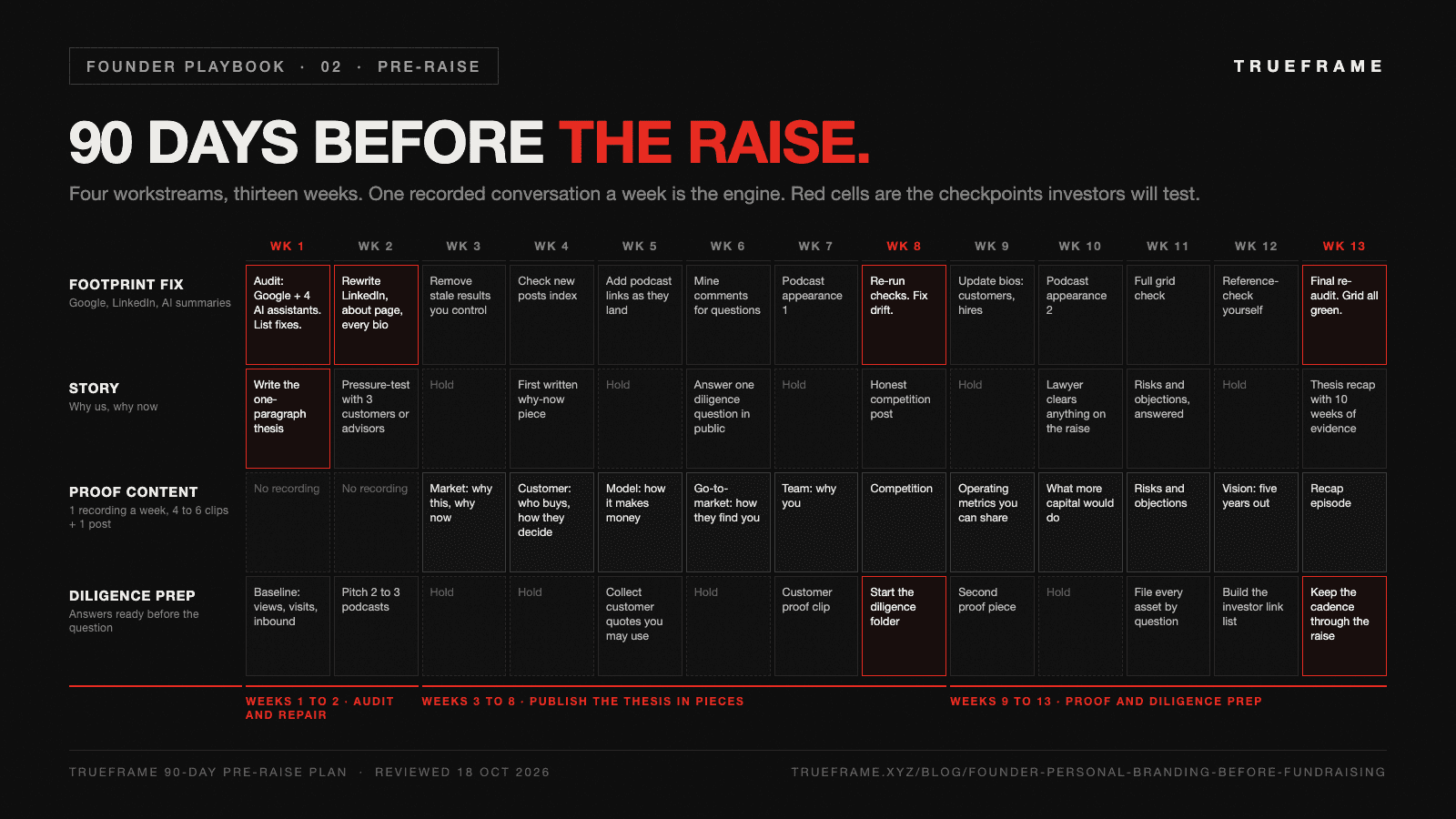
Swipe sideways to inspect the full graphic.
| Week | Footprint and story | Recording topic | Publish and diligence prep |
|---|---|---|---|
| 1 | Run the audit: Google, LinkedIn, four AI assistants. List every fix. | None. Write the one-paragraph thesis. | Set a baseline: profile views, site visits, inbound messages. |
| 2 | Rewrite LinkedIn headline and About, site about page, every bio, from the thesis. | None. Pressure-test the thesis with three customers or advisors. | Pitch two or three podcasts in your category. |
| 3 | Fix or remove stale results you control. | Market: why this problem, why now. | Cut four to six clips. Publish two clips and one post. |
| 4 | Check that new posts index under your name. | Customer: who buys, what they replace, how they decide. | Two clips, one post. First why-now written piece. |
| 5 | Add podcast appearances to site and LinkedIn as they land. | Model: how the business makes money, at the level you can share. | Two clips, one post. Collect customer quotes and proof you are allowed to use. |
| 6 | Review comments and DMs for the questions people ask. | Go-to-market: how customers find you today. | Two clips, one post answering a diligence question (risk, competition). |
| 7 | Podcast appearance 1. | Team: why you, the founding story, the hires that matter. | Two clips, one post. Customer proof clip. |
| 8 | Mid-point re-run of the Google and AI checks. Fix drift. | Competition: the honest comparison. | Two clips, one post. Start the diligence folder. |
| 9 | Update bios with anything new (customers, hires). | Unit economics or operating metrics you can share. | Two clips, one post. Second customer proof piece. |
| 10 | Podcast appearance 2. | What we would do with more capital (thinking, no solicitation). | Two clips, one post. Lawyer reviews anything touching the raise. |
| 11 | Check every surface against the consistency grid. | Risks and objections, answered in public. | Two clips, one post. Add every asset to the folder by diligence question. |
| 12 | Reference-check yourself: ask two people what they would say. | Vision: where this goes in five years. | Two clips, one post. Build the investor link list. |
| 13 | Final re-audit. Grid all green or fixes scheduled. | Recap: the thesis, now with 10 weeks of evidence. | Keep the cadence through the raise. Do not stop publishing when meetings start. |
Weeks 1 to 2: audit and repair
Search your name, your name plus company, and your name plus founder. Open a private window and ask ChatGPT, Claude, Perplexity and Gemini who you are and what your company does. Write down every wrong fact, every stale title and every hedge. Then write the thesis paragraph and rewrite every surface from it. This is two weeks of unglamorous work and it fixes most of the red flags in the table above.
Weeks 3 to 8: publish the thesis in pieces
One recorded conversation a week, 60 to 90 minutes, with someone asking you the questions an investor will ask. Market, customer, model, go-to-market, team, competition. Each recording becomes clips and one written post. By week 8 a stranger can reconstruct your thesis from your public footprint without the deck. That is the goal. Re-run the AI and Google checks at week 8, because the assistants rebuild their summaries from whatever is new.
Weeks 9 to 13: proof and diligence prep
Shift to metrics you can share, risks answered in public, and customer proof. Build the diligence folder as you go: a link list organised by the question it answers, so when an investor asks about churn or competition you send a two-minute clip you already made. Week 13 is a full re-audit. Then keep publishing. Investors notice a founder who went quiet the week the round opened.
What happened when we ran a content engine for an AI founder?
Robert Ta runs Epistemic Me, an AI startup. When he came to us he had no content presence on any platform and six agencies behind him that had not worked. We built a podcast-to-clips engine: one weekly recording becomes five to eight YouTube highlights of three to five minutes plus around fourteen short clips. Robert records once a week. We do the rest.
The result he tracks himself is over six figures of B2B pipeline from qualified leads who named his specific content as the reason they trusted him enough to reach out. The engine also produced more than 50 B2C leads, and one format test generated 366 lead-magnet requests, 262 saves and 74 shares. We are not going to tell you his content raised him money. We do not have a document that ties a clip to a term sheet, so we will not claim one. What we can say is that the same recordings that produced his pipeline are the ones that answer an investor's questions on market, model and go-to-market before the meeting.
“Finally found a team after going through 6 terrible agencies.”
Want us to look at your footprint before the raise?
Book a fit call. We look at your situation, your traction and your timeline, and tell you honestly whether an installed founder content engine would pay back before you open the round. If it would not, we say so.
See how we work with tech foundersWhat should a founder not do before a raise?
Most pre-raise branding damage is self-inflicted in the final month. The pattern is a founder who ignored the footprint for two years, then tries to fix it in three weeks with volume and hype. Investors have seen that pattern enough to recognise it on sight.
- Do not buy followers or engagement. A profile with 40,000 followers and three comments per post reads as fake to anyone who scrolls for ten seconds, and it reads worse to an investor who checks who those followers are.
- Do not post hype. Rocket emojis, unverifiable growth claims and we are crushing it posts fail the Hustle Fund test of confirming claims with stronger sources. Post the number and the source, or post nothing.
- Do not announce the raise in public without legal advice. Depending on your jurisdiction and exemption, public solicitation can limit how you raise. Content about the business is fine. Content about the round goes through your lawyer.
- Do not contradict the deck. If LinkedIn says you serve SMBs and the deck says enterprise, pick one and fix the other before anyone sees both.
- Do not go quiet when meetings start. A footprint that stops updating the week the round opens tells investors the content was for them, which is the one thing it should never look like.
- Do not let an agency ghostwrite opinions you do not hold. Investors will ask you about your posts in the meeting. Everything published has to be something you can defend without notes.
The video above makes the case we make to every founder who asks about follower counts. Two hundred views from the people who buy, hire or invest in your category are worth more than fifty thousand from people who never will. An investor scanning your comments wants to see customers, operators and peers in your market. That audience cannot be bought, and it is the only one that moves a diligence call.
Should you hire an agency or do this yourself before a raise?
Do it yourself if you have no customers yet. The audit and the repair weeks cost you nothing but time, and your 90 days are better spent on customers than on clips. Hire help when the business is real, the story is worth telling and your hours are the constraint. A done-for-you engine takes roughly an hour a week of your time for the recording, and the team handles strategy, scripting, cutting, writing and publishing.
Hormozi's Value Equation from $100M Offers is a useful way to judge either path: dream outcome times perceived likelihood, divided by time delay times effort. For a founder before a raise the dream outcome is a footprint that makes diligence easy. An agency raises likelihood and cuts your effort, at a cash cost. Doing it yourself keeps the cash and costs the hours. Pick the one whose scarce resource you have more of. If you do hire, our guide on choosing a personal branding agency covers the questions to ask, including who owns the raw footage and how they report.
The scorecard we tell founders to run on any agency, including us: strategy depth, proof, ownership, reporting and the real monthly time cost.
Run the scorecardHow do you know the footprint work is paying off?
Measure the surfaces, not the vanity numbers. At weeks 1, 8 and 13, record the first page of Google for your name, your LinkedIn headline impressions, and the exact paragraph each AI assistant returns. Count inbound messages from people in your market. Count the number of diligence questions you can answer with a link to something you already published. When an investor says I watched your clip on pricing before this call, the work is done.
| Check | Week 1 | Week 8 | Week 13 target |
|---|---|---|---|
| Google first page for your name | Record it | Stale results gone? | Company, LinkedIn, two or three interviews or posts |
| AI-assistant paragraph (four assistants) | Record each | Wrong facts fixed? | Accurate, specific, no entity confusion |
| Story consistency grid | Count mismatches | Mismatches halved | Zero mismatches across six surfaces |
| Diligence questions answered by a published asset | Usually zero | Five or more | Ten or more, filed by question |
| Inbound from people in your market | Baseline | Trend | Steady, and named in first meetings |
If you want the same checks as a printable tool, the footprint audit above has the prompt list, the consistency grid and the fix list in one place. Run it this week. The investors you have not met yet are already running theirs.
Related guides
Sources and review date
Primary sources, first-party data and review dates are listed below. Client-reported results and Trueframe analysis are labelled in the article.
- Pitch deck research: how investors review decks · DocSend (Dropbox)Reviewed 18 October 2026
- Writing a business plan · Sequoia CapitalReviewed 18 October 2026
- Due diligence: what actually matters and what doesn't · Hustle Fund, Brian Nichols, 18 September 2026Reviewed 18 October 2026
- What kind of due diligence do VCs do on the founder as a person? · SaaStr, Jason LemkinReviewed 18 October 2026
- How to reference check a founder · GoingVC, Ivelina Dineva, 18 June 2026Reviewed 18 October 2026
- $100M Offers (the Value Equation) · Alex Hormozi, Acquisition.comReviewed 18 October 2026
Skip the reading. Talk it through instead.
Book a fit call and we'll map out what a content engine looks like for your business. No pitch, no pressure.
Don't miss the next one
Some of what we share is time-sensitive. A format that's working right now, a window that closes fast. We email those the moment they're worth jumping on. Drop your email so you catch them in time.
No spam. Unsubscribe anytime.
Frequently asked questions
Do investors actually Google founders before a meeting?
How long before fundraising should a founder start building a personal brand?
What should a founder post on LinkedIn before raising?
Does what ChatGPT or Claude says about a founder matter to investors?
Should a founder buy followers or run paid promotion before fundraising?
Can a personal brand replace traction when fundraising?
Is it worth hiring an agency to build a founder brand before a raise?
Founded & led by
Benjamin Chua (BenChuchu)
Founder and CEO of Trueframe. 9 years building businesses (started at 16), tens of millions of views generated, and 8 figures in revenue created for the founders and brands he works with. He builds the content systems Trueframe runs.