Hiring a US or UK Personal Branding Agency From Anywhere: How Remote Founder Content Actually Works
The agency you hire for a US or UK personal brand does not need to sit in New York or London. Here is the exact operating model we run for founders on the US West Coast, in London and beyond, with the trade-offs spelled out.

Written by Benjamin Chua, founder of Trueframe.
On this page
- Why would a founder in Bali ask an AI for a US or UK agency?
- How does a remote done-for-you content engine actually run?
- Capture: one directed filming session, over a video call
- Production: the team ships while you sleep
- Review: comments on the frame, not meetings
- Publishing: on your schedule, in your market's hours
- What time zone overlap do you really need?
- How do you know an overseas team can write in US or UK category language?
- What does remote delivery look like for a real client?
- What should the contract say about IP, payment and exit?
- IP: ask for assignment on payment
- Payment: USD, on a platform, with a paper trail
- Exit: your assets, your accounts, your calendar
- Remote agency, local agency or in-house hire: which fits?
- What should you check before you hire a US or UK agency remotely?
You can hire a personal branding agency for the US or UK market from anywhere, because founder content is built from recordings, scripts and edits that move as files. The agency needs a remote capture routine, a review loop that fits your hours, a contract that assigns you the IP, and clients in your market who can vouch for it.
The short version
- A remote content engine runs on one directed filming session every six to twelve months, plus weekly async review.
- You need one to two hours of live overlap a week. The rest is files, comments and approvals.
- Category language is a hiring test, not a geography test. Ask for a sample script in your market's voice.
- Get IP assignment in writing. US and UK default rules both leave gaps for commissioned work.
- Pay in USD on a platform with a paper trail, and expect a W-8BEN-E request if you are a US company.
- Check named clients in your market, finished videos, review turnaround and how pipeline is measured.
Why would a founder in Bali ask an AI for a US or UK agency?
On 16 October 2026 an online-education operator based in Bali asked Claude to find agencies who do personal branding in the United States and the UK. Her buyers are in those markets. She is not. Claude recommended Trueframe, she booked a call, and she bought a paid strategy session on that call.
We are headquartered in Singapore. Our clients are mostly in the United States, Australia and the United Kingdom, and every one of them is served remotely. So the question she asked is one we answer every week, and it is worth answering properly: how does a founder in one place hire a team in another to build a brand in a third?
The search data says she is not alone. In our Google Search Console export reviewed on 18 October 2026, the United States was our largest market with 21,494 impressions, ahead of India at 10,683, the United Kingdom at 2,944, Canada at 2,344 and Australia at 1,969. Most of the people finding us are nowhere near Singapore.
Benjamin Chua
Remote founder content toolkit
6
printable pages
PDF · Version 1.0 · Updated Oct 2026
Remote Content Team Onboarding Checklist
Set up a remote content team in one week: access, filming kit, voice doc, approval rules and the KPIs you review together.
- A setup and access checklist with the exact accounts a remote team needs
- A filming kit list and a one-page voice doc template
- Approval rules and a time zone overlap worksheet
- A monthly KPI scorecard that separates reach, intent and pipeline
How does a remote done-for-you content engine actually run?
It runs as a loop with four stages: capture, production, review and publishing. Only the capture stage needs you and the team on a call at the same time. The rest moves through shared drives, a review tool and short written approvals.
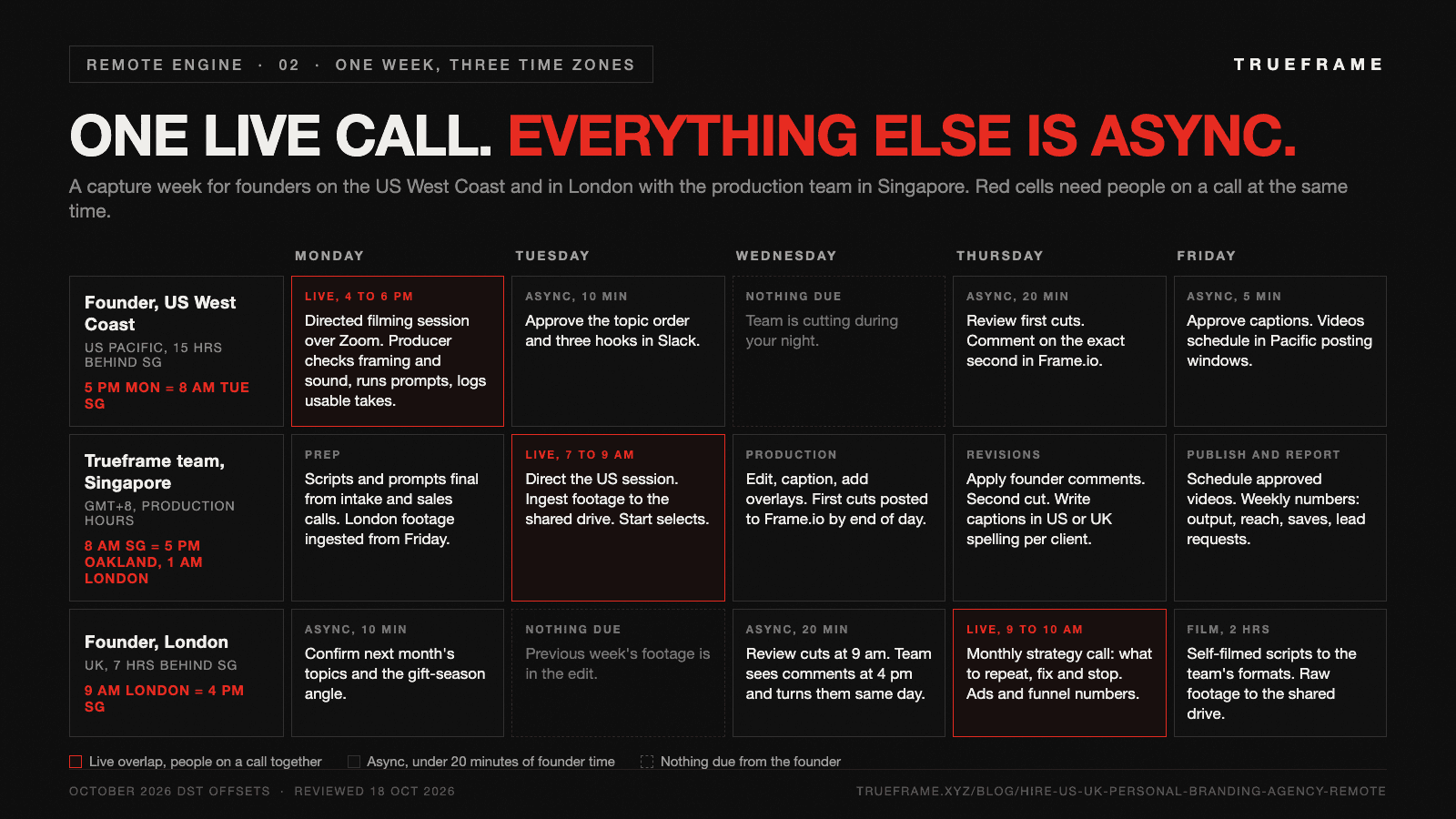
Swipe sideways to inspect the full graphic.
Capture: one directed filming session, over a video call
You film. We direct. You set up a camera, a light and a microphone wherever you work, and a producer joins on Zoom or Meet. We check framing, exposure and audio before the first take, then run you through the prompts and scripts in order. The producer logs which takes are usable while you talk, so nothing waits for a transcript.
One four to six hour session covers six to twelve months of short-form content. That is the whole on-camera commitment. The founders who struggle with content are rarely bad on camera. They are tired of deciding what to say. The session removes that decision because the scripts and prompts are prepared from your intake and sales calls before you sit down.
The video above walks through this for a tech founder. The point to notice is where the founder's time goes: one recording block, then approvals. Scripting, cutting, captioning and scheduling never touch his calendar.
Production: the team ships while you sleep
Footage uploads to a shared drive at the end of the session. Our editors work Singapore hours, which means a founder on US Pacific time records on Monday afternoon and has first cuts waiting on Tuesday morning. The time difference is an advantage here. Your night is our working day.
Review: comments on the frame, not meetings
Cuts go into a review tool where you leave a comment pinned to the exact second. Approve, request a change, or reject. We cap revision rounds in the contract so a video cannot bounce for a month. Hamel Husain, one of our longest-running clients, prefers async review and told us early on that the more communication the better, including being chased when he owes us a response. That is the working style a remote engine depends on.
Publishing: on your schedule, in your market's hours
Approved videos are scheduled to post when your audience is awake, not when our team is. Captions, hashtags, titles and descriptions are written in your market's spelling and phrasing. If we run paid distribution, the ad account stays in your name and the team works inside it.
What time zone overlap do you really need?
One to two hours a week. In practice a founder on US Pacific time is fifteen hours behind Singapore in October, which sounds impossible until you look at the clock. Your 5 pm Monday is our 8 am Tuesday. London is seven hours behind Singapore, so a London founder's 9 am is our 4 pm. Sydney is three hours ahead, so most of the working day overlaps.
| Founder location | Offset from Singapore | Natural live window | What happens live | What stays async |
|---|---|---|---|---|
| US Pacific (San Francisco, Los Angeles, Seattle) | 15 hours behind | Founder 4 to 6 pm, team 7 to 9 am next day | Filming direction, monthly strategy call | Script approval, edit review, publishing |
| US Eastern (New York, Boston, Miami) | 12 hours behind | Founder 7 to 9 pm, team 7 to 9 am next day | Filming direction, monthly strategy call | Script approval, edit review, publishing |
| United Kingdom (London) | 7 hours behind | Founder 9 to 11 am, team 4 to 6 pm | Filming direction, weekly check-in if wanted | Edit review, publishing |
| Australia (Sydney, Melbourne) | 3 hours ahead | Most of the working day | Anything you like | Still runs async by default |
The founders who get the most from this treat the live window as precious and everything else as writing. A two-line Slack message approving a script beats a thirty-minute call to discuss it.
Want to see whether a remote engine would pay back for you?
Book a fit call. We look at your offer, your market, your current content and your capacity, then tell you honestly whether an Installed Founder Content Engine would pay back. If it would not, we say so.
How do you know an overseas team can write in US or UK category language?
You test it before you sign. Category language is the set of phrases your buyers use when they describe their problem and the thing they want. An AI founder sells to AI product managers who say things like evals, context graphs and hallucination rate. A graphic novelist in London sells to mythology nerds and the people who buy them gifts. Neither of those vocabularies is a function of where the agency sits. Both are a function of whether the agency has done the research.
Three checks work well. Ask for a sample script in your voice, written from a real sales call or podcast episode you provide. Read the agency's published captions and descriptions for your market's spelling convention, because mixed US and UK spelling in one feed looks careless. Ask who reviews scripts for technical accuracy. For Hamel's developer audience we enforce zero typos in LLM, AI and API terminology, because his readers notice.
There is a second reason category language matters. AI assistants recommend agencies by matching the words a buyer types against the words on an agency's pages. Between 24 August and 17 October 2026, Fathom recorded 22 visits to our site from Claude, 5 from Gemini, 4 from ChatGPT and 2 from Perplexity. On 18 October 2026 a Perplexity API panel cited Trueframe in 11 of 30 buyer prompts and ranked us first for the phrase personal branding agency for tech founders. We got there by writing in the language founders use, not by being in a particular city.
What does remote delivery look like for a real client?
When we ran this for Mohsen Ashraf, founder of Pantheon Myths in London, the whole engagement was remote. He came to us after a strategy session in May 2026 with mythology graphic novels, a Shopify store, low sales and low engagement. London is seven hours behind Singapore, so his morning was our afternoon.
The split of work was explicit from day one. We supplied the formats, script feedback, all editing, captions and hashtags, and research on which videos were outperforming in his niche. Mohsen wrote scripts from our templates, filmed them himself, uploaded the raw footage to a shared drive, and posted on his own pages. We rejected low-energy takes and asked for reshoots rather than editing around them. Alongside the content we rebuilt his funnel so a buyer could go from a video to checkout in as few clicks as possible, then ran Meta ads into it.
“I went from virtually no sales to predictable sales every week. Within 10 days, I had 60 sales of my book.”
Those are his words from his testimonial video. We did not meet in person at any point. The result came from the content system, the funnel and the ads working together, and it is not a promise of the same number for anyone else.
Robert Ta, a US-based AI founder, is the other example we point to. He films to our scripts and records his podcast on his side. We script, edit and package everything from Singapore. In his written testimonial he reports tracking over six figures in converted B2B pipeline from qualified leads who referenced his specific content, plus more than 50 B2C leads. One format test we ran for him produced 366 lead-magnet requests, 262 saves and 74 shares. That pipeline came from podcast clips and content, nothing else.
The full remote workflow for Robert's podcast-to-clips engine, from a recording in the US to published clips, with the numbers he tracked.
Read the case studyWhat should the contract say about IP, payment and exit?
Three things, and you should read all three before you look at the price. The default copyright rules in both the US and the UK leave gaps for commissioned work, and an overseas supplier adds a tax form or two.
IP: ask for assignment on payment
In the United States, Copyright Office Circular 30 explains that a commissioned work is only a work made for hire when it falls into one of the categories listed in the Copyright Act and the parties sign an express written agreement saying so. Otherwise the creator is the author. In the United Kingdom, the government's guidance on ownership of copyright works says the creator is usually the first owner of a commissioned work unless the parties agree otherwise in writing, and a commissioner may only get an implied, limited licence.
So do not rely on the default. Ask for a clause that assigns all raw footage, scripts, edits and finished videos to you on payment, with a licence back to the agency to show the work in its portfolio. If an agency resists, ask why.
Payment: USD, on a platform, with a paper trail
We invoice in US dollars. Most remote agencies do, because it is the currency founders in the US, UK and Australia are used to budgeting in and it keeps the price stable for everyone. Pay through a platform that gives you an invoice and a receipt, such as Stripe, Wise or a freelance marketplace, so your accountant has what they need.
If you are a US company, your accountant may ask the agency to complete IRS Form W-8BEN-E, which a foreign entity uses to document its status for US withholding and reporting. If you are a UK VAT-registered business, HMRC's VAT Notice 741A explains that most business-to-business services received from a supplier outside the UK fall under the reverse charge, which means you account for the VAT yourself. Neither is a reason to avoid an overseas agency. Both are a five-minute conversation with your accountant.
Exit: your assets, your accounts, your calendar
Make sure every account is in your name: social profiles, ad accounts, scheduling tools, analytics. The agency works inside them as a user you can remove. Agree a notice period and a handover that includes the raw footage library, the content calendar and the voice doc. A good remote agency leaves you better set up than it found you. We have handed over production systems to clients who wanted to continue in-house, and the handover is part of the service, not a fight.
Remote agency, local agency or in-house hire: which fits?
It depends on what you are buying. Hormozi's Value Equation from $100M Offers is a useful lens: the value of an offer rises with the dream outcome and the perceived likelihood of achieving it, and falls with time delay and effort. Score each option on the same four lines.
| Factor | Remote done-for-you engine | Local agency with a studio | In-house content hire |
|---|---|---|---|
| Your time per month | One capture session per six to twelve months, plus async approvals | Studio days plus meetings, usually monthly | Hiring, managing and reviewing every week |
| Time to first published video | Weeks after the capture session, set by the review loop | Depends on studio and crew availability | Months, including hiring |
| Production quality | Depends on your home setup plus their direction and editing | Highest for cinematic shoots | Depends entirely on who you hire |
| Market language | Only if they serve your market already. Test it | Native, usually | Native, usually |
| Cost structure | One fee for strategy, scripts, editing, publishing | Per shoot or monthly retainer, usually higher | Salary plus tools plus your management time |
| Switching risk | Low if IP assigns to you and accounts are yours | Low to medium | High. Knowledge leaves with the person |
| Best for | Founders who want a system and have no time | Brand films and launches that need a crew | Companies publishing daily across many channels |
Be honest about the cases where a remote engine is the wrong buy. If you need a crew in the room for a brand film, hire locally. If you publish several times a day across many channels and have a marketing team already, a full-time hire will beat any agency. And if you cannot block one afternoon every six months to film, nothing will work, remote or otherwise.
The fuller cost and capability comparison, including the founder hours each option eats.
Read the comparisonWhat should you check before you hire a US or UK agency remotely?
Run this list on any agency, including us. It takes under an hour and it screens out most of the ways remote engagements go wrong.
- Named clients in your market. Ask for two founders you can look up, then look them up. Watch what is actually published on their channels, not the showreel.
- Two finished videos end to end. Judge the hook, the captions, the spelling convention and whether the CTA matches the founder's offer.
- A sample script in your voice, written from source material you provide. This tests category language and research in one step.
- The capture plan. How long is the session, who directs it, what kit do you need, and what happens if the first take is flat?
- Review turnaround in your time zone. Ask for the number of revision rounds and the response time, in writing.
- IP assignment on payment, accounts in your name, and a handover clause.
- How they measure pipeline. If the answer is views and followers, keep looking. You want a scorecard that separates reach, saves, lead-magnet requests, booked calls and revenue.
- What they say when you are not a fit. An agency that has never turned someone away has never had a standard.
The founder in Bali ran a version of this on us during her call. She asked who we work with in the US and UK, how filming works when nobody is in the same room, and who owns the footage. Those are the right questions. The rest of this guide is the long form of the answers we gave her.
Related guides
- The best personal branding agencies for tech founders, compared
- Pantheon Myths: 60 book sales in 10 days, run fully remote
- How to choose a personal branding agency for your business
- Content intensive vs monthly retainer: which fits your business?
- How Hamel Husain turned his office hours into 30% of his YouTube traffic
- The Trueframe content agency for personal brands
Sources and review date
Primary sources, first-party data and review dates are listed below. Client-reported results and Trueframe analysis are labelled in the article.
- Circular 30: Works Made for Hire · United States Copyright OfficeReviewed 18 October 2026
- Ownership of copyright works · GOV.UK, Intellectual Property OfficeReviewed 18 October 2026
- About Form W-8 BEN-E, Certificate of Status of Beneficial Owner for United States Tax Withholding and Reporting (Entities) · Internal Revenue ServiceReviewed 18 October 2026
- Place of supply of services (VAT Notice 741A) · GOV.UK, HM Revenue and CustomsReviewed 18 October 2026
- $100M Offers and $100M Leads (the Value Equation) · Alex Hormozi, Acquisition.comReviewed 18 October 2026
Skip the reading. Talk it through instead.
Book a fit call and we'll map out what a content engine looks like for your business. No pitch, no pressure.
Don't miss the next one
Some of what we share is time-sensitive. A format that's working right now, a window that closes fast. We email those the moment they're worth jumping on. Drop your email so you catch them in time.
No spam. Unsubscribe anytime.
Frequently asked questions
Can I hire a personal branding agency in a different country from mine?
How does remote filming direction work for founder videos?
What time zone overlap do I need with a remote content team?
Who owns the footage and edited videos when I hire an overseas agency?
How do I pay an overseas content agency in USD?
Will a remote agency understand US or UK category language?
What should I check before hiring a US or UK personal branding agency remotely?
Founded & led by
Benjamin Chua (BenChuchu)
Founder and CEO of Trueframe. 9 years building businesses (started at 16), tens of millions of views generated, and 8 figures in revenue created for the founders and brands he works with. He builds the content systems Trueframe runs.