How Founders Get Recommended by ChatGPT, Claude and Perplexity (Our Own AI Search Case Study)
On 16 October 2026 a buyer in Bali asked Claude for a personal branding agency and Claude named us. We audited every engine the next day. Here is the data, what we think caused it, and the parts we still can't explain.

Written by Benjamin Chua, founder of Trueframe.
On this page
- What actually happened when Claude recommended us?
- How much traffic do AI assistants send a small agency site?
- Which AI engines cite Trueframe, and for which questions?
- Why do the geography prompts fail on every engine?
- What did ChatGPT get wrong about us, and what does it teach?
- What do we think made it work, and how sure are we?
- What is the playbook a founder can copy this month?
- 1. Build a prompt panel from real buyer language
- 2. Make every surface say the same thing
- 3. Get onto the third-party lists, or accept the trade
- 4. Publish one page per buyer question, answer first
- 5. Measure claude.ai and chatgpt.com referrers through to booked calls
- When is this not worth your time?
Founders get recommended by ChatGPT, Claude and Perplexity when a page on their own site answers the exact question a buyer types, when every public profile describes them the same way, and when the engines are allowed to read it. Our audit on 18 October 2026 showed Perplexity citing us in 11 of 30 buyer prompts and Claude sending more visits than the other three engines combined.
The short version
- A buyer in Bali asked Claude for a US or UK personal branding agency. Claude named us (we are in Singapore). She booked and paid for a strategy session.
- Fathom, 24 Aug to 17 Oct 2026: Claude 22 visits, Gemini 5, ChatGPT 4, Perplexity 2. In the previous period Gemini led with 19.
- Perplexity API panel, 18 Oct 2026: Trueframe cited in 11 of 30 prompts, ranked first for 'personal branding agency for tech founders'. Zero citations on all five geography prompts.
- Logged-out ChatGPT did not list us for 'best personal branding agencies in the US/UK'. Those answers come from third-party listicles we are not on.
- ChatGPT repeated an unverified impressions claim from our own LinkedIn company page. Entity hygiene starts with your own profiles.
- What we think worked: one page per buyer question, schema, llms.txt and an AI-crawler allow list. Confidence varies, and we say where.
What actually happened when Claude recommended us?
On 16 October 2026 an online-education operator based in Bali opened Claude and asked it to find agencies who do personal branding in the United States and the UK. Claude gave her a short list. Trueframe was on it. She clicked through to our site, booked a call, and bought a paid strategy session on that call.
Two things about that are strange. We are a Singapore agency, so we don't match the geography she asked for. And she never searched Google. The whole path was Claude, our page, a booking link.
I wanted to know whether that was luck or a pattern, so the next day we audited every engine we could reach. This post is that audit. Everything below is our own first-party data with the method and date stated, including the prompts where we are invisible.
How much traffic do AI assistants send a small agency site?
Benjamin Chua
DIY AI-search audit
5
printable pages
PDF · Version 1.0 · Updated Oct 2026
AI Search Visibility Audit Worksheet
Run the same audit we ran on ourselves: a 15-prompt panel template, an engine grid, an entity checklist and a fix list with owners.
- A 15-prompt panel template built from the questions buyers actually type
- An engine grid for ChatGPT, Claude, Perplexity, Gemini and Google
- A 12-point entity consistency checklist
- A fix list with owner, due date and evidence of done
Not much, and that's the honest starting point. Fathom groups our referrers by channel. From 24 August to 17 October 2026 the AI channels sent 33 visits in total: Claude 22, Gemini 5, ChatGPT 4, Perplexity 2. Claude alone sent twice the other three put together.
The previous period, 1 July to 23 August, looked different: Gemini 19, Claude 12, ChatGPT 11, Perplexity 5. So Claude roughly doubled while the other three fell by two thirds or more. Overall site traffic also fell between the two windows (Instagram referrals alone dropped from 4,317 to 480), so Claude grew against a shrinking base.
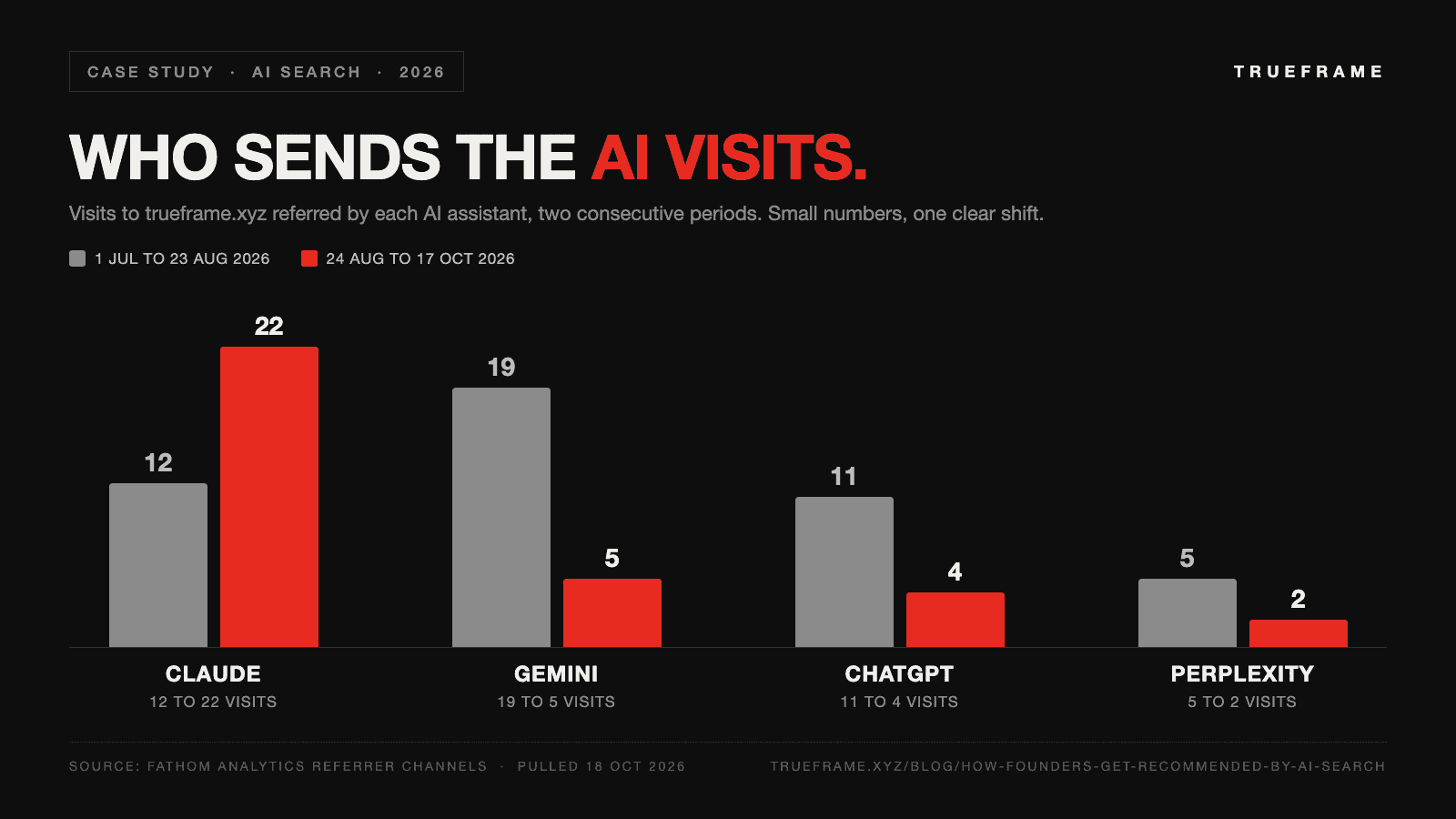
Swipe sideways to inspect the full graphic.
Thirty-three visits is a rounding error next to the 1,246 organic search visits in the same window. The reason we care is who the 33 are. One of the 22 Claude visits was the operator in Bali, and she bought on the first call. Search visitors are often still comparing. A visitor who arrives because an assistant already shortlisted you is further along.
Which AI engines cite Trueframe, and for which questions?
The method: we wrote 30 prompts in the words buyers actually use, grouped into six families (agency by geography, done-for-you founder video, tech and AI founders, pricing and worth, entity questions about us, and niche topics we publish on). On 18 October 2026 we ran all 30 through the Perplexity and Gemini APIs with web grounding on, saved every answer and its cited URLs, and marked a prompt as cited if trueframe.xyz appeared in the citations. We also checked the generic US and UK agency prompts and the entity prompt by hand, logged out, in ChatGPT search.
Two limits to declare up front. Ten of the 30 Gemini prompts hit the API's free-tier quota and returned no answer, so the Gemini numbers below are out of the 20 that did. And we could not run a clean, neutral Claude panel this round, because consumer Claude answers are personalised to the account asking. Claude's evidence in this post is the Fathom referral data, the Bali buyer, and where Brave Search ranks our page.
| Engine | Prompts answered | Cited trueframe.xyz | Not cited | Ranked first |
|---|---|---|---|---|
| Perplexity (API) | 30 of 30 | 11 | 19 | 3 prompts |
| Gemini (API, grounded) | 20 of 30 (10 hit the free-tier quota) | 6 of the 20 answered | 14 | 1 prompt (one more at rank 2) |
| ChatGPT (manual, logged out) | US, UK and entity prompts | 0 (entity answer drew on LinkedIn and benchuchu.com) | US and UK agency prompts | 0 |
| Claude | No neutral panel this round (consumer answers are personalised) | Evidence: 22 Fathom referrals, the Bali buyer, Brave position ~11 | n/a | n/a |
The Perplexity result is the one with enough answers to read a pattern, so here is where the 11 citations landed by prompt family.
| Prompt family | Prompts | Cited | Example prompt and result |
|---|---|---|---|
| Agency by geography (US, UK, Australia, Singapore) | 5 | 0 | 'best personal branding agencies in the US for founders': five listicle domains cited, none of them us |
| Done-for-you founder video | 4 | 2 | 'done-for-you video content agency for founders': rank 3 |
| Tech, AI and SaaS founders | 4 | 2 | 'personal branding agency for tech founders': rank 1, cited /personal-branding-for-tech-founders |
| Pricing and worth | 4 | 2 | 'content agency vs in-house video editor for founders': cited our comparison post |
| Entity (who is Trueframe) | 3 | 3 | 'Trueframe agency reviews': rank 1, but flagged our reviews as self-hosted |
| Niche topics we publish on | 10 | 2 | 'what is the Kumar Method': cited. 'how to write a VSL script': not cited |
For the tech-founder prompt, Perplexity wrote that Trueframe is the clearest niche fit because the page says, in those words, personal branding agency for technical founders. That is the whole mechanism in one sentence. The engine quoted our H1 back as its reason.
Gemini cited us in 6 of the 20 prompts that returned an answer: rank 1 for 'personal branding agency for tech founders', rank 2 for 'best done-for-you video content agency for B2B SaaS founders', plus 'how should a technical founder build a personal brand' and all three entity prompts about Trueframe and me. Same shape as Perplexity: specific prompts with a specific page behind them, and nothing on geography. Gemini also cited trueframe-software.com and trueframestudio.studio alongside us on two entity prompts, so the name collision is not a Perplexity quirk.
Why do the geography prompts fail on every engine?
Because the engines don't answer 'best agencies in the US' from agency websites. They answer it from lists. Perplexity's citations for that prompt were 1dscollective.com, kalamkagaz.com, amworldgroup.com, ohhmybrand.com, brand-professor.com, 50pros.com and a few more. Every one is a 'top personal branding agencies' listicle. Gemini used a near-identical set. Logged-out ChatGPT did the same for the US and UK prompts and did not list us.
Across the 30 Perplexity answers, linkedin.com was cited in 14 and trueframe.xyz in 11. The next most cited domains were listicle publishers, each appearing in five or six answers. If you want the generic list prompt, you need to be on the lists. We are not, and we have not decided whether paying for those placements is worth it. Our own page cannot win that prompt on its own.
Perplexity's answer to 'Trueframe agency reviews' made the same point from the other side. It ranked us first, then wrote that the strongest evidence comes from Trueframe's own site and is not independent third-party verification. It also warned the reader not to mix us up with TrueFrame Roofing or a UK company called TrueFrame Ltd on Trustpilot. Both are fair. Both go on the fix list.
What did ChatGPT get wrong about us, and what does it teach?
When we asked logged-out ChatGPT 'who is Benjamin Chua', it pulled from my LinkedIn profile and the benchuchu.com domain, then repeated a figure of 100 million impressions that it found on our LinkedIn company page. We cannot verify that number from any analytics export we hold. It should never have been on the page. We are removing it.
This is the entity hygiene lesson. AI engines do not fact-check you. They repeat what your own profiles say, with your name attached, to a buyer who is deciding whether to trust you. Every claim on every surface you control has to trace to a source you can produce on a call. We keep ours in a single proof file and check website copy against it. The LinkedIn company page had drifted from that file. Now it gets audited with the rest.
What do we think made it work, and how sure are we?
Four things were in place on the site before the audit. We cannot date each one precisely from the records we hold, we cannot isolate them from each other, and we did not run a control. Here is each one with the evidence we have and the confidence we put on it.
| Change | What we did | Evidence it mattered | Confidence |
|---|---|---|---|
| Dedicated ICP pages | One page per buyer question, e.g. /personal-branding-for-tech-founders, with the question as the H1 and a plain answer first | The page Perplexity ranked first for the tech-founder prompt. Search Console shows AI-style queries landing top 3 on it | High |
| FAQPage and Organization schema | JSON-LD on every page: who we are, what we do, question and answer pairs | Google stopped showing FAQ rich results on 7 May 2026. No engine confirms using the markup. Cheap to keep | Low |
| llms.txt | A Markdown index at /llms.txt of our offer, pages and case studies, updated 25 Sep 2026 | No engine has stated it reads the file. Zero visits traceable to it | Low |
| AI-crawler allow list | robots.txt allows GPTBot, OAI-SearchBot, ChatGPT-User, ClaudeBot, Claude-SearchBot, Claude-User, PerplexityBot, Perplexity-User, Applebot-Extended, Bytespider, Meta-ExternalAgent | Necessary, not sufficient. Blocking Claude-SearchBot or OAI-SearchBot removes you from those search features per each vendor's docs | High that it is required, none that it helps on its own |
The ICP page evidence is the strongest because it shows up in more than one place. Perplexity cited it and quoted its H1 as the reason. Gemini cited the blog post that sits behind it. And Search Console shows long, conversational queries landing on it near the top: 'recommend a personal branding agency for a technical founder' at average position 2.5, 'best companies to build a positive online presence for a founder before fundraising' at 1.8, 'best personal branding agencies for tech founders 2025' at 1.7 across 22 impressions. Those read like prompts, not keywords. Several show impressions with zero clicks, which is what you would expect if a machine read the result rather than a person.
Two gaps we found on the way. Bing Webmaster Tools showed about 54 pages indexed against roughly 130 in our sitemap, and ChatGPT search leans on Bing's index. Brave Search, which Claude's web search has been shown to use, had the tech-founder page at around position 11 for its own target query. Both are fixable and both are on the list before we claim any of this is finished.
A note on the video. The 30-prompt panel is a small script that calls each engine's API, stores the answer and the cited URLs, and writes the yes/no table above. It runs from Claude Code, which is the setup in that video. You do not need the code to run the audit by hand; the worksheet below does the same job with a browser and a spreadsheet.
Want us to run this audit on your name and your category?
Book a fit call. We will look at your pages, your profiles and your prompts, and tell you honestly whether a content engine would pay back for you, or whether you should fix the basics yourself first.
What is the playbook a founder can copy this month?
Five steps, in the order we would do them again. None needs a developer except step four.
1. Build a prompt panel from real buyer language
Pull 15 to 30 prompts from your sales calls, inbound emails and Search Console query report, not from a keyword tool. The Bali buyer typed a sentence, not a keyword. Group them: geography, your category, your buyer type, pricing, your name, your niche topics. Run each prompt logged out in ChatGPT, Claude, Perplexity and Gemini on the same day, and record cited or not, rank, and which domains were cited instead of you. Re-run monthly. The engines change, and so should the panel.
2. Make every surface say the same thing
Write one 40-word description of who you are, who you serve and where you are based. Put the same words on your homepage, your about page, your LinkedIn company page, your personal LinkedIn, your Google Business profile, Crunchbase and every directory that lists you. Check for name collisions and add a disambiguating line if another company shares your name. Then audit every number on every profile against a source you can produce. Delete what you cannot source.
3. Get onto the third-party lists, or accept the trade
For list-style prompts the engines cite listicles and directories, so your own site cannot win them alone. Find the five domains the engines cited for your category prompt and work out what it takes to be on each. Some are editorial, some are paid, some are review platforms. Independent reviews on a platform you do not control also answer the 'self-hosted testimonials' objection Perplexity raised about us. If you decide the placements are not worth it, say so and aim the panel at specific prompts instead.
4. Publish one page per buyer question, answer first
The page Perplexity ranked first has a structure we now repeat: the buyer's question as the H1, a two-sentence plain answer under it, three to five criteria the buyer should use, one recommendation, a short 'why this over the alternative', and proof with dates. Every H2 is a question a buyer would ask. Add Organization and FAQPage schema and an llms.txt file because they are cheap, and keep your robots.txt open to the search crawlers each vendor documents. Then check Bing Webmaster Tools and Brave for the page, because that is where ChatGPT and Claude read from.
5. Measure claude.ai and chatgpt.com referrers through to booked calls
In your analytics, filter referrers for claude.ai, chatgpt.com, perplexity.ai and gemini.google.com and look at them monthly. Expect small numbers and undercounting, because an answer that names you without a link sends nothing. Add 'how did you hear about us' to your booking form with an AI assistant option, and tag your booking links so a call can be traced back to the page that earned it. Count calls and closed clients, not visits. One of our 22 Claude visits became a client. The other 21 are a number.
“Finally found a team after going through 6 terrible agencies.”
Robert found us the slow way, after six agencies that didn't work. His pipeline came from podcast clips and founder content we produced, not from AI search, and I want to be precise about that. The reason his quote belongs here is what it says about the buyer's job. Picking an agency is the hard part. AI assistants now do the first cut of that job for buyers, and the pages they read are the ones that decide whether you are in it.
When is this not worth your time?
If you have no page that answers a specific buyer question, no proof you can date and source, and no booking path, fix those first. AI visibility work on top of a weak site sends a machine to read a weak site. If your category is so broad that every prompt is a list prompt, the listicle route matters more than anything on your own domain. And if you need leads this month, this is the wrong lever. Claude was sending us a dozen visits a period by July and August. The first client we can trace to it came in October.
What we would do again without hesitation: one page per buyer question, written answer first, with proof we can defend. Everything else in the table above is maintenance we are happy to do because it is cheap, not because we can prove it moved the needle.
The scorecard we tell buyers to run on any agency, including us. Useful alongside the prompt panel, because the engines are shortlisting against these same criteria.
Read the guideThe post Perplexity and Gemini cited for 'how should a technical founder build a personal brand'. The positioning that makes the pages above work.
Read the postRelated guides
Sources and review date
Primary sources, first-party data and review dates are listed below. Client-reported results and Trueframe analysis are labelled in the article.
- Does Anthropic crawl data from the web, and how can site owners block the crawler? · Anthropic Help CenterReviewed 18 October 2026
- Overview of OpenAI crawlers (GPTBot, OAI-SearchBot, ChatGPT-User) · OpenAIReviewed 18 October 2026
- Perplexity crawlers (PerplexityBot, Perplexity-User) · PerplexityReviewed 18 October 2026
- The /llms.txt file proposal · Jeremy Howard, llmstxt.orgReviewed 18 October 2026
- Google Search Central updates: deprecating the FAQ rich result feature (May 2026) · Google Search CentralReviewed 18 October 2026
- Anthropic use Brave for Claude's web search · Simon WillisonReviewed 18 October 2026
Skip the reading. Talk it through instead.
Book a fit call and we'll map out what a content engine looks like for your business. No pitch, no pressure.
Don't miss the next one
Some of what we share is time-sensitive. A format that's working right now, a window that closes fast. We email those the moment they're worth jumping on. Drop your email so you catch them in time.
No spam. Unsubscribe anytime.
Frequently asked questions
How do AI assistants like ChatGPT and Claude decide which agency to recommend?
Does llms.txt help you get cited by AI search?
Does FAQ schema still matter now that Google dropped FAQ rich results?
How do I measure traffic from ChatGPT, Claude and Perplexity?
Why does Claude recommend smaller agencies more than ChatGPT does?
How long does it take to start showing up in AI answers?
Founded & led by
Benjamin Chua (BenChuchu)
Founder and CEO of Trueframe. 9 years building businesses (started at 16), tens of millions of views generated, and 8 figures in revenue created for the founders and brands he works with. He builds the content systems Trueframe runs.