After an Alex Hormozi Scaling Workshop: Your 30-Day Marketing Plan
You came back with a list of ideas and one priority: marketing. Here's how I'd turn that into a single test with an owner, a budget and a decision date, with the worksheet I'd use to run it.

Written by Benjamin Chua, founder of Trueframe.
On this page
- How do I write a marketing constraint I can actually test?
- Which funnel stages should I define before I compare numbers?
- How do I read my baseline without fooling myself?
- How do I work backwards from the customers I can deliver?
- What goes into the campaign brief?
- How much cash and time should the test get?
- What should each of the four weeks do?
- Week one: establish the baseline and prepare
- Week two: launch and inspect the real path
- Week three: review quality and remove friction
- Week four: decide
- What happened when we ran this for a client?
- How do I keep the sales handoff inside the plan?
Your first 30 days after a Scaling Workshop should produce one thing: a single marketing test with a written constraint, one owner, a cash limit and a decision date. Choose one commercial problem, make the evidence visible, run the test for four weeks, then continue, change or stop based on what you saw.
The short version
- Write the constraint as a statement you could prove wrong.
- Define your funnel stages before you compare any numbers.
- Read one cohort through time. Keep open opportunities visible.
- Work backwards from the customers you can deliver, and call it a planning model, not a forecast.
- Give the test one audience, one message, one next step, a cash limit and a stop owner.
- Use week four to decide. Inconclusive is a valid result.
A long list of ideas can make the business feel busy without changing how customers arrive. The work starts when you decide which idea deserves time, what it's supposed to improve and what result would make you change course.
If you've worked through Alex Hormozi and Acquisition.com's Scaling Roadmap, or come back from a Scaling Workshop, and marketing came out as your constraint, this guide turns that priority into a working plan. Start with the recommendation that applies to your business, then define the evidence, the owner, the budget and the next decision.
I've received advisory from the Acquisition.com team for my own business. This guide brings that business-owner perspective to the implementation work we do at Trueframe. It's my independent guidance, not an official Acquisition.com resource or an endorsement of Trueframe. The planning examples below are fictional unless I name the client.
This guide starts after the diagnosis. If you haven't yet worked out whether your problem is reach, conversion or the sales handoff, the marketing strategy guide below walks through that first, with a symptom table and the full video course.
The decision tree I use before any campaign: check capacity, find the drop-off, separate reach from conversion, then investigate the weak stage.
Read the strategy guideBenjamin Chua
Post-workshop implementation worksheet
5
printable pages
PDF · Version 1.0 · Updated Oct 2026
The One-Constraint Marketing Plan
Write the constraint, define your stages, read one cohort, budget cash and time, and record a continue, change or stop decision at day 30.
- A constraint statement and stage-definition table
- A cohort baseline you can read without fooling yourself
- A work-backwards planning table and a cash and time budget
- A four-week plan and a day-30 decision record
How do I write a marketing constraint I can actually test?
Write it as a statement someone could prove wrong. "We need more marketing" doesn't name a job anyone can finish. This does: "We have room for three new implementations next quarter, but too few suitable buyers reach a sales conversation. We think our current message attracts companies that are too small."
That sentence names a capacity limit, an observed problem and a possible explanation. It can still be wrong. Treat the explanation as a hypothesis until the evidence backs it.
Before you spend to create more inquiries, check what happens after one arrives. If suitable buyers wait five days for a reply, the handoff matters more than reach. If you can't deliver another sale responsibly, the next project belongs in operations, not marketing.
Write the business consequence next to the marketing symptom. "Low video views" only matters if those views sit on a credible path to the customers you need. A popular video can produce zero suitable inquiries. A modestly viewed explanation can help an existing prospect decide.
Which funnel stages should I define before I compare numbers?
Define the stages your business actually records, in plain words, before anyone shows you a percentage. Don't build a complicated funnel nobody will maintain. Here's the set I use.
| Stage | Working definition |
|---|---|
| Engaged inquiry | A unique person asked a relevant question or requested contact. A view is not an inquiry. |
| Booked conversation | A meeting is scheduled with that person. Reschedules stay the same opportunity. |
| Shown conversation | The meeting happened. |
| Qualified opportunity | Your fit conditions are met and there's a plausible buying decision. |
| Won opportunity | Your defined acceptance or contract event occurred. |
| Collected cash | Payment arrived. Keep this separate from a signed agreement. |
| Delivery capacity | How many more customers you can serve well in the stated period. |
Qualification belongs to your offer. It might include the relevant problem, business size, authority, budget fit and timing. Don't change the definition because this month's numbers look disappointing.
Keep a separate field for source, including "unknown". A buyer may first find you through content, later click an ad and finally mention a referral. Preserve those observations instead of forcing them into one tidy story.
How do I read my baseline without fooling myself?
Follow one cohort through time. A cohort is a group defined by the same starting period or event, such as inquiries first received in June. Google Analytics defines a cohort the same way: users who share a common attribute such as acquisition date. Following that group stops you comparing this month's inquiries with sales from much older conversations.
Suppose 20 qualified opportunities entered in June. By the end of September, five had won, ten had closed without a sale and five were still open. Five out of 20 is the won share to date. Five out of 15 decided opportunities is a different denominator. Neither number tells you how the five open ones will finish.
Keep the counts and their dates visible. Compare groups that have had a similar chance to progress. If sales usually take 90 to 180 days, a 30-day test can establish implementation and early responses. It can't establish the final close rate.
A big percentage drop between stages is a prompt to investigate, not proof that you found the constraint. Check the absolute number of people affected, the value of fixing it, the effort required and whether that stage is even measured consistently. Five missed meetings may deserve attention today. A low click rate on a tiny experimental audience might not.
How do I work backwards from the customers I can deliver?
Use a planning model to expose what has to be true, then replace its assumptions with your own evidence as it arrives. Consider a fictional implementation firm that can take three more customers. It assumes 25% of qualified opportunities become customers, 70% of attended conversations qualify and 70% of booked conversations are attended.
| Planning step | Arithmetic | Rounded requirement |
|---|---|---|
| Qualified opportunities for three wins | 3 divided by 0.25 | 12 |
| Attended conversations for 12 qualified | 12 divided by 0.70 | 18 |
| Bookings for 18 attended | 18 divided by 0.70 | 26 |
Round up, because a fraction of a conversation can't fill the plan. These assumptions don't guarantee three customers. Small samples, different buyers and longer sales cycles can produce very different results.
The firm still needs an evidence-based assumption for how inquiries become bookings and how it will generate those inquiries. If it lacks that evidence, the first test should help estimate it. Don't invent a traffic target just to complete the spreadsheet. And include a downside case: if fewer people attend or qualify, can you afford to keep learning? If not, choose a smaller test or a channel with less upfront commitment.
What goes into the campaign brief?
One audience, one message, one next step. Start with recent customers whose problem you understand and whose work you deliver well. Review why they bought, what nearly stopped them and what they needed to believe before committing. Use authorized material and strip private details from anything public.
Pick one segment for the test. "Business owners" is too broad to guide a useful example. "Established service firms losing time to manual client onboarding" gives you a problem to explain and a reason for the right person to pay attention.
Write the promise in terms you can support. Hormozi's value equation in $100M Offers is a useful check here: the buyer weighs the outcome and how likely they think it is against the time it takes and the effort it costs them. Show what the service does, the conditions it needs and who should choose another approach. An exaggerated outcome may increase inquiries while reducing their usefulness.
Choose a next step that fits the buying decision. A complex service may need a fit conversation. A clear, low-friction purchase may not. Keep that path consistent across the ad, the content, the page and the team's response. A designer or editor should be able to understand who the work is for without sitting in every sales meeting.
How much cash and time should the test get?
A media budget covers one part of the work. Count preparation, page changes, creative production, management and the time spent handling inquiries. Separate what's paid externally from what uses existing staff capacity.
Here's a fictional four-week cash budget in US dollars. The campaign launches on day eight and runs through day 28, which gives it 21 live days.
| Item | Planned cash |
|---|---|
| Media, US$50 per day for 21 days | US$1,050 |
| External creative production | US$500 |
| Page changes | US$300 |
| Campaign setup and management | US$400 |
| Reserved contingency, unspent unless needed | US$250 |
| Maximum authorized cash | US$2,500 |
Planned spend before contingency is US$2,250. The firm also allocates 12 internal hours across preparation, approvals and inquiry handling, tracked separately. Those hours aren't free just because they don't appear on a supplier invoice.
Set a spending stop and name the person who enforces it. Don't quietly extend the campaign because the first result was inconclusive. Later, calculate acquisition cost from a clearly defined cost total and customer cohort. Media-only cost per customer and fully loaded cost answer different questions. If customers haven't closed yet, report spend and open opportunities instead of dividing by hoped-for sales.
Watch when cash actually arrives, too. A signed contract with payment due later doesn't fund today's campaign. Payback depends on collected contribution after delivery costs, not headline contract value.
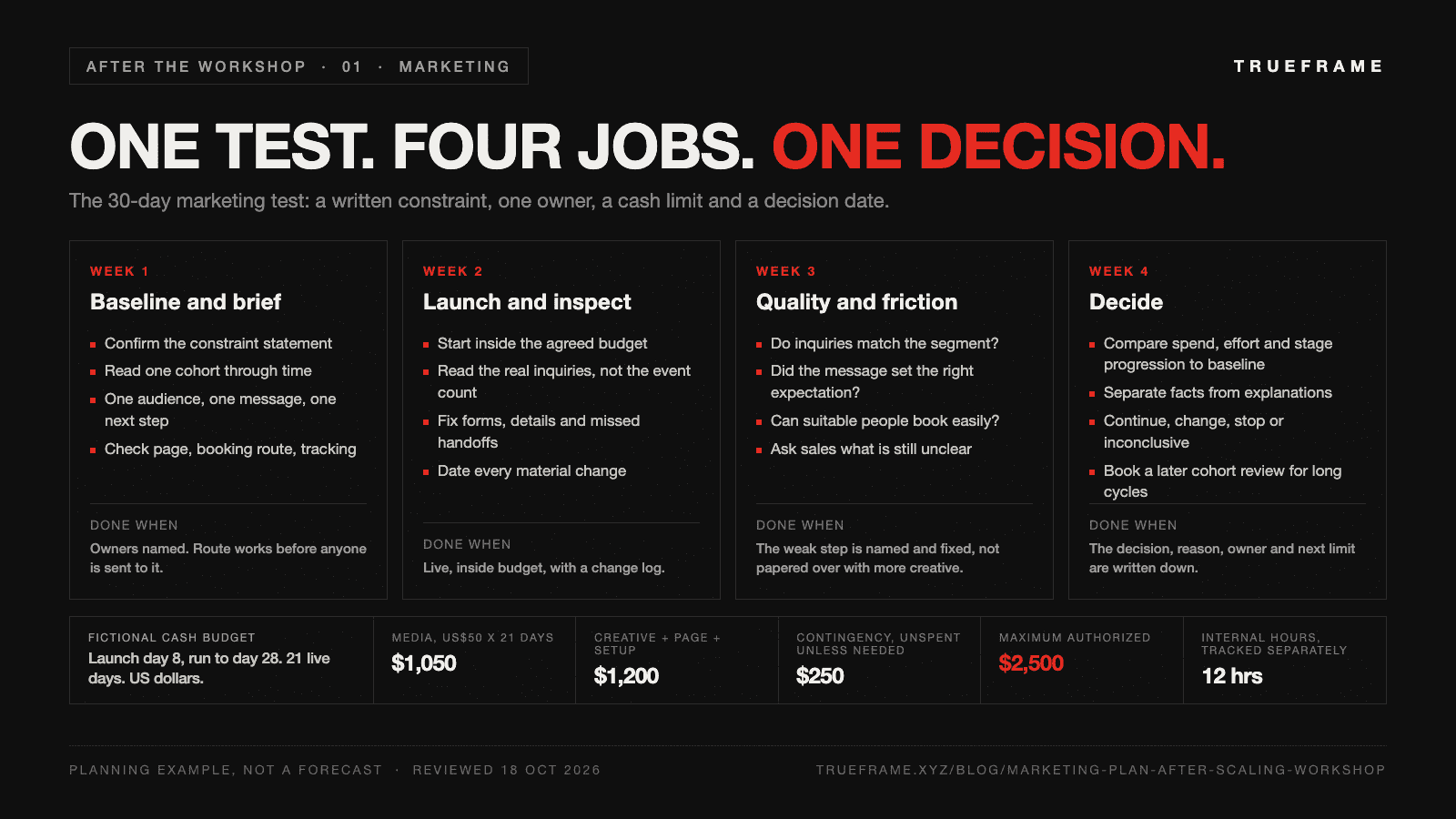
Swipe sideways to inspect the full graphic.
What should each of the four weeks do?
Week one: establish the baseline and prepare
Confirm the constraint, read the relevant cohort and write down the current buying path. Assign the campaign owner and the person who handles inquiries. Check that the page, booking route and tracking work before you send anyone there. Prepare one clear message with enough creative variation to communicate it well. Don't change the audience, offer, price and sales process at the same time if you want to understand what caused the result.
Week two: launch and inspect the real path
Start inside the agreed budget. Look at actual inquiries, the information they contain and how the team responded. A tracking event doesn't prove a suitable person reached a useful conversation. Fix broken forms, wrong details and missed handoffs fast, and record each material change with its date so the review doesn't treat every day as the same test.
Week three: review quality and remove friction
Read the questions people ask. Do they match the intended segment? Did the message set the right expectations? Ask the sales owner what still confuses people on calls. If most inquiries are unsuitable, look at targeting, message and qualification. If suitable people arrive but can't book easily, fix that step. More creative output won't solve either problem on its own.
Week four: decide
Compare actual spend, effort, inquiries and stage progression against the baseline and the hypothesis. Separate implementation facts from possible explanations. Continue when the evidence supports the direction and you can afford the next observation period. Change the test when a specific mismatch is visible. Stop when the economics, fit or delivery capacity make continuing unreasonable.
"Inconclusive" is a valid result. Write down what remains unknown, what evidence would resolve it and how much more time or money you're willing to commit. For a long sales cycle, schedule a later cohort review while keeping the original acquisition window intact.
What happened when we ran this for a client?
Mohsen Ashraf publishes mythology graphic novels under Pantheon Myths. He came to us in May 2026 after trying content himself and trying other specialists. Sales were low, engagement was low, and he told us he was close to burning out on it.
The constraint wasn't "more content". His earlier posts had no purchase path and no direct ask, so attention never turned into orders. We locked one audience and message for the first test, scripted and edited a batch of shorts he filmed himself, built the purchase path, then ran small Meta tests at a fixed daily budget per ad set so a weak angle couldn't quietly eat the month. Each test had a budget, an owner and a review date.
“I went from virtually no sales to predictable sales every week. Within 10 days, I had 60 sales of my book.”
Those are his words from his testimonial, recorded in August 2026. Sixty book sales in ten days came from the whole system working together: the purchase path, the direct ask, the scripts, the edits and the ads. I can't tell you which part did what, and I won't pretend to. What I can tell you is that it only became measurable because we defined the stages and the budget before the first dollar went out.
Want a second pair of eyes on your constraint statement?
Bring the statement and your current buying path to a fit call. We'll look at your situation and tell you honestly whether an Installed Founder Content Engine would pay back, or whether the constraint sits somewhere we don't fix.
How do I keep the sales handoff inside the plan?
Name the person who receives each inquiry, the response expectation and the backup when they're unavailable. Decide where notes go and how an opportunity gets marked unsuitable, open, lost or won. Marketing and sales should share one qualification definition, or the marketing report will celebrate leads while sales describes a completely different group of people.
Review repeated objections with context. "Too expensive" might mean poor fit, weak explanation, bad timing or a real pricing problem. One phrase isn't enough to choose the remedy.
If content production is the constraint, outsourcing can help once the audience, offer and responsibilities are clear. It still needs source material, approvals and someone who owns the buying path. Compare providers on that work, and be honest about whether paid reach or organic content is the right first lever for your cycle.
The scorecard we'd want you to run on any agency, including us: fit, process, proof, ownership and what the founder actually has to do each month.
Read the agency guideWhen each one earns the first test budget, and why the answer depends on your offer, proof and sales cycle rather than on what's fashionable.
Compare the twoRelated guides
- Content is your constraint after the workshop? The implementation guide
- Branding is your constraint after the workshop? Positioning and proof
- How to build a marketing strategy, with the full video course
- Why content gets views but no sales, and what to check
- Content intensive vs monthly retainer: which model fits
- Founder content built around the buyer's decision
Sources and review date
Primary sources, first-party data and review dates are listed below. Client-reported results and Trueframe analysis are labelled in the article.
- Scaling Workshop · Acquisition.comReviewed 18 October 2026
- Get Your Free Personalized $100M Scaling Roadmap · Acquisition.comReviewed 18 October 2026
- $100M Offers: How To Make Offers So Good People Feel Stupid Saying No · Alex Hormozi, Acquisition.comReviewed 18 October 2026
- Cohort exploration · Google Analytics HelpReviewed 18 October 2026
- How to Build a Marketing Strategy That Actually Gets Customers · Benjamin ChuaReviewed 18 October 2026
Skip the reading. Talk it through instead.
Book a fit call and we'll map out what a content engine looks like for your business. No pitch, no pressure.
Don't miss the next one
Some of what we share is time-sensitive. A format that's working right now, a window that closes fast. We email those the moment they're worth jumping on. Drop your email so you catch them in time.
No spam. Unsubscribe anytime.
Frequently asked questions
What should I do first after an Alex Hormozi Scaling Workshop?
How do I know if marketing is really my constraint?
Can I judge a marketing campaign after 30 days?
How much should I budget for a first marketing test?
What if we have no reliable historical conversion data?
Should I implement every workshop idea at once?
When does hiring a content agency make sense after a workshop?
Founded & led by
Benjamin Chua (BenChuchu)
Founder and CEO of Trueframe. 9 years building businesses (started at 16), tens of millions of views generated, and 8 figures in revenue created for the founders and brands he works with. He builds the content systems Trueframe runs.