Branding Is Your Constraint After an Alex Hormozi Workshop? The Complete Implementation Guide
You know who you want to serve, but your public message still sounds like everyone else's. Here's how I'd turn a branding priority into positioning your team can use, proof a buyer can inspect and an offer page that does the explaining for you.

Written by Benjamin Chua, founder of Trueframe.
On this page
- What are buyers actually misunderstanding?
- How do I write positioning my team can use?
- How do I interview buyers without leading them?
- How do I match each claim to evidence?
- How do I turn positioning into an offer page?
- A headline that identifies the work
- Scope the buyer can inspect
- Evidence beside the relevant claim
- A next step with a clear purpose
- How do I compare alternatives without inventing weaknesses?
- Which explanations should sales have ready?
- What happened when we ran this for a client?
- How do I keep the founder's voice and the company's promise aligned?
- How do I check the page works before I measure conversion?
If branding is your constraint after a Scaling Workshop, the job is to make your expertise, offer and proof clear to the buyer you want. Write down what they need to understand before they can choose you, match every claim to evidence, turn that into an offer page and a short set of sales explanations, then test comprehension with fresh readers before you measure conversion.
The short version
- Find the specific misunderstanding before you change anything visual.
- Write one positioning sentence your team can use, with boundaries.
- Interview buyers without feeding them the answer.
- Match each claim to evidence, and write the fallback wording now.
- Build the offer page around the buyer's questions, with proof beside each claim.
- Turn repeated objections into sales assets.
- Test comprehension before you claim conversion improvement.
You've worked through Alex Hormozi and Acquisition.com's Scaling Roadmap, or come back from a Scaling Workshop, and branding came out as a priority. The next job is making your expertise, offer and proof clear to the people you want to buy from you.
I've received advisory from the Acquisition.com team for my own business. This guide applies my own content and positioning perspective at Trueframe to the work that follows: clarifying the message, building the offer page and giving buyers evidence they can inspect. It's independent Trueframe guidance, not an official Acquisition.com resource or an endorsement of Trueframe. Clearline, the consultancy in the examples, is fictional.
Start by writing down what a buyer needs to understand before they can choose you. Who do you help? What do you actually do? What makes your approach suitable for their situation? What evidence can they inspect? Those answers become a clear offer page and a small set of explanations your sales team can use. That gives the branding work a concrete job.
This guide is about the message and the proof. If your real problem is that the right people never encounter you at all, that's a reach problem, and the marketing guide below is the better starting point.
Why a technical founder's public explanations do the sales team's first job, and what that means for what you publish.
Read the founder brand guideBenjamin Chua
Post-workshop positioning worksheet
5
printable pages
PDF · Version 1.0 · Updated Oct 2026
The Positioning and Proof Worksheet
Document the misunderstanding, write the positioning sentence, check every claim against evidence, draft the offer page and test comprehension with fresh readers.
- A misunderstanding log with dated evidence
- The positioning sentence template with boundaries
- A claim-to-evidence table with narrower fallback wording
- An offer-page outline and an objection-to-asset map
- A comprehension test and review record
What are buyers actually misunderstanding?
"People don't understand our value" is a starting observation. Find out what they misunderstand. Read recent inquiries and sales notes and look for the exact questions people repeat. A prospect asking whether you sell software or implementation has a different problem from someone asking why your implementation costs more. The first needs a clearer description of the service. The second may need scope, evidence, a comparison or a different offer. A new logo won't answer either.
| What you observe | What to check next |
|---|---|
| Relevant prospects can't explain what you sell | Category, headline and service description |
| People understand the service but doubt you can deliver | Evidence, qualifications, examples and delivery process |
| Inquiries keep coming from businesses you can't help | Audience language, distribution source and qualification |
| Buyers understand and want it, but can't afford it | Audience fit, terms and economics |
| The right people rarely encounter you | Distribution and demand generation |
| Customers get a different experience from the promise | Delivery, and the accuracy of the promise |
These are prompts to investigate, not a diagnosis from one comment. A warm referral may already trust you. Their understanding doesn't prove a cold visitor sees the same thing. Choose one recurring misunderstanding you can document. "Five recent prospects asked whether we only advise or also implement" is useful. "Our brand feels weak" leaves everyone guessing.
How do I write positioning my team can use?
Start with an internal sentence: we help a specific buyer in a specific situation with a defined job, through a service or approach, with evidence and relevant limits. This is a working brief. It doesn't have to become your headline word for word.
Consider Clearline, a fictional operations consultancy. Its first draft says: "We help ambitious businesses scale through operational excellence." An owner can't tell whether Clearline sells software, coaching, recruitment or implementation. "Ambitious" does nothing to explain fit.
We help founder-led service businesses replace a fragmented client-onboarding process with a documented workflow in their existing tools. We map the handoffs, configure the agreed process and train the people responsible for using it.
Clearline's revised internal positioning sentence (fictional example)
That still needs boundaries. Does Clearline migrate old records? Does it write custom software? Who checks whether the process is followed after handover? Settle those before making the public promise. And choose an audience narrow enough that the work makes sense. Two businesses in different industries might share the same onboarding problem. Two in the same industry might need completely different help.
Hormozi's value equation from $100M Offers is a useful lens for the sentence. The buyer weighs the outcome they want and how likely they believe it is against the time it takes and the effort it asks of them. A positioning sentence that names the job, the approach and the buyer's own responsibilities is already answering three of those four.
How do I interview buyers without leading them?
Interview a few recent suitable customers and, where you can, prospects who chose something else. You're collecting language and uncovering misunderstandings. A small sample isn't market research. Ask:
- What was happening when you started looking for help?
- What did you consider doing instead?
- What did you initially think our service included?
- What was hard to understand or believe?
- What information helped you decide?
- How would you describe the service to a colleague?
Avoid "Wouldn't a done-for-you solution save you time?" It supplies the answer you want. "What did you expect your team would need to do?" is more useful. The usability researchers at Nielsen Norman Group make the same point about facilitators: the hard part is not influencing the participant by accident.
Record the situation behind each answer. Someone who needed urgent rescue work describes you differently from someone planning ahead. Keep both without forcing one universal message. Ask permission before recording or publishing anyone's words. Internal notes can inform your writing without becoming public testimonials, and a phrase that sounds good still has to describe what you deliver.
How do I match each claim to evidence?
A clear promise gets more useful when the buyer can examine how you support it. For Clearline, "we eliminate onboarding delays" is too broad. A sample workflow can't prove every delay disappears. "We document who owns each onboarding step and configure the agreed handoffs" is narrower and easier to support. Build the claim table before you write the page.
| Proposed claim | Evidence needed | What to say if that evidence is missing |
|---|---|---|
| We cut onboarding time in half | Reliable before-and-after records, definitions, dates and limits for the named example | Describe the workflow work without a numerical result |
| Your team will know what to do | A defined training and handover process, and the actual materials | State the training and documents included, without guaranteeing behavior |
| We work in your existing tools | Supported-tool list and confirmed technical scope | Name supported tools and explain what needs assessment |
| You'll need very little time | A documented client task list and credible time assumptions | List the meetings, access and review tasks the buyer must provide |
Proof has different jobs. A demonstration shows how something works. A project example shows what happened in that situation. A written scope shows what you're agreeing to provide. None of them automatically proves a future financial outcome. Keep source, owner, date and permission beside each asset. Label samples as samples. Redacting a name doesn't automatically make a client record publishable.
The FTC's endorsement guidance is worth reading even if you're not in the US: testimonials must reflect the endorser's honest experience, and an exceptional result needs to say what a typical buyer can expect unless you can show it's representative. If the evidence is weak, reduce the claim or collect better evidence. Confident language doesn't close the gap.
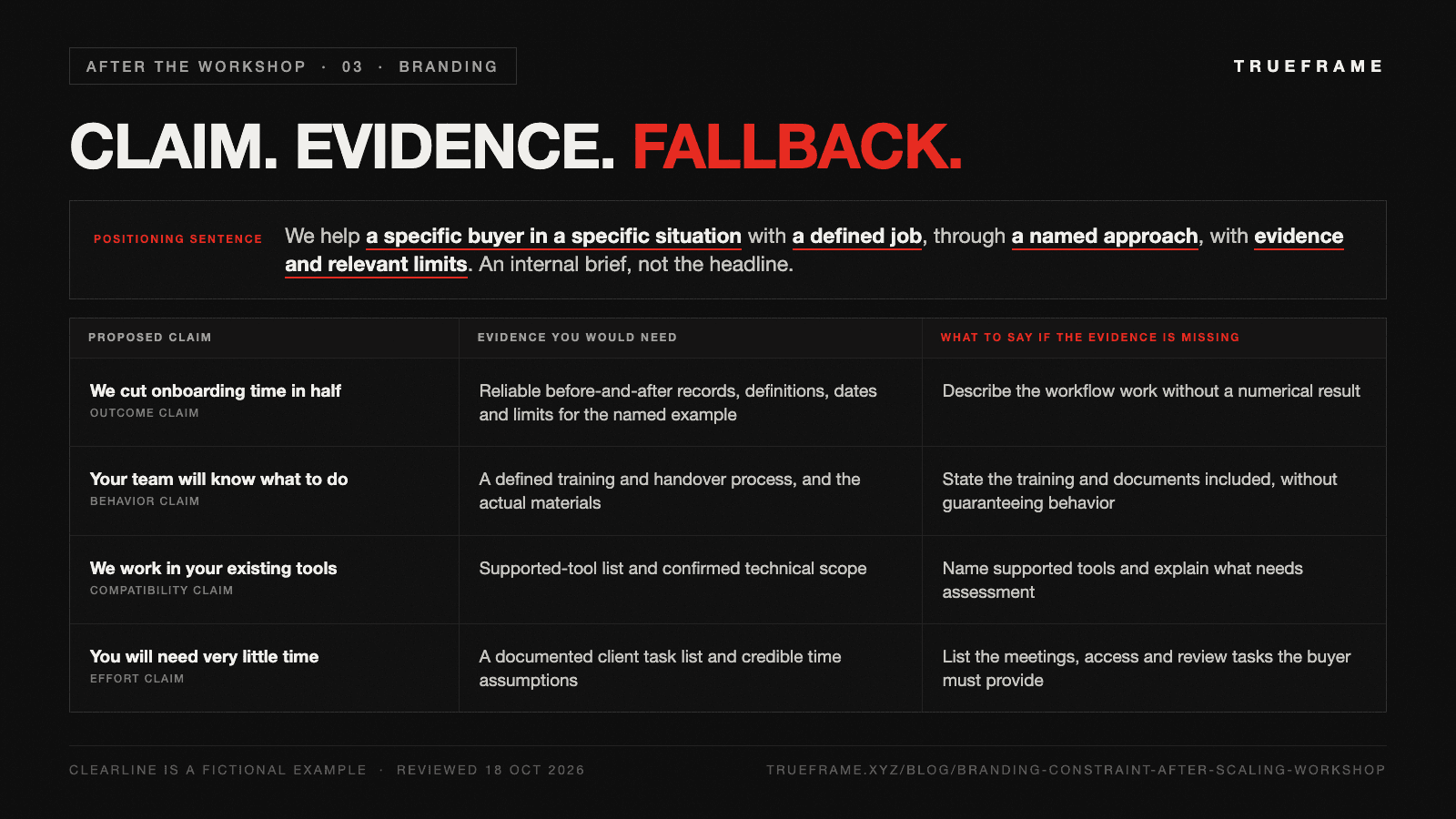
Swipe sideways to inspect the full graphic.
How do I turn positioning into an offer page?
The page should help a suitable buyer decide whether to investigate further. Build it around the questions they need answered, in roughly this order.
A headline that identifies the work
Clearline's fictional starting headline is "Take your business to the next level." A clearer replacement: "Give every new client a clear path from signed proposal to project kickoff." The supporting paragraph then explains the service: Clearline maps your onboarding process, configures the agreed workflow in supported tools and trains your team to run it, for founder-led service businesses whose onboarding currently depends on scattered messages and manual reminders. That describes a job without claiming a system alone guarantees customer behavior or revenue.
Scope the buyer can inspect
Show the stages and tangible outputs: a process map, agreed configuration, documented responsibilities and training. State who supplies access, approves changes and owns the process afterwards. Include exclusions. If custom software is outside the engagement, say so. If the first conversation decides whether the existing tools are suitable, say that before the buyer assumes compatibility. Explain pricing the way your commercial model actually works. A fixed fee can show its inclusions. A scoped project can explain which variables affect the quote. Don't hide a predictable cost behind transformation language.
Evidence beside the relevant claim
Put an example process map near the description of mapping. Put an accurately described project example near the problem it addresses. A wall of unrelated logos gives the reader less to assess. A case study should name the context, the work, the observed result and the limits. If the result could also reflect staffing changes or a new product, keep that uncertainty. A customer quote doesn't remove the need to support your own claim.
A next step with a clear purpose
Say what the conversation covers, what the buyer should prepare and what happens afterwards. Don't promise a full strategy session if the call is a fit assessment. The page is ready for review when someone can explain the service, recognize whether it fits and name the next step without the founder translating.
What a founder's site needs so an interested buyer can understand the offer and take the next step on a phone.
Read the website guideHow do I compare alternatives without inventing weaknesses?
Your buyer may compare you with hiring, doing it internally, buying software or waiting. Ask which alternatives they actually considered. For each, compare scope, internal responsibility, commitment and relevant limits, and verify any named provider's current terms before publishing a comparison.
Avoid "freelancers only execute" or "in-house is always cheaper". Providers differ, and internal cost depends on the people involved. Clearline could explain that its service includes configuring an agreed workflow, while a software subscription provides tools the customer's team configures. That comparison needs the actual subscription scope, and it should admit when a capable internal operator is the reasonable choice. Useful positioning makes a choice easier, including when the choice isn't you.
Which explanations should sales have ready?
Turn the repeated objections into a short asset list. Each asset answers a decision question, with a source and a clear limit.
| Buyer question | Useful asset | Boundary to preserve |
|---|---|---|
| How much work will our team do? | Client responsibilities checklist | Distinguish meetings from preparation and ongoing operation |
| Can this work with our tools? | Supported-tool and assessment guide | Don't imply untested compatibility |
| What happens after handover? | Support and ownership explanation | State the actual support period and exclusions |
| Why hire help instead of doing it ourselves? | Scope and internal-capacity comparison | Acknowledge capable internal alternatives |
Start with the question that shows up in the most relevant conversations rather than producing every format at once. A written guide may be enough. A screen demonstration helps when the buyer needs to see a process. The format follows the explanation.
What happened when we ran this for a client?
Robert Ta is the founder of Epistemic Me, an AI alignment startup. When we started in June 2025 he had zero content presence and a lot of credibility that nobody could see. His first attempt had been street-interview content. It underperformed, and there was no strategy behind it.
The positioning work was deciding what his content had to make a buyer understand, then choosing formats that could carry it. In February 2026 we moved him off street interviews into procedural, how-to content built around the decisions his buyers were facing, and locked a format that led with the explanation. Later that year the scope became a weekly podcast cut into highlights and shorts. Robert went through six agencies before us, so his bar for a team that could hold a consistent message was not low.
“Finally found a team after going through 6 terrible agencies.”
Before working with Ben and True Frame, I was spinning my wheels. I was creating content without strategy. Ben and his team built me a system requiring minimal time from me while generating serious results. I've tracked over six figures in converted pipeline revenue from qualified leads who referenced my specific content as trust building and helpful.
Robert Ta, founder of Epistemic Me, written testimonial
Notice what his buyers did: they referenced specific pieces of content as the reason they trusted him. That's positioning doing its job. He also reported more than 50 B2C leads through the engine, and one format test produced 366 lead-magnet requests, 262 saves and 74 shares. Those numbers came from clips and content, not from a logo. I'd be careful attributing any single deal to any single piece, and so would he. The pattern across the pipeline is the evidence.
Want us to pressure-test your positioning sentence?
Bring the sentence and your claim table to a fit call. We'll look at your offer, your proof and your buyers, and tell you honestly whether an Installed Founder Content Engine would pay back, or whether you should fix the page yourself first.
How do I keep the founder's voice and the company's promise aligned?
Record how the founder explains one real decision. Keep the words that make the explanation specific. Remove statements the business can't substantiate, even when they sound confident on camera. For a technical founder, that often means translating a detailed implementation explanation into the buyer's operational concern while keeping the conditions intact.
Visual identity has a job too. Readable type, consistent layouts and appropriate images make the information easier to use. Make those choices around the message and the audience. A visual refresh alone can't establish missing expertise or fix an unclear service.
How do I check the page works before I measure conversion?
Show the draft to a few people who resemble the intended buyer. Let them read without coaching, then ask what the company sells, who it serves, what the engagement requires and what they'd check next. Write down the misunderstandings before you explain the intended answer. Fix recurring confusion and repeat with fresh readers. This is qualitative feedback, not proof of demand.
When the page goes live, record the date and what changed. Track relevant inquiries, recurring questions and progression through the sales process, with traffic source and audience changes in view. If five calls become seven after a rewrite, the page may have helped. That alone doesn't establish causation. Traffic, referral quality, seasonality or sales handling could explain it. Longer buying cycles need longer observation.
The scorecard to run on any agency, including us: does their process start with your buyer's misunderstanding, and does their proof survive this guide's claim table?
Read the agency guideRelated guides
- Marketing is your constraint? A 30-day plan after the workshop
- Content is your constraint after the workshop? The implementation guide
- How to build a marketing strategy before you rewrite the page
- Founder content built around the buyer's decision
- The full Robert Ta podcast-to-pipeline case study
- Why content gets views but no sales
Sources and review date
Primary sources, first-party data and review dates are listed below. Client-reported results and Trueframe analysis are labelled in the article.
- Scaling Workshop · Acquisition.comReviewed 18 October 2026
- $100M Offers: How To Make Offers So Good People Feel Stupid Saying No · Alex Hormozi, Acquisition.comReviewed 18 October 2026
- Usability Testing 101 · Nielsen Norman GroupReviewed 18 October 2026
- FTC's Endorsement Guides: What People Are Asking · US Federal Trade CommissionReviewed 18 October 2026
- Creating helpful, reliable, people-first content · Google Search CentralReviewed 18 October 2026
- How to Turn Content Into Cash (A Business Owner's Guide) · Benjamin ChuaReviewed 18 October 2026
Skip the reading. Talk it through instead.
Book a fit call and we'll map out what a content engine looks like for your business. No pitch, no pressure.
Don't miss the next one
Some of what we share is time-sensitive. A format that's working right now, a window that closes fast. We email those the moment they're worth jumping on. Drop your email so you catch them in time.
No spam. Unsubscribe anytime.
Frequently asked questions
Do I need a rebrand after an Alex Hormozi workshop?
What is a positioning statement for a founder-led business?
How do I prove my claims on an offer page?
What if we have very few case studies?
Should I put Alex Hormozi's name on my own offer page?
How many buyers should I interview before changing my positioning?
How do I know if the new offer page is working?
Founded & led by
Benjamin Chua (BenChuchu)
Founder and CEO of Trueframe. 9 years building businesses (started at 16), tens of millions of views generated, and 8 figures in revenue created for the founders and brands he works with. He builds the content systems Trueframe runs.