Content Is Your Constraint After an Alex Hormozi Workshop? The Complete Implementation Guide
You've decided content matters. This is how I'd get one useful explanation from buyer question to approved, published piece in 30 days, with the handoffs that stop founder content stalling.

Written by Benjamin Chua, founder of Trueframe.
On this page
- What should the first content cycle actually finish?
- What material do we already have, and can we use it?
- Where does our content actually stall?
- How do I build a buyer-question map before the calendar?
- How do I run an interview that produces usable answers?
- Who owns each handoff?
- What should editing fix first?
- What does the first 30 days look like?
- Where does the finished piece go?
- What happened when we ran this for a client?
- How do I review the first cycle?
If content is your constraint after a Scaling Workshop, build the production system before the content calendar. Take one buyer question through inventory, interview, draft, review, explicit approval and publication in 30 days, with a named owner for every handoff. That single cycle shows you where founder content actually stalls, and it's the process we run for clients.
The short version
- Define what the first cycle will finish. A scheduled post isn't published.
- Inventory the material you already have and mark each item ready, needs review or unusable.
- Trace one stuck piece to find where production actually stops.
- Build a buyer-question map before any calendar.
- Brief a 45-minute interview against that map.
- Give every handoff an owner. Silence is never approval.
- Review the process and the buyer response separately.
You've worked through Alex Hormozi and Acquisition.com's Scaling Roadmap, or attended a Scaling Workshop, and content came out as the thing holding you back. Now you need to turn that conclusion into something your team can actually produce, week after week, without you rewriting every draft at midnight.
I've received advisory from the Acquisition.com team for my own business. At Trueframe, my work is turning founder expertise into content. This guide covers the practical steps from a buyer question to an approved, published explanation, with the worksheet we'd use to run the process. It's independent Trueframe guidance, not an official Acquisition.com resource or an endorsement of Trueframe.
Start by getting one useful explanation through the entire production process. Choose a buyer question, gather the evidence, capture your answer, approve it and put it where the intended buyer can use it. That first cycle will teach you more about the real work than a calendar full of proposed topics.
Use your own roadmap or workshop notes to keep the business priority clear. This guide assumes you've already decided content deserves attention. If your actual problem is delivery capacity or an offer people don't want, more material can wait. The aim for the next 30 days is a working process, not a promise of leads, sales or rankings inside that window.
How content built around the buyer's decision turns into conversations, and why most founder calendars skip that step.
Read the pipeline guideBenjamin Chua
Post-workshop production worksheet
5
printable pages
PDF · Version 1.0 · Updated Oct 2026
The Founder Content First-Cycle Worksheet
Inventory your sources, map one buyer question, brief one interview, assign every handoff an owner and record the first 30-day cycle.
- A source inventory with permission and accuracy status
- A buyer-question map with evidence and intended use
- A 45-minute interview brief
- A handoff table with owners, due dates and an explicit approval record
- A 30-day cycle calendar and a first-cycle review
What should the first content cycle actually finish?
A small, specific result, written down before you assign work. A fictional operations consultancy might aim to publish one guide explaining what a client's team must prepare before an implementation, plus four short answers drawn from the same interview, if each one is useful on its own.
One guide and four short pieces is an illustrative scope, not a quota. One strong guide may be enough when the team is busy or the subject needs careful review.
Write down what "finished" means. The explanation answers the buyer's question, its evidence and wording are approved, it's live at its intended destination, and the people handling sales know when to use it. A recording, an export and a scheduled post are earlier stages. None of them proves the piece is published or usable.
What material do we already have, and can we use it?
Spend up to an hour finding the material most relevant to the first question. Treat the hour as a limit for a first pass, not a mandate to audit the whole business. Look for the current offer description, recurring sales questions, approved examples, recordings, diagrams and unfinished drafts. Record topic, location, date and status for each.
| Material | What to check before reusing it |
|---|---|
| Sales questions | Does the question still come up with the buyers you want? |
| Existing explanation | Does it describe the current offer accurately? |
| Client example | Do you have permission for this specific use? |
| Screenshot or diagram | Is it current, legible and free of confidential information? |
| Performance claim | What source supports it, over what period, with what limits? |
| Unfinished draft | What decision or evidence is holding it up? |
Mark each item ready to use, needs review or unsuitable. Don't send an editor a folder of mixed historical material and expect them to know which version is true. If evidence is missing, narrow the claim or use a clearly labelled hypothetical. A plausible result is still an invented result.
Where does our content actually stall?
Pick one real unfinished piece and follow it through. When was the idea proposed? When did someone supply the source? Who received the draft? What happened next? Keep this short. You're looking for the point where work stopped and the reason.
Maybe the writer never got an answer to the central question. Maybe the founder approved the topic but later rejected the argument. Maybe the edit is done and nobody owns publishing. Those are different problems. Another editor won't fix missing source material. Recording more won't clear an approval queue.
Write a plain diagnosis: "This piece has waited eight days because nobody is authorized to approve the factual example." Then assign the decision and a realistic due date. If you have no previous material, walk a proposed piece through the same steps and ask what each person would need before accepting the handoff.
How do I build a buyer-question map before the calendar?
Choose one buying question and three to five related questions for the first cycle. The number keeps the assignment manageable. It isn't a formula for performance. Our fictional consultancy chooses: "What will implementation require from our team?"
| Buyer question | Useful answer | Source needed |
|---|---|---|
| Who needs to be involved? | Roles and decisions required from the client | Current project process |
| What must we prepare? | A checklist of inputs and access | Approved intake checklist |
| What could delay the work? | Common dependencies and their consequences | Verified process notes |
| What does the consultant handle? | Clear responsibility split | Current agreed service scope |
Now the interview has a purpose. The writer knows which answers must appear. The reviewer knows what to check. Add the intended use beside each item: the preparation checklist might belong on the website and in a pre-call email, while a short explanation of client responsibilities might answer a question in a sales conversation.
Google's people-first content guidance asks the same thing from a different angle: does the page show first-hand expertise and offer original information rather than restating what's already out there? A question map built from real sales conversations is how you get there.
How do I run an interview that produces usable answers?
Give the interviewer the question map and the relevant sources beforehand. Ask them to flag missing information before recording instead of discovering every gap on the call. A 45-minute session could use five minutes to confirm the audience and question, 25 to work through the answers, ten to clarify limits and evidence, and five to agree follow-up material. That's 45 minutes of interview. Preparation, setup, editing and review are separate work.
- "Walk me through what the client's operations manager does before the project starts."
- "Which input causes delays when it arrives late?"
- "What would make this advice unsuitable for a different business?"
- "Which document supports that explanation, and can we show it?"
Ask for concrete examples without pressuring the founder into a dramatic story. A blank checklist or a fictional scenario may teach the process more clearly than a client anecdote you can't share. And if the founder explains better in writing, use written answers or a marked-up outline. The process should help them communicate accurately, not force everyone to talk.
Who owns each handoff?
A shared document or your existing project tool is enough. Record who owns the next step, what they need and when it's due. Here's what each handoff should contain.
| Step | The handoff should contain |
|---|---|
| Research | Buyer question, current sources and evidence gaps |
| Interview | Prompts, approved examples and follow-up questions |
| Outline | Main answer, sequence and claims needing review |
| Editing | Approved meaning, source material and format requirements |
| Factual review | Specific claims, supporting sources and unresolved limits |
| Final approval | The exact version, destination and proposed publication date |
| Distribution | Approved files, copy, links and destination details |
One person can own several steps. The point is that ownership is explicit. Agree review dates the business can meet. If a reviewer misses a deadline, remind them, reschedule the piece or send it to an authorized delegate within their scope. Silence never counts as approval.
Keep feedback in one place. A changed claim returns to the right reviewer. Fixing a typo after approval is different from changing the promise in the headline.
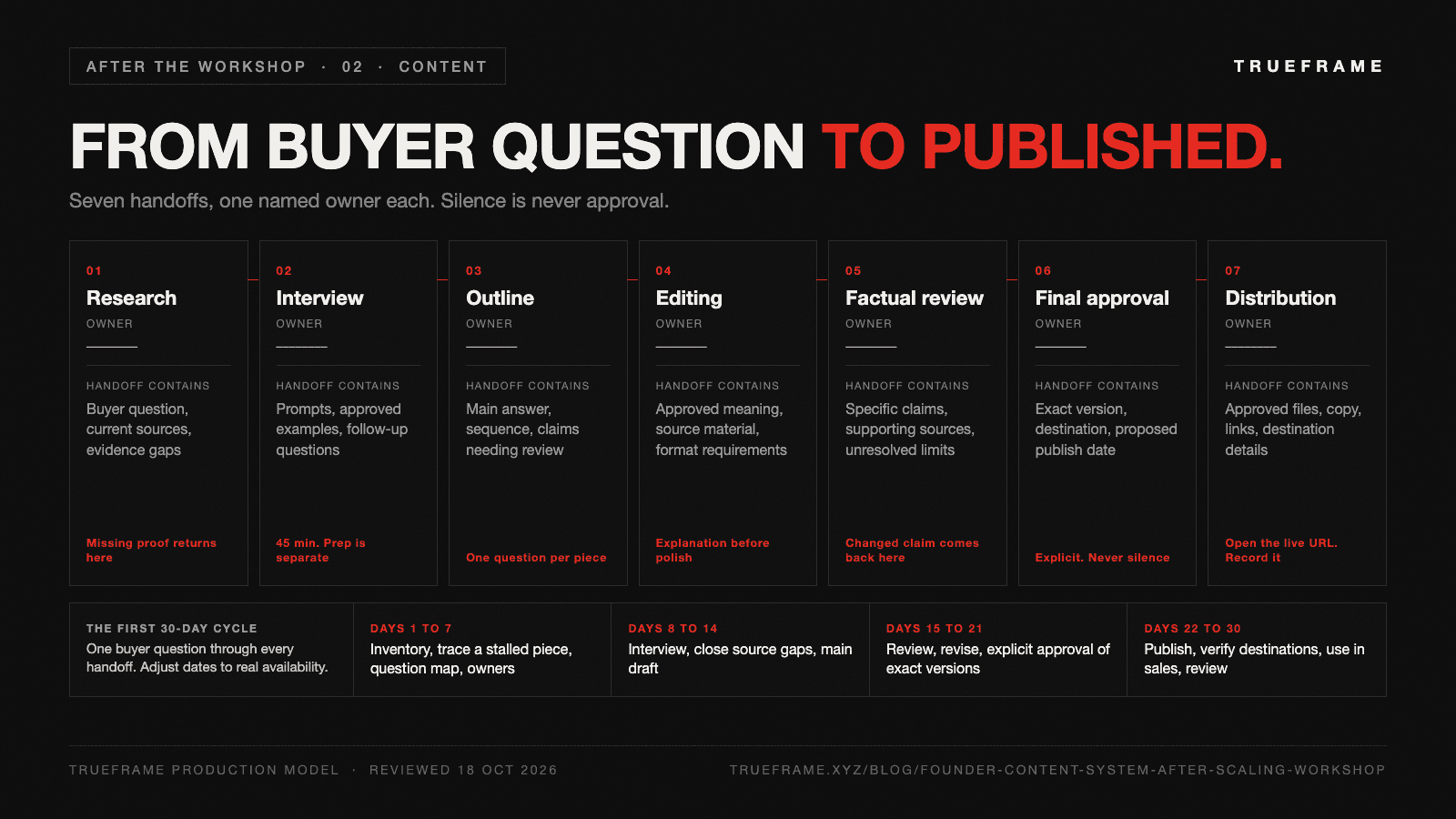
Swipe sideways to inspect the full graphic.
What should editing fix first?
The explanation, before the presentation. Check whether the main piece answers the chosen question completely enough to be useful. Remove repetition, clarify terms and keep the conditions that affect the recommendation. For the consultancy, "we handle implementation" becomes misleading if the client must supply data and nominate a decision-maker. Those responsibilities stay in the final piece.
Short extracts need the same care. A clip saying "you can leave this to us" may lose the qualification that followed it in the interview. Review each one as a standalone piece. Don't assume every section deserves its own post. Keep the pieces that have a clear point and enough context.
Then check captions, spelling, links and phone readability. If a visual carries important information, make it available in the text or as a proper text alternative. The W3C's guidance is simple: informative images need at least a short description of the essential information, and complex graphics need a complete text equivalent.
What does the first 30 days look like?
Use these as milestones, then adjust to real availability. If another campaign already occupies the same people, reduce the scope or move the dates.
| Calendar days | Work | Evidence the stage is complete |
|---|---|---|
| 1 to 7 | Inventory, trace a blockage, choose the question and owners | Sources and brief are ready; missing evidence is assigned |
| 8 to 14 | Interview, resolve source gaps, draft the main explanation | A complete draft exists with claims ready for review |
| 15 to 21 | Review, revise, produce any useful short versions | Exact versions receive explicit approval |
| 22 to 30 | Publish, verify destinations, use in sales, review the process | Live links and usage notes are recorded |
Don't compress a missed approval into the last day to hit the plan. Record the delay and adjust the next handoff. If the cycle finishes early, use the time to review how the material is being used. Starting a second big batch immediately hides the problems you were meant to learn from.
Where does the finished piece go?
Give distribution a specific job. Choose a primary destination where the intended reader can find and use the explanation. Add other destinations when you have a reason and the capacity to maintain them. For the consultancy, that means the preparation guide on its website and a short note to the sales owner about when to send it.
After publishing, open the actual destination. Confirm the title, media, links and next step work. Record the live URL and date. And remember that a strong organic response suggests an idea worth testing. It doesn't prove the same material will work as a paid ad. Paid testing needs its own audience, objective, budget and review.
What happened when we ran this for a client?
Hamel Husain runs Parlance Labs and teaches one of the top AI evaluation courses on Maven. When we started, his episodes, office hours and interviews were sitting on recording tools with nothing repurposed. The expertise was there. The production system wasn't.
We built the engine around the handoffs above: a source inventory of his existing recordings, a question map from what his developer audience kept asking, eight-plus shorts a month, long-form YouTube editing, a LinkedIn carousel series and a lead-magnet funnel. Every piece went through a developer-audience factual check before publishing, because one typo in an API name costs that audience's trust.
The review step did its job in October 2025. The early niche-only strategy was underperforming, so we repositioned toward top-of-funnel explainers instead of producing more of the same. By April 2026 the new lead-magnet format was doing 5x the reach, 29x the comments and 7.5x the saves of the previous format. Shorts now drive more than 30% of his YouTube traffic, and in peak weeks his LinkedIn impressions ran from 70K to 235K.
None of that came from a bigger calendar. It came from a process that could tell us a format wasn't working and change direction while the founder kept doing his actual job.
“The actual reel or video that they give you in the end just far exceeds my expectations of how I could have dreamed of it being.”
Dr. Marion Chan is a plastic surgeon in Melbourne. Her engagement runs on the same handoff model: she records, we script, edit, factually review and report. Her words above are from her July 2026 testimonial.
Want this system installed instead of built from scratch?
Book a fit call. We'll look at your offer, your source material and your capacity, and tell you honestly whether an Installed Founder Content Engine would pay back for you, or whether running this worksheet yourself is the better move.
How do I review the first cycle?
Review the process and the buyer response separately. For the process: where did work wait, how much founder time did it take, which corrections repeated? Those observations improve the next cycle. For the buyer response: did the sales team use the guide? Which questions remained? Did relevant prospects mention it? Were any inquiries linked to it?
Keep those observations separate from signed agreements and collected cash. A helpful conversation is real evidence, but it doesn't establish revenue attribution. Thirty days is often too short to judge commercial results, especially with a long sales cycle. It's enough to inspect whether the process produced accurate, useful material and whether the team can repeat it.
The quarter-long version of this process, with buyer-stage topics, weekly cadence and a measurement scorecard.
See the 90-day planHow one long recording becomes a month of pieces when selection, editing and review follow the same handoff rules.
Read the repurposing guideRelated guides
- Marketing is your constraint? A 30-day plan after the workshop
- Branding is your constraint after the workshop? Positioning and proof
- How to build a marketing strategy before you fill a calendar
- Content agency vs in-house: who should own which handoff
- Five video formats that work for tech founders
- The Hamel Husain YouTube growth case study
Sources and review date
Primary sources, first-party data and review dates are listed below. Client-reported results and Trueframe analysis are labelled in the article.
- Scaling Workshop · Acquisition.comReviewed 18 October 2026
- Get Your Free Personalized $100M Scaling Roadmap · Acquisition.comReviewed 18 October 2026
- Creating helpful, reliable, people-first content · Google Search CentralReviewed 18 October 2026
- Images Tutorial: text alternatives · W3C Web Accessibility InitiativeReviewed 18 October 2026
- How to Build an IKEA Level Content System · Benjamin ChuaReviewed 18 October 2026
Skip the reading. Talk it through instead.
Book a fit call and we'll map out what a content engine looks like for your business. No pitch, no pressure.
Don't miss the next one
Some of what we share is time-sensitive. A format that's working right now, a window that closes fast. We email those the moment they're worth jumping on. Drop your email so you catch them in time.
No spam. Unsubscribe anytime.
Frequently asked questions
How do I build a content system after an Alex Hormozi workshop?
Why does founder content keep stalling?
How long should a founder content interview be?
How much content should a founder publish in the first 30 days?
Do we need a new content tool?
What should a founder outsource first in content production?
Can I judge content results after 30 days?
Founded & led by
Benjamin Chua (BenChuchu)
Founder and CEO of Trueframe. 9 years building businesses (started at 16), tens of millions of views generated, and 8 figures in revenue created for the founders and brands he works with. He builds the content systems Trueframe runs.