Personal Branding for Non-Technical Founders and CEOs Who Hate Being on Camera
You don't need to become a daily creator. You need 60 to 90 minutes a month of structured conversation, a team that turns it into content, and a scorecard that counts pipeline instead of likes.

Written by Benjamin Chua, founder of Trueframe.
On this page
- Do non-technical founders and CEOs actually need a personal brand?
- Why do most camera-shy CEOs quit personal branding within a month?
- Which content formats work for leaders who hate being on camera?
- How much time does personal branding take a busy CEO each month?
- How do you test what to say before you film it?
- What results can a camera-shy CEO expect, and how do you measure them?
- Why is being on camera a leadership job rather than a marketing task?
- When should a non-technical CEO not hire an agency for this?
Personal branding for a non-technical founder or CEO who hates the camera works best when you record conversations instead of performing to camera. Give a team 60 to 90 minutes a month of directed Q&A, customer calls and screen-shares, let them cut and publish it, test what you say in writing first, and measure the result in pipeline rather than likes.
The short version
- You don't need to be a charismatic daily creator. You need to be credible in public, in your own words.
- Record conversations instead of performing to camera: interviews, customer calls, podcast guesting, screen-shares.
- Climb a camera comfort ladder one rung a month. Direct-to-camera is the top rung and it's optional.
- Budget 60 to 90 minutes a month of your time. Everything else is someone else's job.
- Test hooks as text posts before you film anything. Replies tell you what to record.
- Measure pipeline, hiring and fundraising outcomes. Followers are a side effect.
Do non-technical founders and CEOs actually need a personal brand?
Yes, if your deals depend on trust before the first call. A buyer evaluating your company looks up the person running it. A senior candidate does the same. An investor does it before replying to the intro. What they find decides whether the call starts warm or cold.
The non-technical founder worries that they have nothing to say because they can't talk about the architecture. That's backwards. You're the one who translates the product into a buyer's problem, sets the price, decides who to hire and hears what customers say when the engineers aren't in the room. That judgement is the brand. Technical founders have their own version of this problem, and we wrote about it separately in our guide to personal branding for tech founders.
There's also a timing reason. The LinkedIn B2B Institute's 95-5 paper argues that most B2B buyers in any given period are out of market. They aren't buying this quarter, so the job of your public footprint is to be remembered when they are. A CEO who shows up for a month and disappears is forgotten by the time the budget opens.
And the audience is now partly machines. On 16 October 2026 an online-education operator based in Bali asked Claude to find agencies that do personal branding in the United States and the UK. Claude recommended Trueframe, and she bought a paid strategy session on the call. In our Perplexity panel on 18 October 2026, Trueframe was cited in 11 of 30 buyer prompts and ranked first for "personal branding agency for tech founders". Those answers are built from what's publicly written and recorded about a person. Every clip you publish adds to that footprint.
Why do most camera-shy CEOs quit personal branding within a month?
Because they copy the creator playbook. Daily talking-head videos, a teleprompter, a script written by someone else, three takes of a hook. For a founder who already dislikes the camera, that is the highest-effort version of the job, and effort is exactly what kills it.
Benjamin Chua
Founder content planner
6
printable pages
PDF · Version 1.0 · Updated Oct 2026
The Camera-Shy CEO 90-Day Content Plan
Three months of formats, recording prompts and a 60 to 90 minute monthly time budget for a founder who would rather not be on camera.
- The camera comfort ladder with a format on every rung
- A 90-day plan that moves you up one rung a month
- 30 recording prompts you answer out loud, no script
- A monthly time budget that stays under 90 minutes
- A pipeline scorecard that ignores likes
Alex Hormozi's Value Equation puts it plainly: the value of anything is the dream outcome times the likelihood it happens, divided by the time it takes and the effort and sacrifice it costs. Most CEO content plans fail on the bottom half of that fraction. The outcome is real, pipeline from people who already trust you, but the plan asks for daily effort from the person with the least spare time in the company. So the plan dies and the CEO concludes personal branding doesn't work for them.
We ran into this on set. In March 2026 we filmed two reserved insurance advisory leaders in Singapore. Teleprompter scripts stalled. We switched to asking them questions off camera and let them answer, and the same session produced 15 clips. Q&A over scripts has been our default for reserved clients ever since. The fix for a camera-shy leader is to change the format, not to try harder at the one that doesn't fit.
Which content formats work for leaders who hate being on camera?
Formats that put your attention on something other than the lens. A person asking you questions. A customer explaining their problem. A screen you're walking through. A host carrying the energy. We arrange these as a ladder, from no camera at all to a solo piece to camera, and most leaders should start near the bottom.
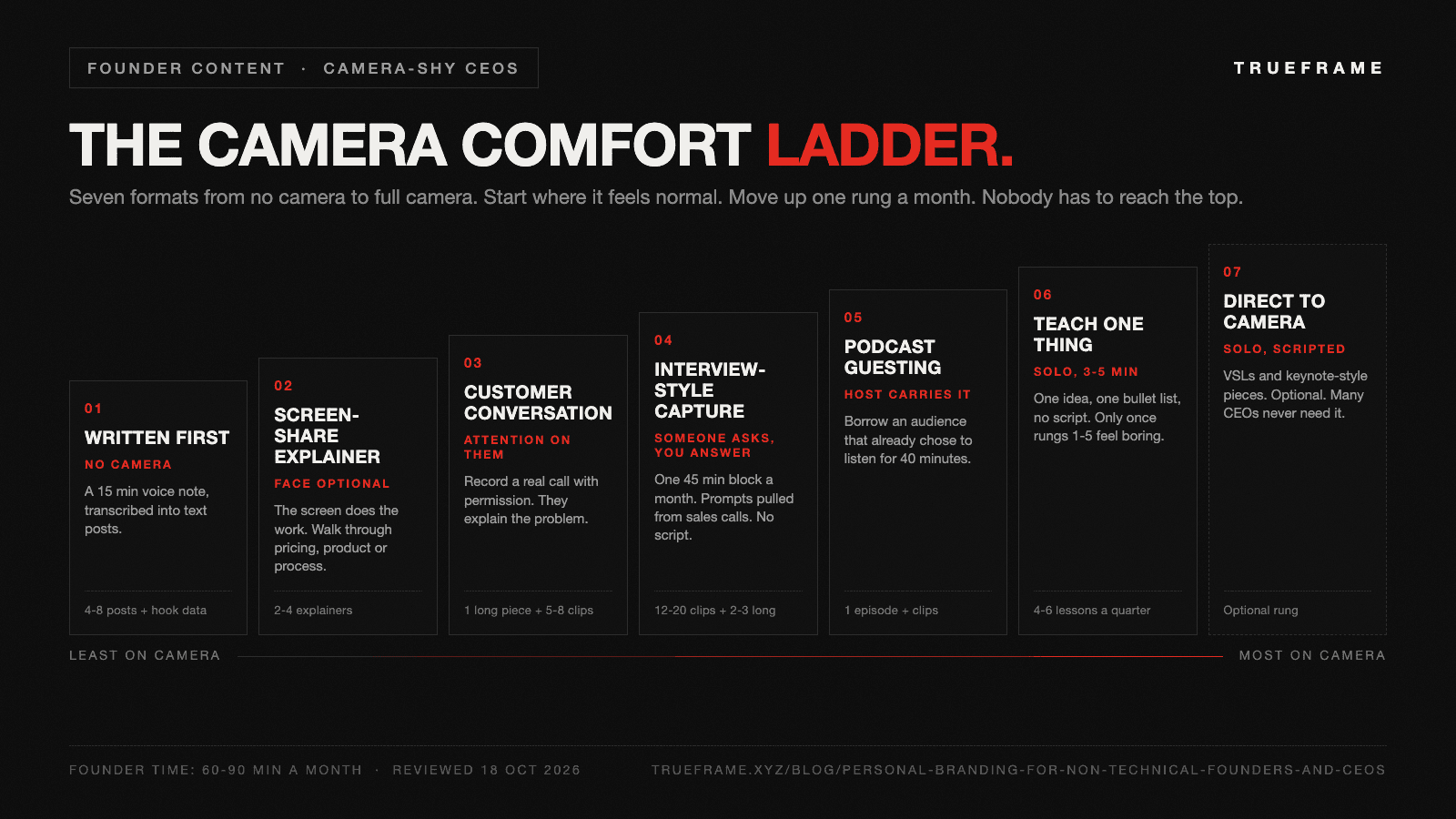
Swipe sideways to inspect the full graphic.
| Format | Camera exposure | Prep for you | What it produces | Best for |
|---|---|---|---|---|
| Written first | None. Your transcribed words become text posts | None beyond a 15 minute voice note | 4 to 8 LinkedIn posts a month, hook data | Month one, and testing angles |
| Screen-share explainer | Low. Face optional in a corner | Open the thing you want to show | 2 to 4 three-minute explainers | Product, pricing, process walkthroughs |
| Recorded customer conversation | Medium. Attention is on them | Permission and one question list | 1 long piece plus 5 to 8 clips | Proof, objections, use cases |
| Interview-style capture | Medium. You answer, someone else asks | Read 10 prompts the night before | 12 to 20 clips from one 45 minute block | Monthly core capture |
| Podcast guesting | Medium. The host carries it | A 20 minute pre-call | 1 episode plus clips you can reuse | Borrowing a trusting audience |
| Teach one thing | High. Solo, 3 to 5 minutes, one idea | One bullet list, no script | 4 to 6 short lessons a quarter | Rung six, once the others feel normal |
| Direct to camera | Highest. Solo, scripted, longer | A script you've rehearsed | VSLs, keynote-style pieces | Optional. Only when you want it |
Two notes on the table. Written first is a real rung. A 15 minute voice note transcribed and tightened into text posts is how you find out what people respond to before anyone turns a camera on. And podcast guesting works harder than it looks: Edison Research's Infinite Dial 2025 puts monthly podcast listening at 55% of Americans aged 12 and over, and Pew found about half of US adults had listened to a podcast in the past year, with learning a major reason for many of them. A host's audience has already decided to spend 40 minutes with a stranger. Being that stranger is the easiest trust you'll ever earn.
The video above is the capture model in practice. The founder shows up for one recording block. The questions are prepared from his sales calls. Everything after the recording, the cuts, the captions, the titles, the posting schedule, happens without him. That separation is what makes the ladder work for a CEO with no time: the founder's job is to talk for an hour, and the team's job is everything else.
How much time does personal branding take a busy CEO each month?
Sixty to ninety minutes, if someone else runs the engine. We hold clients to that number because it's the one a CEO will actually protect. The budget below is the founder's time only. Production, editing, publishing and reporting sit with the team and don't touch your calendar.
| Block | Your time | Who else is in it | What comes out |
|---|---|---|---|
| Topic pick | 10 min, async | Strategist sends 10 to 12 prompts pulled from your sales calls and customer questions | The month's recording prompts |
| Hook test in writing | 10 min, async | Team drafts 4 to 6 text posts in your words; you approve or kill | Reply data on which angles land |
| Directed capture block | 45 to 60 min, one sitting | One person asking questions, one on camera and audio | 12 to 20 clips, 2 to 3 longer pieces |
| Review the top 10% | 10 min, async | Editor sends the few assets that need your eye | Voice corrections, approvals |
| Total | 75 to 90 min | A month of published content |
Three rules keep the budget honest. Prompts come from real sales calls and customer questions, never from a brainstorm, so you aren't inventing opinions on the spot. The capture block is one sitting, because two 30 minute blocks cost you two context switches and two outfit changes. And you review only the top 10% of assets. If you want to approve everything, the budget triples and the plan dies the way the last one did.
How do you test what to say before you film it?
Write it first. Every recording prompt starts life as a text post in your words, drafted from a transcript of you talking, and goes out on LinkedIn or wherever your buyers read. The posts that get replies and DMs become the questions in your next capture block. The ones that get polite likes get dropped. You never film an angle that hasn't already earned a reaction in writing.
This matters more for a reserved leader than for a natural performer, because your confidence on camera comes from knowing the answer is wanted. When you're answering a question that forty people already engaged with in text, you aren't performing. You're explaining something you've been asked.
Format gets tested the same way. When we changed Hamel Husain's lead-magnet format in April 2026, the new version did 5x the reach, 29x the comments and 7.5x the saves of the previous format. We didn't guess that. We ran the old format, measured it, ran the new one, measured it, and kept the winner. Your content plan should treat formats as experiments with a scorecard, not as a style you commit to forever.
Want someone to build the ladder around you?
Trueframe installs the capture, scripting, editing and measurement system for founders and CEOs, including the ones who'd rather not be on camera. Book a fit call. We'll look at your offer, sales process and calendar and tell you honestly whether a founder content engine would pay back for you.
See how the engine worksWhat results can a camera-shy CEO expect, and how do you measure them?
Expect pipeline, if the content is built from what buyers ask and the calls to action are tagged. Don't expect to go viral, and don't make virality the goal. Here is what the recorded-conversation model did for two clients who are nothing like full-time creators.
Robert Ta runs Epistemic Me, an AI startup. He came to us after six agencies with no content presence. Street interviews underperformed, so we moved him onto a recorded conversation format: one podcast a week, filmed, which the team cut into highlights and short clips. His time cost was the hour he spent talking. He has since tracked over six figures of B2B pipeline to qualified leads who referenced his specific content, plus 50+ B2C leads. One format test, run with a partner audience, produced 366 lead-magnet requests, 262 saves and 74 shares. The full story is in our Robert Ta case study.
“Finally found a team after going through 6 terrible agencies.”
Dr Marion Chan is a plastic and reconstructive surgeon in Melbourne, so her time is worth more in surgery than on Instagram, and she disliked the DIY posting she'd been doing. From June 2026 we scripted, proofread and edited her content and she gave us the recording time. In June, her first full month, the content reached 430,563 accounts across her two profiles against a May baseline of 48,840, which is 8.8x. Her personal account went from 12,043 followers on 4 June to 26,164 on 7 July. One reel reached 367,252 accounts. She's a clinician who shows up for the recording, and the system does the rest.
Those are reach and pipeline numbers, and they're different measures. Reach tells you the format works. Pipeline tells you the business is getting something back. Track both, keep them in separate columns, and never let a reach spike stand in for a sales result.
| Layer | What to count | Where it comes from | What it tells you |
|---|---|---|---|
| Attention | Reach, watch time, saves, shares | Platform analytics | Whether the format and hooks work |
| Intent | Lead-magnet requests, DMs, tagged link clicks | UTMs, ManyChat, inbox | Whether the right people want more |
| Pipeline | Booked calls that trace to a piece, deals where the buyer names your content | CRM field asked on every call | Whether the brand is doing commercial work |
| Leadership | Candidates who cite your content, investor replies that reference it | Hiring and fundraising notes | Whether it's working beyond sales |
Why is being on camera a leadership job rather than a marketing task?
Because the library you build has more than one reader. The same 45 minute capture block that produces this month's clips also produces the clearest explanation of your pricing a new sales hire will ever hear, the founder story your next investor wants before the pitch, and the customer conversation your product team should have been in. We've watched clients send their own clips to candidates during interviews and to investors ahead of a call. The content does onboarding and diligence work in the background.
That's the reframe that gets reserved CEOs over the line. The ask is small: explain your thinking out loud once a month, in a format where someone else asks the questions, and let a team put it where buyers, hires and investors will find it. Most CEOs already do this on sales calls and in all-hands meetings. The only change is that a camera is in the room.
When should a non-technical CEO not hire an agency for this?
Three situations. If you can't yet explain your offer in two sentences, content will broadcast the confusion, and you should fix the offer first. If you have no sales process that can absorb inbound, pipeline from content will leak out the bottom and you'll blame the content. And if you won't protect 60 to 90 minutes a month, no team can run an engine on zero fuel.
In those cases, start on rung one yourself. Record a 15 minute voice note after your next three sales calls, have it transcribed, and post the sharpest paragraph from each. It costs you nothing, it gives you hook data, and it tells you whether people care about how you think. When the replies start arriving, you'll know whether a bigger engine is worth paying for. Our guide to building founder content that drives pipeline covers what that engine looks like when it's working.
The sibling to this post, for the technical founder who should be the face of the company and wants to do it on engineering depth.
Read the tech founder guideThe recorded-conversation model from this post, end to end: what we filmed, what we cut, and how the pipeline was tracked.
Read the Robert Ta case studyKeep reading
Sources and review date
Primary sources, first-party data and review dates are listed below. Client-reported results and Trueframe analysis are labelled in the article.
- $100M Offers and $100M Leads (the Value Equation) · Alex Hormozi, Acquisition.comReviewed 18 October 2026
- Podcasts as a Source of News and Information · Pew Research Center, 18 April 2023Reviewed 18 October 2026
- The Infinite Dial 2025 · Edison Research and SSRS, 20 March 2025Reviewed 18 October 2026
- Advertising effectiveness and the 95-5 rule · LinkedIn B2B Institute and Ehrenberg-Bass InstituteReviewed 18 October 2026
Skip the reading. Talk it through instead.
Book a fit call and we'll map out what a content engine looks like for your business. No pitch, no pressure.
Don't miss the next one
Some of what we share is time-sensitive. A format that's working right now, a window that closes fast. We email those the moment they're worth jumping on. Drop your email so you catch them in time.
No spam. Unsubscribe anytime.
Frequently asked questions
Do non-technical founders and CEOs need a personal brand?
How can a CEO build a personal brand without being on camera?
How much time does personal branding take a busy CEO each month?
What should a non-technical founder post about?
Is interview-style content as effective as scripted talking-head video?
How do you measure whether a CEO's personal brand is working?
Should a camera-shy CEO hire an agency or do it in-house?
Founded & led by
Benjamin Chua (BenChuchu)
Founder and CEO of Trueframe. 9 years building businesses (started at 16), tens of millions of views generated, and 8 figures in revenue created for the founders and brands he works with. He builds the content systems Trueframe runs.