Video vs Written Content: Which Should a B2B Founder Start With?
Video shows how you think under pressure. Writing lets a buying committee scan, compare and forward. The right first format depends on the question you're answering and the production load you can actually carry. Here is the decision matrix we use, with the hours attached.

Written by Benjamin Chua, founder of Trueframe.
On this page
- What should you decide before choosing a format?
- When does video answer the question better?
- When does writing answer the question better?
- What does each format really cost to produce?
- Should your own strengths decide the format?
- What happened when a founder used both formats for different jobs?
- How do you test one question in both formats fairly?
- How many founder hours does each path take?
- Written-first: two articles, then two companion videos
- Video-first: record weekly, adapt to text
- How do you make either format usable in bad conditions?
- Where will each piece actually be seen?
Start with the format that answers your buyer's question clearly and fits the work you can sustain. Video wins when someone needs to see a process or hear you reason through a judgment. Writing wins when they need to scan, compare or forward an exact answer. Your own strengths decide the production path; the buyer's question decides the format.
The short version
- Pick one narrow buying question before you pick a format.
- Demonstrations lean video. Comparisons lean writing. Objections often need both.
- Compare the full workflow, not recording time versus typing time.
- Run one question in both formats and read the result as directional, not proof.
- Budget founder hours and support hours separately. Nine versus twelve proves nothing on its own.
What should you decide before choosing a format?
The buying question. Pick one that comes up before somebody buys and make it narrow enough to answer properly. 'How does our service work?' covers too much. 'What will your operations manager need to do in the first two weeks?' is an assignment.
A beautifully produced video won't rescue an explanation that leaves the buyer confused. A long article doesn't become useful because it contains more detail. The format is a decision about how to communicate, so it follows the question, and the matrix below is how we make that call for the founders we work with.
| Buyer's task | Example question | Start with | Why | Add later |
|---|---|---|---|---|
| Show me how this works | How does a request move from intake to approval? | Video (screen or process demo) | The viewer sees the sequence and where human judgment enters | A written step list and diagram for the people implementing it |
| Help me compare the options | In-house, a specialist, or you? | Written (table plus reasoning) | Committees scan, compare side by side and forward it | A short video on where the answer changes |
| Address the thing that worries me | Will implementation disrupt my staff? | Both, led by the honest qualification | A founder on camera carries tone; the written list carries the exact limits | A testimonial from someone who had the same worry |
| Help me believe you can do it | Have you solved this for a company like mine? | Video (case walkthrough) | Specifics and delivery are hard to fake on camera | A written case page with the numbers and limits |
| Let me check one detail fast | What does the client have to provide? | Written | Reference material gets searched, not watched | A 60-second clip pointing to the page |
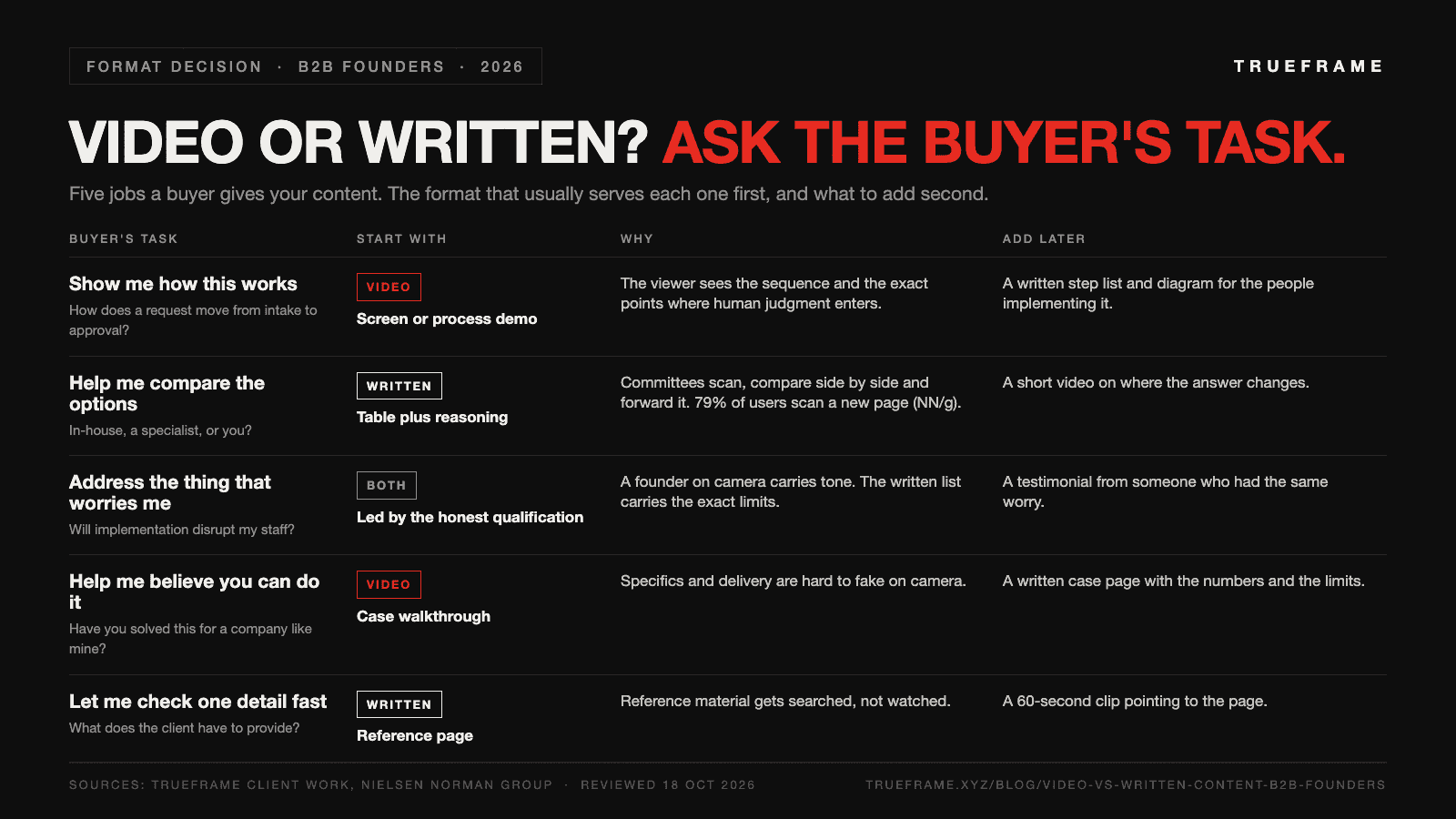
Swipe sideways to inspect the full graphic.
Benjamin Chua
Founder content planning tool
4
printable pages
PDF · Version 1.0 · Updated Oct 2026
Video or Written Content Decision Worksheet
Choose the first format for one buying question, then plan a fair same-question test with production hours, review hours and the evidence you will accept.
- A six-check table that settles the explanation before the format
- A buyer-question matrix: demonstrate, compare or reassure
- A same-question test plan with hours, routes and evidence
- A sustainability check so you pick the format you can keep shipping
When does video answer the question better?
When the buyer needs to see something happen or hear you think. A software founder demonstrating how a user gets from an incoming request to an approved decision is showing the sequence and the exact points where a human has to judge. Text can list those steps; it can't show the hesitation before the decision, and that hesitation is often the thing the buyer is evaluating.
Video is also where a worried prospect hears how you think about their worry. 'Will this disrupt my staff?' deserves a founder on camera explaining the real trade-off, plus a written list of what the client provides, what you handle and where disruption stays possible. Put the careful qualification somewhere easy to find and revisit. Don't bury it in a fast edit.
When does writing answer the question better?
When the reader needs to scan, compare or return to an exact wording. Nielsen Norman Group's reading research found 79% of test users scanned any new page rather than reading word by word. A buying committee comparing in-house versus specialist help does exactly that: they want responsibilities, prerequisites and costs side by side, and they want to paste the table into an email.
Think about the next reader. If the buyer circulates your comparison internally, the person who receives it may never watch the original video. The written explanation has to stand on its own.
What does each format really cost to produce?
More than the recording or the typing. Both formats need preparation and review; they just spend those resources differently.
| Work involved | Video | Written content |
|---|---|---|
| Explaining the idea | Interview, outline or script | Interview, outline or draft |
| Capturing the explanation | Recording, setup and possible retakes | Drafting and possible restructuring |
| Checking accuracy | Spoken meaning, edit decisions and on-screen claims | Wording, examples and structure |
| Making it accessible | Accurate captions and essential visuals described in speech | Clear headings, readable text, useful image descriptions |
| Updating one detail | Often a new edit, sometimes a new recording | A text change and a review |
These are tendencies, not proof that one format is always cheaper. A concise technical article can be brutal to write. A simple demonstration can be easy to record. A polished video with several visual explanations can take a week of an editor's time while the founder spent an hour on camera. That division is often sensible; the production effort still exists and someone pays for it.
That video is the bridge between the two formats. Every founder we film starts with something written, even if it's three bullet points. The founders who write well record from an outline. The founders who talk well get interviewed and we write from the transcript. Same destination, different entry door.
Should your own strengths decide the format?
They should decide the production path, not the format. Record yourself answering a real customer question for a few minutes, then write a short answer to the same question. Notice where the explanation gets clearer. Do better examples show up when you talk? Do you only spot the gap in the argument once you see the paragraph? Does a drawing carry more than either?
A founder who speaks well can use an interview as the source for both formats. The written version still needs editing: transcripts are full of repetition, references to something on screen and sentences that worked aloud but don't read. A founder who writes well can turn a strong article into a recording outline, but reading it sentence by sentence sounds stiff. Keep the reasoning and examples, change the phrasing for speech.
Your preference is useful evidence about production. It says nothing about what your buyers prefer.
What happened when a founder used both formats for different jobs?
Hamel Husain teaches AI evaluation to a developer audience and runs a top course on Maven. When we started, his episodes, office hours and interviews were sitting in recording tools with nothing repurposed. He didn't have a format problem. He had an 'everything exists and nothing ships' problem.
We built a multi-platform engine that gave each format a job. Short video clips cut from his long recordings went to YouTube Shorts, TikTok and Instagram, with the long-form office hours and guest podcasts edited for the main channel. Written and visual pieces went to LinkedIn: carousels and a flashcard series built from the same source material.
Each format did what the matrix predicts. The Shorts did the discovery job: they grew to drive 30%+ of his YouTube traffic. The written and carousel work did the scan-and-share job: in his highest-output weeks LinkedIn impressions ran between 70K and 235K. And when we launched a new top-of-funnel lead-magnet format in April 2026, built around a downloadable flashcard resource, it hit 5x the reach, 29x the comments and 7.5x the saves of the previous format.
The lesson isn't that one format won. The same ideas, cut for discovery as video and laid out for reference as text, did two different jobs at once. If he'd picked one format and stopped, he'd have had half the system.
How recordings that were going nowhere became a cross-platform engine, with the numbers and what they do and don't prove.
Read the case studyHow do you test one question in both formats fairly?
Start from the same buyer question and the same intended decision. Say the question is what a ten-person business must prepare before implementing your service. Write a readable article and record a short video from the same outline, using the same approved examples and the same qualifications.
Share each through an appropriate existing channel. Note the production effort and how people actually use the explanation. Ask prospects which parts stayed unclear. If someone forwards the article to a colleague or refers to the video on a call, record that.
Then read the result as directional. Your written channel might already have more reach. The video might be shown to a different audience. One version may have landed at a better moment. A small test tells you whether each format communicates clearly and whether the production process fits your week. It does not establish that one format will produce more revenue in every future campaign.
How many founder hours does each path take?
Here are two hypothetical four-week plans. They are planning illustrations, not output guarantees and not a Trueframe package.
Written-first: two articles, then two companion videos
| Founder activity over four weeks | Time |
|---|---|
| Select questions and provide source examples | 1 hour |
| Explain or draft the two pieces | 3 hours |
| Review and revise the written work | 2 hours |
| Prepare and record two companion videos | 2 hours |
| Review edits and coordinate distribution | 1 hour |
| Total founder time | 9 hours |
Video-first: record weekly, adapt to text
| Founder activity per week | Time |
|---|---|
| Select questions and prepare prompts | 30 minutes |
| Set up and record | 60 minutes |
| Review the edited video | 20 minutes |
| Review the written adaptation | 40 minutes |
| Coordinate and share the finished work | 30 minutes |
| Total per week | 3 hours |
| Total over four weeks | 12 hours |
Both plans assume someone else handles editorial production, video editing and publishing; those hours and fees are additional. The two plans also produce different quantities and types of work, so nine hours versus twelve doesn't prove writing is faster. It shows why a complete plan beats comparing recording time with typing time. If the total doesn't fit your calendar, choose fewer outputs. Rushed review damages both formats. For a fuller breakdown of where founder hours go, read how much time a founder needs to spend on content.
Not sure which format your buyers need first?
Book a fit call. We'll look at your buyer questions, your existing material and your available recording time, then tell you honestly whether a founder-led video engine would pay back or whether you should start somewhere else.
How do you make either format usable in bad conditions?
For video, caption it properly and check the automatic transcript. W3C's caption guidance gives the example of speech recognition turning '4 to 5 minutes' into '45 minutes' and dropping a 'not', so the captions contradicted the audio. A missing word changes the meaning of a qualification. If the explanation depends on a chart or a screen action, say it out loud too. 'As you can see here' is useless to someone who can't see.
For writing, use headings that state the question being answered, keep tables readable on a phone and explain the units in every numerical example. If a video lives on your site, Google's video SEO guidance asks for a crawlable watch page, a stable thumbnail and consistent metadata, so the video can actually be found. These aren't finishing touches. They are part of communicating the idea, so they belong in the production plan.
Where will each piece actually be seen?
Decide this before you make anything. A written comparison can sit on your site, link from the offer page and go out the moment the question comes up on a sales call. A video can live on a relevant channel and be embedded beside a short summary. Both are useful before they attract an audience, because a salesperson answering a live question has a reason to send them today.
Search is uncertain for both formats. Neither guarantees rankings, and a good explanation still needs a clear title, a useful page and a route people take to find it. And copying the same piece onto more platforms doesn't create value automatically. Each destination needs enough context for the piece to stand alone and a sensible next step. Our guide to founder content that drives pipeline covers how to connect each piece to the buying process.
Related guides
Sources and review date
Primary sources, first-party data and review dates are listed below. Client-reported results and Trueframe analysis are labelled in the article.
- Captions/Subtitles: making audio and video media accessible · W3C Web Accessibility InitiativeReviewed 18 October 2026
- How Users Read on the Web · Nielsen Norman Group, 1997Reviewed 18 October 2026
- Video SEO best practices · Google Search CentralReviewed 18 October 2026
- Creating helpful, reliable, people-first content · Google Search CentralReviewed 18 October 2026
Skip the reading. Talk it through instead.
Book a fit call and we'll map out what a content engine looks like for your business. No pitch, no pressure.
Don't miss the next one
Some of what we share is time-sensitive. A format that's working right now, a window that closes fast. We email those the moment they're worth jumping on. Drop your email so you catch them in time.
No spam. Unsubscribe anytime.
Frequently asked questions
Is video or written content better for B2B founders?
Is video better for building trust?
Should a technical founder write long articles first?
Can one interview become both a video and an article?
What if I can only afford one format?
How long should a video vs written content test run?
Founded & led by
Benjamin Chua (BenChuchu)
Founder and CEO of Trueframe. 9 years building businesses (started at 16), tens of millions of views generated, and 8 figures in revenue created for the founders and brands he works with. He builds the content systems Trueframe runs.