LinkedIn Ghostwriter vs Video Content Agency: Which One Should a Founder Hire?
Both will put your name in front of buyers. They do it in different places, at different price points, and with very different amounts of your time. Here's how I'd decide, including the cases where we're the wrong buy.

Written by Benjamin Chua, founder of Trueframe.
On this page
- What does a LinkedIn ghostwriter actually sell?
- What does a video content agency actually sell?
- When is a ghostwriter the better buy?
- You're a written-first founder
- Your buyers only live on LinkedIn
- The budget is tight and the offer is still moving
- When does video win?
- Trust at higher price points
- Multi-platform reach from one recording
- YouTube search
- The AI-search footprint
- What video costs
- When should you combine them?
- How do you run the decision in fifteen minutes?
- What should you ask each provider before you sign?
- What does it cost to pick the wrong one?
Hire a LinkedIn ghostwriter when your buyers decide on LinkedIn, the sale is small enough that text builds the trust, and you think in writing. Hire a video content agency when the sale is high-ticket, buyers check YouTube, Google or AI assistants before a call, and you explain things better out loud. Many founders need both, in that order.
The short version
- A ghostwriter sells your thinking in text on one platform. A video agency sells your thinking in a form that travels across platforms and search.
- Written wins on LinkedIn-only buyers, lower price points, tighter budgets and founders who review drafts in minutes.
- Video wins on trust at higher price points, multi-platform reach, YouTube search and the text footprint AI assistants read: transcripts, watch pages and clips.
- Combine them when one recording can feed both. Hamel Husain's LinkedIn hits 70K to 235K impressions in peak weeks while Shorts drive 30%+ of his YouTube traffic, from the same source material.
- Score six factors. Four or more on one side decides it. Three and three means written first, video once the offer is proven.
Ask ChatGPT for a personal branding agency and most of what comes back is LinkedIn ghostwriting. That's a real category and some of those shops are good at it. It also means founders compare a written service with a video service as if they were the same product at different prices. They put your name in different places, build trust at different speeds, and cost your calendar very different amounts.
We run video engines for founders, so I have a view. I'm going to lay out the fair version anyway, including the cases where a ghostwriter is the better buy and we'd tell you so on the call.
What does a LinkedIn ghostwriter actually sell?
A ghostwriter sells your thinking, written in your voice, published on LinkedIn on a schedule you'd never keep yourself. The good ones interview you for 30 to 60 minutes, pull the stories and opinions out of you, and turn one conversation into a week or two of posts. You review drafts, approve, and they post. Some also handle comments, carousels and a newsletter.
What you get is reach and recall inside one network. What you don't get is anything outside it. A LinkedIn post has no watch page, no transcript, no YouTube presence and almost no life in Google. It works while the feed shows it, then it's gone unless someone goes looking on your profile.
| LinkedIn ghostwriter | Video content agency | |
|---|---|---|
| Core product | Written posts in your voice, usually 3 to 5 a week | Recorded founder video cut into long-form, clips and posts |
| Where it shows up | LinkedIn feed and profile | YouTube, LinkedIn, Instagram, TikTok, your site, Google and AI answers |
| Your time per month | One or two interviews plus draft approvals | One recording block plus review of cuts |
| What trust it builds | You sound sharp and consistent | Buyers see and hear you before the first call |
| Search footprint | Low. Posts rarely rank or get cited | Transcripts, watch pages, descriptions and clips that search and assistants can read |
| Cost to produce | Lower. No capture, edit or packaging step | Higher. Capture, editing, packaging and distribution per piece |
| Fastest signal | 30 to 60 days | 90 days |
| Fails when | Buyers need to see you, or they aren't on LinkedIn | The founder won't record, or the offer isn't proven yet |
Benjamin Chua
Founder content decision tool
5
printable pages
PDF · Version 1.0 · Updated Oct 2026
Ghostwriter vs Video Decision Tool
Score your situation across six factors, cost both options in cash and founder hours, and leave with a written decision.
- A six-factor scorecard with a clear reading of the result
- A cash and founder-hours worksheet for both options
- The questions to ask a ghostwriter and a video agency before signing
- A verified case where written and video ran together
What does a video content agency actually sell?
A video agency sells a recording system and everything after it. You sit down once a month, or once a week if you're running a podcast, and talk through what you know. The team turns that into long-form YouTube, short clips, written posts and a library of material your sales team can send. The founder's job is the thinking on camera. Everything else belongs to the system.
The thing most founders miss is the by-product. Every recording produces a transcript, and every transcript becomes posts, a description, a watch page and captions. That's the written content a ghostwriter would have interviewed you for, as a side effect, plus the one thing writing can't give you: a buyer watching you explain something for four minutes before they book a call.
Watch how much of the output in that video is written. The posts, descriptions and captions all come out of the same hour, which is why the cost gap between a writer and a video team is smaller than the monthly fee suggests.
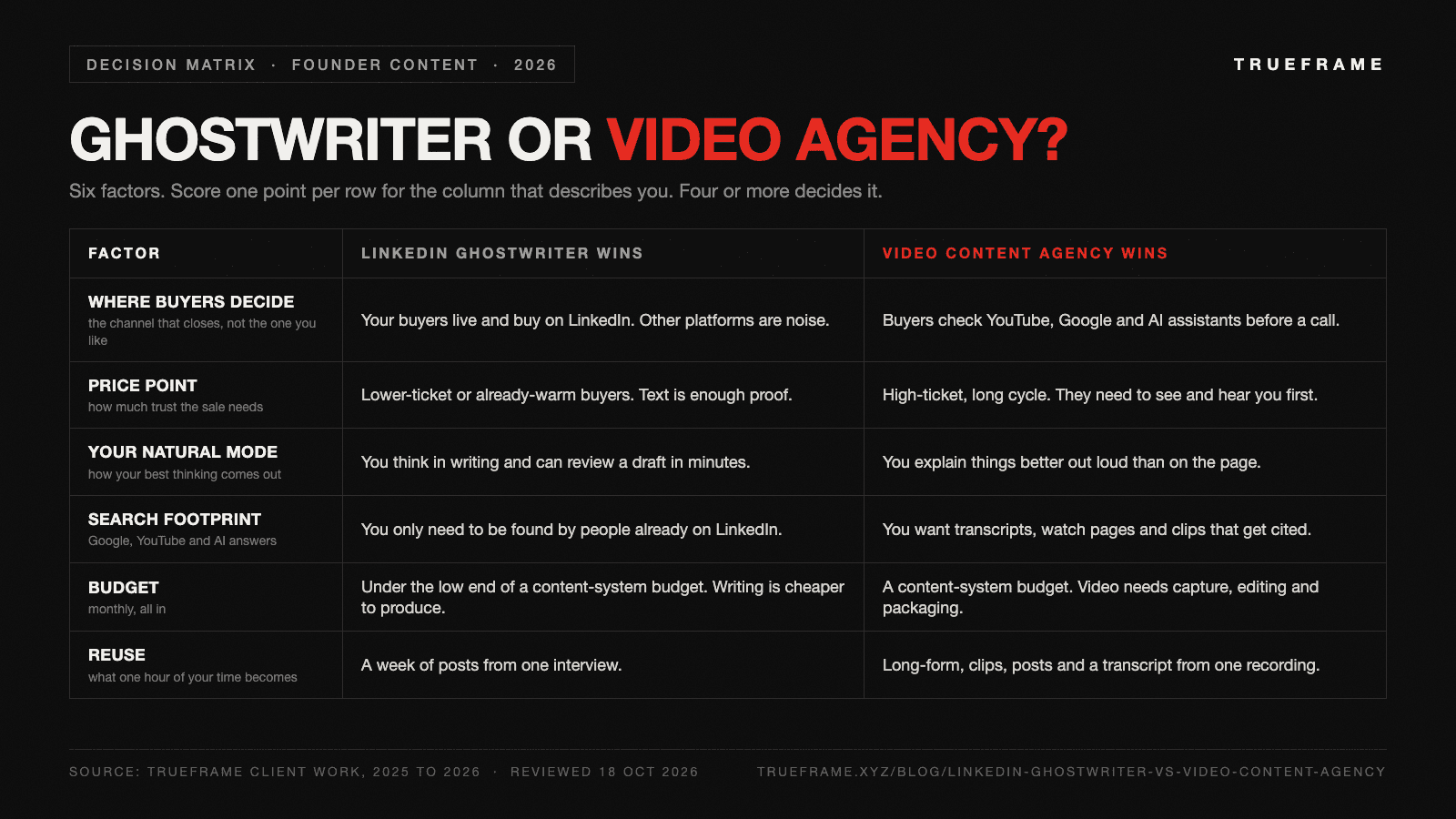
Swipe sideways to inspect the full graphic.
When is a ghostwriter the better buy?
A ghostwriter is the better buy when three things are true at once: your buyers decide on LinkedIn, the sale doesn't need video-level trust, and you think in writing.
You're a written-first founder
Some founders think on the page. They can read a draft, fix the one wrong word and approve it in four minutes. Put that founder in front of a camera and the energy drops, the takes multiply and the review loop becomes a chore. If writing is where your best thinking comes out, buy writing. The format should match the founder, not the other way round.
Your buyers only live on LinkedIn
If you sell to a role that spends its working day in the LinkedIn feed and nowhere else, that's where the trust has to be built. B2B services, recruiting, fractional executive work and a lot of consulting fit this. Spending on YouTube when your buyer has never opened YouTube for a work question is a vanity decision.
The budget is tight and the offer is still moving
Writing is cheaper to produce because there's no capture, edit or packaging step. The Editorial Freelancers Association's 2026 rate chart, built from rates members charged in 2025, puts business and marketing ghostwriting at $87.50 to $125 an hour, or 50 cents to $1.00 a word. Retainers from LinkedIn ghostwriting shops sit above that freelance floor because they add the interviews, the strategy, the comment handling and the design. The drivers are post volume, how much research the writer does, and whether anyone is managing engagement after the post goes live.
There's a second reason to start with writing when the offer is still moving. A post is cheap to test. If you change your positioning every six weeks, you don't want a library of polished videos saying the old thing. Write until the message holds, then film it.
If you go the written route, this is the funnel that has to sit under the posts. Buyer call-out, raise-your-hand step, capture and tracking.
Read the LinkedIn funnel fixWhen does video win?
Video wins when the sale needs more trust than text can carry, when your buyers are in more than one place, and when you want to be found by people who weren't already following you.
Trust at higher price points
Alex Hormozi's Value Equation in $100M Offers puts perceived likelihood of achievement on top of the fraction. Video moves that variable faster than anything else a founder can publish, because the buyer gets to watch you think. A five-figure engagement, an enterprise contract or a course that costs more than a laptop all involve a buyer asking, is this person actually good? Four minutes of you answering a hard question on camera settles that better than forty posts.
Robert Ta came to us with zero content presence and six agencies behind him. We built a founder-led system around short-form, long-form YouTube and a weekly podcast cut into clips. In his own written testimonial he has tracked over six figures in converted pipeline from qualified leads who referenced his specific content as trust building, plus more than 50 B2C leads. That pipeline came from the podcast clips and the content. The buyers named the videos.
“Finally found a team after going through 6 terrible agencies.”
Multi-platform reach from one recording
A written post lives on one platform. A recording lives on all of them: a YouTube video, a dozen shorts, a LinkedIn post, an Instagram reel and a transcript from the same hour. If your buyers are split across LinkedIn, YouTube and whatever their peers forward on WhatsApp, video reaches all three without tripling your time.
YouTube search
YouTube's own press page says Shorts now average more than 200 billion daily views. More useful for a founder is what YouTube is for: people type a question and watch the answer. A LinkedIn post about how to evaluate an AI vendor disappears in three days. A YouTube video with the same title gets found by someone searching that exact question eight months later. Hamel Husain's channel is a good example of the shape: Shorts drive more than 30% of his YouTube traffic, and that traffic feeds long-form videos that keep getting watched.
The AI-search footprint
This is the factor that changed in the last year. Google's guidance on AI Overviews and AI Mode says there are no extra requirements and no special markup. It tells site owners to keep important content in text form and to support it with relevant video. Its video SEO guidance adds that a video needs an indexed watch page, a stable thumbnail, structured data and a unique title and description to be understood.
Read those two documents together and the implication for a founder is simple. Video gets you cited when it comes with text: a transcript, a description, a watch page, a blog post that discusses it. A LinkedIn post mostly stays inside LinkedIn, where assistants can't read it well. A recording gives you the text for free.
We watch this in our own data. Between 24 August and 17 October 2026, Fathom recorded visits to trueframe.xyz referred from Claude (22), Gemini (5), ChatGPT (4) and Perplexity (2). Small numbers, but they are buyers who asked an assistant a question and were sent to us. On 18 October 2026 we ran 30 buyer prompts through the Perplexity API, and Trueframe was cited in 11 of them, including first position for "personal branding agency for tech founders". One of those referrals this month was an online-education operator based in Bali who asked Claude for personal branding agencies in the US and UK, got our name, and booked a paid strategy session on the call.
The text that comes with video is what gets you cited. A recording hands you transcripts, watch pages and clips. A LinkedIn post hands you a LinkedIn post.
What video costs
More than writing, and it should. An ongoing founder-led video system commonly needs a working budget of $2,000 to $10,000+ a month depending on how much of the system the partner owns. Clutch's 2026 pricing guide reports most video production agencies charging $100 to $149 an hour, with most projects on its platform costing under $10,000. The drivers are capture (remote or on-site), volume, how much strategy and scripting the team owns, and whether publishing and performance review are included. The full breakdown is in our video content cost guide, linked below.
Not sure which side you land on?
Book a fit call. We'll look at your buyers, your price point and how you actually think, then tell you honestly whether a video engine would pay back or whether a writer is the smarter first buy.
When should you combine them?
Combine them when one recording can feed both, and when your buyers are split between LinkedIn and everywhere else. The mistake is running two unconnected vendors: a writer interviewing you on Monday and a video team recording you on Thursday, each inventing topics. The right version shares a source. The founder records. The video team cuts. The writer works from the transcript. Everything says the same thing in the same week.
Hamel Husain is the clearest case we have. When we started, his episodes, office hours and interviews were sitting unused, LinkedIn was inconsistent and YouTube was underused. We built a multi-platform engine: eight or more short-form pieces a month, long-form YouTube editing, a flashcard and carousel series for LinkedIn, podcast highlight clips and course CTA reels, all from the same recordings. In his highest-output weeks, when eight to twelve LinkedIn posts go out, the account reaches 70,000 to 235,000 impressions. On YouTube, Shorts drive more than 30% of his traffic. When we switched his lead-magnet format in April 2026, the new format pulled 5x the reach, 29x the comments and 7.5x the saves of the old one. The written side and the video side are the same material in different clothes.
Robert's engine works the same way at a smaller scale. One podcast a week becomes five to eight YouTube highlights and around fourteen shorts. When we piloted a new format with him, it drew 366 lead-magnet requests, 262 saves and 74 shares in days. The written posts around those clips are written from the clips, which is how the message stays consistent without a second interview.
| Setup | How it runs | Fits when | Watch for |
|---|---|---|---|
| Written first, video later | Ghostwriter for 60 to 90 days while the message settles, then film the posts that worked | Offer still moving, budget tight, LinkedIn-heavy buyers | Never actually making the switch to video |
| Video first, writer from the transcript | Record once, team cuts video, writer turns the transcript into posts | High-ticket, multi-platform buyers, founder talks better than writes | Posts that read like transcripts instead of posts |
| Two vendors, one source | Separate writer and video team, shared recording and topic list | Established founder with budget for both and someone to coordinate | Two vendors inventing two different messages |
How do you run the decision in fifteen minutes?
Score the six factors in the matrix above. One point per row to whichever column describes you. Four or more on one side is your answer. Three and three means written first, video once the offer is proven, and the budget to move up when it is.
- Where buyers decide. Ask your last five customers where they first saw you and what they watched or read before the call. Score the channel they name rather than the one you prefer.
- Price point. If a buyer can approve the purchase without a second meeting, text is usually enough. If it needs a committee or a quarter of budget, score video.
- Your natural mode. Be honest about where your best thinking comes out. The format that drains you will not survive month four.
- Search footprint. Do you want to be found by people who don't follow you yet, through Google, YouTube or an AI assistant? If yes, score video.
- Budget. If the all-in monthly number sits below the low end of a content-system budget, score written. Writing is cheaper to produce, so score it honestly.
- Reuse. Count what one hour of your time becomes. A week of posts, or long-form plus clips plus posts plus a transcript.
Then check the proof the Hormozi way: ask what each claim is built from. Impressions and views are both reach. Ask both providers for a qualified conversation that named the content, with a date. If neither can, score on the six factors and ignore the case studies.
What should you ask each provider before you sign?
- Ask a ghostwriter: how many hours of mine does a month need, including interviews and approvals? Who owns the topic list? What happens to engagement after the post goes live? Show me a client whose buyer isn't on LinkedIn and what you told them.
- Ask a video agency: what does one recording block produce, in long-form, clips and written pieces? Who writes the scripts and who checks them for accuracy in my field? Do you publish and review performance, or hand me files? Which client did you turn away because video was the wrong buy?
- Ask both: which booked call in the last quarter can you trace to a specific piece, and how did you trace it? What do I own if we stop: raw footage, transcripts, accounts, drafts? What is the shortest commitment you'll take?
The full planning ranges by format and buying model, what each budget buys, and the break-even math that tells you whether the spend is sane.
Read the cost guideWhat does it cost to pick the wrong one?
Pick a ghostwriter when you needed video and you'll be sharp on LinkedIn and invisible everywhere your buyer checks before the call. Six months in, the posts are good, the pipeline hasn't moved, and nobody can explain why. Pick a video agency when your buyer only lives on LinkedIn and the offer is still changing, and you'll pay for a library that says last quarter's message to an audience that wasn't looking.
Neither mistake is fatal. Both cost you a quarter. If you score the six factors and land on written, hire a writer and build the funnel under the posts. If you land on video, make sure the agency owns the whole system, recording to transcript to post, so the written side arrives as a by-product instead of a second invoice.
The format should match the founder and the buyer. Written for LinkedIn-only buyers and founders who think on the page. Video for high-ticket trust, multi-platform reach and the text footprint that gets you found. Both, from one recording, when you can afford it.
Keep reading
- Video vs written content: which format a B2B founder should start with
- How to choose a personal branding agency, with the provider scorecard
- Content agency vs in-house: the full decision guide
- How Robert Ta turned a weekly podcast into six figures of pipeline
- How B2B founders use YouTube to support pipeline
- The done-for-you content agency for personal brands
Want an honest read on your situation?
Book a fit call. We'll look at your buyers, your offer and how you actually think, and tell you plainly whether an Installed Founder Content Engine would pay back, or whether a writer is the better first move.
Sources and review date
Primary sources, first-party data and review dates are listed below. Client-reported results and Trueframe analysis are labelled in the article.
- Editorial Rates, 2026 rate chart (rates charged in 2025) · Editorial Freelancers AssociationReviewed 18 October 2026
- Video Production Pricing Guide 2026 · ClutchReviewed 18 October 2026
- YouTube press and statistics · YouTubeReviewed 18 October 2026
- Video SEO best practices · Google Search CentralReviewed 18 October 2026
- AI features and your website · Google Search CentralReviewed 18 October 2026
- $100M Offers (the Value Equation) · Alex Hormozi, Acquisition.comReviewed 18 October 2026
Skip the reading. Talk it through instead.
Book a fit call and we'll map out what a content engine looks like for your business. No pitch, no pressure.
Don't miss the next one
Some of what we share is time-sensitive. A format that's working right now, a window that closes fast. We email those the moment they're worth jumping on. Drop your email so you catch them in time.
No spam. Unsubscribe anytime.
Frequently asked questions
Should a founder hire a LinkedIn ghostwriter or a video content agency?
How much does a LinkedIn ghostwriter cost?
How much does a video content agency cost compared with a ghostwriter?
Does video content help with AI search and ChatGPT recommendations?
Can a ghostwriter and a video agency work together?
How long before I know which one is working?
Founded & led by
Benjamin Chua (BenChuchu)
Founder and CEO of Trueframe. 9 years building businesses (started at 16), tens of millions of views generated, and 8 figures in revenue created for the founders and brands he works with. He builds the content systems Trueframe runs.