Founder-Led Video Production: Formats, Costs and a Workflow That Doesn't Eat Your Week
Founder-led video works when the founder is the source and almost nothing else. Here is the cost model, the format stack, the home studio that matters, and the pipeline we run so a founder's week stays intact.

Written by Benjamin Chua, founder of Trueframe.
On this page
- What does founder-led video production actually involve?
- How much does founder-led video production cost?
- Which video formats should a founder produce?
- What gear do you need for a founder home studio?
- What does a weekly workflow look like that doesn't eat your week?
- How do you protect your voice when someone else writes and edits?
- How do you measure the chain from video to pipeline?
- When should a founder not hire a video production partner?
Founder-led video production puts the founder on camera and a team around everything else: topics, scripts, recording direction, editing, packaging, publishing and measurement. Done well, it costs a founder about two and a half hours a week. The budget runs from a few hundred dollars of gear to a $2,000 to $10,000+ monthly system.
The short version
- Count founder hours in the cost model. A founder editing their own videos is the most expensive editor in the building.
- Assign formats by job: short-form hunts cold attention, long-form farms trust, clips multiply one recording, a VSL converts.
- Buy audio first. A $100 to $200 mic beats a camera that costs five times more.
- Run one recurring 90-minute capture block. Everything downstream is scheduled off it.
- Write voice rules once. Veto only the top 10% of assets. Ship the rest.
- Measure the chain from video to attention to intent to pipeline, one link at a time.
What does founder-led video production actually involve?
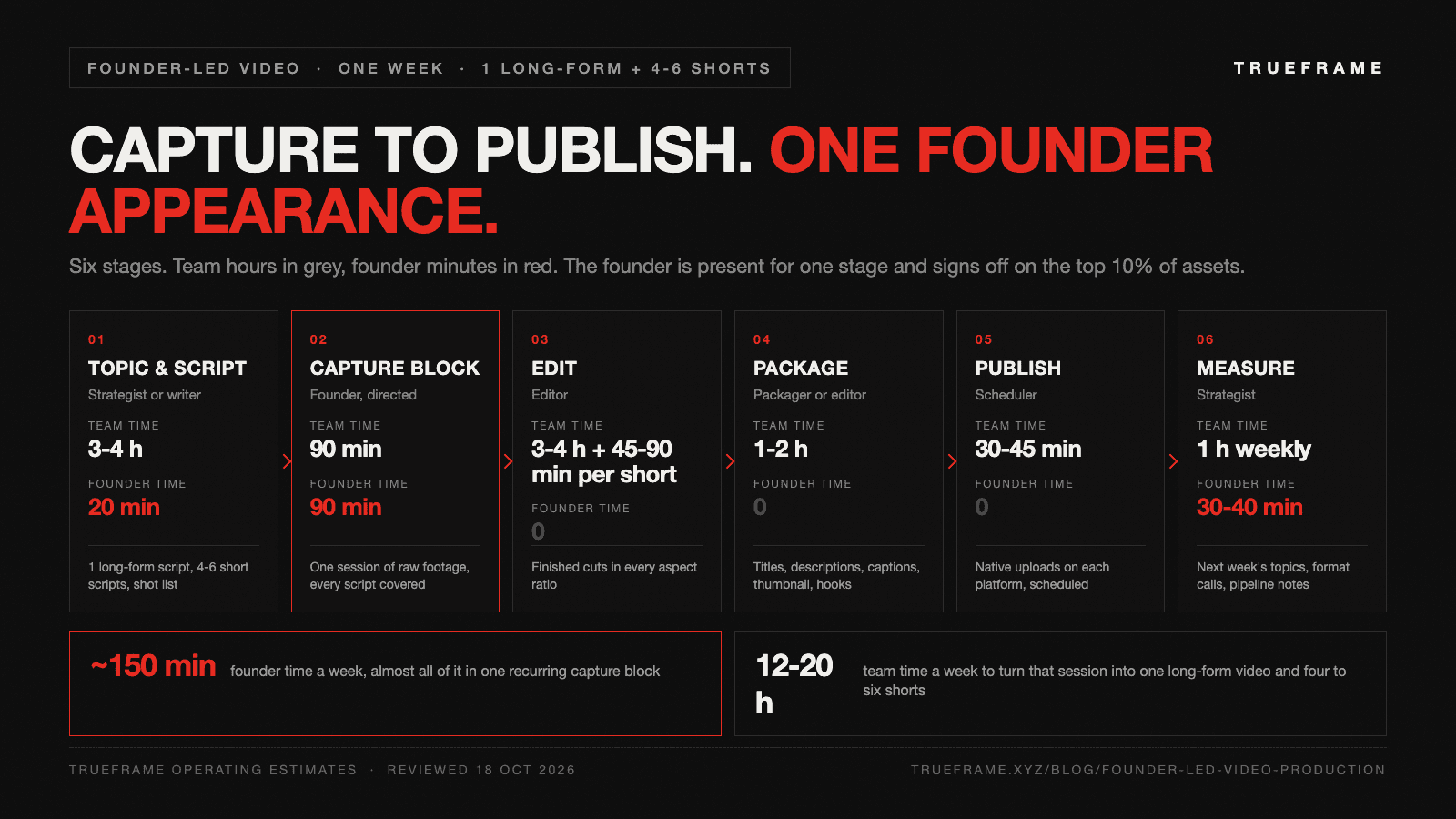
It involves six stages, and the founder only has to be present for one of them. Topic and script. Capture. Edit. Package. Publish. Measure. The founder shows up for capture and signs off on a small set of assets. A team or partner owns the joins between the other five.
That is the whole difference between founder-led video and a founder making videos. When a founder makes videos, they research the topic, write the script, set up the camera, record, open the editor, cut, caption, write the title, post, and check the numbers. Each step is small. Together they eat a day a week, which is why most founder channels stop at video eleven.
Swipe sideways to inspect the full graphic.
Here is how we run it. The founder records once a week for 90 minutes against a script and shot list that already exist. The recording goes to an editor who cuts a long-form piece and the shorts from the same session. A packager writes titles, descriptions and captions and builds the thumbnail. A scheduler publishes to each platform in its native format. Once a week, someone reads the numbers and changes the next week's topics. The founder sees the script before recording and the top assets before they publish, and nothing else.
Benjamin Chua
Founder production toolkit
6
printable pages
PDF · Version 1.0 · Updated Oct 2026
Founder Video Production Planner
Run your first capture block with a timed agenda, a shot list, a gear checklist and the review rules that keep your voice intact.
- A 90-minute capture block agenda, minute by minute
- A shot list that turns one session into shorts, long-form and clips
- An audio-first gear checklist with what to skip
- Voice rules and the top-10% veto sheet for review
How much does founder-led video production cost?
A done-for-you founder content system commonly sits in a $2,000 to $10,000+ per month planning range. A freelance editor runs $15 to $150+ an hour. One in-house editor had a U.S. median wage of $75,420 in May 2025, before benefits, software, gear and the other three roles. The number most founders leave out is their own time, and it is usually the biggest line.
Put a rate on your hour. If your time is worth $250 an hour and doing production yourself takes eight hours a week, you are spending roughly $8,600 a month of founder time before you buy a single tool. That is the true DIY price. It is also why an agency fee that looks expensive next to a freelancer can be the cheapest option on the table once the founder's calendar is in the maths.
| Model | What you pay | What you still own | Founder hours a week | When it wins |
|---|---|---|---|---|
| Do it yourself | $0 to $300 a month in tools, plus your hours at your rate | Everything | 8 or more | Pre-revenue, still testing which message lands |
| Freelance editor | $15 to $150+ an hour, or $150 to $750 per short-form edit | Topics, scripts, filming, briefing, posting, review, management | 4 to 6 | Your brief and footage are already reliable |
| In-house team | Editor at a $75,420 U.S. median wage, plus a strategist, designer and project manager on separate salaries, plus benefits and software | Hiring, management, cover when someone leaves | 3 to 5, plus management | Daily volume across several brands or products |
| Done-for-you system | $2,000 to $10,000+ a month depending on scope | Showing up to the capture block and vetoing the top 10% | About 2.5 | Consistency keeps collapsing and the founder's time is the constraint |
Hormozi's Value Equation is a useful way to read that table. Value rises with the dream outcome and the perceived likelihood of achieving it, and falls with time delay and effort and sacrifice. The in-house team and the done-for-you system can both reach the same outcome. The difference is effort and sacrifice: how many hours and how much management the founder has to give up to get there.
Choose the format, volume, footage, ownership and edit complexity. The calculator shows a USD planning range and the client break-even maths for your numbers.
Use the cost calculatorThe full price guide behind the ranges above: short-form edits, content systems, YouTube programmes, explainers, shoots and what each quote usually leaves out.
Read the pricing guideWhich video formats should a founder produce?
Pick formats by the job each one does, then stack them so one recording feeds several. In Hormozi's language, short-form hunts: it goes out and finds cold attention from people who have never heard of you. Long-form farms: it deepens trust with people who already found you. A founder who only hunts gets views and no pipeline. A founder who only farms talks to the same forty people forever.
| Format | Job | Cadence we run | Founder effort | What to watch |
|---|---|---|---|---|
| Short-form (Shorts, Reels, TikTok) | Hunt new attention | 4 to 6 a week | None beyond the capture block | Views from the right people, follows, saves |
| Long-form YouTube | Farm trust and search | 1 a week or fortnight | Review before publish | Watch time, subscribers, search impressions |
| Podcast or call clips | Multiply one recording | 5 to 8 highlights plus 14 shorts a week from one episode | Record the episode | Which moments get cut and reshared |
| Carousels and text posts from the transcript | Reach people who don't press play | 3 to 5 a week on LinkedIn | None | Impressions, profile visits |
| VSL or offer video | Convert warm viewers | One, rebuilt when the offer changes | Script approval, one recording | Booked calls, show rate |
YouTube Shorts now run up to three minutes, which changed what a short can do. A founder can teach one complete idea in a vertical clip and still be in the Shorts feed. When we took over Hamel Husain's YouTube channel, the shorts cut from recordings he was already making ended up driving 30%+ of his YouTube traffic, verified in his own analytics. He didn't record anything new for them. The format did the hunting.
The second thing Hamel's channel taught us is that format changes compound. In April 2026 we moved his short-form to a new top-of-funnel lead-magnet format. Against the previous format it did 5x the reach, 29x the comments and 7.5x the saves. Same founder, same expertise, same recording habit. The stack changed.
If you want the five specific short-form formats we recommend tech founders steal first, with the hook formulas, they are in a separate guide linked at the end. This post is about the system around them.
What gear do you need for a founder home studio?
Less than you think, and audio first. Viewers forgive a soft image. They do not forgive a voice that echoes or crackles. Spend the first $100 to $200 on a USB desk mic or a clip-on lavalier, and you will beat a founder who spent $2,000 on a camera and used its built-in mic.
- Microphone: a USB dynamic mic on a desk arm, or a wireless lav clipped near the collar. Keep it 10 to 15 cm from your mouth. This is the whole budget if you have to choose.
- Room: soft surfaces. A rug, curtains, a bookshelf behind you, a sofa to the side. Hard bare rooms make even a good mic sound like a bathroom.
- Light: one soft light in front of you, slightly above eye level, and a window you don't sit in front of. A second small light behind you for depth is optional.
- Camera: your phone on a tripod at eye level, or any mirrorless camera you already own. 1080p is enough for every platform you will post to.
- Prompter: a tablet or laptop under the lens running the script at a slow scroll. This is what lets a 90-minute block produce six usable videos instead of two.
- Position: the same chair, the same framing, the same mic distance every week. Mark the tripod feet with tape. Consistency makes the edit faster and the channel look like a channel.
The gear test: can you sit down, press one button and be recording in under two minutes? If setup takes 20 minutes, the capture block will quietly stop happening by week four.
What doesn't matter yet: a second camera angle, a cinema camera, a studio, a lighting rig with four heads, and a green screen. We add these for clients when the content is working and the extra production has a job. Buying them first is a way to delay recording.
What does a weekly workflow look like that doesn't eat your week?
It looks like one recurring capture block with everything else scheduled around it. Block the same 90 minutes every week. Scripts and the shot list arrive the day before. You read them for 20 minutes, flag anything wrong, then sit down and record straight through. The block is the heartbeat. If it moves, everything downstream moves with it.
The video above is the walkthrough of exactly this setup for a tech founder. The thing to watch for is how little of the system touches him. He records. The scripting, cutting, packaging and posting happen without him, and the week's topics come from what the numbers said last week.
| Stage | Owner | Time per stage | Founder time | Output |
|---|---|---|---|---|
| 1. Topic and script | Strategist or writer | 3 to 4 hours | 20 min approving | One long-form script, 4 to 6 short scripts, shot list |
| 2. Capture block | Founder, directed remotely or in person | 90 minutes | 90 min recording | One session of raw footage, every script covered |
| 3. Edit | Editor | 3 to 4 hours long-form, 45 to 90 min per short | None | Finished cuts in each aspect ratio |
| 4. Package | Packager or editor | 1 to 2 hours | None | Titles, descriptions, captions, thumbnail, hooks |
| 5. Publish | Scheduler | 30 to 45 minutes | None | Native uploads on each platform, scheduled |
| 6. Measure | Strategist | 1 hour weekly, 2 hours monthly | 30 to 40 min reviewing top assets | Next week's topics, format decisions, pipeline notes |
Add the founder column up and you get about 150 minutes a week. That is the number to protect. Everything in this article is in service of keeping that column small while the output column stays full.
The IKEA idea in that short is the reason the table works. Every stage has a standard input and a standard output. A script always looks the same, so the founder reads it fast. A capture session always produces the same kinds of footage, so the editor never hunts. A short always gets packaged the same way, so the scheduler never asks. Standard parts are what let the founder step out of five of the six stages.
Want this pipeline installed around your calendar?
Book a fit call. We'll look at your offer, your buyers, your recording habit and your sales path, then tell you honestly whether a founder content engine would pay back for you, or whether a freelancer or in-house hire is the better buy.
Book a fit callHow do you protect your voice when someone else writes and edits?
Write a voice-rules doc once, then veto only the top 10% of assets. The doc is one or two pages: the words you use, the words you never use, the claims you are allowed to make, the stories you tell and the ones that are off limits, how you open, how you close, and three examples of posts that sound like you and three that don't. Every writer and editor on the account reads it before touching anything.
Then stop reviewing everything. Pick the assets where a mistake would cost you: long-form episodes, anything with a number or a claim, anything that names a client or a competitor, and the VSL. That is usually the top 10% by stakes. Those you see before they publish. The other 90% ship under the voice rules, and you fix the rules, not the individual post, when something comes out wrong.
Founders resist this at first, then notice two things. The team gets better fast because the rules make feedback specific. And the week stops filling with approval requests at 11pm. A veto on the top 10% protects the brand. A veto on 100% kills the cadence, and the cadence is the product.
How do you measure the chain from video to pipeline?
Measure four links in order, and never report one as another. Attention: views and watch time from people who match your buyer. Intent: profile visits, resource downloads, comments that ask a real question, DMs, replies to the newsletter. Pipeline: booked calls and qualified opportunities where the person references something they watched. Revenue: closed deals, tracked back by asking on every first call what they saw.
| Link | What to count | Where it lives | What it does not prove |
|---|---|---|---|
| Attention | Views, watch time, follows from buyer-fit accounts | Platform analytics | That anyone wants to buy |
| Intent | Downloads, saves, shares, DMs, question comments, profile visits | Platform analytics, your lead-magnet capture, inbox | That the intent is qualified |
| Pipeline | Booked calls and opportunities that name a video or post | Booking tool UTMs, CRM source field, first-call question | That the deal will close |
| Revenue | Closed deals with content in the recorded path | CRM, finance | That the same content will do it again |
When we ran this for Robert Ta, an AI founder running Epistemic Me, the chain was the whole point. He had tried six agencies and was publishing without a path from content to demand. We scripted 12 short-form videos a month and two long-form YouTube videos with full packaging, then moved him to a podcast-to-clips machine: one recording a week becomes 5 to 8 YouTube highlights and around 14 shorts.
What happened, in his own words: more than six figures in converted B2B pipeline from qualified leads who referenced his specific content as trust-building, plus 50+ B2C leads through the engine. One single format test, run with a pilot audience, produced 366 lead-magnet requests, 262 saves and 74 shares in days. Those are three different links in the chain, and we report them separately.
“Finally found a team after going through 6 terrible agencies.”
Two measurement habits make the chain hold. First, every link that leaves a platform carries a UTM, so a booked call can be traced to the post it came from. Second, the first question on every sales call is "what did you see of ours before booking?" and the answer goes into the CRM. Analytics tell you what happened on the platform. The call tells you what happened in the buyer's head. You need both.
If you host long-form on your own site as well as YouTube, Google's video guidance applies: a dedicated watch page per video, a stable thumbnail URL and VideoObject structured data that matches the actual video. It is a publishing checklist item, and it is the kind of step that disappears when the founder is the one publishing at midnight.
When should a founder not hire a video production partner?
Three situations. You haven't closed the offer yet, so you don't know which message to produce. You already have a sharp brief, reliable footage and someone inside the business who owns performance, so a freelance editor is the right buy. Or your sales path can't take the leads: no booking link, no follow-up, no one answering DMs. Content that works pours water into a bucket, and a partner will spend your money filling a bucket with a hole in it.
In those cases, do the version of this that costs nothing: a phone, a $150 mic, one 90-minute block a week, and a voice-rules doc you write for yourself. Run it for eight weeks. If the attention link lights up and your week survives, you have the inputs a system needs, and you'll be a far better buyer when you do hire.
The numbers worth keeping
- $2,000 to $10,000+ a month is the planning range for a done-for-you founder content system.
- $75,420 was the May 2025 U.S. median wage for one film and video editor, before benefits or the other three roles.
- Eight founder hours a week at $250 an hour is roughly $8,600 a month of founder time. Put your own rate in.
- About 150 founder minutes a week runs one long-form video and four to six shorts when the capture block and voice rules are in place.
- Shorts drive 30%+ of Hamel Husain's YouTube traffic, cut from recordings he already made.
- One recording a week became 5 to 8 highlights and around 14 shorts for Robert Ta, who tracked six figures of B2B pipeline to his content.
Keep going
Not sure which model fits?
Bring your offer, your calendar and your current numbers to a fit call. We'll look at your situation and tell you honestly whether an installed founder content engine would pay back, or point you to the cheaper option if it won't.
Sources and review date
Primary sources, first-party data and review dates are listed below. Client-reported results and Trueframe analysis are labelled in the article.
- Film and Video Editors and Camera Operators: Occupational Outlook Handbook · U.S. Bureau of Labor StatisticsReviewed 18 October 2026
- $100M Offers and $100M Leads (the Value Equation) · Alex Hormozi, Acquisition.comReviewed 18 October 2026
- Get started with YouTube Shorts · YouTube HelpReviewed 18 October 2026
- Video SEO best practices · Google Search CentralReviewed 18 October 2026
Skip the reading. Talk it through instead.
Book a fit call and we'll map out what a content engine looks like for your business. No pitch, no pressure.
Don't miss the next one
Some of what we share is time-sensitive. A format that's working right now, a window that closes fast. We email those the moment they're worth jumping on. Drop your email so you catch them in time.
No spam. Unsubscribe anytime.
Frequently asked questions
What is founder-led video production?
How much does founder-led video production cost?
How many hours a week does founder-led video take?
What gear do you need for founder-led video?
Which video formats should a founder start with?
Should a founder review every video before it publishes?
How do you measure whether founder video is working?
Founded & led by
Benjamin Chua (BenChuchu)
Founder and CEO of Trueframe. 9 years building businesses (started at 16), tens of millions of views generated, and 8 figures in revenue created for the founders and brands he works with. He builds the content systems Trueframe runs.